
BuddhistCatholicContemplativeEvangelicalGeneral ChristianHinduJewishLatter-day SaintMuslimNew VisionsProgressive Christian
Beliefs
- Buddhist
- Catholic
- Contemplative
- Evangelical
- General Christian
- Hindu
- Jewish
- Latter-day Saint
- More Voices
- Muslim
- New Visions
- Pagan
- Progressive Christian
Topics
- Religion News
- Food and Religion
- Sports and Religion
- Religious Art
- Religious Music and Entertainment
- Religious Events
- History and Religion
- Style and Religion
- Politics and Religion
- Women in Religion
- Recreation Outdoors and Religion
- Business Finance and Religion
- Careers Workplace and Religion
- Education and Religion
- Family Parenting and Religion
- Health Fitness and Religion
- Home and Religion
- Relationships and Religion
- Technology and Religion
- Travel and Religion
Columnists
- Buddhist Columnists
- Business Finance and Religion Columnists
- Careers Workplace and Religion Columnists
- Catholic Columnists
- Contemplative Columnists
- Education and Religion Columnists
- Evangelists Columnists
- Family Parenting and Religion Columnists
- General Christian Columnists
- Health Fitness and Religion Columnists
- Hindu Columnists
- History and Religion Columnists
- Home and Religion Columnists
- Jewish Columnists
- More Voices Columnists
- Latter Day Columnists
- Muslim Columnists
- New Visions Columnists
- Nonreligious Columnists
- Pagan Columnists
- Politics and Religion Columnists
- Progressive Columnists
- Recreation Outdoors and Religion Columnists
- Relationships and Religion Columnists
- Religion News Columnists
- Religious Art Columnists
- Religious Events Columnists
- Religious Music and Entertainment Columnists
- Sports and Religion Columnists
- Style and Religion Columnists
- Technology and Religion Columnists
- Travel and Religion Columnists
- Women in Religion Columnists
Resource Library
- 2026 Calendar
- Library of World Religions
- The 100 Most Holy Places on Earth
- Patheos Answers
- Podcasts
- Videos
- Faith Leaders Database
- Anglican Episcopalian
- Bahai
- Baptist
- Buddhism
- Christianity
- Confucianism
- Eastern Orthodoxy
- Hinduism
- Holiness and Pentecostal
- ISKCON
- Islam
- Judaism
- Lutheran
- Methodist
- The Church of Jesus Christ of Latter-day Saints
- New Age
- Paganism
- Presbytarian and Reformed
- Protestantism
- Religion Behind the Scenes
- Roman Catholic
- Scientology
- Shia Islam
- Sikhism
- Sufism
- Sunni Islam
- Taoism
- Zen
- See all religions
Research Tools
 Ad-Free & Subscriber Log-In Subscription Support
Ad-Free & Subscriber Log-In Subscription Support
Follow Patheos 

- Trending:
- Forgiveness
- |
- Marriage
- |
- Consciousness
- |
- Death Penalty
- |
- Election
- |
- Halloween

-
About
-
Catholic Apologetics
-
Church History
-
Great Apologists
-
Christian Worldview
-
Protestantism & Misc.
- Home
- Catholic
- History and Religion
- Can We Honor Jesus Christ Through His Mother Mary?
Can We Honor Jesus Christ Through His Mother Mary?
Last updated on: May 24, 2017 at 2:56 pm by Dave Armstrong
Can We Honor Jesus Christ Through His Mother Mary? 2017-05-24T14:56:00-04:00 Dave Armstrong
Patheos Explore the world's faith through different perspectives on religion and spirituality! Patheos has the views of the prevalent religions and spiritualities of the world.
(vs. John Cranman)
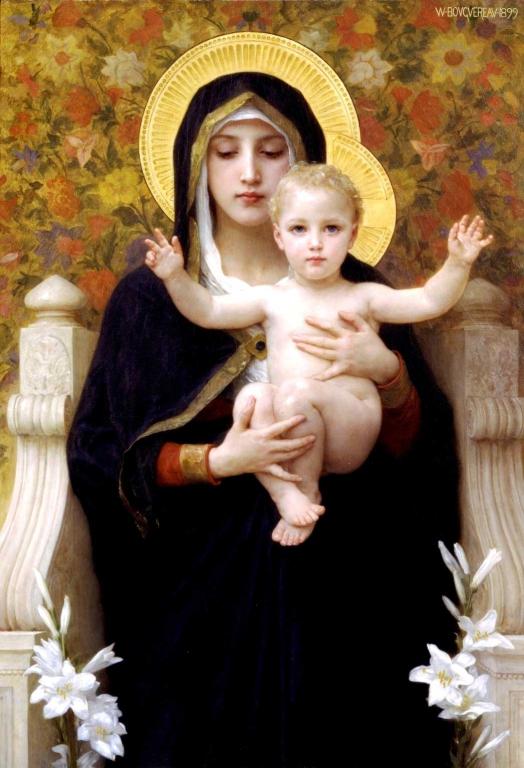
The Virgin of the Lilies (1899) by William-Adolphe Bouguereau (1825-1905) [public domain / Wikimedia Commons]

(4-9-15)
The following dialogue took place on my Facebook author page. I posted a meme which read: “We never give more honour to Jesus than when we honour his Mother, and we honour her simply and solely to honour him all the more perfectly. We go to her only as a way leading to the goal we seek — Jesus, her Son.” [St. Louis Marie de Montfort]
This led to the exchange below with one John Cranman (apparently Protestant Reformed). His words will be in blue.
* * * * *
This is literally vacuous.
Catholics think in terms of “both/and” rather than making false and unnecessary dichotomies (“either/or”). This is also the Hebrew and biblical outlook.
The best way to honor Jesus is to simply do what He says. If we are talking about a hierarchy of ways to honor Christ, I can imagine that living out the Great Commission is way further up there than honoring Mary. So obviously, honoring Mary isn’t the “best” way to honor Christ.
You’re still thinking in either/or terms. There is no necessity to do that. Doing Jesus’ will honors Jesus; so does honoring His mother, which (as it says above) is always intended as primarily honor and glory to the Son, Who made His very mother, as He willed.
Okay; is honoring Mary the primary way to honor Christ, or is it not? Because, the former is what this meme is claiming.
No it’s not. It’s saying it is up at the top of honoring Jesus, without ruling out other ways of doing that. Both/and. Honoring His mother is honoring Him, in Catholic / biblical both/and thinking. The problem in Protestant thinking (esp. Reformed) is persistent false dichotomies. It can’t comprehend honor of anyone besides God, as if such honor detracts from His honor and is necessarily idolatry. Catholics recognize distinctions between adoration and veneration, and also follow the notion of worshiping God through His creation. Thus, Paul writes:
Romans 1:20 (RSV) Ever since the creation of the world his invisible nature, namely, his eternal power and deity, has been clearly perceived in the things that have been made. . . .
Analogously, we can say, “Jesus’ eternal power and deity, has been clearly perceived in the things [in this instance, Mary] that have been made.” That’s both/and thinking.
Dave, this is just sophistry then. Why not just speak plainly here? It doesn’t say that it’s “up at the top”. It says that “we never give more honor” than when we honor Mary. I would even argue that it’s nowhere near required, nor at the top.
You have to see it as “sophistry” because you are restricted by your own false premises (either/or thinking). I am speaking plainly (and biblically and logically and apostolically). But to you it is sophistry because you don’t yet comprehend the biblical both/and outlook. You are too beholden to the traditions of men (either/or dichotomies).
Stating “we never give more honor” is not saying that it is the highest or only form of honoring Christ; only that no other form could give more honor. Technically, then, one could also say, in line with the meme, that “we never give more honor to Christ than simply do what He says.” They could both be on the highest level. And indeed they are!
Moreover, the saint makes the following equation: “we honour her simply and solely to honour him.” But there’s your “both/and” outlook again, which Protestants rarely can conceptualize, because they’ve relentlessly been taught either/or thinking in their own circles. Thus, they see it as “sophistry” or (also commonly) “idolatry”.
These aren’t false premises. It has to do with clear communication. The meme communicates an idea. Now if the meme doesn’t actually mean what it says, then it’s communicating in a very unclear way. That’s sort of what sophistry means. Clear communication has nothing to do with the “traditions of men”. It has to do with language and passing along ideas.
And what do you mean here?: “Stating “we never give more honor” is not saying that it is the highest or only form of honoring Christ; only that no other form could give more honor.” If honoring Mary is the maximal way to honor God, then it logically follows that honoring Mary is the highest way to honor God. But I can’t tell whether you are admitting that, or denying it. What you’re saying isn’t clear.
I’m saying that it is the highest, and so are many other things we can do, as you note. It’s the “highest” without excluding other “highests.” Both / and . . . And it is the same as honoring Jesus Christ our Lord, as the meme says: “we honour her simply and solely to honour him.”
That’s what you can’t grasp, because you don’t see that we can adore God through creatures (and even things) that he has made. Protestantism, for the most part. has no category for that. It’s worship God, and no honor or veneration for anyone else, or secondarily venerating them, through which we are primarily adoring God.
Also it’s not. Honoring Mary is not the maximal, or highest way we can honor God. That’s such nonsense. It’s not even anywhere near the top. Dying for Christ, for example, is a much higher way to honor God. Maybe even the ultimate way, as there is nothing greater one can give than to lay down his/her life.
And Jesus nowhere tells us we are obligated to show this ongoing devotion and honor towards Mary. He always points our spiritual devotion towards God, not multiplied entities.
Jesus may not have, but there are a lot of Christian elements He didn’t talk about at all, or not explicitly: that come primarily from the epistles. The biblical motif of imitating holy people is similar to veneration (see: Rom 11:14; 1 Cor 4:15-16; 11:1-2; Phil 3:17; 4:9; 1 Thess 1:6-7; 2:9-14; 3:7-9; 1 Tim 4:12; 2 Tim 3:10-14; Heb 6:12; 13:7; Jas 5:10-11; 1 Pet 3:1-2; 5:2-3).
Paul makes it clear more than once that imitating him is in complete harmony with the notion of imitating Christ, whom Paul is imitating (see, e.g., Ephesians 5:1: “Therefore be imitators of God, as beloved children:): “Be imitators of me, as I am of Christ” (1 Cor 11:1); “And you became imitators of us and of the Lord . . .” (1 Thess 1:6). It’s not either/or.
By analogy, it is altogether proper to venerate and honor saints, who have more perfectly attained God’s likeness (Matt 22:30; 1 Cor 13:9-12; 2 Cor 3:18; Phil 3:21; Heb 11:40; 1 Jn 3:2; Rev 21:27; 22:14), in light of the example of how “heroes of the faith” are regarded (Hebrews 11) and also the biblical injunctions to honor all sorts of people:
Romans 12:10 love one another with brotherly affection; outdo one another in showing honor. (cf. 1 Cor 12:23-26)
Romans 13:6-7 For the same reason you also pay taxes, for the authorities are ministers of God, attending to this very thing. Pay all of them their dues, taxes to whom taxes are due, revenue to whom revenue is due, respect to whom respect is due, honor to whom honor is due.
Ephesians 6:2 “Honor your father and mother” (this is the first commandment with a promise), (cf. Ex 20:12; Deut 5:16)
1 Timothy 5:3 Honor widows who are real widows.
1 Timothy 5:17 Let the elders who rule well be considered worthy of double honor, especially those who labor in preaching and teaching;
1 Peter 2:17 Honor all men. Love the brotherhood. Fear God. Honor the emperor.
1 Peter 3:7 Likewise you husbands, live considerately with your wives, bestowing honor on the woman . . . (cf. Gen 30:20)
King Asa was honored after his death:
2 Chronicles 16:14 They buried him in the tomb which he had hewn out for himself in the city of David. They laid him on a bier which had been filled with various kinds of spices prepared by the perfumer’s art; and they made a very great fire in his honor. (cf. 21:19, showing that this was a general practice)
King Hezekiah was also so honored:
2 Chronicles 32:33 And Hezeki’ah slept with his fathers, and they buried him in the ascent of the tombs of the sons of David; and all Judah and the inhabitants of Jerusalem did him honor at his death.
Only Catholicism tells us otherwise, through its own interpretive liberties. And not everyone agrees with those liberties. So if I’m seeing things through “Protestant” lenses, then likewise you, through Catholic ones.
There are many more examples in the Bible of veneration of both men and angels (often as direct representatives of God):
Genesis 18:1-4, 22 And the LORD appeared to him by the oaks of Mamre, as he sat at the door of his tent in the heat of the day. [2] He lifted up his eyes and looked, and behold, three men stood in front of him. When he saw them, he ran from the tent door to meet them, and bowed himself [shachah] to the earth, [3] and said, “My lord, if I have found favor in your sight, do not pass by your servant. [4] Let a little water be brought, and wash your feet, and rest yourselves under the tree, . . . [22] So the men turned from there, and went toward Sodom; but Abraham still stood before the LORD.
The text in-between goes back and forth, referring to “men” or “they” or “them” (18:9, 16) and “The LORD” or first-person address from God (18:10, 13-14, 17-21) interchangeably, for the same phenomenon and personal / physical / verbal encounter.
Joshua 5:13-15 When Joshua was by Jericho, he lifted up his eyes and looked, and behold, a man stood before him with his drawn sword in his hand; and Joshua went to him and said to him, “Are you for us, or for our adversaries?” [14] And he said, “No; but as commander of the army of the LORD I have now come.” And Joshua fell on his face to the earth, and worshiped [shachah], and said to him, “What does my lord bid his servant?” [15] And the commander of the LORD’s army said to Joshua, “Put off your shoes from your feet; for the place where you stand is holy.” And Joshua did so.
A “man” is equated with God also in Genesis 32:24, 30. The Angel of the Lord is sometimes referred to as God Himself, but not always; and is venerated. So. for example:
Judges 13:15-22 Mano’ah said to the angel of the LORD, “Pray, let us detain you, and prepare a kid for you.” [16] And the angel of the LORD said to Mano’ah, “If you detain me, I will not eat of your food; but if you make ready a burnt offering, then offer it to the LORD.” (For Mano’ah did not know that he was the angel of the LORD.) [17] And Mano’ah said to the angel of the LORD, “What is your name, so that, when your words come true, we may honor you?” [18] And the angel of the LORD said to him, “Why do you ask my name, seeing it is wonderful?” [19] So Mano’ah took the kid with the cereal offering, and offered it upon the rock to the LORD, to him who works wonders. [20] And when the flame went up toward heaven from the altar, the angel of the LORD ascended in the flame of the altar while Mano’ah and his wife looked on; and they fell on their faces to the ground. [21] The angel of the LORD appeared no more to Mano’ah and to his wife. Then Mano’ah knew that he was the angel of the LORD. [22] And Mano’ah said to his wife, “We shall surely die, for we have seen God.” (cf. 6:12-16, 20-23)
This passage is remarkable in that it goes back and forth between God (13:16, 19, 22) and the angel of the Lord (or of God) as His direct representative (13:15-18, 20-21 and in the larger passage, 13:3, 6, 9, 13). The angel is honored (v. 17), they fall on their faces to worship (v. 20) and at length the angel is equated with God as His visible manifestation (v. 22). But the difference between the angel and God is highlighted by the angel being described as a “man of God” (13:6, 8) and “the man” (13:10-11).
The angel of the Lord is also equated with God (theophany) in Gen 31:11-13; Jud 2:1; but differentiated from God as well, as a representative: (2 Sam 24:16; 1 Ki 19:6-7; 2 Ki 19:35; Dan 3:25, 28; 6:23; Zech 1:8-14).
The Bible, in summary, is quite clear: there is an occasional use of angels or men as direct representatives of God, and they are “worshiped” [i.e., venerated] only insofar as they represent God, as a visual image or object, through whom God is working and communicating. But veneration is strictly separated from the adoration due to God alone (see: Acts 10:25-26; Rom 1:25; Col 2:18; Rev 22:8-9). Everything has to be considered together, as a whole.
All of this explicit biblical evidence is precisely in line with what the Catholic Church teaches. It is the outright prohibition of all veneration and honor of creatures whatever in most forms of Protestantism that is a grossly unbiblical notion.
Moreover, “worship” is used in a wider (literary) sense of showing reverence or obeisance to men of authority (in this instance, a king), in 1 Chronicles 29:20: “And David said to all the congregation, Now bless the LORD your God. And all the congregation blessed the LORD God of their fathers, and bowed down their heads, and worshipped [shachah] the LORD, and the king” (KJV). RSV has: “worshiped the LORD, and did obeisance to the king,” but it is one Hebrew word applied to both.
Much of what you point out here in scripture is not at all incompatible with my position. Of course we honor people, and even imitate their example. Of course I’d fearfully honor an angel if one were before me.
But that’s worlds apart from offering my ongoing spiritual devotion towards any of the above, or singing psalms and praises to them in some ongoing fashion.
Well, John, we Catholics read the same Bible you read, that says “honor all men” — so we think that the Mother of our Lord Jesus Christ, Who was God, is worthy of great honor: above all other creatures. Martin Luther very much thought so, too. It’s not just a Catholic thing. He wrote:
The “great things” are nothing less than that she became the Mother of God, in which work so many and such great good things are bestowed on her as pass man’s understanding. For on this there follows all honor, all blessedness, and her unique place in the whole of mankind, among which she has no equal, namely, that she had a child by the Father in heaven, and such a Child. She herself is unable to find a name for this work, it is too exceeding great; all she can do is break out in the fervent cry, are great things, impossible to describe or define. Hence men have crowded all her glory into a single word, calling her the Mother of God. No one can say anything greater of her or to her, though he had as many tongues as there are leaves on the trees, or grass in the fields, or stars in the sky, or sand by the sea. (The Magnificat, June 1521; tr. A. T. W. Steinhaeuser)
[P]raise and thank God through Mary and the grace given her. Laud and love her . . . Similarly, our prayer should include the Mother of God as we say: O God, what a noble person you have created in her! May she be blessed! And so on. And you who honored her so highly, grant also to me . . . (Personal Prayer Book, 1522, tr. Martin H. Bertram; in LW, v. 43)
We do not want to take away from Mary any honor which is her due. . . . let the Blessed Virgin keep her place of honor. Among all the women of the world she has this privilege from God, that as a virgin she gave birth to the Son of God. (Lectures on Genesis, Chapters 1-5, Feb. 1536, ed. Jaroslav Pelikan, tr. George V. Schick; in LW, v. 1)
* * * * *
Previous Post
April 8, 2015
How to Talk About the Papacy Without Offending Catholics
Next Post

April 13, 2015 Broad Exchange with a Former Catholic, Bible-Only Protestant
Browse Our Archives
Select a Category & Last Things About Me Anti-Catholicism Atheism & Agnosticism Baptism and Sacramentalism Bible and Tradition Blessed Virgin Mary Books by Dave Armstrong C. S. Lewis Calvinism & General Protestantism Catholic Apologetics Catholic Apologists Catholic conversion Catholic converts Christmas Church (Ecclesiology) Church History Conversion and Converts Development of Doctrine Eastern Orthodoxy Ecumenism & Christian Unity Eucharist & Liturgy Fathers of the Church French Translations G. K. Chesterton Hell Hell & Satan Hell & Satan & Last Things Heresies & Comparative Religion Holistic Health Inquisition & Crusades & Scandals James White Jews & Judaism & Old Testament John Calvin John Henry Newman Liberal / Modernist Theology Life Issues Literary Resume Lutheranism Mariology Martin Luther Music Orthodoxy Papacy & Infallibility Personal Page Philosophy & Science Political & Ethical & Moral Issues Protestant Persecution & Intolerance Protestantism Purgatory Purgatory & Penance Romantic & Imaginative Theology Saints & Purgatory & Penance Salvation Salvation & Justification Satan & Last Things Sexuality and Gender Issues Spanish Translations Traditionalism vs. Radical Catholic Reactionaries Traducciones al español / tradução para português Trinitarianism & Christology Uncategorized Videos
Select a Month October 2026 September 2026 August 2026 July 2026 June 2026 May 2026 April 2026 March 2026 February 2026 January 2026 December 2025 November 2025 October 2025 September 2025 August 2025 July 2025 June 2025 May 2025 April 2025 March 2025 February 2025 January 2025 December 2024 November 2024 October 2024 September 2024 August 2024 July 2024 June 2024 May 2024 April 2024 March 2024 February 2024 January 2024 December 2023 November 2023 October 2023 September 2023 August 2023 July 2023 June 2023 May 2023 April 2023 March 2023 February 2023 January 2023 December 2022 November 2022 October 2022 September 2022 August 2022 July 2022 June 2022 May 2022 April 2022 March 2022 February 2022 January 2022 December 2021 November 2021 October 2021 September 2021 August 2021 July 2021 June 2021 May 2021 April 2021 March 2021 February 2021 January 2021 December 2020 November 2020 October 2020 September 2020 August 2020 July 2020 June 2020 May 2020 April 2020 March 2020 February 2020 January 2020 December 2019 November 2019 October 2019 September 2019 August 2019 July 2019 June 2019 May 2019 April 2019 March 2019 February 2019 January 2019 December 2018 November 2018 October 2018 September 2018 August 2018 July 2018 June 2018 May 2018 April 2018 March 2018 February 2018 January 2018 December 2017 November 2017 October 2017 September 2017 August 2017 July 2017 June 2017 May 2017 April 2017 March 2017 February 2017 January 2017 December 2016 November 2016 October 2016 September 2016 August 2016 July 2016 June 2016 May 2016 April 2016 March 2016 February 2016 January 2016 December 2015 November 2015 October 2015 September 2015 August 2015 July 2015 June 2015 May 2015 April 2015 March 2015 February 2015 January 2015 December 2014 November 2014 October 2014 September 2014 August 2014 July 2014 June 2014 April 2014 March 2014 February 2014 January 2014 December 2013 November 2013 October 2013 September 2013 August 2013 July 2013 June 2013 April 2013 March 2013 February 2013 January 2013 December 2012 November 2012 October 2012 September 2012 August 2012 July 2012 June 2012 May 2012 April 2012 March 2012 February 2012 January 2012 December 2011 November 2011 October 2011 September 2011 August 2011 July 2011 June 2011 April 2011 March 2011 February 2011 October 2010 September 2010 August 2010 July 2010 April 2010 March 2010 December 2009 October 2009 August 2009 July 2009 June 2009 May 2009 March 2009 February 2009 October 2008 September 2008 April 2008 March 2008 February 2008 January 2008 December 2007 November 2007 October 2007 May 2007 March 2007 February 2007 January 2007 November 2006 October 2006 September 2006 August 2006 July 2006 June 2006 May 2006 April 2006 March 2006 February 2006 October 2005 June 2005 April 2005 February 2005 July 2004 May 2004 April 2004
Follow Us!
TAKE THE
Religious Wisdom Quiz
Who was the first son of Adam and Eve?
Select your answer to see how you score.
Irad Cain Abel Levi
Books by This Author Books by Dave Armstrong
Related posts from Biblical Evidence for Catholicism

Holy Ground: Why Mary Had NO Other Children...
Biblical Evidence for Catholicism
Protestant Confessions & "Ever-Virgin" Mary
Biblical Evidence for Catholicism

Mary Wife of Clopas (Jn 19:25): Mary's Sister-in-Law?
Biblical Evidence for Catholicism

Jesus Had Four Brothers? The Bible Sez No!
Biblical Evidence for Catholicism
TRENDING AT PATHEOS Catholic

I was strolling through the top floor of the brand new Parthenon...

What Does Gêvâh Mean For Kimberley Guifoyle &...
This week, a lot of the news is focused on Kimberly Guilfoyle....

INNER CIRCLE: Profound Mystery (Of Christ In All...
Ephesians 5:31-32 “For this reason, a man will leave his father and...

Do Not Rejoice When Your Enemy Falls: The...
Turning an execution into a public spectacle is a disturbing expression of...

'The Chosen' S6 Trailer: The Passion Gets Very...
Not many watching 'The Chosen' worry about spoilers, but just because they...

The purpose-driven labor priest
A labor activist reads Rick Warren and it gets me wondering about...
view all Catholic blogs
Ad-Free & Subscriber Log-In Subscription Support
- About Us
- 2026 Calendar
- Videos
- Podcasts
- Library of World Religions
- Faith In Media Tracker
- Advertise With Us
- Write for Us
- Privacy Policy
- Terms of Service
- Do Not Sell My Data
- Contact Us
- Radiant Digital
- Manage Newsletter Subscriptions
- Unsubscribe From Notifications
- Sitemap
Copyright 2008-2026, Patheos. All rights reserved.
Subscription Support Ad-Free & Subscriber Log-In
Follow Patheos