
BuddhistCatholicContemplativeEvangelicalGeneral ChristianHinduJewishLatter-day SaintMuslimNew VisionsProgressive Christian
Beliefs
- Buddhist
- Catholic
- Contemplative
- Evangelical
- General Christian
- Hindu
- Jewish
- Latter-day Saint
- More Voices
- Muslim
- New Visions
- Pagan
- Progressive Christian
Topics
- Religion News
- Food and Religion
- Sports and Religion
- Religious Art
- Religious Music and Entertainment
- Religious Events
- History and Religion
- Style and Religion
- Politics and Religion
- Women in Religion
- Recreation Outdoors and Religion
- Business Finance and Religion
- Careers Workplace and Religion
- Education and Religion
- Family Parenting and Religion
- Health Fitness and Religion
- Home and Religion
- Relationships and Religion
- Technology and Religion
- Travel and Religion
Columnists
- Buddhist Columnists
- Business Finance and Religion Columnists
- Careers Workplace and Religion Columnists
- Catholic Columnists
- Contemplative Columnists
- Education and Religion Columnists
- Evangelists Columnists
- Family Parenting and Religion Columnists
- General Christian Columnists
- Health Fitness and Religion Columnists
- Hindu Columnists
- History and Religion Columnists
- Home and Religion Columnists
- Jewish Columnists
- More Voices Columnists
- Latter Day Columnists
- Muslim Columnists
- New Visions Columnists
- Nonreligious Columnists
- Pagan Columnists
- Politics and Religion Columnists
- Progressive Columnists
- Recreation Outdoors and Religion Columnists
- Relationships and Religion Columnists
- Religion News Columnists
- Religious Art Columnists
- Religious Events Columnists
- Religious Music and Entertainment Columnists
- Sports and Religion Columnists
- Style and Religion Columnists
- Technology and Religion Columnists
- Travel and Religion Columnists
- Women in Religion Columnists
Resource Library
- 2026 Calendar
- Library of World Religions
- The 100 Most Holy Places on Earth
- Patheos Answers
- Podcasts
- Videos
- Faith Leaders Database
- Anglican Episcopalian
- Bahai
- Baptist
- Buddhism
- Christianity
- Confucianism
- Eastern Orthodoxy
- Hinduism
- Holiness and Pentecostal
- ISKCON
- Islam
- Judaism
- Lutheran
- Methodist
- The Church of Jesus Christ of Latter-day Saints
- New Age
- Paganism
- Presbytarian and Reformed
- Protestantism
- Religion Behind the Scenes
- Roman Catholic
- Scientology
- Shia Islam
- Sikhism
- Sufism
- Sunni Islam
- Taoism
- Zen
- See all religions
Research Tools
 Ad-Free & Subscriber Log-In Subscription Support
Ad-Free & Subscriber Log-In Subscription Support
Follow Patheos 

- Trending:
- Forgiveness
- |
- Marriage
- |
- Consciousness
- |
- Death Penalty
- |
- Election
- |
- Halloween

-
About
-
Catholic Apologetics
-
Church History
-
Great Apologists
-
Christian Worldview
-
Protestantism & Misc.
- Home
- Catholic
- History and Religion
- Introduction to Dave Armstrong’s Book, “The ‘Catholic’ Luther”
Introduction to Dave Armstrong’s Book, “The ‘Catholic’ Luther”
Last updated on: May 24, 2017 at 8:32 pm by Dave Armstrong
Introduction to Dave Armstrong’s Book, “The ‘Catholic’ Luther” 2017-05-24T20:32:51-04:00 Dave Armstrong
Patheos Explore the world's faith through different perspectives on religion and spirituality! Patheos has the views of the prevalent religions and spiritualities of the world.
. . . An Ecumenical Collection of His ‘Traditional’ Utterances”
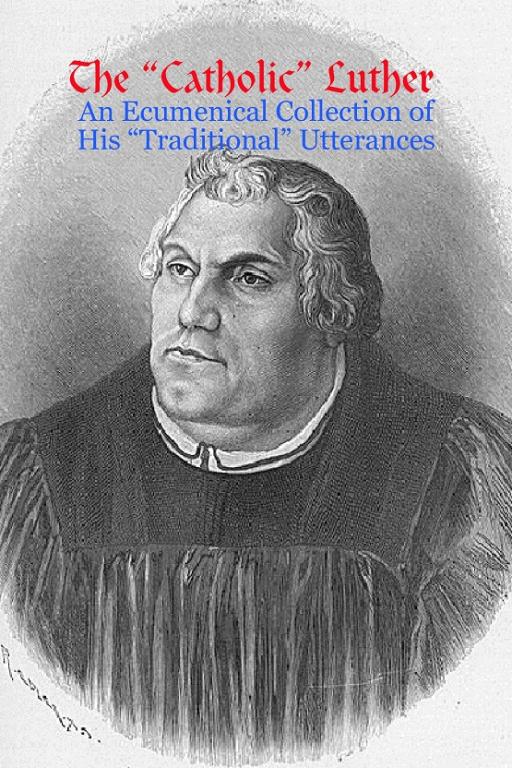
[see information for this book and its purchase]***
(10-10-14)
***
I’ve studied Martin Luther (1483-1546), the founder of Protestantism and specifically Lutheranism, a great deal from the time of my conversion to Catholicism (1990) and even before (I remember reading Roland Bainton’s famous biography, Here I Stand, around the time I got married in 1984). I’ve devoted a book to him, and a large website with scores and scores of articles (almost certainly the largest Catholic web page about Luther online today)
I have been very critical of Luther’s theology, where one would except a Catholic apologist to be, but I’ve also always sought to give him credit where it is due, to defend him against bum raps, and to note as much agreement between Luther and Catholics as it is possible to do.
The first thing is (Catholic) apologetics, the second is ecumenism. I am committed to both, as an observant Catholic, since the Church encourages both things. Even the last third of my (primarily critical) book about Luther was much like this book will be: a collection of Luther’s statements that Catholics can heartily agree with.
My concern and goal in the present volume is to give “balance” and greater overall accuracy to the Catholic treatment of Luther: or at least how it is perceived (which is often a very different thing from the reality). Heaven knows he wrote a lot of things that are offensive to us and that we can vigorously disagree with. But that is not all the record regarding this complex and extraordinary man (love him or not).
If we are to fully understand him, we also need to learn and understand about the orthodox and traditional aspects of his teaching, alongside those which depart from orthodoxy (from the Catholic point of view). This was actually the topic of my very first “officially published” article as a Catholic, in January 1993: entitled, “The Real Martin Luther.” I wrote in it:
[T]he real Luther is far more fascinating and complex than his detractors or hagiographers have generally realized. There exists in “the Father of the Reformation” a curious mix of orthodoxy and heterodoxy . . .
This sort of “dual analysis” has basically guided my approach to Luther ever since. When he agrees with Catholic positions, I find his arguments to be very good, solid, and (I think) convincing to one on the fence. Notable examples of this would be his defense of the Real Presence of Jesus in the Eucharist over against Zwingli and other “sacramentarians” (as they were called), his belief in baptismal regeneration, the perpetual virginity of Mary, and the grave sinfulness of contraception. There are many more, as we shall see.
From any point of view, we owe it to Luther or to anyone, to present his views in their fullness and broadness; in their totality. I’m interested in the facts of the matter: whether he agrees or disagrees. We all understand that we hold to positions on all the issues, according to our Christian affiliation. But that doesn’t change the nature of the facts, and how we can best arrive at them, even despite natural bias on all sides.
I can already foresee one of the criticisms that will inevitably be made against this book: “you have quoted him out of context! If you read the next paragraph, you’ll see something very different . . .”, etc., etc.
In one sense, I can agree that I will be “guilty as charged,” but not as a critic who would say such a thing would imagine. Luther does indeed often say something different in the larger context. One of his standard literary techniques (conscious or not) is to highlight one aspect of a question, and then strongly contrast it with another (to him, more important) aspect, as he sees it. I observed him doing this in the very first writing that I consulted in order to compile this book (Preface to the First Part of the German Works, edition of 1539).
I cited him as favorably viewing the Church fathers, councils, and apostolic tradition. This was not inaccurate. He did write those things. But he qualifies them over against Scripture, as he always does, and according to his position of sola Scriptura (Scripture as the final and only infallible source of authority, and the rule of faith). Here is almost all of this short piece, with the portion that I cited for this book italicized (not including one Latin italicized phrase in the original):
I would gladly have seen all my books forgotten and destroyed; if only for the reason that I am afraid of the example. For I see what benefit it has brought to the churches, that men have begun to collect many books and great libraries, outside and alongside of the Holy Scriptures; and have begun especially to scramble together, without any distinction, all sorts of “Fathers,” “Councils,” and “Doctors.” Not only has good time been wasted, and the study of the Scriptures neglected; but the pure understanding of the divine Word is lost, until at last the Bible has come to lie forgotten in the dust under the bench.
Although it is both useful and necessary that the writings of some of the Fathers and the decrees of some of the Councils should be preserved as witnesses and records, nevertheless, I think, est modus in rebus, [“There is moderation in all things”] and it is no pity that the books of many of the Fathers and Councils have, by God’s grace, been lost. If they had all remained, one could scarce go in or out for books, and we should still have nothing better than we find in the Holy Scriptures.
Then, too, it was our intention and our hope, when we began to put the Bible into German, that there would be less writing, and more studying and reading of the Scriptures. For all other writings should point to the Scriptures, as John pointed to Christ; when he said, “He must increase, but I must decrease.” [John 3:30] In this way every one may drink for himself from the fresh spring, as all the Fathers have had to do when they wished to produce anything worth while. Neither Fathers nor Councils nor we ourselves will do so well, even when our very best is done, as the Holy Scriptures have done; that is to say, we shall never do so well as God Himself. Even though for our salvation we need to have the Holy Spirit and faith and divine language and divine works, nevertheless we must let the Prophets and Apostles sit at the desk, while we sit at their feet and listen to what they say. It is not for us to say what they must hear.
. . . For when the Bible can be left lying under the bench, and when it is true of the Fathers and Councils that the better they were, the more completely they have been forgotten; there is good hope that, when the curiosity of this age has been satisfied, my books too will not long remain; . . .
Well, then, let it go, in God’s Name. I only ask in all kindness that the man who wishes at this time to have my books will by no means let them be a hindrance to his own study of the Scriptures, but read them as I read the orders and the ordures of the pope and the books of the sophists. I look now and then to see what they have done, or learn from them the history and thought of their time, but I do not study them, or feel myself bound to conform to them. I do not treat the Fathers and the Councils very differently. In this I follow the example of St. Augustine, who is one of the first, and almost the only one of them to subject himself to the Holy Scriptures alone, uninfluenced by the books of all the Fathers and the Saints. . . . If this example of St. Augustine had been followed, the pope would not have become Antichrist, the countless vermin, the swarming, parasitic mass of books would not have come into the Church, and the Bible would have kept its place in the pulpit.
In a quotations book, I can’t explain this sort of scenario every time. It’s constant in Luther’s writings. So what I do instead is make strong note of it in this Introduction, with a quintessentially illustrative example, so that readers will know that I understand this prominent aspect of Luther’s thinking. With all of the above understood, I think the accusation that I am quoting out of context is unwarranted and unjustified; indeed, most unfair.
I’m simply citing the portions of Luther’s writings that a Catholic would agree with. Often it will be a partial agreement, later nuanced and qualified by Luther, and sometimes contradicted by Luther, as his thought is not always necessarily logically consistent or coherent.
It should go without saying also, that Luther’s views in a number of areas develop and sometimes change over time. One clear example of that would be his expressed opinions in The 95 Theses of 1517, where he espouses purgatory and even indulgences themselves (rightly understood). He was concerned with abuses of indulgences at that time. Later he would reject them outright. My chronological arrangement under topics will help readers to see any such developments in his thought.
Obviously I can’t cite the entire portion above. If I did that with every quotation that I think is most pithy and “readable” and educational standing on its own, this book would be ten times longer than it is, just as the entire reading above is about ten times longer than what I drew from it. Every work of systematic theology does the same thing: citing short portions of Scripture to establish a common theme of one strand of theology. It’s impossible to provide two pages of context for each passage. That’s not the purpose of it.
We clearly see Luther’s overall, minutely explained position in the whole, which might be briefly paraphrased as follows: “Fathers, councils, and tradition are good to an extent, but always as understood in a qualified sense. Scripture (God’s inspired revelation) is far, far superior to any of them, and they are good only to the extent that they conform their views to it.”
A Catholic (many would be surprised to find out) can almost agree to this. The difference is that we believe that legitimate apostolic tradition and magisterial Church teaching (dogmas and doctrines) do always in fact conform to Scripture. The Bible is “higher” in the sense of being inspired, but in application, all three are harmonious and work together, as three legs of a stool do. That’s our rule of faith (and was very much St. Augustine’s as well, as can easily be proven; Luther misrepresented his views in this work), whereas Luther’s was sola Scriptura.
Both positions are widely misunderstood. Luther has a measure of respect for tradition and the fathers (as observed here), and the Catholic Church has supreme respect for Holy Scripture, even though Luther and others constantly insinuate that it does not: that it has been actively opposed to Holy Scripture and has wanted it to be obscured and buried. The actual historical record reveals this to be sheer nonsense.
In any event, I cited the italicized portions above in this work, in three sections, and what I cited remains true, as far as it goes. Luther wrote that we should “listen” to apostles. His position is not an extreme version of sola Scriptura that shuns absolutely everything that is not in the Bible itself. But he grants them less authority than Catholics do. He stated that the writings of “some” fathers and “some” councils are “useful and necessary” and “should be preserved.”
This is a respectful position regarding past precedent and received tradition, but it is qualified in a way that is different from how Catholics view the same things. I cite portions of his writing that particularly appeal to Catholics, since we fully agree with them, with the understanding that Luther and Catholics don’t agree on every jot and tittle. This is not quoting “out of context.” It’s partial quotation of one truth that Luther asserts, while not necessarily always noting (as is impossible to do in a quotations book) other truths that he places alongside these. The two things are different.
The present Introduction is, therefore, supremely important for readers to grasp exactly what I am trying to accomplish and what I am asserting about Luther and his theological positions: to be interpreted within the parameters and assumed qualifications here surveyed.
The ecumenical endeavor is devoted to finding things that Christians have in common. This book will do exactly that. My aim is not to exaggerate or distort anything in Luther, in order to make out that it is something it is not, or that he is different than he was.
Ironically, I’ll likely receive heavy criticism from several directions. Some Catholics (especially those who consider themselves more “traditional” on the spectrum) will think I am whitewashing Luther and giving the public a “cleaned-up” version who appears so Catholic that they will think there is scarcely any difference between the two theological camps. They’ll object to that as dishonest and compromised.
Some Lutherans, on the other hand, may object insofar as they might think I have deliberately concealed Luther’s “Lutheran distinctives” in order to make him palatable to Catholics. And this will offend them. They’ll say that I’m not presenting him as he was, and not in context.
I’ve done neither thing. As I noted, I’ve been very critical of many of Luther’s views for almost 25 years now, and have written reams and reams of material along those lines, including a book: so much so that no doubt there are hundreds if not thousands of Lutherans and other Protestants out there right now who are convinced I am “anti-Luther” and his greatest enemy.
They’re wrong. I’m not. I’m a Catholic apologist, who defends Catholic views and critiques non-Catholic ones. Here my aim is different. Rather than highlighting differences, I highlight agreement. The second goal is equally as legitimate as the first. I don‘t just do one without the other. I do both. In any event, it’s not dishonest. It’s selective, true, but not dishonestly so, and not in the sense of quoting out of context.
Let the critics say what they will. I’ve explained myself, and it’s not rocket science, what I am asserting.
If I can persuade, by means of this book, many people that Catholics and Lutherans have more in common than either side (for the most part) imagined, I’ll be more than happy and fulfilled, having accomplished my goal.
Every word in the rest of the book (save brief bracketed interjections here and there and these introductory sections) will be Luther’s own.
Previous Post
October 6, 2014
Swishy Bishops, Liberal Dissidents, & "PR" Regarding Pope Francis
Next Post

October 14, 2014 John Calvin: Sermon 22 on Matthew 1:22-25
Browse Our Archives
Select a Category & Last Things About Me Anti-Catholicism Atheism & Agnosticism Baptism and Sacramentalism Bible and Tradition Blessed Virgin Mary Books by Dave Armstrong C. S. Lewis Calvinism & General Protestantism Catholic Apologetics Catholic Apologists Catholic conversion Catholic converts Christmas Church (Ecclesiology) Church History Conversion and Converts Development of Doctrine Eastern Orthodoxy Ecumenism & Christian Unity Eucharist & Liturgy Fathers of the Church French Translations G. K. Chesterton Hell Hell & Satan Hell & Satan & Last Things Heresies & Comparative Religion Holistic Health Inquisition & Crusades & Scandals James White Jews & Judaism & Old Testament John Calvin John Henry Newman Liberal / Modernist Theology Life Issues Literary Resume Lutheranism Mariology Martin Luther Music Orthodoxy Papacy & Infallibility Personal Page Philosophy & Science Political & Ethical & Moral Issues Protestant Persecution & Intolerance Protestantism Purgatory Purgatory & Penance Romantic & Imaginative Theology Saints & Purgatory & Penance Salvation Salvation & Justification Satan & Last Things Sexuality and Gender Issues Spanish Translations Traditionalism vs. Radical Catholic Reactionaries Traducciones al español / tradução para português Trinitarianism & Christology Uncategorized Videos
Select a Month October 2026 September 2026 August 2026 July 2026 June 2026 May 2026 April 2026 March 2026 February 2026 January 2026 December 2025 November 2025 October 2025 September 2025 August 2025 July 2025 June 2025 May 2025 April 2025 March 2025 February 2025 January 2025 December 2024 November 2024 October 2024 September 2024 August 2024 July 2024 June 2024 May 2024 April 2024 March 2024 February 2024 January 2024 December 2023 November 2023 October 2023 September 2023 August 2023 July 2023 June 2023 May 2023 April 2023 March 2023 February 2023 January 2023 December 2022 November 2022 October 2022 September 2022 August 2022 July 2022 June 2022 May 2022 April 2022 March 2022 February 2022 January 2022 December 2021 November 2021 October 2021 September 2021 August 2021 July 2021 June 2021 May 2021 April 2021 March 2021 February 2021 January 2021 December 2020 November 2020 October 2020 September 2020 August 2020 July 2020 June 2020 May 2020 April 2020 March 2020 February 2020 January 2020 December 2019 November 2019 October 2019 September 2019 August 2019 July 2019 June 2019 May 2019 April 2019 March 2019 February 2019 January 2019 December 2018 November 2018 October 2018 September 2018 August 2018 July 2018 June 2018 May 2018 April 2018 March 2018 February 2018 January 2018 December 2017 November 2017 October 2017 September 2017 August 2017 July 2017 June 2017 May 2017 April 2017 March 2017 February 2017 January 2017 December 2016 November 2016 October 2016 September 2016 August 2016 July 2016 June 2016 May 2016 April 2016 March 2016 February 2016 January 2016 December 2015 November 2015 October 2015 September 2015 August 2015 July 2015 June 2015 May 2015 April 2015 March 2015 February 2015 January 2015 December 2014 November 2014 October 2014 September 2014 August 2014 July 2014 June 2014 April 2014 March 2014 February 2014 January 2014 December 2013 November 2013 October 2013 September 2013 August 2013 July 2013 June 2013 April 2013 March 2013 February 2013 January 2013 December 2012 November 2012 October 2012 September 2012 August 2012 July 2012 June 2012 May 2012 April 2012 March 2012 February 2012 January 2012 December 2011 November 2011 October 2011 September 2011 August 2011 July 2011 June 2011 April 2011 March 2011 February 2011 October 2010 September 2010 August 2010 July 2010 April 2010 March 2010 December 2009 October 2009 August 2009 July 2009 June 2009 May 2009 March 2009 February 2009 October 2008 September 2008 April 2008 March 2008 February 2008 January 2008 December 2007 November 2007 October 2007 May 2007 March 2007 February 2007 January 2007 November 2006 October 2006 September 2006 August 2006 July 2006 June 2006 May 2006 April 2006 March 2006 February 2006 October 2005 June 2005 April 2005 February 2005 July 2004 May 2004 April 2004
Follow Us!
TAKE THE
Religious Wisdom Quiz
Who was the major prophet during King Hezekiah's reign in Judah?
Select your answer to see how you score.
Daniel Ezekiel Jeremiah Isaiah
Books by This Author Books by Dave Armstrong
Related posts from Biblical Evidence for Catholicism

Book: Martin Luther: Dissenter and Defender
Biblical Evidence for Catholicism
Luther’s Anfechtung vs. Paul’s Spiritual Confidence
Biblical Evidence for Catholicism
"Martin Luther: Dissenter & Defender": Introduction
Biblical Evidence for Catholicism
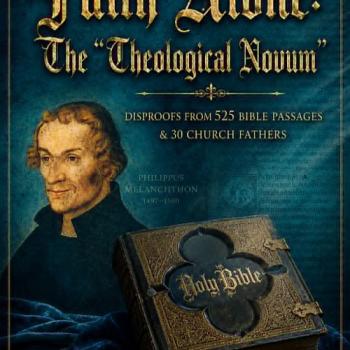
Introducing "Faith Alone: The 'Theological Novum'”
Biblical Evidence for Catholicism
TRENDING AT PATHEOS Catholic

Janie Learns the Way of the Cross: A...
Teaching children about Jesus' Passion can be challenging. Many parents and educators...

Looking For Good Catholic Writing - October 2026
He alone extends the heavens, and he walks upon the waves of...

In "Irreplaceable," our book on vocation and technology, Trevor Sutton and I...

I was strolling through the top floor of the brand new Parthenon...

What Does Gêvâh Mean For Kimberley Guifoyle &...
This week, a lot of the news is focused on Kimberly Guilfoyle....

INNER CIRCLE: Profound Mystery (Of Christ In All...
Ephesians 5:31-32 “For this reason, a man will leave his father and...
view all Catholic blogs
Ad-Free & Subscriber Log-In Subscription Support
- About Us
- 2026 Calendar
- Videos
- Podcasts
- Library of World Religions
- Faith In Media Tracker
- Advertise With Us
- Write for Us
- Privacy Policy
- Terms of Service
- Do Not Sell My Data
- Contact Us
- Radiant Digital
- Manage Newsletter Subscriptions
- Unsubscribe From Notifications
- Sitemap
Copyright 2008-2026, Patheos. All rights reserved.
Subscription Support Ad-Free & Subscriber Log-In
Follow Patheos