
BuddhistCatholicContemplativeEvangelicalGeneral ChristianHinduJewishLatter-day SaintMuslimNew VisionsProgressive Christian
Beliefs
- Buddhist
- Catholic
- Contemplative
- Evangelical
- General Christian
- Hindu
- Jewish
- Latter-day Saint
- More Voices
- Muslim
- New Visions
- Pagan
- Progressive Christian
Topics
- Religion News
- Food and Religion
- Sports and Religion
- Religious Art
- Religious Music and Entertainment
- Religious Events
- History and Religion
- Style and Religion
- Politics and Religion
- Women in Religion
- Recreation Outdoors and Religion
- Business Finance and Religion
- Careers Workplace and Religion
- Education and Religion
- Family Parenting and Religion
- Health Fitness and Religion
- Home and Religion
- Relationships and Religion
- Technology and Religion
- Travel and Religion
Columnists
- Buddhist Columnists
- Business Finance and Religion Columnists
- Careers Workplace and Religion Columnists
- Catholic Columnists
- Contemplative Columnists
- Education and Religion Columnists
- Evangelists Columnists
- Family Parenting and Religion Columnists
- General Christian Columnists
- Health Fitness and Religion Columnists
- Hindu Columnists
- History and Religion Columnists
- Home and Religion Columnists
- Jewish Columnists
- More Voices Columnists
- Latter Day Columnists
- Muslim Columnists
- New Visions Columnists
- Nonreligious Columnists
- Pagan Columnists
- Politics and Religion Columnists
- Progressive Columnists
- Recreation Outdoors and Religion Columnists
- Relationships and Religion Columnists
- Religion News Columnists
- Religious Art Columnists
- Religious Events Columnists
- Religious Music and Entertainment Columnists
- Sports and Religion Columnists
- Style and Religion Columnists
- Technology and Religion Columnists
- Travel and Religion Columnists
- Women in Religion Columnists
Resource Library
- 2026 Calendar
- Library of World Religions
- The 100 Most Holy Places on Earth
- Patheos Answers
- Podcasts
- Videos
- Faith Leaders Database
- Anglican Episcopalian
- Bahai
- Baptist
- Buddhism
- Christianity
- Confucianism
- Eastern Orthodoxy
- Hinduism
- Holiness and Pentecostal
- ISKCON
- Islam
- Judaism
- Lutheran
- Methodist
- The Church of Jesus Christ of Latter-day Saints
- New Age
- Paganism
- Presbytarian and Reformed
- Protestantism
- Religion Behind the Scenes
- Roman Catholic
- Scientology
- Shia Islam
- Sikhism
- Sufism
- Sunni Islam
- Taoism
- Zen
- See all religions
Research Tools
 Ad-Free & Subscriber Log-In Subscription Support
Ad-Free & Subscriber Log-In Subscription Support
Follow Patheos 

- Trending:
- Forgiveness
- |
- Marriage
- |
- Consciousness
- |
- Death Penalty
- |
- Election
- |
- Halloween

-
About
-
Catholic Apologetics
-
Church History
-
Great Apologists
-
Christian Worldview
-
Protestantism & Misc.
- Home
- Catholic
- History and Religion
- Introduction: Anticipating & Reflecting Upon a Holy Land Pilgrimage
Introduction: Anticipating & Reflecting Upon a Holy Land Pilgrimage
Last updated on: June 6, 2026 at 12:25 am by Dave Armstrong
Introduction: Anticipating & Reflecting Upon a Holy Land Pilgrimage 2026-06-06T00:25:45-04:00 Dave Armstrong
Patheos Explore the world's faith through different perspectives on religion and spirituality! Patheos has the views of the prevalent religions and spiritualities of the world.
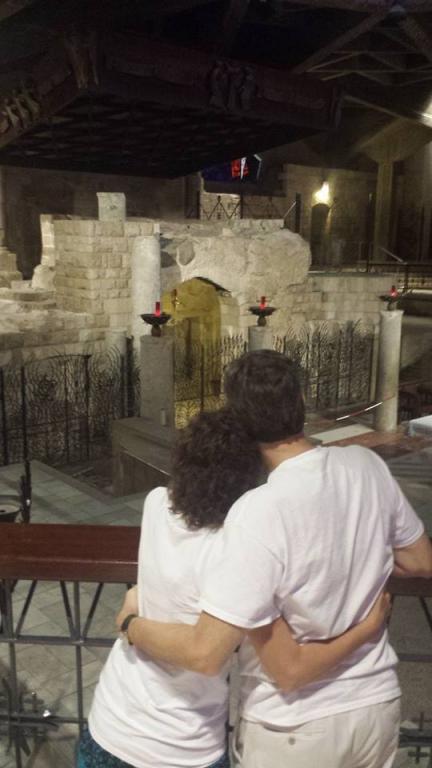
Dave & Judy Armstrong sharing a very moving moment: saying the Hail Mary at the location of the Annunciation in Nazareth, where the angel said those words to the Blessed Virgin Mary (October 2014)
(8-11-14)
[this is the Introduction to my book, Footsteps that Echo Forever: My Holy Land Pilgrimage]
“Pilgrimage.” I must confess that in my formerly evangelical Protestant mind, prior to 1990, the word conjured up images of semi-fanatical, curiously odd – yet nevertheless admirably devout – Catholics with long faces, crawling on their bloodied knees up St. Patrick’s mountain in Ireland, or those steps in the church in Rome (whose name I don’t recall offhand). Somehow – I thought, but did not yet comprehend – these people felt they had something to gain by punishing and torturing themselves.
The “pilgrim” to me; the first thing that came to my mind, was those old straight-laced folks with the funny hats and Anglo-Saxon names and somber faces, who came to America on the Mayflower in 1620 and had the first Thanksgiving so they wouldn’t starve to death.
I knew that pilgrimages had something to do with “holy places” (the idea of which I used to oppose: at least in the abstract) and, as I thought then, with the ghoulish, bizarre – if not idolatrous – practice of veneration of relics.
I’ve learned a few things in the last twenty-four years. The “holy place” is a thoroughly biblical notion. Jerusalem was and is a holy city (Neh 11:1, 18; Is 48:2). The temple in Jerusalem (gone since 70 A.D.) was a particularly holy place (1 Chr 29:3; Is 11:9; 56:7; 64:10). The inner sanctum of the temple: called the Holy of Holies (Lev 16) was the ultimate holy place in the world, and in Judaism.
Originally the wooden, treasure chest-like ark of the covenant was in the Holy Of Holies, and God was thought to be present there in a very special way, on what was called the mercy seat, in between two carved cherubim (Ex 25:22). It was so holy it could not be touched, and hence it was transported with poles that ran through rings on its side.
In fact, on one occasion, when it was about to fall over while being moved, one Uzziah merely reached out to steady it and was immediately struck dead (2 Sam 6:2-7). The men of Beth-shemesh also died when they simply looked inside the ark (1 Sam 6:19; cf. Ex 33:20).
Mt. Sinai was holy due to God’s tangible presence there, in the burning bush (Ex 3:5). Just before the Hebrews were to receive the Ten Commandments, God charged the people to not even touch the mountain, or its “border,” on pain of death (19:12-13). Even animals were included in the restriction!
God knew that people often have to learn the hard way. In any event, His special presence – considered apart from the fact that He is also omnipresent – imparts holiness (Dt 7:6; 26:19; Jer 2:3). Angels are called “holy ones” in Scripture precisely because of their proximity to God (Job 5:1; Ps 89:6-7).
That is a bare summary of what the Bible teaches about holy places. And lest anyone try to make the tired, foolish argument that all of the above is in the Old Testament, and as such supposedly “doesn’t count anymore,” the New Testament continues to refer to Jerusalem as the “holy city” (Mt 4:5; 27:53), and Jesus spoke of the Holy of Holies as “the holy place” (Mt 24:15; cf. Heb 9:3).
St. Peter refers to the Mount of Transfiguration as “the holy mountain” (2 Pet 1:17-18; cf. Mt 17:1-6). Protestants widely use the terms “Holy Bible” and “Holy Land”. In so doing, they tacitly acknowledge the notion of “holy things”: even though, if pressed, they may argue against it, as I once did myself.
According to the Bible and Catholic history and tradition, there is such a thing as a holy place or holy item. And that is the very basis of the pilgrimage (which is why I took a little time explaining it, and its biblical foundation).
As an evangelical Protestant (1977-1990) with a lively reverence and pious sense towards the Bible and the Holy Land, I could have, no doubt, traveled to Israel and experienced God’s presence deeply and profoundly, even if I hadn’t fully grasped the concept of the holy place. It wouldn’t have been vastly different from what it will be like for me now.
Yet the difference for the Catholic or Orthodox Christian and a few “higher” groups of Protestants, is that the holy thing literally conveys grace, as the sacraments do (though in a somewhat different sense, similar to what is called a sacramental (holy water, crucifixes, scapulars, etc.).
Thus, to travel to Jerusalem or other places where the events of the Bible and life of our Lord Jesus took place, is not merely to revel in its sublime historical significance, nor to try to “go back in time” or suchlike (as many of us love to do on vacations). It’s much more than that. Provided that a person has an appropriately open and willing heart, he or she literally receives grace, and becomes closer to God as a result.
That’s our little “theological lesson” and a backdrop to the upcoming pilgrimage. But getting back to a more subjective or experiential plane, I’d like to try to convey my thoughts and feelings at this vantage-point: almost exactly three months before I begin the pilgrimage. How do I conceive of it: having never really done such a thing?
I approach it by means of analogies: experiences that come closest to what I can only imagine at this point that it will be like. The one thing that keeps coming back to my mind is what it felt like to visit Gettysburg: the site in Pennsylvania of the greatest battle of the American Civil War (in July 1863). I’ve been there twice, and the experience was the same both times, for myself, as well as my wife Judy and my children who were with us. They were old enough the second time to understand much better.
The feeling (as best I can describe it) was a tangible sense of the presence of spirits and a sort of awestruck suspension of everything else; the realization that one was present at a profoundly solemn and spiritual place: a “hallowed ground” where unspeakably dramatic events involving bravery and noble and high ideals occurred; where thousands of men courageously died, and many thousands more were wounded: never to be the same again.
When I was there, I literally felt a sort of “spirit” hang over it: so real that you can almost reach out and touch it. I’ve never experienced anything like it before or since, and I felt it – quite distinctly and unmistakably – two times, more than ten years apart.
Part of it, I suppose, was seeing the movie about it shortly before our first visit. That helped to “bring it to life,” yet if we had never seen the film, I’m firmly convinced that it wouldn’t have felt any differently, because the historical knowledge is essentially different from the spiritual experience.
Gettysburg is, I think, a “holy place” of a sort. By analogy, I believe that being in the Holy Land, in the very places where Jesus walked, and where David and Moses and Abraham and Mary and the apostles lived and followed God, must feel very much like that experience, and far more so. To be immersed in that for even a day would be an unspeakable privilege. But we will be there for fifteen days, on the trip and pilgrimage of a lifetime.
As a second analogy I would imagine that eucharistic adoration “feels like” in many respects what it is like to be in the Holy Land: precisely because of the eucharistic presence of Jesus. The closer one is to God, the more one has a sense of holiness and a profound sense of fellowship and unity with Him.
The third related analogy that I have in my mind, is various times of experiencing a “filling of the Holy Spirit” (Eph 5:18): many of them as a Protestant. On several occasions, usually when one or both of us was greatly upset about something, my wife Judy and I would pray for each other, to receive peace from the Holy Spirit.
And, lo and behold, it happened just about every time: a wonderful, unspeakable sense of peace and a sort of “spiritual ecstasy.” We don’t seek it; we’re not fanatical about trying to have experiences (it’s been many years now, I think). I rarely talk about it. But these experiences were as real as the keyboard and the desk in front of me as I write. No one could ever convince me that they were not real.
And that indescribably pleasant, blessed feeling of closeness to, or special proximity to God is how I imagine it will be in the Holy Land, where God became man and walked among us and died for us, and where Peter and Paul (transformed by God’s grace and what they had seen) ventured out to share the new gospel.
These are my feelings now. I’ve never been to such a holy place (unless we count Gettysburg as that: which to me makes sense). I’ve never been anywhere outside of the United States and Canada (though I’m very well-traveled in those two countries). Thus, this book will be a report of the journey of this 56-year-old (still fairly “youthful”) Catholic apologist, who has loved and studied and defended and shared about the Bible and Christianity; and more specifically, Catholicism, these past 33 years.
The book will be designed to have many different aspects, all woven together into a type of “adventure narrative” or spiritual odyssey. It will be a firsthand report of what I feel like as I travel to all these holy sites in Israel. That is the traditional pilgrimage account or, if you will, a diary. I’ll be writing at the end of each day in my hotel: recording my thoughts and feelings in a spontaneous manner.
Two other elements are more directly “apologetic” and draw upon my more usual writing styles and goals (what my readers usually expect from me). I will be detailing some of the exciting archaeological discoveries that have been occurring in Israel and Jordan, and almost literally revolutionizing the increasingly secular, non-believing field of biblical archaeology (at least for those willing to see).
For example, some of the very recent spectacular finds (only in the last 20 years) include the baptismal site of Jesus in Jordan, the City of David excavations in Jerusalem, just outside of the current Old City and next to where the temple used to be, another Davidic-period city at the Valley of Elah, where David killed Goliath, and what is believed to be Joshua’s altar on Mt. Ebal.
We may not be able to visit every last one of these sites, but I will still write about them a bit, even if we don’t, since they are such exciting confirmations of the Bible and of traditional Christian, Catholic faith (tying into the apologetics which is my specialty).
I’ll also be utilizing scriptural references to relate the places we visit to biblical history; along with the occasional exposition of the text. These, then, to summarize, are the four elements that will make up this book:
1) The pilgrimage and spiritual journey, written about in a very personal way: how I feel, what I (and others) experience; firsthand descriptions and impressions of these holy sites.
2) Survey of archaeological findings and their significance.
3) Citing of related Scripture, with occasional exposition.
4) A running narrative, tying it all together as an exciting journey or odyssey; an adventure (as indeed, it will inevitably be).
My hope is that a lively sense of the pilgrimage can be directly conveyed to you, the reader. Some of you may never be able to take such a trip. I probably never would have, myself, on my barely adequate apologist’s salary, but I was blessed by having most of my expenses generously, graciously paid for. And believe me, I know and understand very well the pain and longing and yearning of wanting so badly to take such a trip, for years, decades, but never being able to (till now in my case).
Whether you are never able to travel to the Holy Land or have been there, or plan to go in the future, the goal is to make our pilgrimage come alive for you: so that you can experience it vicariously (somewhat like watching a movie and becoming engrossed in it), and to educate the reader about the cutting-edge archaeological discoveries that are taking place.
Beyond that, we want to share and express the joy of being a Catholic and disciple of Jesus. In a world (even in the Church) where discussions and thoughts are often so negative, bitter, acrimonious, or cynical (just as they were in Bible times!), we are striving to present a positive vision of being a Catholic and follower of Jesus.
Heaven knows, almost all of us (save whatever saints walk the earth today) fall far short of the high ideals of the Christian life, but, having said that, in this book I hope to achieve some semblance of what St. Paul calls for us to be and to do:
Philippians 4:4, 6-8 Rejoice in the Lord always; again I will say, Rejoice. . . . [6] Have no anxiety about anything, but in everything by prayer and supplication with thanksgiving let your requests be made known to God. [7] And the peace of God, which passes all understanding, will keep your hearts and your minds in Christ Jesus. [8] Finally, brethren, whatever is true, whatever is honorable, whatever is just, whatever is pure, whatever is lovely, whatever is gracious, if there is any excellence, if there is anything worthy of praise, think about these things.
I hope you will join us now on our spiritual pilgrimage and additional quest after the best and latest exciting archaeological sites in the Holy Land. Apart from some research components that I’ll be working on before we leave, the narrative and “diary” beginning in the first chapter, will (of necessity) be written after we arrive in Israel: on 18 October 2014 (three months away, as of this writing).
These are preliminary thoughts and expectations. That will be the Real Thing.
* * * * *
Jews & Judaism & Old Testament
Previous Post
August 9, 2014
2014 Fundraiser for Dave Armstrong's Apologetics Apostolate
Next Post
August 17, 2014 Martin Luther and Anabaptist Executions in the 1530s
Browse Our Archives
Select a Category & Last Things About Me Anti-Catholicism Atheism & Agnosticism Baptism and Sacramentalism Bible and Tradition Blessed Virgin Mary Books by Dave Armstrong C. S. Lewis Calvinism & General Protestantism Catholic Apologetics Catholic Apologists Catholic conversion Catholic converts Christmas Church (Ecclesiology) Church History Conversion and Converts Development of Doctrine Eastern Orthodoxy Ecumenism & Christian Unity Eucharist & Liturgy Fathers of the Church French Translations G. K. Chesterton Hell Hell & Satan Hell & Satan & Last Things Heresies & Comparative Religion Holistic Health Inquisition & Crusades & Scandals James White Jews & Judaism & Old Testament John Calvin John Henry Newman Liberal / Modernist Theology Life Issues Literary Resume Lutheranism Mariology Martin Luther Music Orthodoxy Papacy & Infallibility Personal Page Philosophy & Science Political & Ethical & Moral Issues Protestant Persecution & Intolerance Protestantism Purgatory Purgatory & Penance Romantic & Imaginative Theology Saints & Purgatory & Penance Salvation Salvation & Justification Satan & Last Things Sexuality and Gender Issues Spanish Translations Traditionalism vs. Radical Catholic Reactionaries Traducciones al español / tradução para português Trinitarianism & Christology Uncategorized Videos
Select a Month October 2026 September 2026 August 2026 July 2026 June 2026 May 2026 April 2026 March 2026 February 2026 January 2026 December 2025 November 2025 October 2025 September 2025 August 2025 July 2025 June 2025 May 2025 April 2025 March 2025 February 2025 January 2025 December 2024 November 2024 October 2024 September 2024 August 2024 July 2024 June 2024 May 2024 April 2024 March 2024 February 2024 January 2024 December 2023 November 2023 October 2023 September 2023 August 2023 July 2023 June 2023 May 2023 April 2023 March 2023 February 2023 January 2023 December 2022 November 2022 October 2022 September 2022 August 2022 July 2022 June 2022 May 2022 April 2022 March 2022 February 2022 January 2022 December 2021 November 2021 October 2021 September 2021 August 2021 July 2021 June 2021 May 2021 April 2021 March 2021 February 2021 January 2021 December 2020 November 2020 October 2020 September 2020 August 2020 July 2020 June 2020 May 2020 April 2020 March 2020 February 2020 January 2020 December 2019 November 2019 October 2019 September 2019 August 2019 July 2019 June 2019 May 2019 April 2019 March 2019 February 2019 January 2019 December 2018 November 2018 October 2018 September 2018 August 2018 July 2018 June 2018 May 2018 April 2018 March 2018 February 2018 January 2018 December 2017 November 2017 October 2017 September 2017 August 2017 July 2017 June 2017 May 2017 April 2017 March 2017 February 2017 January 2017 December 2016 November 2016 October 2016 September 2016 August 2016 July 2016 June 2016 May 2016 April 2016 March 2016 February 2016 January 2016 December 2015 November 2015 October 2015 September 2015 August 2015 July 2015 June 2015 May 2015 April 2015 March 2015 February 2015 January 2015 December 2014 November 2014 October 2014 September 2014 August 2014 July 2014 June 2014 April 2014 March 2014 February 2014 January 2014 December 2013 November 2013 October 2013 September 2013 August 2013 July 2013 June 2013 April 2013 March 2013 February 2013 January 2013 December 2012 November 2012 October 2012 September 2012 August 2012 July 2012 June 2012 May 2012 April 2012 March 2012 February 2012 January 2012 December 2011 November 2011 October 2011 September 2011 August 2011 July 2011 June 2011 April 2011 March 2011 February 2011 October 2010 September 2010 August 2010 July 2010 April 2010 March 2010 December 2009 October 2009 August 2009 July 2009 June 2009 May 2009 March 2009 February 2009 October 2008 September 2008 April 2008 March 2008 February 2008 January 2008 December 2007 November 2007 October 2007 May 2007 March 2007 February 2007 January 2007 November 2006 October 2006 September 2006 August 2006 July 2006 June 2006 May 2006 April 2006 March 2006 February 2006 October 2005 June 2005 April 2005 February 2005 July 2004 May 2004 April 2004
Follow Us!
TAKE THE
Religious Wisdom Quiz
According to 2 Peter, what are believers partakers of?
Select your answer to see how you score.
The divine nature God's kingdom Christ's sufferings Eternal glory
Books by This Author Books by Dave Armstrong
Related posts from Biblical Evidence for Catholicism

Book: Martin Luther: Dissenter and Defender
Biblical Evidence for Catholicism
"Martin Luther: Dissenter & Defender": Introduction
Biblical Evidence for Catholicism
Introducing "Faith Alone: The 'Theological Novum'”
Biblical Evidence for Catholicism
Faith Alone: The "Theological Novum" (Dave Armstrong Book)
Biblical Evidence for Catholicism
TRENDING AT PATHEOS Catholic

Swimfan: Forgotten Aughts Pleasures
This is a recovery effort. In 2002, My Big Fat Greek Wedding...

Top Three Anti-Catholic Lies About Catholicism
This is my initial transcript for the video, "THE 3 WORST...

Pope Leo Celebrates Mass for Nurses & Docs...
I don't have any idea how he did it, but Pope Leo...

The Sermon on the Mount, Part I: Matthew...
The Sermon on the Mount, Part I (Matthew 4:12-5:12) St. Matthew moves...

What's up from Crossway: Reviewing some of their latest A few weeks...

Janie Learns the Way of the Cross: A...
Teaching children about Jesus' Passion can be challenging. Many parents and educators...
view all Catholic blogs
Ad-Free & Subscriber Log-In Subscription Support
- About Us
- 2026 Calendar
- Videos
- Podcasts
- Library of World Religions
- Faith In Media Tracker
- Advertise With Us
- Write for Us
- Privacy Policy
- Terms of Service
- Do Not Sell My Data
- Contact Us
- Radiant Digital
- Manage Newsletter Subscriptions
- Unsubscribe From Notifications
- Sitemap
Copyright 2008-2026, Patheos. All rights reserved.
Subscription Support Ad-Free & Subscriber Log-In
Follow Patheos