
BuddhistCatholicContemplativeEvangelicalGeneral ChristianHinduJewishLatter-day SaintMuslimNew VisionsProgressive Christian
Beliefs
- Buddhist
- Catholic
- Contemplative
- Evangelical
- General Christian
- Hindu
- Jewish
- Latter-day Saint
- More Voices
- Muslim
- New Visions
- Pagan
- Progressive Christian
Topics
- Religion News
- Food and Religion
- Sports and Religion
- Religious Art
- Religious Music and Entertainment
- Religious Events
- History and Religion
- Style and Religion
- Politics and Religion
- Women in Religion
- Recreation Outdoors and Religion
- Business Finance and Religion
- Careers Workplace and Religion
- Education and Religion
- Family Parenting and Religion
- Health Fitness and Religion
- Home and Religion
- Relationships and Religion
- Technology and Religion
- Travel and Religion
Columnists
- Buddhist Columnists
- Business Finance and Religion Columnists
- Careers Workplace and Religion Columnists
- Catholic Columnists
- Contemplative Columnists
- Education and Religion Columnists
- Evangelists Columnists
- Family Parenting and Religion Columnists
- General Christian Columnists
- Health Fitness and Religion Columnists
- Hindu Columnists
- History and Religion Columnists
- Home and Religion Columnists
- Jewish Columnists
- More Voices Columnists
- Latter Day Columnists
- Muslim Columnists
- New Visions Columnists
- Nonreligious Columnists
- Pagan Columnists
- Politics and Religion Columnists
- Progressive Columnists
- Recreation Outdoors and Religion Columnists
- Relationships and Religion Columnists
- Religion News Columnists
- Religious Art Columnists
- Religious Events Columnists
- Religious Music and Entertainment Columnists
- Sports and Religion Columnists
- Style and Religion Columnists
- Technology and Religion Columnists
- Travel and Religion Columnists
- Women in Religion Columnists
Resource Library
- 2026 Calendar
- Library of World Religions
- The 100 Most Holy Places on Earth
- Patheos Answers
- Podcasts
- Videos
- Faith Leaders Database
- Anglican Episcopalian
- Bahai
- Baptist
- Buddhism
- Christianity
- Confucianism
- Eastern Orthodoxy
- Hinduism
- Holiness and Pentecostal
- ISKCON
- Islam
- Judaism
- Lutheran
- Methodist
- The Church of Jesus Christ of Latter-day Saints
- New Age
- Paganism
- Presbytarian and Reformed
- Protestantism
- Religion Behind the Scenes
- Roman Catholic
- Scientology
- Shia Islam
- Sikhism
- Sufism
- Sunni Islam
- Taoism
- Zen
- See all religions
Research Tools
 Ad-Free & Subscriber Log-In Subscription Support
Ad-Free & Subscriber Log-In Subscription Support
Follow Patheos 

- Trending:
- Forgiveness
- |
- Marriage
- |
- Consciousness
- |
- Death Penalty
- |
- Election
- |
- Halloween

-
About
-
Catholic Apologetics
-
Church History
-
Great Apologists
-
Christian Worldview
-
Protestantism & Misc.
- Home
- Catholic
- History and Religion
- Ken Temple’s “Review” of Rod Bennett’s Book, “Four Witnesses”: Part III
Ken Temple’s “Review” of Rod Bennett’s Book, “Four Witnesses”: Part III
Last updated on: June 6, 2026 at 12:25 am by Dave Armstrong
Ken Temple’s “Review” of Rod Bennett’s Book, “Four Witnesses”: Part III 2026-06-06T00:25:45-04:00 Dave Armstrong
Patheos Explore the world's faith through different perspectives on religion and spirituality! Patheos has the views of the prevalent religions and spiritualities of the world.
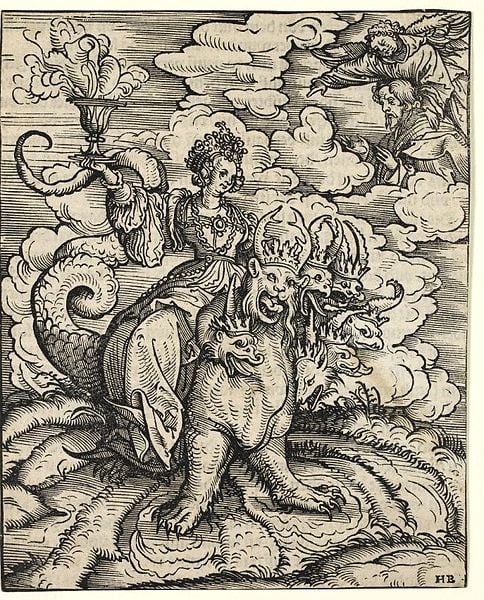
Hans Burgkmair the Elder (1473-1531), The Whore of Babylon; sitting on the seven-headed beast, St John and the angel looking on from a cloud in top right corner. From a series of 21 woodcuts of the Apocalypse for Martin Luther’s translation of the New Testament (Augsburg: S. Otmar, 1523) [public domain / Wikimedia Commons]

***
(4-26-14)
***
***
[link to the article being critiqued below]
***
Introduction:
Page 11 – Rod is wrong about the meaning of Sola Scriptura. “Raised in a strong, Bible-believing branch of Protestant Evangelicalism, I was taught to glory in the famous Reformation rallying cry of “Sola Scriptura” – the fiery conviction that the Bible and the Bible alone constitutes the basis for Christian belief.”
This may be the sentiment and mis-understanding that Rod, in his experience, felt, and this is a very common idea about what Sola Scriptura is, but it is incorrect. Rather “Sola Scriptura” says that the Bible is the only infallible rule for faith, doctrine, and practice for the church. It does not say it is the “only” basis for Christian belief; rather it is the “only infallible rule”. So, Protestants believe in secondary authorities that are good and useful, but not infallible, such as local church elders/teacher/pastors/overseers, whose ministry is to teach the Scriptures properly and interpret the Scriptures properly(but we can never claim that any human is infallible); also consulting church history, historical theology, great writers and theologians of the past, ancient creeds, ancient councils, doctrinal statements, good exegetical commentaries.
That’s fine (it’s what I understand the definition of sola Scriptura to be and how I define it in my two books against it); however, Rod may have been using the word “basis” in the sense of “[implied, infallible] rule of faith”. In any event, Rod, on the same page and the next one, acknowledges that the best Protestants did indeed make recourse to history:
Even Luther and Calvin — the very men who taught us Sola Scriptura in the first place — knew and respected these venerable saints whom ancient custom has given the title Fathers of the Church. They quite often used the writings of early giants like Ambrose and Augustine to bolster their various arguments.
Thus, Ken leaves a false impression (by the ever-present selective citation) that Rod thinks Protestantism teaches an absolute, Bible-Only view. This is untrue.
Page 11 – When discussing the various Evangelical groups and churches Rod was a part of, he talks about the Evangelical spirit of always seeking to base things on the pure New Testament Church. He states, “Not one of them had ever sent me back to any first or second-century documentation for evidence.”
But on the same page, what Ken conveniently omits is the sentence immediately before the one above, where Rod also made reference to these groups “whose publicly announced intention was ‘to restore the pure Christianity of the early Church.’ ” Thus he shows that his own experience with Protestantism was not a phenomenon of Bible Only with no Church history whatever (only inadequate particular knowledge of that history). Things must be interpreted in context. Ken ignored the context both before and after Rod’s statement that he knocked down (likely misunderstanding it in the first place). Or he saw the context, but chose only to cite things that give an impression that Ken wishes to create, rather than what Rod actually was trying to express. This will not do. Readers can see through this dubious technique, once it is exposed for what it is.
p. 14 – Seems to imply that the early church fathers were more clear than the Scriptures themselves.
I don’t see that he implied it at all. He commented on the fathers’ “clear, unambiguous teaching . . . the actual doctrine of primitive Christianity set down in black and white.” He made no comparison of that with Scripture. It would be like someone saying, “wow, this river here is so clear!” and someone else concluding that he therefore thought it was clearer than some other particular river. Maybe so, but that can’t be determined by a self-referential statement of that sort. Ken assumes it because it is what he imagines Rod to be saying, according to the usual caricature that Catholics think Scripture is an utter mystery that no one can figure out (I exaggerate some, but not much).
Ken then makes a point about the equivalency of elders and bishops in 1 Clement, claiming that “overseers/bishops (Greek:επισκοποις – episcopois ) is the same office as elders (Greek: πρεσβυτερους – presbuterous).” I already dealt with that argument at length in Part I; also offering various clear New Testament evidences of ecclesiastical hierarchy. No need to reiterate it here, except to note one thing.
He tries to enlist St. Irenaeus in favor of his notion expressed above (Against Heresies, 4:26:5). But elsewhere the saint is very clear as to the primacy and “pre-eminent authority” of the Roman See, with which “every Church should agree”. That sure sounds like a higher level of authority of the Roman bishop in relation to other bishops. He possesses the primacy. The Roman See is preeminent because it was founded by Peter and Paul, and Irenaeus also makes reference to “apostolical tradition” which has been passed down through apostolic succession (cf. 4:26:2). It’s Catholic all-around, and very foreign to a Protestant outlook:
Since, however, it would be very tedious, in such a volume as this, to reckon up the successions of all the Churches, we do put to confusion all those who, in whatever manner, whether by an evil self-pleasing, by vainglory, or by blindness and perverse opinion, assemble in unauthorized meetings; [we do this, I say,] by indicating that tradition derived from the apostles, of the very great, the very ancient, and universally known Church founded and organized at Rome by the two most glorious apostles, Peter and Paul; as also [by pointing out] the faith preached to men, which comes down to our time by means of the successions of the bishops. For it is a matter of necessity that every Church should agree with this Church, on account of its pre-eminent authority, that is, the faithful everywhere, inasmuch as the apostolical tradition has been preserved continuously by those [faithful men] who exist everywhere. (Against Heresies, 3, 3, 2; ANF, Vol. I)
p. 54 – “the church had been preaching the gospel, saving souls, and founding congregations all over the Near East for at least ten years before a single line of the New Testament was written.” While this is technically true, it seems the way it is framed is to make the reader downplay the importance of the written word.
Not at all. That is Ken’s hostile and cynical assumption. When the Catholic makes any point at all about Scripture that is contrary to sola Scriptura, then it is said that they are denigrating the Bible. We’re gonna hear this false charge till Kingdom Come. The Protestant of Ken’s sort can’t seem to grasp that by saying Tradition and Church are also authoritative with Scripture, it’s not required to be “against” Scripture. The fact remains that Tradition and Church played a supremely important role, especially during the period that canonization was still taking place.
For the anti-Catholic Protestant like Ken, in order to truly respect and honor Holy Scripture, one must adhere to sola Scriptura. He acts as if the Bible and sola Scriptura are almost identical, and that no one could possibly respect the Bible without holding to the late-arriving, unbiblical notion of sola Scriptura. But this is completely false and an untrue “equivalence.” That leads to silly statements like the above. The Bible is revered if it is regarded as the inspired, infallible, revelation from God; it’s not required to believe it is the only infallible source of authority (which it itself does not teach, and massively contradicts!) in order to revere it.
Ken then goes on to make trite, inane, rather silly and logically circular arguments about tradition and Scripture. I’m afraid I don’t have the patience to deal with them (having done so many times before), seeing that they are not directly addressing Rod’s arguments. I’ll have to refer readers to my two books on sola Scriptura (one / two), and web page on the same topic.
Clement mentions 1 Corinthians in his letter – 1 Clement 47 . . . Clement quotes from OT and NT passages . . .
Big wow. This is quite a minimalistic statement, and proves little or nothing with regard to the overall thrust of Ken’s argument. What he neglects to tell his readers is that St. Clement of Rome cites, alludes to, or names as authentic, only ten books out of the 27 in the New Testament (Matthew, John, Romans, 1 Corinthians, Ephesians, 1 Timothy, Titus, Hebrews, James, and 2 Peter). See Norman L. Geisler and William E. Nix, From God to Us: How We Got Our Bible (Chicago: Moody Press, 1974), chart on p. 109.
So all of Paul’s letters and for sure the 3 synoptic gospels and Acts were already written by this time, along with 1 Peter. These are almost 30 years before Clement.
Great; I’m absolutely delighted that Ken pointed this out, as it is a great aid to the Catholic argument. Assuming this is true, why, then, Does St. Clement show no knowledge of Mark, Luke, Acts, 2 Corinthians, Galatians, Philippians, Colossians, 1 and 2 Thessalonians, 2 Timothy, Philemon, 1 Peter, and five other NT books? Ken apparently assumes that he does merely because they were already written, but that doesn’t follow. Only the hard evidence of what we know establishes his point, not bald assumptions that because a biblical book exists, therefore everyone in the early Church was aware of it.
Rod seems to emphasize that Clement had nothing to go by except the claim that he was taught by Peter himself and everything was all oral and in their memories and hearts.
No; Rod emphasized that the canon was incomplete, so that Tradition and Church were that much more important as a result. The fact remains that from what we know, Clement knew about or used in his letters, only ten out of 27 New Testament books. That’s not exactly a “grand slam” bit of information for sola Scriptura in the 1st century Church.
p. 62 – “. . . the proud city of Rome must learn to look where Clement looked – to the simple man to whom the Good Shepherd said, “Feed My sheep.” Rod is trying to build the case that the deposit of correct doctrine was in the person of Peter, in his office as bishop of Rome or “Pope”, in Rome, passed on to Clement, and that that was the solution to the problem of disunity and Gnosticism at the time of 1 Clement. Rod seems to imply that Clement is a “living voice” of authority and can solve the disunity problems by commanding obedience.
Absolutely. St. Irenaeus made the same argument some 100 years later, as we have seen. St. Irenaeus always grounded his anti-heretical arguments in apostolic succession and the fact that no heresy could trace its beliefs back to the beginning in unbroken succession. That was sufficient in his mind to prove falsity of the belief, even if biblical argumentation is not yet introduced. The argument is already won against the heretic, by that fact. And it works against Protestants, too, in instances where they hold to doctrines that started in the 16th century and have no pedigree in Church history.
I Clement has a passage that teaches that justification is by faith alone, . . . (1 Clement 32)
Here is a classic case of Ken’s constant technique of citing one aspect of a thing while ignoring other equally relevant passages that contradict his assertion based on the half-truth presentation that he thinks is compelling. It’s cute and amusing but intellectually detestable. In the same book it’s stated: “For her faith and hospitality Rahab the harlot was saved” (12:1). That ain’t faith alone. It’s faith and hospitality (a work) leading to salvation. And again, St. Clement shows an emphasis not unlike St. James:
Let us therefore cleave unto those to whom grace is given from God. Let us clothe ourselves in concord, being lowlyminded and temperate, holding ourselves aloof from all back biting and evil speaking, being justified by works and not by words. (30:3)
Keeping God’s ordinances and commandments is directly tied to salvation (just as it is at least 50 times in the Bible):
Receive our counsel, and ye shall have no occasion of regret. For as God liveth, and the Lord Jesus Christ liveth, and the Holy Spirit, who are the faith and the hope of the elect, so surely shall he, who with lowliness of mind and instant in gentleness hath without regretfulness performed the ordinances and commandments that are given by God, be enrolled and have a name among the number of them that are saved through Jesus Christ, through whom is the glory unto Him for ever and ever. Amen. (58:2)
So much for that silly argument . . .
* * * * *
Previous Post
April 26, 2014
Ken Temple's "Review" of Rod Bennett's Book, "Four Witnesses": Part II
Next Post

June 6, 2014 The Bible on Separation from Divisive Christians
Browse Our Archives
Select a Category & Last Things About Me Anti-Catholicism Atheism & Agnosticism Baptism and Sacramentalism Bible and Tradition Blessed Virgin Mary Books by Dave Armstrong C. S. Lewis Calvinism & General Protestantism Catholic Apologetics Catholic Apologists Catholic conversion Catholic converts Christmas Church (Ecclesiology) Church History Conversion and Converts Development of Doctrine Eastern Orthodoxy Ecumenism & Christian Unity Eucharist & Liturgy Fathers of the Church French Translations G. K. Chesterton Hell Hell & Satan Hell & Satan & Last Things Heresies & Comparative Religion Holistic Health Inquisition & Crusades & Scandals James White Jews & Judaism & Old Testament John Calvin John Henry Newman Liberal / Modernist Theology Life Issues Literary Resume Lutheranism Mariology Martin Luther Music Orthodoxy Papacy & Infallibility Personal Page Philosophy & Science Political & Ethical & Moral Issues Protestant Persecution & Intolerance Protestantism Purgatory Purgatory & Penance Romantic & Imaginative Theology Saints & Purgatory & Penance Salvation Salvation & Justification Satan & Last Things Sexuality and Gender Issues Spanish Translations Traditionalism vs. Radical Catholic Reactionaries Traducciones al español / tradução para português Trinitarianism & Christology Uncategorized Videos
Select a Month October 2026 September 2026 August 2026 July 2026 June 2026 May 2026 April 2026 March 2026 February 2026 January 2026 December 2025 November 2025 October 2025 September 2025 August 2025 July 2025 June 2025 May 2025 April 2025 March 2025 February 2025 January 2025 December 2024 November 2024 October 2024 September 2024 August 2024 July 2024 June 2024 May 2024 April 2024 March 2024 February 2024 January 2024 December 2023 November 2023 October 2023 September 2023 August 2023 July 2023 June 2023 May 2023 April 2023 March 2023 February 2023 January 2023 December 2022 November 2022 October 2022 September 2022 August 2022 July 2022 June 2022 May 2022 April 2022 March 2022 February 2022 January 2022 December 2021 November 2021 October 2021 September 2021 August 2021 July 2021 June 2021 May 2021 April 2021 March 2021 February 2021 January 2021 December 2020 November 2020 October 2020 September 2020 August 2020 July 2020 June 2020 May 2020 April 2020 March 2020 February 2020 January 2020 December 2019 November 2019 October 2019 September 2019 August 2019 July 2019 June 2019 May 2019 April 2019 March 2019 February 2019 January 2019 December 2018 November 2018 October 2018 September 2018 August 2018 July 2018 June 2018 May 2018 April 2018 March 2018 February 2018 January 2018 December 2017 November 2017 October 2017 September 2017 August 2017 July 2017 June 2017 May 2017 April 2017 March 2017 February 2017 January 2017 December 2016 November 2016 October 2016 September 2016 August 2016 July 2016 June 2016 May 2016 April 2016 March 2016 February 2016 January 2016 December 2015 November 2015 October 2015 September 2015 August 2015 July 2015 June 2015 May 2015 April 2015 March 2015 February 2015 January 2015 December 2014 November 2014 October 2014 September 2014 August 2014 July 2014 June 2014 April 2014 March 2014 February 2014 January 2014 December 2013 November 2013 October 2013 September 2013 August 2013 July 2013 June 2013 April 2013 March 2013 February 2013 January 2013 December 2012 November 2012 October 2012 September 2012 August 2012 July 2012 June 2012 May 2012 April 2012 March 2012 February 2012 January 2012 December 2011 November 2011 October 2011 September 2011 August 2011 July 2011 June 2011 April 2011 March 2011 February 2011 October 2010 September 2010 August 2010 July 2010 April 2010 March 2010 December 2009 October 2009 August 2009 July 2009 June 2009 May 2009 March 2009 February 2009 October 2008 September 2008 April 2008 March 2008 February 2008 January 2008 December 2007 November 2007 October 2007 May 2007 March 2007 February 2007 January 2007 November 2006 October 2006 September 2006 August 2006 July 2006 June 2006 May 2006 April 2006 March 2006 February 2006 October 2005 June 2005 April 2005 February 2005 July 2004 May 2004 April 2004
Follow Us!
TAKE THE
Religious Wisdom Quiz
What does "Ebenezer" mean, as in the stone Samuel set up?
Select your answer to see how you score.
Stone of God Stone of Law Stone of help Stone of David
Books by This Author Books by Dave Armstrong
Related posts from Biblical Evidence for Catholicism

Top Three Anti-Catholic Lies About Catholicism
Biblical Evidence for Catholicism

Three More Anti-Catholic Lies About Catholicism (#6-4)
Biblical Evidence for Catholicism

Top Ten Anti-Catholic Lies (#10-7)
Biblical Evidence for Catholicism

17 Church Fathers on Purgatory (Esp. 1 Cor...
Biblical Evidence for Catholicism
TRENDING AT PATHEOS Catholic

57th Dove Awards Honor Dolly Parton, Crown New...
On gospel music’s biggest night, the 57th annual GMA Dove Awards honored...

The First Eucharistic Controversy: Christ’s Real Presence
For Catholics, the Eucharist is the source and summit of the Christian...

What a Stop Sign Can Teach Us About...
How to Make a Decision When You Can't Hear God Main point:...

Archdiocese Hosts Military Marriage Retreat in Germany
RASTATT, Germany — The transient military lifestyle, with its frequent deployments and...

Nearly every morning, I make the drive to Detroit with my high-school-age...

The Real AI Story Is Adoption Without Trust
Artificial intelligence has crossed a political threshold. It is no longer a...
view all Catholic blogs
Ad-Free & Subscriber Log-In Subscription Support
- About Us
- 2026 Calendar
- Videos
- Podcasts
- Library of World Religions
- Faith In Media Tracker
- Advertise With Us
- Write for Us
- Privacy Policy
- Terms of Service
- Do Not Sell My Data
- Contact Us
- Radiant Digital
- Manage Newsletter Subscriptions
- Unsubscribe From Notifications
- Sitemap
Copyright 2008-2026, Patheos. All rights reserved.
Subscription Support Ad-Free & Subscriber Log-In
Follow Patheos