
BuddhistCatholicContemplativeEvangelicalGeneral ChristianHinduJewishLatter-day SaintMuslimNew VisionsProgressive Christian
Beliefs
- Buddhist
- Catholic
- Contemplative
- Evangelical
- General Christian
- Hindu
- Jewish
- Latter-day Saint
- More Voices
- Muslim
- New Visions
- Pagan
- Progressive Christian
Topics
- Religion News
- Food and Religion
- Sports and Religion
- Religious Art
- Religious Music and Entertainment
- Religious Events
- History and Religion
- Style and Religion
- Politics and Religion
- Women in Religion
- Recreation Outdoors and Religion
- Business Finance and Religion
- Careers Workplace and Religion
- Education and Religion
- Family Parenting and Religion
- Health Fitness and Religion
- Home and Religion
- Relationships and Religion
- Technology and Religion
- Travel and Religion
Columnists
- Buddhist Columnists
- Business Finance and Religion Columnists
- Careers Workplace and Religion Columnists
- Catholic Columnists
- Contemplative Columnists
- Education and Religion Columnists
- Evangelists Columnists
- Family Parenting and Religion Columnists
- General Christian Columnists
- Health Fitness and Religion Columnists
- Hindu Columnists
- History and Religion Columnists
- Home and Religion Columnists
- Jewish Columnists
- More Voices Columnists
- Latter Day Columnists
- Muslim Columnists
- New Visions Columnists
- Nonreligious Columnists
- Pagan Columnists
- Politics and Religion Columnists
- Progressive Columnists
- Recreation Outdoors and Religion Columnists
- Relationships and Religion Columnists
- Religion News Columnists
- Religious Art Columnists
- Religious Events Columnists
- Religious Music and Entertainment Columnists
- Sports and Religion Columnists
- Style and Religion Columnists
- Technology and Religion Columnists
- Travel and Religion Columnists
- Women in Religion Columnists
Resource Library
- 2026 Calendar
- Library of World Religions
- The 100 Most Holy Places on Earth
- Patheos Answers
- Podcasts
- Videos
- Faith Leaders Database
- Anglican Episcopalian
- Bahai
- Baptist
- Buddhism
- Christianity
- Confucianism
- Eastern Orthodoxy
- Hinduism
- Holiness and Pentecostal
- ISKCON
- Islam
- Judaism
- Lutheran
- Methodist
- The Church of Jesus Christ of Latter-day Saints
- New Age
- Paganism
- Presbytarian and Reformed
- Protestantism
- Religion Behind the Scenes
- Roman Catholic
- Scientology
- Shia Islam
- Sikhism
- Sufism
- Sunni Islam
- Taoism
- Zen
- See all religions
Research Tools
 Ad-Free & Subscriber Log-In Subscription Support
Ad-Free & Subscriber Log-In Subscription Support
Follow Patheos 

- Trending:
- Forgiveness
- |
- Marriage
- |
- Consciousness
- |
- Death Penalty
- |
- Election
- |
- Halloween

-
About
-
Catholic Apologetics
-
Church History
-
Great Apologists
-
Christian Worldview
-
Protestantism & Misc.
- Home
- Catholic
- History and Religion
- “Quotable Mystics and Contemplatives” (by Dave Armstrong): Brief Biographical Portraits
“Quotable Mystics and Contemplatives” (by Dave Armstrong): Brief Biographical Portraits
Last updated on: June 6, 2026 at 12:25 am by Dave Armstrong
“Quotable Mystics and Contemplatives” (by Dave Armstrong): Brief Biographical Portraits 2026-06-06T00:25:45-04:00 Dave Armstrong
Patheos Explore the world's faith through different perspectives on religion and spirituality! Patheos has the views of the prevalent religions and spiritualities of the world.
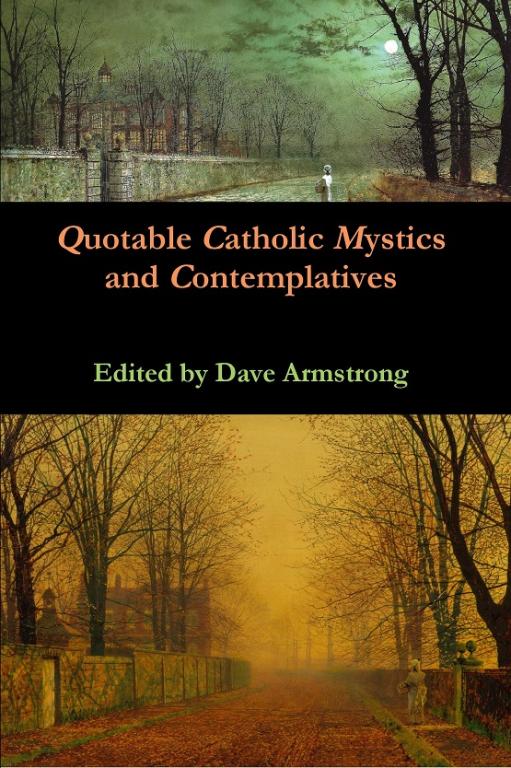
***
(3-10-14)
***
See the info-page for this book.
***
[from public domain Internet writings: Wikipedia, The Catholic Encyclopedia (1913), and descriptions from the Christian Classics Ethereal Library website: source of most of the books used in this collection]
St. Bernard of Clairvaux (1090-1153) / On Loving God: Cistercian and Doctor of the Church
Bernard of Clairvaux, O.Cist was a French abbot and the primary builder of the reforming Cistercian order. He had a great taste for literature and devoted himself for some time to poetry. He wanted to excel in literature in order to take up the study of the Bible.
Bernard would expand upon St. Anselm of Canterbury’s role in transmuting the sacramentally ritual Christianity of the Early Middle Ages into a new, more personally held faith, with the life of Christ as a model and a new emphasis on the Virgin Mary. Rather than the more rational approach to divine understanding that the scholastics adopted, Bernard would preach an immediate faith.
St. Bernard was named a Doctor of the Church in 1830. At the 800th anniversary of his death, Ven. Pope Pius XII issued an encyclical on Bernard, Doctor Mellifluus, in which he labeled him “The Last of the Fathers.” Bernard did not reject human philosophy which is genuine and leads to God; he differentiates between different kinds of knowledge, the highest being theological.
He was instrumental in re-emphasizing the importance of Lectio Divina and contemplation on Scripture within the Cistercian order. Bernard had observed that when Lectio Divina was neglected monasticism suffered, and considered Lectio Divina and contemplation guided by the Holy Spirit the keys to nourishing Christian spirituality.
His mystical treatise, De diligendo Dei (On Loving God), possibly written around 1128, outlines seven stages of ascent leading to union with God, and urges the reader to love God without measure. He surveys the four types of love that Christians experience as they grow in their relationship with God: loving one’s self, selfish love, loving God as God, and loving one’s self in God. He reminds us that not only did God give us life, but He gave us Himself, and that we are indebted to God for his love and His sacrifice.
Not only should we love God because it is what He deserves, but also because loving God does not go without reward. Loving God is to our advantage. The Lord rewards those who love Him with the blessed state of heaven, where sorrow and sadness cannot enter. St. Bernard’s medieval prose is poetic and full of clever imagery. His work is as beautiful as it is knowledgeable.
St. Bonaventure (c. 1217-1274) / The Mind’s Road to God: Franciscan and Doctor of the Church
Bonaventure, O.F.M.; born Giovanni di Fidanza, was an Italian medieval scholastic theologian and philosopher. The seventh Minister General of the Order of Friars Minor, he was also a Cardinal Bishop of Albano. He was canonised on 14 April 1482 by Pope Sixtus IV and declared a Doctor of the Church in the year 1588 by Pope Sixtus V. He is known as the “Seraphic Doctor” (Latin: Doctor Seraphicus), and was ranked along with Thomas Aquinas as the greatest of the Doctors of the Church by another Franciscan, Pope Sixtus V, in 1587. Bonaventure was regarded as one of the greatest philosophers of the Middle Ages.
He steered the Franciscans on a moderate and intellectual course that made them the most prominent order in the Catholic Church until the coming of the Jesuits. His theology was marked by an attempt completely to integrate faith and reason. He thought of Christ as the “one true master” who offers humans knowledge that begins in faith, is developed through rational understanding, and is perfected by mystical union with God.
A master of the memorable phrase, Bonaventure held that philosophy opens the mind to at least three different routes humans can take on their journey to God. Non-intellectual material creatures he conceived as shadows and vestiges (literally, footprints) of God, understood as the ultimate cause of a world philosophical reason can prove was created at a first moment in time.
Intellectual creatures he conceived of as images and likenesses of God, the workings of the human mind and will leading us to God understood as illuminator of knowledge and donor of grace and virtue. The final route to God is the route of being, in which Bonaventure brought Anselm’s argument together with Aristotelian and Neoplatonic metaphysics to view God as the absolutely perfect being.
Many historians, theologians, and philosophers consider Bonaventure’s essay, The Mind’s Road to God a masterpiece among the shorter works of medieval philosophy. It contains Bonaventure’s interpretation of a vision St. Francis of Assisi had. In the vision, St. Francis receives the wounds of Christ from a six-winged seraph. The six wings symbolized six steps along the road to perfection and the divine. The steps or stages he details integrates the Neoplatonic hierarchy of being with Christian doctrine concerning God’s relationship with his creation.
Blessed John of Ruysbroeck (c. 1293-1381): priest
John of Ruysbroeck (Dutch: Jan van Ruusbroec, Jan or Johannes van Ruysbroeck), was one of the Flemish mystics. From 1318 until 1343 he served as a parish priest at St Gudula. He led a life of extreme austerity and retirement. After John’s death in 1381, his relics were carefully preserved and his memory honoured as that of a saint. After his death, stories called him the Ecstatic Doctor or Divine Doctor. He was beatified on 1 December 1908, by Pope St. Pius X.
Literally, Ruysbroeck wrote as the spirit moved him. He loved to wander and meditate in the solitude of the forest adjoining the cloister; he was accustomed to carry a tablet with him, and on this to jot down his thoughts as he felt inspired so to do. Late in life he was able to declare that he had never committed aught to writing save by the motion of the Holy Ghost.
In his dogmatic writings he explains, illustrates, and enforces traditional teachings with remarkable force and lucidity. In his ascetic works, his favourite virtues are detachment, humility and charity; he loves to dwell on such themes as flight from the world, meditation upon the Life, especially the Passion of Christ, abandonment to the Divine Will, and an intense personal love of God. In common with most of the German mystics Ruysbroeck starts from God and comes down to man, and thence rises again to God, showing how the two are so closely united as to become one.
Ruysbroeck insisted that the soul finds God in its own depths, and noted three stages of progress in what he called the spiritual ladder of Christian attainment: (1) the active life, (2) the inward life, (3) the contemplative life. He did not teach the fusion of the self in God, but held that at the summit of the ascent the soul still preserves its identity.
In relation to the contemplative life, he held that three attributes should be acquired: The first is spiritual freedom from worldly desires (“as empty of every outward work as if he did not work at all”), the second is a mind unencumbered with images (“inward silence”), and the third is a feeling of inward union with God (“even as a burning and glowing fire which can never more be quenched”).
Blessed John Ruysbroeck’s writings are considered classics of spirituality, anticipating the writings of St. John of the Cross in their clarity and doctrine. He strongly opposed the quietist tendencies of many of his contemporaries, and his books are lucid commentaries on the Augustinian doctrine of the life of grace.
Adornment of the Spiritual Marriage is a study of the Bible’s metaphor of Christ as the Bridegroom and the church as the Bride, a “marriage” that produces perfect union. Union with God is also the theme of The Sparkling Stone and The Book of Supreme Truth, which describe several mystical levels of union with God in which the human body and mind are forgotten.
Blessed John Ruysbroeck is known for having an extraordinary propensity for theology and philosophy, and his works exhibit his great mind. These classic pieces of spiritual literature are rife with imagistic language and readers will be in awe of this spiritual giant’s mind.
Blessed Henry Suso (1295-1366): Dominican
Henry Suso, O.P. (also called Amandus, a name adopted in his writings, and Heinrich Seuse in German), was a German Dominican friar, who was a noted spiritual writer and mystic. He was beatified by the Catholic Church in 1831 by Pope Gregory XVI. Suso was widely read in the later Middle Ages.
In the prologue to his Life, Suso recounts how, after about five years in the monastery (in other words, when about 18 years old), he had experienced a conversion to a deeper form of religious life through the intervention of Divine Wisdom. He made himself “the Servant of the Eternal Wisdom”, which he identified with the divine essence and, in a concrete form, with the personal Eternal Wisdom made human. Henceforth a burning love for the Eternal Wisdom dominated his thoughts and controlled his actions.
Suso often subjected himself to extreme forms of mortifications, which he prudently moderated in maturer years, and bore with rare patience corporal afflictions, bitter persecutions, and grievous calumnies.
The mutual love of God and man which is his principal theme gives warmth and colour to his style. His intellectual equipment was characteristic of the Scholastic theologians of his age. In his doctrine there was never the least trace of an unorthodox tendency. Suso is the poet of the early mystic movement. His faith is purely medieval in tone, inspired by the romanticism of the age of chivalry.
C. H. McKenna, in his introduction to A Little Book of Eternal Wisdom stated: “It would be difficult to speak too highly of this little book or of its author. In soundness of teaching, sublimity of thought, clearness of expression, and beauty of illustration, we do not know of a spiritual writer that surpasses Henry Suso.”
Johannes Tauler (c. 1300-1361): Dominican
Johannes Tauler, O.P., was a German mystic, preacher and theologian: one of the greatest of the Middle Ages. He belonged to the Dominican order, and was known as one of the most important Rhineland Mystics. He promoted a certain neo-platonist dimension in spirituality.
In Basel, around 1339-1343, he became acquainted with the circles of devout clergy and laity known as the Friends of God (Gottesfreunde). Tauler mentions the Friends of God often in his sermons. Influenced by this group, he taught that the state of the soul was affected more by a personal relationship with God than by external practices.
Tauler left no formal treatises, either in Latin or the vernacular. Rather, we have around eighty of his sermons, which began to be collected during his lifetime. They were considered among the noblest in the German language: intensely practical, and touching on all sides the deeper problems of the moral and spiritual life. They are full of fervour and of profound spiritual feeling. The language is quiet and measured, yet warm, animated, and full of imagery. His sermons warmed and inflamed the hearts of his hearers by the quiet flame of the pure love that burned in his own breast.
The centre of Tauler’s mysticism is the doctrine of the visio essentioe Dei, the blessed contemplation or knowledge of the Divine nature. He takes this doctrine from Thomas Aquinas, but goes further than the latter in believing that the Divine knowledge is attainable in this world also by a perfect man, and should be sought by every means. God dwells within each human being. In order, however, that the transcendent God may appear in man as a second subject, the human, sinful activities must cease. Aid is given in this effort by the light of grace which raises nature far above itself. The way to God is through love; God replies to its highest development by His presence. Tauler gives advice of the most varied character for attaining that height of religion in which the Divine enters into the human subject.
Tauler was entirely medieval (i.e., Catholic) in spirit and never thought of withdrawing his allegiance to the Catholic Church. He expresses his opinion very plainly in his sermon on St. Matthew.
Walter Hilton (c. 1340/45 -1396): Augustinian
Walter Hilton was an English Augustinian mystic, probably educated at Cambridge.
The first book of his most influential work: The Scale [or, Ladder] of Perfection, is addressed to a woman recently enclosed as an anchoress, providing her with appropriate spiritual exercises; the bulk of its ninety-three chapters deal with the extirpation of the “foul image of sin” in the soul – the perversion of the image of the Trinity in the three spiritual powers of Mind, Reason and Will (reflecting the Father, Son and Holy Spirit respectively, according to a tradition drawn from St Augustine) – through a series of meditations on the seven deadly sins.
The second book seems from its style and content rather to be addressed to a larger, perhaps more sophisticated audience; its major themes are the reformation of the soul in faith and in both faith and feeling. This latter is described in an extended metaphor as a spiritual journey to Jerusalem, or “peace” in meditation, a gift which is also its own giver, Christ.
Hilton’s spiritual writings were influential during the fifteenth century in England. The Scale of Perfection survives in some sixty-two manuscripts, and was first work originally written in English to circulate on the European continent (in Latin translation).
Anyone who desires to strike a balance between worldly and spiritual life will find Hilton’s direct and instructive prose a useful resource.
Julian[a] of Norwich (c. 1342-c. 1416): anchoress; probably Benedictine.
Julian (or, Juliana) of Norwich was an English anchoress who is regarded as one of the most important Christian mystics. Very little is known about Julian’s life. Her personal name is unknown and the name “Julian” simply derives from the fact that her anchoress’s cell was built onto the wall of the church of St Julian in Norwich.
She is venerated by Anglicans and Lutherans, but has never been canonized, or officially beatified, by the Catholic Church, probably because so little is known of her life aside from her writings; although she is unofficially venerated in the Catholic Church, much as St. Hildegard of Bingen was before her canonization in 2012.
Her fame rests on her book The Sixteen Revelations of Divine Love, which she wrote in 1393. She claimed to have received fifteen revelations on one day in 1373 and another on the following day. In prolonged states of ecstasy she saw visions of the sufferings of Christ and of the Trinity, in particular, the vast love of God and the existence of evil.
She meditated on these visions for twenty years, concentrating on the love of God, which supplies the answer to all life’s problems and especially to the evil in the world. she also emphasizes the need to follow God in order to receive the beautiful vision of God in the afterlife. For her deep and penetrating descriptions of God and love, countless readers have found this work uplifting, encouraging, and challenging. Revelations of Divine Love astounds readers, engulfing them in a powerful revelation of God’s love. Her book contains both the original visions and her meditations on them. Revelations is a celebrated work in Catholicism and Anglicanism because of the clarity and depth of Julian’s visions of God. Julian of Norwich is now recognized as one of England’s most important mystics. The book is also believed to be the earliest surviving volume written in the English language by a woman. It represents the most perfect fruit of later medieval mysticism in England.
Like St. Catherine, Juliana has little of the dualism of body and soul that is frequent in the mystics. God is in our “sensuality” as well as in our “substance”, and the body and the soul render mutual aid. Knowledge of God and knowledge of self are inseparable: we may never come to the knowing of one without the knowing of the other. She lays special stress upon the “homeliness” and “courtesy” of God’s dealings with us. In the Blessed Virgin the Lord would have all mankind see how they are loved. Throughout her revelation Juliana submits herself to the authority of the Church: “I yield me to our mother Holy Church, as a simple child oweth.”
Scholars hold that Julian of Norwich was influenced by a famous book on mystical experience, The Cloud of Unknowing, as well as by Neoplatonic philosophy.
St. Catherine of Siena (1347-1380) / The Dialogue: Dominican and Doctor of the Church
St. Catherine of Siena, T.O.S.D. (Italian) was a tertiary of the Dominican Order, and a Scholastic philosopher and theologian. She was canonized in 1461, and on 3 October 1970 she was proclaimed a Doctor of the Church by Ven. Pope Paul VI.
Catherine is said by her confessor and biographer Raymond of Capua’s Life to have had her first vision of Christ when she was age five or six: experiencing a vision of Him seated in glory with the Apostles Peter, Paul, and John. At age seven, Catherine vowed to give her whole life to God.
Her major treatise is The Dialogue of Divine Providence (1377-1378), written in the beautiful Tuscan vernacular of the fourteenth century. Her contemporaries are united in asserting that much of the book was dictated while Catherine was in ecstasy, though it also seems possible that Catherine herself may then have re-edited many passages in the book.
It is a dialogue between a soul who “rises up” to God and God himself. It treats of the whole spiritual life of man in the form of a series of colloquies between the Eternal Father and the human soul (represented by St. Catherine herself), and is the mystical counterpart in prose of Dante’s Divine Comedy.
The Eternal Father describes, through many different analogies, allegories, and metaphors, the spiritual life of humankind. In his description, the Eternal Father emphasizes the importance of cultivating virtue, continually praying, and the need for obedience. Any reader will be inspired by the sound advice throughout this dialogue.
St. Catherine ranks high among the mystics and spiritual writers of the Church. She remains a greatly respected figure for her spiritual writings, and political boldness to “speak truth to power”: it being exceptional for a woman, in her time period, to have had such influence in politics and on world history.
The keynote to St. Catherine’s teaching is that man, whether in the cloister or in the world, must ever abide in the cell of self-knowledge, which is the stable in which the traveler through time to eternity must be born again.
The Cloud of Unknowing: late 14th century anonymous work
The Cloud of Unknowing is an anonymous work of Christian mysticism written in Middle English in the latter half of the 14th century: probably around 1375. The text is a spiritual guide on contemplative prayer. The underlying message is that the only way to truly “know” God is to abandon all preconceived notions and beliefs or “knowledge” about God and be courageous enough to surrender to the realm of “unknowingness,” at which point, the seeker begins to glimpse the true nature of God.
It draws on the mystical tradition of Pseudo-Dionysius the Areopagite and Christian Neoplatonism, which focuses on the via negativa road to discovering God as a pure entity, beyond any capacity of mental conception and so without any definitive image or form.
The English Augustinian mystic Walter Hilton has at times been suggested as the author, but this generally doubted. It is possible that the writer he was a Carthusian priest, though this is not certain.
The book counsels a young student to seek God, not through knowledge and the intellect, but through intense contemplation, motivated by love, and stripped of all thought. This is brought about by putting all thoughts and desires under a “cloud of forgetting”, and thereby piercing God’s cloud of unknowing with a “dart of longing love” and spiritual union with God from the heart.
The work was not all that popular in late medieval England, perhaps because the Cloudis addressed to solitaries and concentrates on the advanced levels of the mystical path. It is found in only 17 manuscripts. But it became increasingly popular over the course of the twentieth century, with nine English translations or modernizations produced during this period. In particular, the Cloud has influenced recent contemplative prayer practices.
The book documents techniques used by the medieval monastic community to build and maintain that contemplative knowledge of God. Written as a primer for the young monastic, the work is instructional, but does not have an austere didactic tone. Rather, the work embraces the reader with a maternal call to grow closer to God through meditation and prayer.
Theologia Germanica: late 14th century work by an anonymous priest (member of the Teutonic Order)
Theologia Germanica, also known as Theologia Deutsch or as Der Franckforter, is a mystical treatise believed to have been written in the later 14th century by an anonymous author. According to the introduction of the Theologia the author was a priest and a member of the Teutonic Order living in Frankfurt, Germany.
The author is usually associated with the Friends of God: a lay mystical group within the Catholic Church and a center of German mysticism: influenced by Suso and Tauler. It was founded between 1339 and 1343 in Basel, Switzerland, and was also fairly important in Strasbourg and Cologne.
Martin Luther gave the treatise its modern name and produced an edition of it in 1518. It has not been widely known before that time (only eight manuscripts from the fifteenth century are known). He wrote about it: “Next to the Bible and St. Augustine, no book has ever come into my hands from which I have learned more of God and Christ, and man and all things that are.”
Theologia Germanica proposes that God and man can be wholly united by following a path of perfection, as exemplified by the life of Christ, renouncing sin and selfishness, ultimately allowing God’s will to replace human will. It had a large following in later Lutheran and pietist traditions. John Calvin didn’t like it much, and wrote that it was “conceived by Satan’s cunning” and “contains a hidden poison.”
The Lutheran mystic Johann Arndt reedited an earlier printing based on Luther in 1597; this version was endorsed by Philipp Jakob Spener (1635-1705: the “father” of Lutheran pietism), and went through more than sixty printings. Some hundred editions were published up to our time.
It was listed in the Index of Prohibited Books by the Catholic Church from 1612 to the late twentieth century, and, therefore, should be approached with considerable caution by Catholics.
Thomas à Kempis (c. 1380-1471) / The Imitation of Christ: Augustinian
Thomas à Kempis, C.R.S.A. was a German canon regular and author of The Imitation of Christ, which is one of the best-known Christian books on devotion. He was associated with the Brethren of the Common Life: a pietist religious community founded in the Netherlands in the 14th century by Gerard Groote, formerly a successful educator who had had a religious experience and preached a life of simple devotion to Jesus Christ.
Thomas’s life was a quiet one, his time being spent between devotional exercises, composition, and copying. He copied the Bible no fewer than four times, one of the copies being preserved at Darmstadt, Germany. In its teachings he was widely read and his works abound in biblical quotations, especially from the New Testament.
Thomas was kind and affable towards all, especially the sorrowful and the afflicted; constantly engaged in his favorite occupations of reading, writing, or prayer; in time of recreation for the most part silent and recollected, finding it difficult even to express an opinion on matters of mundane interest, but pouring out a ready torrent of eloquence when the conversation turned on God or the concerns of the soul.
Thomas à Kempis reflected the mystical spirituality of his times, the sense of being absorbed in God. The Imitation of Christ is a charming instruction on how to love God. This small book, free from intellectual pretensions, has had great appeal to anyone interested in probing beneath the surface of life. It has come to be, after the Bible, the most widely translated book in Christian literature.
For almost six hundred years, this gentle book, filled with the spirit of the love of God, has brought understanding and comfort to millions of readers in over fifty languages, and provided them with a source of heartfelt personal prayer.
St. Catherine of Genoa (1447-1510): layperson
St. Catherine of Genoa was an Italian mystic, admired for her work among the sick and the poor and remembered because of various writings describing both these actions and her mystical experiences. She and her teaching were the subject of Baron Friedrich von Hügel’s classic work The Mystical Element of Religion (1908). She was beatified in 1675 by Pope Clement X, and canonized in 1737 by Pope Clement XII. Her writings also became sources of inspiration for other saints such as Robert Bellarmine and Francis de Sales.
She wished to enter a convent at age 13 or so, but the nuns refused her on account of her youth, after which she appears to have put the idea aside without any further attempt. She was married: very unhappily until her husband’s religious conversion around 1477, and was widowed at age 50.
St. Catherine had a mystical experience in 1473: an overpowering sense of God’s love for her: one of the most extraordinary operations of God in the human soul of which we have record, the result being a marvelous inward condition that lasted till her death. In this state, she received wonderful revelations, of which she spoke at times to those around her, but which are mainly embodied in her two celebrated works: the Dialogues of the Soul and Body (or, Spiritual Dialogue), and the Treatise on Purgatory.
This marked the beginning of her life of close union with God in prayer, without using forms of prayer such as the rosary. She began to receive Holy Communion almost daily, a practice extremely rare for laypeople in the Middle Ages.
From the moment of that sudden vision of herself and God, the saint’s interior state seems never to have changed, save by varying in intensity and being accompanied by more or less severe penance, according to what she saw required of her by the Holy Spirit Who guided her incessantly.
St. Teresa of Ávila (1515-1582): Carmelite and Doctor of the Church
St. Teresa of Ávila, also called St. Teresa of Jesus, was a prominent Spanish mystic, Carmelite nun, an author of the Catholic Reformation and theologian of contemplative life through mental prayer. She was a reformer of the Carmelite order and is considered to be a founder of the Discalced Carmelites along with St. John of the Cross.
In 1622, she was canonized by Pope Gregory XV and on 27 September 1970, was named a Doctor of the Church by Ven. Pope Paul VI. St. Teresa is revered as the Doctor of Prayer. The mysticism in her works exerted a formative influence upon many theologians of the following centuries.
In 1559, Teresa became firmly convinced that Jesus Christ presented himself to her in bodily form, though invisible. These visions lasted almost uninterrupted for more than two years. In another vision, a seraph drove the fiery point of a golden lance repeatedly through her heart, causing an ineffable spiritual-bodily pain. The memory of this episode served as an inspiration throughout the rest of her life, and motivated her lifelong imitation of the life and suffering of Jesus, epitomized in the motto usually associated with her: Lord, either let me suffer or let me die.
The kernel of Teresa’s mystical thought throughout all her writings is the ascent of the soul in four stages. The first, or “mental prayer”, is that of devout contemplation or concentration, the withdrawal of the soul from without and especially the devout observance of the passion of Christ and penitence. The second is the “prayer of quiet”, in which at least the human will is lost in that of God by virtue of a charismatic, supernatural state given by God, while the other faculties, such as memory, reason, and imagination, are not yet secure from worldly distraction. The third stage the “devotion of union” is not only a supernatural but an essentially ecstatic state. Here there is also an absorption of the reason in God, and only the memory and imagination are left to ramble. This state is characterized by a blissful peace, a sweet slumber of at least the higher soul faculties, or a conscious rapture in the love of God.
The fourth is the “devotion of ecstasy or rapture,” a passive state, in which the feeling of being in the body disappears. Sense activity ceases; memory and imagination are also absorbed in God or intoxicated. Body and spirit are in the throes of a sweet, happy pain, alternating between a fearful fiery glow. Later it is followed by a reactionary relaxation in a swoon-like weakness, attended by a negation of all the faculties in the union with God. The subject awakens from this in tears; it is the climax of mystical experience, producing a trance.
Her book, The Way of Perfection, remains accessible to modern readers. In it, she sets out to lead others along the way to union with God through prayer, silence, and meditation. She suggests ways for readers to seek self-perfection, and her words are practical, heartfelt, and drawn from personal experience. It’s also less formal and less poetically obscure than others of her books.
The Interior Castle was inspired by a vision she received from God. In it, there was a crystal globe with seven mansions, with God in the innermost mansion. St. Teresa interpreted this vision as an allegory for the soul’s relationship with God; each mansion represents one place on a path towards the “spiritual marriage”– i.e. union with God in the seventh mansion. One begins on this path through prayer and meditation. She also describes the resistance that the Devil places in various rooms, to keep believers from union with God. Throughout, she provides encouragements and advice for spiritual development. It also has much literary merit as a piece of Spanish Renaissance literature.
In her Autobiography, St. Teresa expresses in beautiful language her deep relationship with God, and her wisdom and hopeful outlook have inspired Christians everywhere for centuries. She begins her story with tales of her childhood in the early 1500s, the death of her mother, how she became a nun, and the hardships of her life including illness and a period of “lukewarmness” during which she ceased to pray. She also relates the visions and instructions she received from God later in her life.
St. John of the Cross (1542-1591): Carmelite and Doctor of the Church
St. John of the Cross, O.C.D. (Spanish) was a major figure of the Catholic Reformation, a mystic, a Carmelite friar and a priest. He was a reformer of the Carmelite Order and is considered, along with St. Teresa of Ávila, as a founder of the Discalced Carmelites. He is also known for his writings. Both his poetry and his studies on the growth of the soul are considered the summit of mystical Spanish literature and one of the peaks of all Spanish literature. He was canonized as a saint in 1726 by Pope Benedict XIII and declared a Doctor of the Church in 1926 by Pope Pius XI.
The Spiritual Canticle (a poem of forty stanzas) tells the story of the soul’s search for Christ. is describes a bride (representing the soul) searching for her bridegroom (representing Jesus Christ), anxious at having lost him; both are filled with joy upon reuniting. It can be seen as a free-form Spanish version of the Song of Solomon and serves as an allegorical reading thereof in light of the gospel.
Dark Night of the Soul narrates the journey of the soul from her bodily home to her union with God. It happens during the night, which represents the hardships and difficulties she meets in detachment from the world and reaching the light of the union with the Creator. There are several steps during this night, which are related in successive stanzas. The main idea of the poem can be seen as the painful experience that people endure as they seek to grow in spiritual maturity and union with God.
A poet at heart, St. John describes the journey and the union with beautifully rich and deeply symbolic language. He also offers encouragement and comfort directly to readers as they, too, struggle with the excruciating dark night. Offering hope to the downtrodden and discouraged, Dark Night is one of the most difficult books a person can read, but its difficulty is surpassed by its reward. It’s one of the most profound works of Christian mysticism.
Ascent of Mount Carmel is a more systematic study of the ascetical endeavour of a soul looking for perfect union with God and the mystical events happening along the way. St. John depicts the soul’s ascent to Mount Carmel (allegorically, the place of God) and the “dark night” that the soul must endure to reach it. St. John describes the different mystic experiences the soul encounters on its way to union with God through the dark night. It’s a hauntingly beautiful and profound account of Christian spirituality.
St. John of the Cross was clearly influenced by the Bible. Scriptural images are common in both his poems and prose. In total, there are 1,583 explicit and 115 implicit quotations from the Bible in his works. Many other influences of earlier mystical writers have been proposed, but most theories cannot be definitively proven. It is most certain that the pseudo-Dionysian tradition was a key influence on his thought.
* * * * *
Previous Post
March 7, 2014
Bible vs. Contraception: Onan's Sin and Punishment
Next Post
April 13, 2014 Books by Dave Armstrong: "The Catholic Answer Bible"
Browse Our Archives
Select a Category & Last Things About Me Anti-Catholicism Atheism & Agnosticism Baptism and Sacramentalism Bible and Tradition Blessed Virgin Mary Books by Dave Armstrong C. S. Lewis Calvinism & General Protestantism Catholic Apologetics Catholic Apologists Catholic conversion Catholic converts Christmas Church (Ecclesiology) Church History Conversion and Converts Development of Doctrine Eastern Orthodoxy Ecumenism & Christian Unity Eucharist & Liturgy Fathers of the Church French Translations G. K. Chesterton Hell Hell & Satan Hell & Satan & Last Things Heresies & Comparative Religion Holistic Health Inquisition & Crusades & Scandals James White Jews & Judaism & Old Testament John Calvin John Henry Newman Liberal / Modernist Theology Life Issues Literary Resume Lutheranism Mariology Martin Luther Music Orthodoxy Papacy & Infallibility Personal Page Philosophy & Science Political & Ethical & Moral Issues Protestant Persecution & Intolerance Protestantism Purgatory Purgatory & Penance Romantic & Imaginative Theology Saints & Purgatory & Penance Salvation Salvation & Justification Satan & Last Things Sexuality and Gender Issues Spanish Translations Traditionalism vs. Radical Catholic Reactionaries Traducciones al español / tradução para português Trinitarianism & Christology Uncategorized Videos
Select a Month October 2026 September 2026 August 2026 July 2026 June 2026 May 2026 April 2026 March 2026 February 2026 January 2026 December 2025 November 2025 October 2025 September 2025 August 2025 July 2025 June 2025 May 2025 April 2025 March 2025 February 2025 January 2025 December 2024 November 2024 October 2024 September 2024 August 2024 July 2024 June 2024 May 2024 April 2024 March 2024 February 2024 January 2024 December 2023 November 2023 October 2023 September 2023 August 2023 July 2023 June 2023 May 2023 April 2023 March 2023 February 2023 January 2023 December 2022 November 2022 October 2022 September 2022 August 2022 July 2022 June 2022 May 2022 April 2022 March 2022 February 2022 January 2022 December 2021 November 2021 October 2021 September 2021 August 2021 July 2021 June 2021 May 2021 April 2021 March 2021 February 2021 January 2021 December 2020 November 2020 October 2020 September 2020 August 2020 July 2020 June 2020 May 2020 April 2020 March 2020 February 2020 January 2020 December 2019 November 2019 October 2019 September 2019 August 2019 July 2019 June 2019 May 2019 April 2019 March 2019 February 2019 January 2019 December 2018 November 2018 October 2018 September 2018 August 2018 July 2018 June 2018 May 2018 April 2018 March 2018 February 2018 January 2018 December 2017 November 2017 October 2017 September 2017 August 2017 July 2017 June 2017 May 2017 April 2017 March 2017 February 2017 January 2017 December 2016 November 2016 October 2016 September 2016 August 2016 July 2016 June 2016 May 2016 April 2016 March 2016 February 2016 January 2016 December 2015 November 2015 October 2015 September 2015 August 2015 July 2015 June 2015 May 2015 April 2015 March 2015 February 2015 January 2015 December 2014 November 2014 October 2014 September 2014 August 2014 July 2014 June 2014 April 2014 March 2014 February 2014 January 2014 December 2013 November 2013 October 2013 September 2013 August 2013 July 2013 June 2013 April 2013 March 2013 February 2013 January 2013 December 2012 November 2012 October 2012 September 2012 August 2012 July 2012 June 2012 May 2012 April 2012 March 2012 February 2012 January 2012 December 2011 November 2011 October 2011 September 2011 August 2011 July 2011 June 2011 April 2011 March 2011 February 2011 October 2010 September 2010 August 2010 July 2010 April 2010 March 2010 December 2009 October 2009 August 2009 July 2009 June 2009 May 2009 March 2009 February 2009 October 2008 September 2008 April 2008 March 2008 February 2008 January 2008 December 2007 November 2007 October 2007 May 2007 March 2007 February 2007 January 2007 November 2006 October 2006 September 2006 August 2006 July 2006 June 2006 May 2006 April 2006 March 2006 February 2006 October 2005 June 2005 April 2005 February 2005 July 2004 May 2004 April 2004
Follow Us!
TAKE THE
Religious Wisdom Quiz
What does "Amen" originally mean?
Select your answer to see how you score.
So be it Be true Let it happen Praise God
Books by This Author Books by Dave Armstrong
Related posts from Biblical Evidence for Catholicism

Book: Martin Luther: Dissenter and Defender
Biblical Evidence for Catholicism
"Martin Luther: Dissenter & Defender": Introduction
Biblical Evidence for Catholicism
Introducing "Faith Alone: The 'Theological Novum'”
Biblical Evidence for Catholicism
Faith Alone: The "Theological Novum" (Dave Armstrong Book)
Biblical Evidence for Catholicism
TRENDING AT PATHEOS Catholic

In "Irreplaceable," our book on vocation and technology, Trevor Sutton and I...

I was strolling through the top floor of the brand new Parthenon...

What Does Gêvâh Mean For Kimberley Guifoyle &...
This week, a lot of the news is focused on Kimberly Guilfoyle....

INNER CIRCLE: Profound Mystery (Of Christ In All...
Ephesians 5:31-32 “For this reason, a man will leave his father and...

Do Not Rejoice When Your Enemy Falls: The...
Turning an execution into a public spectacle is a disturbing expression of...

'The Chosen' S6 Trailer: The Passion Gets Very...
Not many watching 'The Chosen' worry about spoilers, but just because they...
view all Catholic blogs
Ad-Free & Subscriber Log-In Subscription Support
- About Us
- 2026 Calendar
- Videos
- Podcasts
- Library of World Religions
- Faith In Media Tracker
- Advertise With Us
- Write for Us
- Privacy Policy
- Terms of Service
- Do Not Sell My Data
- Contact Us
- Radiant Digital
- Manage Newsletter Subscriptions
- Unsubscribe From Notifications
- Sitemap
Copyright 2008-2026, Patheos. All rights reserved.
Subscription Support Ad-Free & Subscriber Log-In
Follow Patheos