
BuddhistCatholicContemplativeEvangelicalGeneral ChristianHinduJewishLatter-day SaintMuslimNew VisionsProgressive Christian
Beliefs
- Buddhist
- Catholic
- Contemplative
- Evangelical
- General Christian
- Hindu
- Jewish
- Latter-day Saint
- More Voices
- Muslim
- New Visions
- Pagan
- Progressive Christian
Topics
- Religion News
- Food and Religion
- Sports and Religion
- Religious Art
- Religious Music and Entertainment
- Religious Events
- History and Religion
- Style and Religion
- Politics and Religion
- Women in Religion
- Recreation Outdoors and Religion
- Business Finance and Religion
- Careers Workplace and Religion
- Education and Religion
- Family Parenting and Religion
- Health Fitness and Religion
- Home and Religion
- Relationships and Religion
- Technology and Religion
- Travel and Religion
Columnists
- Buddhist Columnists
- Business Finance and Religion Columnists
- Careers Workplace and Religion Columnists
- Catholic Columnists
- Contemplative Columnists
- Education and Religion Columnists
- Evangelists Columnists
- Family Parenting and Religion Columnists
- General Christian Columnists
- Health Fitness and Religion Columnists
- Hindu Columnists
- History and Religion Columnists
- Home and Religion Columnists
- Jewish Columnists
- More Voices Columnists
- Latter Day Columnists
- Muslim Columnists
- New Visions Columnists
- Nonreligious Columnists
- Pagan Columnists
- Politics and Religion Columnists
- Progressive Columnists
- Recreation Outdoors and Religion Columnists
- Relationships and Religion Columnists
- Religion News Columnists
- Religious Art Columnists
- Religious Events Columnists
- Religious Music and Entertainment Columnists
- Sports and Religion Columnists
- Style and Religion Columnists
- Technology and Religion Columnists
- Travel and Religion Columnists
- Women in Religion Columnists
Resource Library
- 2026 Calendar
- Library of World Religions
- The 100 Most Holy Places on Earth
- Patheos Answers
- Podcasts
- Videos
- Faith Leaders Database
- Anglican Episcopalian
- Bahai
- Baptist
- Buddhism
- Christianity
- Confucianism
- Eastern Orthodoxy
- Hinduism
- Holiness and Pentecostal
- ISKCON
- Islam
- Judaism
- Lutheran
- Methodist
- The Church of Jesus Christ of Latter-day Saints
- New Age
- Paganism
- Presbytarian and Reformed
- Protestantism
- Religion Behind the Scenes
- Roman Catholic
- Scientology
- Shia Islam
- Sikhism
- Sufism
- Sunni Islam
- Taoism
- Zen
- See all religions
Research Tools
 Ad-Free & Subscriber Log-In Subscription Support
Ad-Free & Subscriber Log-In Subscription Support
Follow Patheos 

- Trending:
- Forgiveness
- |
- Marriage
- |
- Consciousness
- |
- Death Penalty
- |
- Election
- |
- Halloween

-
About
-
Catholic Apologetics
-
Church History
-
Great Apologists
-
Christian Worldview
-
Protestantism & Misc.
- Home
- Catholic
- History and Religion
- Does Pope Francis Think that Jesus Was a Sinner?
Does Pope Francis Think that Jesus Was a Sinner?
Last updated on: May 25, 2017 at 3:16 pm by Dave Armstrong
Does Pope Francis Think that Jesus Was a Sinner? 2017-05-25T15:16:56-04:00 Dave Armstrong
Patheos Explore the world's faith through different perspectives on religion and spirituality! Patheos has the views of the prevalent religions and spiritualities of the world.
. . . Beyond Bearing Our Sins on the Cross (i.e., Partaking / Entering Into Sin)?
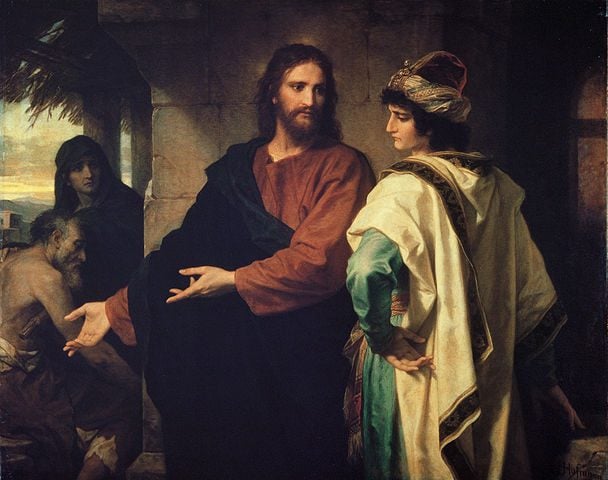
Christ and the Rich Young Ruler (1889), by Heinrich Hofmann (1824-1911) [public domain / Wikimedia Commons]

***
(2-27-14)
***
Some are now going after the pope’s homily from 15 June 2013. He made a comment on 2 Corinthians 5:21. Here it is from RSV:
For our sake he made him to be sin who knew no sin, so that in him we might become the righteousness of God.
In turn this passage reflects the biblical language of, particularly, three other passages:
Galatians 3:13 Christ redeemed us from the curse of the law, having become a curse for us — for it is written, “Cursed be every one who hangs on a tree”.
Isaiah 53:6 the LORD has laid on him the iniquity of us all.
1 Peter 2:24 He himself bore our sins in his body on the tree, that we might die to sin and live to righteousness.
As the Lamb of God, in biblical analogical thinking, Jesus was completely innocent (just as a lamb is), but took the punishment on Himself, to die for us and redeem us. According to some lexicons and commentaries, one of the thoughts in 2 Corinthians 5:21 is that He was a “representative” of sin.
The Holy Father’s critics in this instance have pounced upon his phrases (from the article above): “He became the sinner for us” and later “become the sinner for us.” This, they claimed, goes beyond the traditional biblical, Catholic terminology, drawn directly from the Bible: “made him to be sin” (a topic I have written about before). And they argued that it was problematic, because it would entail some heretical Lutheran or Nestorian elements, whereby Christ actually became a sinner and partook of entered into sin.
As it stands, one might conceivably think there was possibly bad theology here, or a sloppy terminology that was not ideal. For my part, I conceded, in argument with one such critic, that the language was unfortunate and attempted to explain it in part as follows:
My speculation is that the pope is right-brained, and not as concerned with precision as others of us are. Lots of saints were that way, including St. Francis of Assisi, who was quite “unsystematic.” Blessed Pope John Paul II was the opposite: the left-brained philosopher. Pope Benedict was perhaps in the middle, but closer to John Paul II, as a theologian and author; whereas Pope Francis is pastoral and a “popularizer” (somewhat like Blessed John XXIII).
I proceeded to make an argument that the problematic terminology had to be interpreted in light of the more conventional phrases that were also present in the same homily, and that he was using “sin” and “sinner” in a synonymous sense, as comments on 2 Corinthians 5:21. I also found an old quote from St. John Chrysostom (Homily 11 on 2 Corinthians, specifically on 2 Corinthians 5:21) where he said that to say that Christ is “sin” is far more striking than if the Bible had said He was a “sinner.” I had actually thought of that as an argument myself, so was pleasantly surprised to find it. As always, I gave the pope the benefit of the doubt (very unlike his numerous strong critics): that he knows his basic theology.
These critics apparently think that the pope is ignorant of various basic Catholic soteriology: that, indeed, Christ not only bore our sins, became sin (biblical terminology) but literally became a sinner in every sense of the word, just as we are. Now, I maintain that that is utterly implausible from the outset, because it would project onto the pope errors of such a magnitude that it would amount to saying he is utterly ignorant of basic theology. That I contend is ridiculous on its face. To establish such a charge would require much more than merely an out-of-context critique of some arguably sloppy, imprecise language. There would have to be ironclad proof beyond all doubt. That is simply not present here.
I assume, on the other hand, that the pope knows basic theology and that the Cardinals knew that he did, therefore elected him, and that his less-clear remarks can be interpreted by the more clear ones that directly correspond to biblical language. That’s sensible, plausible, consistent, involves no second-guessing of the pope’s abilities or orthodoxy, assumes what is routinely assumed (the pope knows theology), and doesn’t involve unwarranted assumptions or hostile ones.
But alas and lo and behold, I spent the better part of my work day in futile endeavors: complete with the obligatory insults and potshots from detractors all along the way: including, today, “Gnostic” (a new one!) and the obligatory “ultramontane” (the inevitable fate of all who defend the pope). I had forgotten for a moment that, so often, the translations we get out of the Vatican are less-than-ideal. I learned that when I wrote my book, Pope Francis Explained.
I had presupposed for the sake of argument that I was working with an accurate translation. So out of curiosity, I did a Babylon translation of the offending phrases in their sentences, since one of the critics provided the Italian version of the “controversial” part of the homily. Here are the results that I found, using three online translators and also in consultation with an Italian friend, Greta Villani:
- La vera riconciliazione è che Dio in Cristo ha preso i nostri peccati e si è fatto peccato per noi.
a) Vatican translation: “True reconciliation means that God in Christ took on our sins and He became the sinner for us.”
b) Babylon translation: “True reconciliation and that God was in Christ took our sins and was made sin for us.”
c) Google translation: “True reconciliation is that God in Christ has taken our sins and was made sin for us.”
d) Bing translation: “The real reconciliation is that God in Christ took our sins and became SIN for us.”
e) Greta Villani translation: “The true reconciliation is that God in Christ took our sins and he became sin for us.”
- E a lui piace, perché è stata la sua missione: farsi peccato per noi, per liberarci . . .
a) Vatican translation: “And Jesus likes that, because it was his mission: to become the sinner for us, to liberate us . . .”
b) Babylon translation: “And he likes, because it was his mission: to be sin for us, to liberate us.”
c) Google translation: “And he likes it, because it was his mission to be sin for us, to free us.”
d) Bing translation: “And he likes to, because it was his mission to be sin for us, to get away from …”
e) Greta Villani translation: “And he likes it because it was his mission: to become sin for us, to free us . . .”
I asked my friend, Greta: “How lousy was it, then, to translate those sentences as ‘became / become the sinner for us’? Is that permissible or possible to do, or is it taking liberties?” She said: “It definitely changes the meaning of the phrase.”
With this bit of information, the argument collapsed, and even the person I was primarily disputing about it with, conceded as much. The pope in fact echoed closely if not identically the biblical language and it was yet another tempest in a teapot and bum rap; much ado about nothing, just like all the other instances I have investigated thus far: all in my book except for this alleged “difficulty.”
It has turned out to be entirely a “false alarm.” This should be good news all-around: a win-win: the pope wasn’t heterodox, nor was he sloppy in language. The infallible, inspired Vatican translator (heaven help us all!) was the one who was sloppy, leading to needless suspicions of heresy. If he was truly that stupid, he should be fired.
Pope Francis never even said what it was claimed that he said. I had to devote an entire work day to a non-issue that should have never been raised at all if a translator wasn’t asleep or drunk on his job. But I’m delighted that it has been resolved. That’s well worth the time spent. If someone runs across this “argument” online they can also find this article, if they look hard enough.
* * * * *
Previous Post
February 26, 2014
Death of the Reform of the Reform of the Liturgy? Part II
Next Post
March 1, 2014 Dave Armstrong: Quotable Catholic Mystics and Contemplatives
Browse Our Archives
Select a Category & Last Things About Me Anti-Catholicism Atheism & Agnosticism Baptism and Sacramentalism Bible and Tradition Blessed Virgin Mary Books by Dave Armstrong C. S. Lewis Calvinism & General Protestantism Catholic Apologetics Catholic Apologists Catholic conversion Catholic converts Christmas Church (Ecclesiology) Church History Conversion and Converts Development of Doctrine Eastern Orthodoxy Ecumenism & Christian Unity Eucharist & Liturgy Fathers of the Church French Translations G. K. Chesterton Hell Hell & Satan Hell & Satan & Last Things Heresies & Comparative Religion Holistic Health Inquisition & Crusades & Scandals James White Jews & Judaism & Old Testament John Calvin John Henry Newman Liberal / Modernist Theology Life Issues Literary Resume Lutheranism Mariology Martin Luther Music Orthodoxy Papacy & Infallibility Personal Page Philosophy & Science Political & Ethical & Moral Issues Protestant Persecution & Intolerance Protestantism Purgatory Purgatory & Penance Romantic & Imaginative Theology Saints & Purgatory & Penance Salvation Salvation & Justification Satan & Last Things Sexuality and Gender Issues Spanish Translations Traditionalism vs. Radical Catholic Reactionaries Traducciones al español / tradução para português Trinitarianism & Christology Uncategorized Videos
Select a Month October 2026 September 2026 August 2026 July 2026 June 2026 May 2026 April 2026 March 2026 February 2026 January 2026 December 2025 November 2025 October 2025 September 2025 August 2025 July 2025 June 2025 May 2025 April 2025 March 2025 February 2025 January 2025 December 2024 November 2024 October 2024 September 2024 August 2024 July 2024 June 2024 May 2024 April 2024 March 2024 February 2024 January 2024 December 2023 November 2023 October 2023 September 2023 August 2023 July 2023 June 2023 May 2023 April 2023 March 2023 February 2023 January 2023 December 2022 November 2022 October 2022 September 2022 August 2022 July 2022 June 2022 May 2022 April 2022 March 2022 February 2022 January 2022 December 2021 November 2021 October 2021 September 2021 August 2021 July 2021 June 2021 May 2021 April 2021 March 2021 February 2021 January 2021 December 2020 November 2020 October 2020 September 2020 August 2020 July 2020 June 2020 May 2020 April 2020 March 2020 February 2020 January 2020 December 2019 November 2019 October 2019 September 2019 August 2019 July 2019 June 2019 May 2019 April 2019 March 2019 February 2019 January 2019 December 2018 November 2018 October 2018 September 2018 August 2018 July 2018 June 2018 May 2018 April 2018 March 2018 February 2018 January 2018 December 2017 November 2017 October 2017 September 2017 August 2017 July 2017 June 2017 May 2017 April 2017 March 2017 February 2017 January 2017 December 2016 November 2016 October 2016 September 2016 August 2016 July 2016 June 2016 May 2016 April 2016 March 2016 February 2016 January 2016 December 2015 November 2015 October 2015 September 2015 August 2015 July 2015 June 2015 May 2015 April 2015 March 2015 February 2015 January 2015 December 2014 November 2014 October 2014 September 2014 August 2014 July 2014 June 2014 April 2014 March 2014 February 2014 January 2014 December 2013 November 2013 October 2013 September 2013 August 2013 July 2013 June 2013 April 2013 March 2013 February 2013 January 2013 December 2012 November 2012 October 2012 September 2012 August 2012 July 2012 June 2012 May 2012 April 2012 March 2012 February 2012 January 2012 December 2011 November 2011 October 2011 September 2011 August 2011 July 2011 June 2011 April 2011 March 2011 February 2011 October 2010 September 2010 August 2010 July 2010 April 2010 March 2010 December 2009 October 2009 August 2009 July 2009 June 2009 May 2009 March 2009 February 2009 October 2008 September 2008 April 2008 March 2008 February 2008 January 2008 December 2007 November 2007 October 2007 May 2007 March 2007 February 2007 January 2007 November 2006 October 2006 September 2006 August 2006 July 2006 June 2006 May 2006 April 2006 March 2006 February 2006 October 2005 June 2005 April 2005 February 2005 July 2004 May 2004 April 2004
Follow Us!
TAKE THE
Religious Wisdom Quiz
What famous cathedral is in Paris, known for its flying buttresses and rose windows?
Select your answer to see how you score.
Notre Dame St. Paul's St. Peter's Canterbury
Books by This Author Books by Dave Armstrong
Related posts from Biblical Evidence for Catholicism

Was Peter "Any Old" Apostle? 10 Anti-Papal Arguments
Biblical Evidence for Catholicism

11 Protestant Objections to Papal Authority Debunked
Biblical Evidence for Catholicism

Matthew 16 & the Papacy (vs. Patrick O'Brien)
Biblical Evidence for Catholicism

God, Modern Physics, & Dark Energy: An Analogy
Biblical Evidence for Catholicism
TRENDING AT PATHEOS Catholic

In "Irreplaceable," our book on vocation and technology, Trevor Sutton and I...

I was strolling through the top floor of the brand new Parthenon...

What Does Gêvâh Mean For Kimberley Guifoyle &...
This week, a lot of the news is focused on Kimberly Guilfoyle....

INNER CIRCLE: Profound Mystery (Of Christ In All...
Ephesians 5:31-32 “For this reason, a man will leave his father and...

Do Not Rejoice When Your Enemy Falls: The...
Turning an execution into a public spectacle is a disturbing expression of...

'The Chosen' S6 Trailer: The Passion Gets Very...
Not many watching 'The Chosen' worry about spoilers, but just because they...
view all Catholic blogs
Ad-Free & Subscriber Log-In Subscription Support
- About Us
- 2026 Calendar
- Videos
- Podcasts
- Library of World Religions
- Faith In Media Tracker
- Advertise With Us
- Write for Us
- Privacy Policy
- Terms of Service
- Do Not Sell My Data
- Contact Us
- Radiant Digital
- Manage Newsletter Subscriptions
- Unsubscribe From Notifications
- Sitemap
Copyright 2008-2026, Patheos. All rights reserved.
Subscription Support Ad-Free & Subscriber Log-In
Follow Patheos