
BuddhistCatholicContemplativeEvangelicalGeneral ChristianHinduJewishLatter-day SaintMuslimNew VisionsProgressive Christian
Beliefs
- Buddhist
- Catholic
- Contemplative
- Evangelical
- General Christian
- Hindu
- Jewish
- Latter-day Saint
- More Voices
- Muslim
- New Visions
- Pagan
- Progressive Christian
Topics
- Religion News
- Food and Religion
- Sports and Religion
- Religious Art
- Religious Music and Entertainment
- Religious Events
- History and Religion
- Style and Religion
- Politics and Religion
- Women in Religion
- Recreation Outdoors and Religion
- Business Finance and Religion
- Careers Workplace and Religion
- Education and Religion
- Family Parenting and Religion
- Health Fitness and Religion
- Home and Religion
- Relationships and Religion
- Technology and Religion
- Travel and Religion
Columnists
- Buddhist Columnists
- Business Finance and Religion Columnists
- Careers Workplace and Religion Columnists
- Catholic Columnists
- Contemplative Columnists
- Education and Religion Columnists
- Evangelists Columnists
- Family Parenting and Religion Columnists
- General Christian Columnists
- Health Fitness and Religion Columnists
- Hindu Columnists
- History and Religion Columnists
- Home and Religion Columnists
- Jewish Columnists
- More Voices Columnists
- Latter Day Columnists
- Muslim Columnists
- New Visions Columnists
- Nonreligious Columnists
- Pagan Columnists
- Politics and Religion Columnists
- Progressive Columnists
- Recreation Outdoors and Religion Columnists
- Relationships and Religion Columnists
- Religion News Columnists
- Religious Art Columnists
- Religious Events Columnists
- Religious Music and Entertainment Columnists
- Sports and Religion Columnists
- Style and Religion Columnists
- Technology and Religion Columnists
- Travel and Religion Columnists
- Women in Religion Columnists
Resource Library
- 2026 Calendar
- Library of World Religions
- The 100 Most Holy Places on Earth
- Patheos Answers
- Podcasts
- Videos
- Faith Leaders Database
- Anglican Episcopalian
- Bahai
- Baptist
- Buddhism
- Christianity
- Confucianism
- Eastern Orthodoxy
- Hinduism
- Holiness and Pentecostal
- ISKCON
- Islam
- Judaism
- Lutheran
- Methodist
- The Church of Jesus Christ of Latter-day Saints
- New Age
- Paganism
- Presbytarian and Reformed
- Protestantism
- Religion Behind the Scenes
- Roman Catholic
- Scientology
- Shia Islam
- Sikhism
- Sufism
- Sunni Islam
- Taoism
- Zen
- See all religions
Research Tools
 Ad-Free & Subscriber Log-In Subscription Support
Ad-Free & Subscriber Log-In Subscription Support
Follow Patheos 

- Trending:
- Forgiveness
- |
- Marriage
- |
- Consciousness
- |
- Death Penalty
- |
- Election
- |
- Halloween

-
About
-
Catholic Apologetics
-
Church History
-
Great Apologists
-
Christian Worldview
-
Protestantism & Misc.
- Home
- Catholic
- History and Religion
- Dialogue on the Term, “Protestant Reformation” & Alternatives
Dialogue on the Term, “Protestant Reformation” & Alternatives
Last updated on: May 25, 2017 at 6:15 pm by Dave Armstrong
Dialogue on the Term, “Protestant Reformation” & Alternatives 2017-05-25T18:15:38-04:00 Dave Armstrong
Patheos Explore the world's faith through different perspectives on religion and spirituality! Patheos has the views of the prevalent religions and spiritualities of the world.
For Example, Era of Reformations” and “Protestant Revolt” (vs. Dr. Edwin W. Tait)
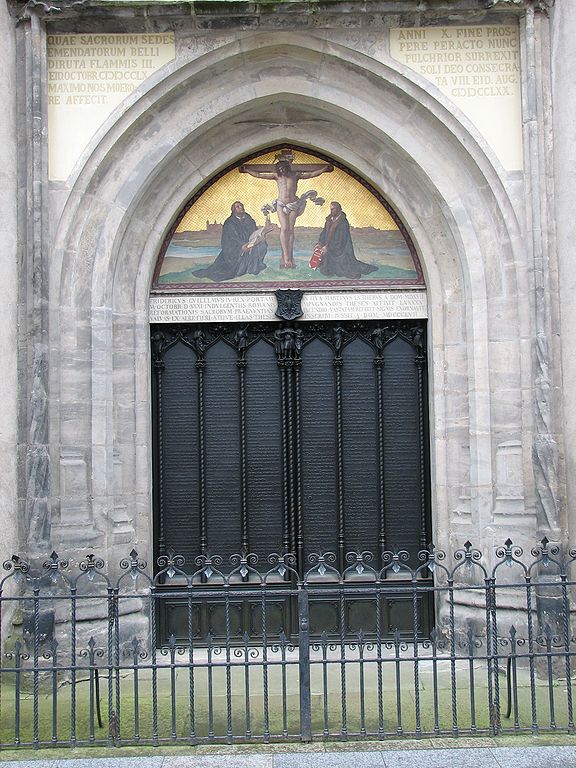
Wittenberg, Germany: All Saints’ Church, where Martin Luther posted his 95 Theses on 31 October 1517, sparking the Protestant Revolt. The original doors burned. [Wikimedia Commons / Creative Commons Attribution-Share Alike 3.0 Unported license]

***
(1-7-14)
***
Dr. Edwin Tait is an Anglican Church historian, with whom I’ve engaged in many fun and enjoyable dialogues through the years. This came about on one of my Facebook threads. His words will be in blue.
* * * * *
The very term [“Protestant Reformation”] is presuppositionally anti-Catholic or at least “hyper-Protestant.” I have always put it in quotes (just as I do, “Dark Ages” and “Enlightenment”) or use the more accurate and objective “Revolt” or “Revolution.”
One way to remove the anti-Catholic implications of “Reformation” is to speak, as most scholars of the period now do, of the “Reformations,” so that “Protestant Reformation” is just one of several rival versions of Reformation (or rather, several versions in itself :)) Using the term “Reformation” doesn’t imply that it was a good thing. If you don’t say “Reformation,” then Protestants are justified in going back to “Romanist” and “Papist.” I don’t think this linguistic devolution would be healthy.
I like the use of “Reformations”: not sure how widespread that is. But that’s fair to Catholics. If we use “Reformation” as if only the Protestants conducted one (and it supposedly saved the ultra-corrupt Catholic Church and/or Christianity itself), then that is severely biased.
“Protestant Revolt” is not biased at all; it’s strictly factual, and a mere variation of what “Protest”-ants call themselves. They protested; they revolted against the Catholic Church. That is a very different thing from supposedly reforming it. The latter is the myth and polemics. “Revolt” is undeniable, objective historical fact.
“Reformation” has no analogy to “Romanist” and “Papist” in the sense you describe. All three are loaded terms from the Protestant perspective. To use them presupposes Protestantism (and, to varying degrees, anti-Catholicism). Names of epochs in historiography need to be as neutral as possible.
Revolt is biased, because it implies the Catholic understanding that this is primarily a question of whether or not to obey the authority of the Church. I think you know that Protestants don’t see it that way. The bottom line is that generally we should call people what they want to be called. For Protestants to call the Catholic Church “Catholic” is an act of extreme courtesy, which some Catholics abuse by quoting Augustine’s line about the person looking for the “Catholic Church” in a town (i.e., they argue that because Protestants are courteous enough to call Catholics what Catholics want to be called, therefore Protestants must be tacitly acknowledging that Catholics are right).
“Reformation” describes the intent of the Protestant movement, whether or not it describes what they accomplished. “Revolt” describes how Catholics see it. Similarly with “Romanists” and “Papists.” These are in fact perfectly accurate descriptions of one of the major differences between Catholics and other Christians (indeed, many Catholic apologists claim that all non-Catholics are united by their hatred of Rome, which would make “Romanist” a perfectly good term). But these are pejorative slurs, because they don’t capture what Catholics consider most important about themselves.
The same is true, mutatis mutandis, with “pro-choice.” I use that term because it accurately describes what people who support the legalization of abortion think they are defending. And by using that term and doing them that courtesy, I can reasonably expect them to call my side of the debate “prolife” instead of their own chosen slur, “anti-choice.” Labels are never going to be exhaustive. It’s reasonable, most of the time, to let people pick their own labels because those labels will best express what members of a tradition/movement/faction think is important about themselves.
I am not laying down an absolute rule. No one expects Protestants to call the Pope the Vicar of Christ. But most people do expect them to call him the Pope, which, if one wants to quibble, implies that he has a paternal relationship to all Christians. In some contexts it’s appropriate to say “the Bishop of Rome” if you are trying to make the point that in your eyes that’s all he is.
I’m really just arguing for basic, commonsense courtesy in how we use labels. So I shouldn’t have put it in terms of “call people what they want to be called.” There are times when people make unreasonable demands, or make “revisionist” claims about themselves that clearly don’t match either history or conventional nomenclature (the numerous Protestant groups that object to being called Protestants, for instance, or in my judgement those Catholics who object to the conventional term “Roman Catholic”). I did say “most of the time” not all the time. What I’m objecting to, fundamentally, is the use of terminology to make polemical points.
[You] rightly objected to the language of “the Reformation” because it embodies a Whig Protestant narrative about what happened in the sixteenth century. The standard way to deal with that, which as I said is now pretty much the norm among scholars, is to speak of plural Reformations. That’s courteous to everyone. Substituting the plainly polemical and pejorative term “Protestant Revolt” is not. I stand by my claim: if you use that term, you are behaving just like those Protestants who insist on saying “Romanist” or “Papist,” and you will be deservedly classed with them as bigots who refuse to use common courtesy.
Revolt is biased, because it implies the Catholic understanding that this is primarily a question of whether or not to obey the authority of the Church.
Not at all. They decided they didn’t like the Catholic rule of faith and so they rejected it, going to Scripture Alone as their new rule. This was a revolt against the status quo. I don’t see how it is even arguable. Otherwise, why do Protestants exist at all? They came from Catholicism; thus they had to reject that system in terms of authority in order to leave it.
And that’s a revolt. Case closed. Simply calling the thing a “revolt” is theologically neutral. One can be either for or against a revolt. It’s strictly a sociological or historical term. But “The [Protestant] Reformation” has tons of Protestant baggage presupposed. It’s saying that the movement reformed the Catholic Church and Christianity even though it brought in elements that had nothing to do with prior tradition or precedent. Protestants claim they were simply restoring the Church to what it was before, yet they can’t trace their doctrines to the fathers en masse in virtually any dispute with Catholics. They get trumped in any such debate every time.
Therefore, it’s not a “Reformation” at all. It’s a Revolt or Revolution. Now I’m making the polemical / theological case, but again, the term “Revolt” is neutral in and of itself. I like the American Revolution; I detest the French and Russian, etc. The word is neutral and thus describes all three of those events, which a person can agree or disagree with.
we should call people what they want to be called.
I do. I call “Reformed” Protestants that, and also use “Reformed Jew.” We’re talking about names of historical periods, which is different. They ought to be neutral and not slanted to one side over another.
“those Catholics who object to the conventional term “Roman Catholic”)”
That’s a different tissue. I object to that (though not greatly) because of history (it began as a hostile polemical Anglican description) and ecclesiology (it implies that Eastern Catholics are on a lesser footing than Latin ones) . . .
If it’s intended to mean “the Catholic Church headed at Rome,” I have no objection; it is these other issues that make me object to it.
I suppose my position could best be described thus: there are three factors to be borne in mind in deciding what to call a movement or group: what the conventional, convenient term is; what the group in question wants to be called; and what you believe best reflects the truth about that particular movement. A safe rule is to choose a term that satisfies two out of these three requirements. And yes, that applies to the Reformation, which is the name of a movement and not just of a period (as a period one can either say “the era of the Reformations” or “early modern Christianity,” which is actually the approach I prefer, following John O’Malley–I’m all in favor of using language to undercut the Whig narrative, just not in favor of picking unnecessary fights over language and getting people’s backs up before they’ve even heard why I view things the way I do). “Protestant Revolt” is not a neutral term. It is a pejorative term and always has been. (“Revolt” and “Revolution,” by the way aren’t the same term. “Revolution” has, for many modern people, a much more positive ring–hence Peter Blickle’s suggestion that we should say “Revolution of 1525” instead of “the Peasants’ Revolt”).
That’s courteous to everyone. Substituting the plainly polemical and pejorative term “Protestant Revolt” is not.
No! That’s thoroughly incoherent. It doesn’t even make literal linguistic sense, since “Protestant” means “protesters” — which is essentially the same as saying “revolt.” Yet you decry “revolt” and accept “Protestants” [i.e., revolters] as standard nomenclature. What gives there?
Multiple “Reformations” is acceptable because it’s fair. But that hasn’t dripped down to common use. “Revolt” is fair and not at all equivalent to the highly polemical “Romanism” and “Papist.”
“[Protestant] Reformation”: used to describe the early 16th century is heavily biased and takes sides.
Dave, this isn’t about etymology. It’s about common usage. If you like multiple “Reformations,” why not adopt that terminology? You could play a role in helping it drip down to common usage, given the high profile of your website. “Protestant Revolt” is even less known–it’s only used by very polemical Catholics and it closes doors to respectful dialogue. I still don’t see how “Romanist” and “Papist” are more polemical. I think they have just as much to commend them (which isn’t much). You are reminding me of nothing so much as C. S. Lewis explaining solemnly that when he used the term “Papist” in OHEL he wasn’t being pejorative at all. . . .
If you like multiple “Reformations,” why not adopt that terminology?
It’s not entirely practical because one still has to refer to one “Reformation” or the other and that lands one back at square one. What do I call Luther’s movement or Calvin’s, or the Anabaptist phenomenon? I have to call them something when specifically referring to them, and the best I can come up with in fairness is “revolt” because that is a literal description of what happened, without getting into theological issues.
I said using more than one “Reformation” is fair, but it’s not easy to use in sentences: “The period of multiple reformations: Lutheran, Catholic, Anabaptist, Calvinist, Zwinglian, English . . .”? No one talks like that! Even scholars aren’t that pedantic . . .
If we say “Catholic Reformation” that is accurate: the Catholic Church reformed itself. It didn’t fundamentally transform or split up in doing so. “Counter-reformation” was biased: implying that it was merely in reaction to the glorious Protestant “Reformation” rather than valid in its own right.
If we say “Protestant Reformation” what is it reforming? They claimed they were reforming the Catholic Church, which in effect they redefined, so as to water down ecclesiology and the traditional “three-legged stool” rule of faith (Bible-Church-Tradition).
So they were “reforming” something: either Catholicism or what they call “the Christian Church”. Yet Protestantism as such hadn’t existed before. Therefore, one can’t “reform” by going back to what didn’t exist. One has to reform what exists, taking it back, and that can only be the Catholic Church. But it’s no “reform” to introduce doctrines that were never held before. Again, that is revolt, revolution, or sheer innovation.
Protestantism was an is a mixture. The good things it retained were already in Catholicism. The new things it introduced were novelties that had no predecessors except in various heresies. This is Bouyer’s argument in his brilliant book that this post was initially about.
Right. And I agree with Bouyer’s book. I have more or less agreed with it since I read it, about 15 years ago.
“Protestant Revolt” is even less known–it’s only used by very polemical Catholics and it closes doors to respectful dialogue.
Why are my actual arguments about that invalid or unsound?
Is “Revolution” not a literally descriptive and non-biased term when applied to England, France, America, and Russia? Why not also the similar “Revolt” then, applied to religious history?
Each one clearly overturned what was. In England the monarchy was greatly watered-down. In France the monarchy ended, as also in America, and a colony split from the motherland. In Russia the monarchy (czars) ended and Communism replaced it.
Likewise, with Protestantism, the authority of the pope, councils, bishops, tradition, and apostolic succession was rejected and a new system brought in.
Yet oddly, you argue that in the latter case it is “polemical” to apply Revolt or Revolution to it, whereas (I assume) you wouldn’t argue that with regard to the political revolutions.
Because, as I initially said, the term “revolt” does not describe what Protestants thought was important about what they were doing. What they thought they were doing was reforming the Church–the same Church that had always existed. They didn’t grant your premise (with which I agree) that they were fundamentally starting something new. Yes, there was a revolt involved, but for them, in their self-understanding, that was secondary. Hence the analogy with “Romanist” and “Papist.” The Papacy is important to Catholics, but it is important as a guarantee of Catholicity.
Reducing Catholicism to “Rome” is pejorative, even if Protestants can’t see this. Similarly, reducing the Reformation to its negative, “revolting” element is pejorative, even if you can’t see this. (But you ought to, because you’re an ex-Protestant and a generally fair person :)) Furthermore, terminology of this kind is defined more by historical usage than by etymology. When Lewis tried to use “Papist” non-pejoratively, he made himself a laughing-stock and fueled suspicions that he really was anti-Catholic, because the term was laden with a history of pejorative, prejudiced usage.
As for Sola Scriptura, it’s not a term the “Reformers” (scare quotes in your honor!) actually used and it’s a bit misleading, because it isn’t really a rule of faith in itself. It is a claim about Scripture as the rule of faith. And of course, as Catholics have been pointing out from the beginning of Protestantism, it’s a rule of faith inherited from Catholicism. Protestants “revolted” against elements of Catholic theology and practice, and they aided and abetted an ongoing revolt by civil authorities against the existence of a parallel, autonomous ecclesiastical hierarchy, but they did so as part of what they thought was a Reformation of the one and only Church based on the rule of faith it had always professed, namely Scripture.
They changed a lot of things precisely because of the things they didn’t want to change. The basic argument was: the Church has always defined itself by faithfulness to Scripture, so if we now find that some things we’ve been doing are contrary to Scripture, then preservation of what we have always been requires us to reject these beliefs and practices. One can fairly easily poke holes in this, but it’s both unfair and counterproductive to start out the conversation with language that doesn’t even acknowledge that this is what they thought they were doing.
But the bottom line is: this is a conventional term. It doesn’t commit you to any particular understanding of what happened. Insisting on “Revolt,” though, does.
There is even an analogy in what is overturned: authority: whether it is political or religious. That is what revolutions do. Back when Henry VIII kept his pants on he followed the pope as authority. When he couldn’t keep ’em on, he stopped doing so. He himself was a good Catholic Christian, and even one-time defender. Afterwards, good Catholics were drawn and quartered simply for being what Henry once was, and Catholics lost even most legal rights for nearly 300 years.
That is a revolution. If it isn’t, I sure don’t know what the word means. Yet “English Reformation” is used in this historically dishonest way just like the other usages are . . .
Untrue about Henry VIII. As far as I know he never kept his pants on, and not keeping one’s pants on did not stop either him or any other monarch of the era from accepting the authority of the Pope. It was his desire for a legitimate heir, and the fact that Anne Boleyn was capable of greater restraint in this regard, that led him to break with Rome (plus the fact that he had intellectual resources at his court for justifying the act, which is how the Protestants got in the game even though Henry didn’t really like Protestantism).
I guess one reason I don’t worry too much about using “Reformation” is that I’m not a big fan of reformations in general. The Catholic Reformation is one of the reasons I have had so much trouble becoming Catholic, and why I have often hankered after Orthodoxy, which has never really had a Reformation of any kind. Precisely because the English “Reformation” was so political, there was less Reformation (of either kind) in England than elsewhere, which is the main reason I’ve been Anglican all these years.
Again, I’m not defending it. I know I should have become Catholic in 1997 or at least 1998 (probably the last time when I had any reasonable suspicion that Protestantism might be a valid alternative to Catholicism and Orthodoxy–ever since then the only validity I’ve seen in Protestantism is as a more open form of Christianity than Catholicism, which ought to use that openness precisely to repent of the Reformation and return to Catholicism while preserving what is good in Protestantism, and my only excuse for not doing this individually has been than doing so would repeat the error of the Reformers in reverse).
Anyway, reformations and revolutions have a lot in common. That’s why I don’t like reformations. But certainly the Catholic Reformation did preserve essential continuity with what had gone before.
Well, one can distinguish between initial goals (which I grant, though they were historically and theologically fallacious in premise) and what actually happened. I am naming the movement after the fact, in terms of what it actually brought about, and that was division, schism, and revolt.
Again, it seems to me that in political revolutions, the same applies. They are named after the fact: after they achieve their aim; otherwise it is called only an “attempt” etc. 1905 in Russia was a failed attempt, whereas 1917 succeeded and thus is called a “Revolution.” I suspect that “Renaissance” and “Enlightenment” were primarily applied after the fact as well.
The former is pretty fair as a description, but the latter is not at all unless anti-Christian mentalities are presupposed. A movement that murdered people like, e.g., the prominent French chemist Lavoisier (as I have noted) is no champion of either intellect or freedom. So why does it have this name? It’s a disgrace and a monument to the massive secularist bias in historiography.
Now, if we discuss whether “Reformation” applies to Protestantism, they, of course think it does, but ain’t that the point? We’re trying to achieve neutrality in historical labels, so if we accept Protestant premises, that isn’t doing that. The objective, fair, after-the-fact description is revolt or revolution, just as in the political revolutions. No one argues about those being given that title, do they? Why should religious matters be different?
Likewise, another analogy can be made to the Orthodox split. We call that a Schism: a split in the Church. Polemicists on each side say the other guys forsook the true apostolic faith and split off. Ecumenists (like me) say both are in the Church and it is a tragedy that they split.
But we don’t say “Orthodox Reformation” do we? No, we say “schism,” because that is a neutral term. There was a split and calling it “schism” doesn’t choose sides; hence is fair.
Likewise, with “Protestant Revolt” or “tragic religious schism / division” of the 16th century or suchlike.
“Anglican” originally just meant “Christian in England.” After the decisive break with Rome (which didn’t really happen fully till 1572, contra the Catholic obsession with Henry VIII), it meant “Protestant Christian in England.” It wasn’t really till 1662 that it excluded the Puritans, for instance. Sure, there were always radicals who were considered heretics by everyone. . . .
Protestantism has many forms. And of course confessional Protestantism has if anything more rigid boundaries than Catholicism–certainly narrower ones that exclude more. Neither confessional nor radical Protestantism have been live options for me since the 90s. The only version of Protestantism I’ve found myself able to accept–and that only with many misgivings and probably a bad conscience–is some form of Anglican/Wesleyan Protestantism which accepts no confessional commitments beyond the “Lambeth Quadrilateral” (basically “mere Christianity” plus bishops).
The reason “schism” is neutral vis-a-vis the Orthodox is that the use of the term doesn’t say anything about which side went into schism (or if, as ecumenical Protestants of the sort I’ve sort-of, very dubiously been all these years would argue, both sides went into schism from each other).
***
I didn’t claim it [“Reformation” broadly applied] was objective. I claimed that “Revolt” clearly isn’t. There are no “objective” terms. There are terms that are relatively “objective” in the sense that they allow us to get on with discussing the reality behind them instead of fighting over the term, and allow us to proceed with that discussion without it being too weighted down by unstated biases. I think Dave’s right that the language as it exists has a Protestant bias, and I pointed out to him that many scholars have moved toward using the plural–language like “the era of the Reformations” for the whole period. I myself like to use “the sixteenth century” or “early modern Christianity” when I can. But “Reformation” is the conventional term and I don’t think it’s worth too much fighting over, and I certainly think “Revolt” is far more biased. That’s what I actually argued, not the obviously indefensible position that “Reformation” is an objective term.
So it is biased to observe that Protestants revolted against the Catholic Church? What is the proper, objective, non-biased way to express their warm, cozy relationship with the existing Christian Church in western Europe at the time? That they respectfully, lovingly proposed 50 changes in existing doctrine and practice (as I have documented in Luther’s three revolutionary tracts from 1520), were denied same, and so took their ball and bat and went home, claiming they were kicked out?
We continue to profoundly disagree. I gave several quite relevant analogies, such as to revolutions. We say Russian Revolution (change of regime: objective), not “Communist Reformation” (slanted towards one side).
We talk of the schism of the 11th century (noting the undeniable fact of a split / division and not taking a side), not the “Orthodox Reformation.”
Yet when it comes to Protestants, we can only describe their movement in a way that entirely favors them and even entirely presupposes their premises: Protestant Reformation: which is even linguistic nonsense any way you look at it, since it literally means “Revolter’s Reformation.” How can one simultaneously reform something that it is revolting / protesting against?
The result was that those folks wound up outside of the Catholic Church. We can haggle about why they did, or if they were forced out, or whether this was against their will or intention, but that was the result, and as I argued, we name epochs after the fact, based on what happened, not based on what one saintly party in the goodness of their hearts desired to happen, in order to “reform” their wholly wicked opponents, whom they felt compelled to tar with all sorts of compliments like “Whore of Babylon” and mock them (like the Nazis did the Jews) in widely distributed woodcuts, etc.: showing leaders of the Church being pooped out of the devil’s rear end, etc. Very warm fuzzy ecumenism there . . . designed to foster mutual respect.
Revolt implies to most people a rebellion against legitimate authority. But far more important is the historic usage. “Revolt” is a linguistic protest against the Whig narrative that has dominated language about the Reformation. I agree that the Whig narrative needs to be overturned–or rather, the overturning that has already largely happened in scholarly circles needs to be more widely known and accepted. But there are better ways of doing it than using a term that is obviously intended pejoratively and that ignores the substantive content and goals of the Protestant movement.
The bottom line is this: the term “Revolt” is only used by Catholics with a polemical agenda. “Reformation” is used by people across the spectrum as a conventional term, regardless of one’s evaluation of the sixteenth-century Protestant movement. That makes “Reformation” far more objective, relatively speaking, than “Revolt,” but of course it isn’t perfect.
Again, I ask what I did above: how do we describe the relationship of Protestants to Catholics in the 16th century? They wound up outside the Catholic Church. And we call that reform, and mustn’t ever call it a revolt or revolution or dissent or schism, lest we be accused of profound bias and not understanding Protestants?
We don’t talk like this about anything else. If we refer to the Southern states separating from the union in 1860-61, we say they seceded. They were called “rebels” and even often called themselves that. We don’t talk about the Confederacy “reforming” the Union by leaving it. We usually don’t say they were “forced” out. A Southern partisan (and I am largely so, myself, even though a Northerner) would say that they left of their own volition because they had a legal right to, and by analogy to what the United States (particularly Virginia) did with regard to England, when they declared independence.
But they don’t pretend to be “reforming” the Northern states in legally “dissing” them. The language of description is honest and accurate. If I say the Southerners revolted, that is a plain fact. If I say in so doing they engaged in the “Southern Reformation” or “Confederate Reformation” of the United States, this is nonsense. They chose to leave. Now, they thought they continued the vision of the Founders in a more perfect, consistent way, but it was still conceived as a separate country (just as states were conceived as separate, independent entities), not as a “reform” of the North.
Yet this sort of analogous claptrap is used in describing the origins of Protestantism.
We don’t talk this way about third parties in politics: as if they are “reforming” the parties they left. They are repudiating and rejecting them, which is why they split!
As I’ve said, I like “era of the Reformations”. We can agree and have common ground there. The historians are finally getting up to speed and changing the blatant bias in description that has been present almost 500 years (though I haven’t noticed them dropping the absolutely outrageous “Enlightenment” yet).
We agree on that and about present bias. I continue to strongly disagree that “Revolt” is inherently slanted or polemical or biased. Per my many different arguments (I offered two more analogies in my last comment), “Revolt” is the objective term in a way that “Reformation” is not. But if the latter must be used, referring to plural ones in some sort of equivalency or neutrality is the only way to go.
There is agreement here, and I’m glad about that, but I continue to advocate “revolt” or “revolution” as the neutral terms to describe the onset of Protestantism. Catholic historians have historically used “Revolt” (e.g., Daniel-Rops), while Protestants have used “Reformation.” You say both are biased terms, but I think one is far more objective than the other, based on both historical argumentation and analogies to other similar phenomena of major changes or splits.
I agree that it is or at least has been the generally accepted position of historians. It is undeniably the common usage. Thus, you argue (on a “realist” / “likely to actually happen” plane) that we should modify it and make it more objective by pluralizing it. That I agree with and am happy about, but I advocate “Revolt” as the superior option. My suggestion will never happen in fact, so your suggestion (and claim that use is in fact changing among historians) is the best we can expect in real life.
I’m ever the idealist: stressing truth or falsity of ideas and descriptions rather than always bowing to current consensus. But I have “bent” toward your view with regard to “era of Reformations” whereas you haven’t flinched at all in your opposition to “Revolt” as the supposed polemical equivalent of “Romanist” and “Papist.” I submit that part of a desire to lessen polemics is being willing to compromise a bit with what others are saying.
But in any event, it was a great discussion and I appreciate, as always, having my thoughts stimulated, and the opportunity to lay them out on this issue.
Catholics, Orthodox, Protestants, and non-Christians all commonly use the term “Reformation”. That’s all I’m saying. I’m not saying that people should use it. I think it’s a fine term to use as long as we keep it plural and keep reminding people that Catholics were doing “reformation” long before anyone thought of Protestantism, and that by anyone’s standard some “reformations” make things worse. (I tend to think that reformations pretty uniformly make things worse, or at least that things have to be very bad indeed before any reformation would not be mostly a change for the worse.)
***Dave, I disagree with you a lot, but you’re honorable and gentlemanly, and you really care about truth. Also, I often learn from you, even with regard to my own field (you’re the one from whom I learned about that Melanchthon letter to Brenz, for instance).
That’s very kind of you to say, Edwin, thank you. I feel the same about you as well. I so appreciate the dialogue without rancor, as it seems to become more and more rare in our day and age.
[see further related vigorous discussion with others in a combox on my Facebook page: April 2014, and also a third treatment of the general topic on Facebook, in the same month]
*****
Calvinism & General Protestantism
Previous Post

January 6, 2014
Exchange on a Humorous Meme About Calvinism / Satirical Humor
Next Post
January 7, 2014 St. Augustine, Calvin, & Calvinists Regarding Total Depravity
Browse Our Archives
Select a Category & Last Things About Me Anti-Catholicism Atheism & Agnosticism Baptism and Sacramentalism Bible and Tradition Blessed Virgin Mary Books by Dave Armstrong C. S. Lewis Calvinism & General Protestantism Catholic Apologetics Catholic Apologists Catholic conversion Catholic converts Christmas Church (Ecclesiology) Church History Conversion and Converts Development of Doctrine Eastern Orthodoxy Ecumenism & Christian Unity Eucharist & Liturgy Fathers of the Church French Translations G. K. Chesterton Hell Hell & Satan Hell & Satan & Last Things Heresies & Comparative Religion Holistic Health Inquisition & Crusades & Scandals James White Jews & Judaism & Old Testament John Calvin John Henry Newman Liberal / Modernist Theology Life Issues Literary Resume Lutheranism Mariology Martin Luther Music Orthodoxy Papacy & Infallibility Personal Page Philosophy & Science Political & Ethical & Moral Issues Protestant Persecution & Intolerance Protestantism Purgatory Purgatory & Penance Romantic & Imaginative Theology Saints & Purgatory & Penance Salvation Salvation & Justification Satan & Last Things Sexuality and Gender Issues Spanish Translations Traditionalism vs. Radical Catholic Reactionaries Traducciones al español / tradução para português Trinitarianism & Christology Uncategorized Videos
Select a Month October 2026 September 2026 August 2026 July 2026 June 2026 May 2026 April 2026 March 2026 February 2026 January 2026 December 2025 November 2025 October 2025 September 2025 August 2025 July 2025 June 2025 May 2025 April 2025 March 2025 February 2025 January 2025 December 2024 November 2024 October 2024 September 2024 August 2024 July 2024 June 2024 May 2024 April 2024 March 2024 February 2024 January 2024 December 2023 November 2023 October 2023 September 2023 August 2023 July 2023 June 2023 May 2023 April 2023 March 2023 February 2023 January 2023 December 2022 November 2022 October 2022 September 2022 August 2022 July 2022 June 2022 May 2022 April 2022 March 2022 February 2022 January 2022 December 2021 November 2021 October 2021 September 2021 August 2021 July 2021 June 2021 May 2021 April 2021 March 2021 February 2021 January 2021 December 2020 November 2020 October 2020 September 2020 August 2020 July 2020 June 2020 May 2020 April 2020 March 2020 February 2020 January 2020 December 2019 November 2019 October 2019 September 2019 August 2019 July 2019 June 2019 May 2019 April 2019 March 2019 February 2019 January 2019 December 2018 November 2018 October 2018 September 2018 August 2018 July 2018 June 2018 May 2018 April 2018 March 2018 February 2018 January 2018 December 2017 November 2017 October 2017 September 2017 August 2017 July 2017 June 2017 May 2017 April 2017 March 2017 February 2017 January 2017 December 2016 November 2016 October 2016 September 2016 August 2016 July 2016 June 2016 May 2016 April 2016 March 2016 February 2016 January 2016 December 2015 November 2015 October 2015 September 2015 August 2015 July 2015 June 2015 May 2015 April 2015 March 2015 February 2015 January 2015 December 2014 November 2014 October 2014 September 2014 August 2014 July 2014 June 2014 April 2014 March 2014 February 2014 January 2014 December 2013 November 2013 October 2013 September 2013 August 2013 July 2013 June 2013 April 2013 March 2013 February 2013 January 2013 December 2012 November 2012 October 2012 September 2012 August 2012 July 2012 June 2012 May 2012 April 2012 March 2012 February 2012 January 2012 December 2011 November 2011 October 2011 September 2011 August 2011 July 2011 June 2011 April 2011 March 2011 February 2011 October 2010 September 2010 August 2010 July 2010 April 2010 March 2010 December 2009 October 2009 August 2009 July 2009 June 2009 May 2009 March 2009 February 2009 October 2008 September 2008 April 2008 March 2008 February 2008 January 2008 December 2007 November 2007 October 2007 May 2007 March 2007 February 2007 January 2007 November 2006 October 2006 September 2006 August 2006 July 2006 June 2006 May 2006 April 2006 March 2006 February 2006 October 2005 June 2005 April 2005 February 2005 July 2004 May 2004 April 2004
Follow Us!
TAKE THE
Religious Wisdom Quiz
What did Isaiah say about Egypt's future in his oracles?
Select your answer to see how you score.
It would conquer Israel It would be conquered It would prosper It would rule Persia
Books by This Author Books by Dave Armstrong
Related posts from Biblical Evidence for Catholicism

On Protestant Explanations of Catholic Conversion
Biblical Evidence for Catholicism

Does Catholic Intercession of Saints Require Omniscience?
Biblical Evidence for Catholicism

Protestant Confessions & "Ever-Virgin" Mary
Biblical Evidence for Catholicism

Jesus Founded the [Catholic] Church. If Not Him,...
Biblical Evidence for Catholicism
TRENDING AT PATHEOS Catholic

In "Irreplaceable," our book on vocation and technology, Trevor Sutton and I...

I was strolling through the top floor of the brand new Parthenon...

What Does Gêvâh Mean For Kimberley Guifoyle &...
This week, a lot of the news is focused on Kimberly Guilfoyle....

INNER CIRCLE: Profound Mystery (Of Christ In All...
Ephesians 5:31-32 “For this reason, a man will leave his father and...

Do Not Rejoice When Your Enemy Falls: The...
Turning an execution into a public spectacle is a disturbing expression of...

'The Chosen' S6 Trailer: The Passion Gets Very...
Not many watching 'The Chosen' worry about spoilers, but just because they...
view all Catholic blogs
Ad-Free & Subscriber Log-In Subscription Support
- About Us
- 2026 Calendar
- Videos
- Podcasts
- Library of World Religions
- Faith In Media Tracker
- Advertise With Us
- Write for Us
- Privacy Policy
- Terms of Service
- Do Not Sell My Data
- Contact Us
- Radiant Digital
- Manage Newsletter Subscriptions
- Unsubscribe From Notifications
- Sitemap
Copyright 2008-2026, Patheos. All rights reserved.
Subscription Support Ad-Free & Subscriber Log-In
Follow Patheos