
BuddhistCatholicContemplativeEvangelicalGeneral ChristianHinduJewishLatter-day SaintMuslimNew VisionsProgressive Christian
Beliefs
- Buddhist
- Catholic
- Contemplative
- Evangelical
- General Christian
- Hindu
- Jewish
- Latter-day Saint
- More Voices
- Muslim
- New Visions
- Pagan
- Progressive Christian
Topics
- Religion News
- Food and Religion
- Sports and Religion
- Religious Art
- Religious Music and Entertainment
- Religious Events
- History and Religion
- Style and Religion
- Politics and Religion
- Women in Religion
- Recreation Outdoors and Religion
- Business Finance and Religion
- Careers Workplace and Religion
- Education and Religion
- Family Parenting and Religion
- Health Fitness and Religion
- Home and Religion
- Relationships and Religion
- Technology and Religion
- Travel and Religion
Columnists
- Buddhist Columnists
- Business Finance and Religion Columnists
- Careers Workplace and Religion Columnists
- Catholic Columnists
- Contemplative Columnists
- Education and Religion Columnists
- Evangelists Columnists
- Family Parenting and Religion Columnists
- General Christian Columnists
- Health Fitness and Religion Columnists
- Hindu Columnists
- History and Religion Columnists
- Home and Religion Columnists
- Jewish Columnists
- More Voices Columnists
- Latter Day Columnists
- Muslim Columnists
- New Visions Columnists
- Nonreligious Columnists
- Pagan Columnists
- Politics and Religion Columnists
- Progressive Columnists
- Recreation Outdoors and Religion Columnists
- Relationships and Religion Columnists
- Religion News Columnists
- Religious Art Columnists
- Religious Events Columnists
- Religious Music and Entertainment Columnists
- Sports and Religion Columnists
- Style and Religion Columnists
- Technology and Religion Columnists
- Travel and Religion Columnists
- Women in Religion Columnists
Resource Library
- 2026 Calendar
- Library of World Religions
- The 100 Most Holy Places on Earth
- Patheos Answers
- Podcasts
- Videos
- Faith Leaders Database
- Anglican Episcopalian
- Bahai
- Baptist
- Buddhism
- Christianity
- Confucianism
- Eastern Orthodoxy
- Hinduism
- Holiness and Pentecostal
- ISKCON
- Islam
- Judaism
- Lutheran
- Methodist
- The Church of Jesus Christ of Latter-day Saints
- New Age
- Paganism
- Presbytarian and Reformed
- Protestantism
- Religion Behind the Scenes
- Roman Catholic
- Scientology
- Shia Islam
- Sikhism
- Sufism
- Sunni Islam
- Taoism
- Zen
- See all religions
Research Tools
 Ad-Free & Subscriber Log-In Subscription Support
Ad-Free & Subscriber Log-In Subscription Support
Follow Patheos 

- Trending:
- Forgiveness
- |
- Marriage
- |
- Consciousness
- |
- Death Penalty
- |
- Election
- |
- Halloween

-
About
-
Catholic Apologetics
-
Church History
-
Great Apologists
-
Christian Worldview
-
Protestantism & Misc.
- Home
- Catholic
- History and Religion
- Introduction: “Victorian King James Version of the New Testament”
Introduction: “Victorian King James Version of the New Testament”
Last updated on: June 6, 2026 at 12:26 am by Dave Armstrong
Introduction: “Victorian King James Version of the New Testament” 2026-06-06T00:26:05-04:00 Dave Armstrong
Patheos Explore the world's faith through different perspectives on religion and spirituality! Patheos has the views of the prevalent religions and spiritualities of the world.
Edited (“Selected”) by Dave Armstrong
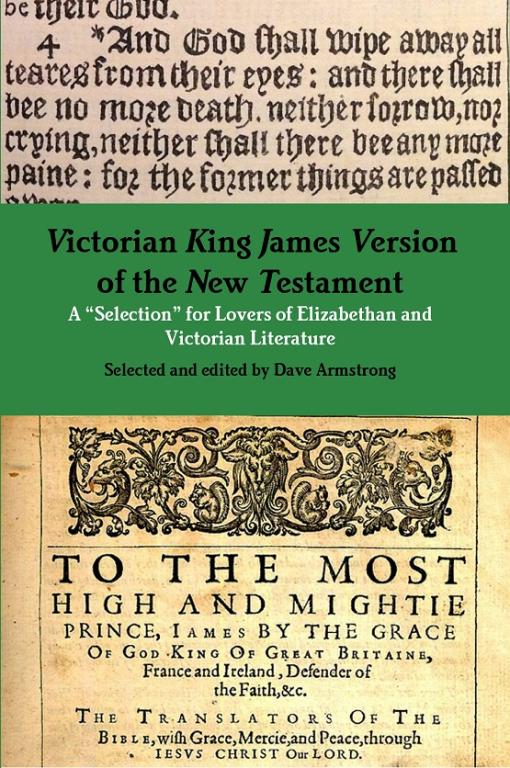
[Lulu cover design by Dave Armstrong]
***
(11-15-13)
***
[this Introduction runs 12 pages in the book]
***
I’ve often thought about (as an outgrowth of my great love for the Bible) a “fresh” version that would retain the grandeur and majesty of the Authorized / “King James” Version’s 1611 English.
*
The general idea of removing archaisms has basically been done in well-known and widely used translations (I myself always use RSV in my study and my books) and many other lesser-known translations (all revisions of the King James Bible, or revisions of revisions: ASV to NASB / RV to RSV / KJV to NKJV, etc.). The present work is a similar “hybrid”.
*
I don’t know Greek, and am therefore not qualified in the slightest to actually translate. But I know English (as a professional author) and know the Bible (as a longtime Christian apologist) very well. This work, accordingly, isn’t technically a new translation at all, but rather a “selection” or collection of what I personally felt were the best renderings that maintained the KJV style as much as possible without the archaisms.
*
This can’t escape being my “subjective project” in that sense. I am the editor and determine the overall text, but (I can’t emphasize this highly enough) I’m not translator of even a single word. This New Testament is the product of a selection of wording from among the chosen renderings of those who are legitimate translators.
*
The main criticism or complaint will probably be that this work is presumptuous. It will be misunderstood by some, perhaps many, as to its vision and intent. I don’t think it is presumptuous at all, though, if someone merely selects from among the many existing translations (all done by linguists and scholars) and comes up with a new hybrid entity with the goal stated up front and made very clear: good English style and maintaining the KJV / Rheims Elizabethan “feel” while also emphasizing literalness of translation and understandability. I’m not claiming to be anything I am not; I’m just a lover of the Bible and good, classic, beautiful English writing.
*
I’m a great fan, specifically, of 18th and 19th century English prose (e.g., John Henry Newman, John Wesley, G. K. Chesterton: all authors I’ve massively read and from whom I’ve collected quotes for published “quotable” books). I also enjoy authors who continue this stylistic tradition, like C. S. Lewis, Ronald Knox, Thomas Howard, and others. That sense of style in prose (insofar as I have been influenced by it) is the leading motif or influence in my modifying or “updating” the KJV language and style (mostly whole verses and/or sentences; occasionally individual words or phrases).
*
If I were merely to update the KJV, it would be doing something scarcely different from what has been done a dozen times or more. But in highlighting the “Victorian” style of 18th-19th century British literature and Bible translations, the project thus acquires a uniqueness.
*
This is the selling point: updating the KJV with a 19th century high Victorian style that would have some strong sense of stylistic similarity (or analogous excellence, if you will) to Elizabethan English. It would be, in a word, a Bible for lovers of great English literature (both Elizabethan and Victorian): not for everyone, but for those who already have this interest, as I do.
*
The overall goal is “literal translation with [in revised passages] 19th century English style and flowing, readable quality.” Passages that remain magnificent today in the KJV or the Rheims 1582 New Testament need not be changed, as long as they are still able to be sufficiently understood. Other phrases or words strange or altogether unknown to us now, will be modified by choosing from other translations from the “Victorian” time period or shortly after it: all from Englishmen or (in two cases) Scotsmen. No American translations will be utilized.
*
There are plenty of translations available that fit the bill for what I’m looking for, that are in the public domain (no copyright issues or conflicts). I have arrived at five that I’ll be utilizing for alternate renderings (The Rheims New Testament provides an alternate “Elizabethan” translation in addition to the 1611 KJV):
*
1) Rheims New Testament (1582): the work principally of the Catholic priest Gregory Martin, with assistance from four other men.
*
2) Young’s Literal Translation (revised version of 1887) by Scotsman Robert Young: the same person who produced an elaborate Bible concordance (1879).
*
3) Weymouth New Testament(1903): by Richard Francis Weymouth.
*
4) Twentieth Century New Testament (1904).
*
5) James Moffatt New Testament (1922): Moffatt was also a Scotsman.
*
My methodology, was to start with the KJV and Rheims New Testaments (the two “Elizabethan” ones), determine if one or the other was to be used, or else use another translation for passages that are archaic or different in meaning due to the evolution of English. Alternate renderings came from among the four additional scholarly translations above. By this method, only real, existing (and acclaimed) translations are utilized. Again; I didn’t “translate” a single word; I couldn’t, since I don’t know Greek. I also consulted the RSV and NASB versions as “models” in cases where it was difficult to choose which version to use.
*
I need to note a few elements of my editing, before I present a summary of the translations utilized:
*
1) Quotations from the Old Testament will be italicized (the method that Moffatt uses), will retain the older (KJV / Rheims) style, in order to convey a sense of citing ancient literature, and will be followed by the listing of the Old Testament passage cited (utilizing NASB cross-references).
*
2) No quotation marks will be used (KJV style). Quotations will start with a capital letter, following a comma.
*
3) The only changes to existing texts that I will make at all will be to capitalization (e.g., Weymouth uses capitalized divine pronouns; I will not, following the practice of most versions), or changing period to commas, etc., in order to make the text flow across verses.
*
4) Following the previous point, standardized proper names will be used, that are the most common (e.g., “Zebedee” rather than “Zebediah” or “Zabdi”: as some of the above versions render it). “Holy Spirit” will be used rather than “Holy Ghost.” I will change these in the text (but this can hardly be considered “translating” – since names often show variation).
*
5) The standard usage of “LORD” and “God” will be followed, rather than “Jehovah” or “Yahweh” or other alternate renderings.
*
The Authorized / King James Version of 1611 was translated by 47 men from the Church of England: all but one, clergymen, and most of the best biblical scholars in England. The text of the Bishops’ Bible (1572) was the primary guide for the translators, and (secondarily) other approved translations: the Tyndale Bible (1536), Coverdale Bible (1535), Great Bible (1539), and (especially, after the Bishop’s Bible), the Geneva Bible (1560).
*
In fact, the KJV Preface reveals that the translators regarded their work as a revision primarily of the Bishops’ Bible, rather than a fresh translation:
*
. . . we never thought from the beginning that we should need to make a new translation, nor yet to make a bad one a good one . . . but to make a good one better, or out of many good ones one principal good one, not justly to be excepted against; that hath been our endeavour, that our mark.
*
The New Testament portion was also stylistically influenced to a considerable extent by the Catholic Rheims New Testament, with the demonstrable adoption even of many of the former’s extensive and colorful “Latinate” words.
*
It was revised in a “Cambridge edition” in 1760: the culmination of twenty years of work by biblical scholar Francis Sawyer Parris (1707-1760), incorporating about about 24,000 changes: mostly outdated spelling and punctuation, and archaic language (as it was regarded at that time). Benjamin Blayney (1728-1801), slightly modified this 1760 version at Oxford in 1769: the result being the standard text ever since (excepting a few more changes).
*
The KJV’s profound influence on English language and literature is so well-known that it hardly needs to be mentioned. F. F. Bruce (1910-1990), the great biblical scholar, in his book, History of the Bible in English (Oxford University Press, 3rd edition, 1978, pp. 109-110), stated:
*
A study of its prose rhythms suggests that the men responsible for it (not only King James’s revisers but their predecessors as far back as Tyndale) had an instinctive feeling for good style. . . Prose rhythms do not obtrude themselves on the notice of readers or hearers, but they make a powerful impression none the less. Harsh combinations of sounds or accents, on the other hand, produce a sense of distaste.
*
The Rheims New Testament (1582), like all Catholic versions until the 20th century, was a translation of St. Jerome’s Latin Vulgate from the 5th century, though primary translator Gregory Martin “conferred” with Greek manuscripts as well, and his version shows particular awareness of subtle distinctions in the Greek past tense; moreover, Bruce noted (pp. 122-123) that its treatment of the Greek definite article was “more accurate” than that of the KJV. It also was influenced by the Protestant Tyndale translation and the earlier Wycliffe Bible.
*
It was greatly revised by Bishop Richard Challoner in 1750; drawing considerably from KJV style, as his “base text.” The result was a revised version – geared towards greater readability – that bore more similarity to the KJV than its own heavily “latinate” predecessor. Bruce describes a “profound influence . . . even more in the cadences of the language than in the vocabulary” (p. 125).
*
Young’s Literal Translation, produced by Scottish Bible scholar Robert Young (1822-1888), fully lives up to its name. It’s considered the most literal translation of the Bible available. The work was first published in 1862, but revised in 1887, in order to take into account the cutting-edge Westcott–Hort Greek text.
*
In the Preface to the second edition, the translator unequivocally states:
*
This inspiration extends only to the original text, as it came from the pens of the writers, not to any translations ever made by man, however aged, venerable, or good; and only in so far as any of these adhere to the original–neither adding to nor omitting from it one particle–are they of any real value, for, to the extent that they vary from the original, the doctrine of verbal inspiration is lost, so far as that version is concerned.
*
If a translation gives a present tense when the original gives a past, or a past when it has a present; a perfect for a future, or a future for a perfect; an a for a the, or a the for an a; an imperative for a subjunctive, or a subjunctive for an imperative; a verb for a noun, or a noun for a verb, it is clear that verbal inspiration is as much overlooked as if it had no existence. THE WORD OF GOD IS MADE VOID BY THE TRADITIONS OF MEN. [emphasis in original] . . .
*
The following translation need not, and ought not, to be considered, in any sense, as coming into competition with the Common Version, but as one to be used in connection with it, and as auxiliary to it; and not a few assurances have been received from clergymen and others that they thus use it, and find it at once interesting and profitable.
F. F. Bruce describes it as “designed to put the English reader as far as possible on a level with the reader of the Hebrew and Greek texts” (p. 132).
*
The Twentieth Century New Testament (1904) was done by twenty British translators who weren’t scholars in the field, but who knew koine Greek. These included wives of ministers, housewives, school teachers, telegraph engineers, and railroad workers. It’s considered the first “modern English” Bible. F. F. Bruce marvels at it:
*
How they succeeded in producing such an excellent version is difficult to understand. In later years several scholars have been glad to avail themselves of interpretations and renderings suggested by this non-specialist effort. (p. 154)
*
The aims of the translators are made very clear in the Preface:
*
This translation of the New Testament is an endeavour to do for the English nation what has been done already for the people of almost all other countries to enable Englishmen to read the most important part of their Bible in that form of their own language which they themselves use. It had its origin in the recognition of the fact that the English of the Authorized Version (closely followed in that of the Revised Version), though widely valued for its antique charm, is in many passages difficult, or even quite unintelligible to the modern reader. The retention, too, of a form of English no longer in common use is liable to give the impression that the contents of the Bible have little to do with the life of today. . . .
*
We believe that the New Testament will be better understood by modern readers if presented in a modern form; and that a translation of it, which presents the original in an exalted literary and antiquated dress, cannot, despite its aroma and the tender memories that have gathered around it, really make the New Testament for the reader of to-day the living reality that it was to its first readers. . . .
*
Our constant effort, . . . has been to exclude all words and phrases not used in current English.
*
By contrast, Baptist linguist and classical scholar Richard Francis Weymouth (1822-1902) was the lone translator of the Modern Speech New Testament (1903): usually known today by his name. F. F. Bruce gives his opinion of the work:
*
. . . the translator had no other object in view than the rendering of the New Testament into dignified modern English, with no theological or ecclesiastical bias . . .
*
His “modern speech” is not ultra-modern; he had no objection to using archaic words provided that they were still understood at the beginning of the twentieth century. “Without at least a tinge of antiquity, it is scarcely possible that there should be that dignity of style that befits the sacred themes.” . . .
*
It was a good omen that the first years of this century should see two such admirable versions of the New Testament in good twentieth-century English. (pp. 157, 160)
*
Linguist, exegete, and Church historian James Moffatt (1870-1944), a Scotsman from Glasgow, produced the final revision of his New Testament in 1922, for his New Translation of the entire Bible. He wrote in a 1926 Introduction to his work:
*
The aim I have endeavoured to keep before my mind in making this translation has been to present the books of the Old and the New Testament in effective, intelligible English. No translation of an ancient classic can be quite intelligible, it is true, unless the reader is sufficiently acquainted with its environment to understand some of its flying allusions and characteristic metaphors. But something may be done and, I am convinced, ought to be done at the present day to offer the unlearned a transcript of the Biblical literature as it lies in the light thrown upon it by modern research. The Bible is not always what it seems to those who read it in the great prose of the English version, or, indeed, in any of the conventional versions. What it is, may be partly suggested by a new rendering, such as the following pages present, that is, a fresh translation of the original, not a revision of any English version.
*
And four years earlier in a Preface to his New Testament, he stated:
*
Any new translation starts under a special handicap. It appears to challenge in every line the rhythm and diction of an English classic, and this irritates many who have no knowledge of the original. The old, they say, is better. . . . But intelligibility is more than associations, and to atone in part for the loss of associations I have endeavoured to make the New Testament, especially St. Paul’s epistles, as intelligible to a modern English reader as any version that is not a paraphrase can hope to make them.
*
F. F. Bruce is a great admirer of Moffatt’s version as well:
*
Moffatt’s translation is characterized by the freedom and vigour of his idiom . . . if a translator’s business is to produce on his readers the same effect as the original text produced on those who read and heard it, Moffatt succeeded wonderfully; and this is part of the secret of the popularity of his version. (pp. 167-168)
*
. . . to read through . . . a New Testament epistle in his version is one of the best ways to get a grasp of the general argument. And people who have been brought up to know and love the A.V. [KJV] from infancy should consider that much of it sounds foreign to those who have not been brought up to appreciate its wording. To such people Moffatt undoubtedly has made the Bible message intelligible . . . (p. 171)
*
Moffatt makes many highly interesting observations about translation in general, and his own. In his last Preface to his complete Bible, from December 1934, he wrote:
*
. . . any translator has a deep sense of responsibility. . . . He desires his transcript to be faithful to the meaning of the original, so far as he can reach that meaning, and also to do some justice to its literary qualities. But he is well aware that his aim often exceeds his grasp. Translation may be a fascinating task, yet no discipline is more humbling.
*
In the 39-page Introduction to the 1926 edition of the New Translation of the Bible, Moffatt continues his thought-provoking reflections:
*
To the best of my ability, I have tried to be exact and idiomatic. . . .
*
Gradually but steadily the English version of 1611 won the power and prestige of a classic. For one thing, it was literature, as none of its predecessors were, not even Tyndale nor the Douai version. “How real a creation,” says Newman [in The Idea of a University] how sui generis, is the style of Shakespeare, or of the Protestant Bible and Prayer Book, or of Swift, or of Pope, or of Gibbon, or of Johnson! Even were the subject-matter without meaning, though in truth the style cannot really be abstracted from the sense, still the style would, on that supposition, remain as perfect and original a work as Euclid’s elements or a symphony of Beethoven. And, like music, it has seized upon the public mind.” Yes, the style of the English version has been creative as well as a creation. It has entered into the literature and language of the English-speaking race. For once, a committee produced a classic. . . .
*
Let the version remain an English classic. But let us be certain about the truth of what it translates. There is a truth in beauty of style, but there is a beauty in truth, and whatever we may lose in parting with an English classic, we gain more by contact with the actual meaning of the original, of which this classic seems to be not quite a perfect representation. Besides, the Bible was originally written for common people in their own language. . . .
*
The archaisms of a masterpiece in Elizabethan prose had become either unintelligible or misleading. . . .
*
Finally, Moffatt (perhaps surprisingly for a non-Catholic scholar with a theologically liberal bent) acknowledges the high importance of the Latin Vulgate as a source in translation (which ties into the fact that the Rheims version – prominent in this present work – was a translation of the Vulgate):
*
. . . the Vulgate is important . . . as it was made before any of our extant manuscripts of the Greek New Testament, and made from materials that in some cases go back to the second century, perhaps even from some Greek manuscripts which no longer exist, it is indispensable as an aid to the task of ascertaining the original Greek text as that was read in North Africa at any rate during the second century. A translation will often show what the text of its original must have been, in a case of dispute. This Latin version of Jerome, then, along with the Syriac versions which go back to the third century at least, must be reckoned of first-rate importance.
*
In summary, the common thread throughout this Bible is my selection (as editor) – for individual verses – of either the KJV or Rheims or else alternate renderings from the other four versions of the New Testament listed and described above. The final product obviously reflects my taste in prose and style, but the (rather high and ambitious) goal is for it to be (hopefully) a New Testament characterized by a blending of the grandeur and majesty of both Elizabethan and Victorian prose.
*
I seek to put beauty and style in the forefront, while preserving literal translations. I aim to produce (as editor) a New Testament that accurately conveys the original language, and one that is theologically orthodox and beautiful: in the 19th century English high Victorian style, combined with unchanged beautiful, majestic Elizabethan style, in passages that are still able to be understood by today’s readers.
*
[Note: you can read the Gospel of Mark in a separate post, along with source analysis for chapters 1-4].
* * * * *
Previous Post
November 14, 2013
"Victorian King James Version": Selection for the Gospel of Mark
Next Post
November 19, 2013 "Victorian King James Version": Selection for Philippians
Browse Our Archives
Select a Category & Last Things About Me Anti-Catholicism Atheism & Agnosticism Baptism and Sacramentalism Bible and Tradition Blessed Virgin Mary Books by Dave Armstrong C. S. Lewis Calvinism & General Protestantism Catholic Apologetics Catholic Apologists Catholic conversion Catholic converts Christmas Church (Ecclesiology) Church History Conversion and Converts Development of Doctrine Eastern Orthodoxy Ecumenism & Christian Unity Eucharist & Liturgy Fathers of the Church French Translations G. K. Chesterton Hell Hell & Satan Hell & Satan & Last Things Heresies & Comparative Religion Holistic Health Inquisition & Crusades & Scandals James White Jews & Judaism & Old Testament John Calvin John Henry Newman Liberal / Modernist Theology Life Issues Literary Resume Lutheranism Mariology Martin Luther Music Orthodoxy Papacy & Infallibility Personal Page Philosophy & Science Political & Ethical & Moral Issues Protestant Persecution & Intolerance Protestantism Purgatory Purgatory & Penance Romantic & Imaginative Theology Saints & Purgatory & Penance Salvation Salvation & Justification Satan & Last Things Sexuality and Gender Issues Spanish Translations Traditionalism vs. Radical Catholic Reactionaries Traducciones al español / tradução para português Trinitarianism & Christology Uncategorized Videos
Select a Month October 2026 September 2026 August 2026 July 2026 June 2026 May 2026 April 2026 March 2026 February 2026 January 2026 December 2025 November 2025 October 2025 September 2025 August 2025 July 2025 June 2025 May 2025 April 2025 March 2025 February 2025 January 2025 December 2024 November 2024 October 2024 September 2024 August 2024 July 2024 June 2024 May 2024 April 2024 March 2024 February 2024 January 2024 December 2023 November 2023 October 2023 September 2023 August 2023 July 2023 June 2023 May 2023 April 2023 March 2023 February 2023 January 2023 December 2022 November 2022 October 2022 September 2022 August 2022 July 2022 June 2022 May 2022 April 2022 March 2022 February 2022 January 2022 December 2021 November 2021 October 2021 September 2021 August 2021 July 2021 June 2021 May 2021 April 2021 March 2021 February 2021 January 2021 December 2020 November 2020 October 2020 September 2020 August 2020 July 2020 June 2020 May 2020 April 2020 March 2020 February 2020 January 2020 December 2019 November 2019 October 2019 September 2019 August 2019 July 2019 June 2019 May 2019 April 2019 March 2019 February 2019 January 2019 December 2018 November 2018 October 2018 September 2018 August 2018 July 2018 June 2018 May 2018 April 2018 March 2018 February 2018 January 2018 December 2017 November 2017 October 2017 September 2017 August 2017 July 2017 June 2017 May 2017 April 2017 March 2017 February 2017 January 2017 December 2016 November 2016 October 2016 September 2016 August 2016 July 2016 June 2016 May 2016 April 2016 March 2016 February 2016 January 2016 December 2015 November 2015 October 2015 September 2015 August 2015 July 2015 June 2015 May 2015 April 2015 March 2015 February 2015 January 2015 December 2014 November 2014 October 2014 September 2014 August 2014 July 2014 June 2014 April 2014 March 2014 February 2014 January 2014 December 2013 November 2013 October 2013 September 2013 August 2013 July 2013 June 2013 April 2013 March 2013 February 2013 January 2013 December 2012 November 2012 October 2012 September 2012 August 2012 July 2012 June 2012 May 2012 April 2012 March 2012 February 2012 January 2012 December 2011 November 2011 October 2011 September 2011 August 2011 July 2011 June 2011 April 2011 March 2011 February 2011 October 2010 September 2010 August 2010 July 2010 April 2010 March 2010 December 2009 October 2009 August 2009 July 2009 June 2009 May 2009 March 2009 February 2009 October 2008 September 2008 April 2008 March 2008 February 2008 January 2008 December 2007 November 2007 October 2007 May 2007 March 2007 February 2007 January 2007 November 2006 October 2006 September 2006 August 2006 July 2006 June 2006 May 2006 April 2006 March 2006 February 2006 October 2005 June 2005 April 2005 February 2005 July 2004 May 2004 April 2004
Follow Us!
TAKE THE
Religious Wisdom Quiz
What did Jesus say to Lazarus to raise him?
Select your answer to see how you score.
Awake! Lazarus, come out! Live again! Be healed!
Books by This Author Books by Dave Armstrong
Related posts from Biblical Evidence for Catholicism

A Few "Worst" & "Best" Arguments vs. Protestantism
Biblical Evidence for Catholicism

Jerusalem Council vs. James White & Sola Scriptura
Biblical Evidence for Catholicism

Book: Martin Luther: Dissenter and Defender
Biblical Evidence for Catholicism

Biblical Perspicuity: Absurd Anti-Catholic "Defense"
Biblical Evidence for Catholicism
TRENDING AT PATHEOS Catholic

57th Dove Awards Honor Dolly Parton, Crown New...
On gospel music’s biggest night, the 57th annual GMA Dove Awards honored...

The First Eucharistic Controversy: Christ’s Real Presence
For Catholics, the Eucharist is the source and summit of the Christian...

What a Stop Sign Can Teach Us About...
How to Make a Decision When You Can't Hear God Main point:...

Archdiocese Hosts Military Marriage Retreat in Germany
RASTATT, Germany — The transient military lifestyle, with its frequent deployments and...

Nearly every morning, I make the drive to Detroit with my high-school-age...

The Real AI Story Is Adoption Without Trust
Artificial intelligence has crossed a political threshold. It is no longer a...
view all Catholic blogs
Ad-Free & Subscriber Log-In Subscription Support
- About Us
- 2026 Calendar
- Videos
- Podcasts
- Library of World Religions
- Faith In Media Tracker
- Advertise With Us
- Write for Us
- Privacy Policy
- Terms of Service
- Do Not Sell My Data
- Contact Us
- Radiant Digital
- Manage Newsletter Subscriptions
- Unsubscribe From Notifications
- Sitemap
Copyright 2008-2026, Patheos. All rights reserved.
Subscription Support Ad-Free & Subscriber Log-In
Follow Patheos