
BuddhistCatholicContemplativeEvangelicalGeneral ChristianHinduJewishLatter-day SaintMuslimNew VisionsProgressive Christian
Beliefs
- Buddhist
- Catholic
- Contemplative
- Evangelical
- General Christian
- Hindu
- Jewish
- Latter-day Saint
- More Voices
- Muslim
- New Visions
- Pagan
- Progressive Christian
Topics
- Religion News
- Food and Religion
- Sports and Religion
- Religious Art
- Religious Music and Entertainment
- Religious Events
- History and Religion
- Style and Religion
- Politics and Religion
- Women in Religion
- Recreation Outdoors and Religion
- Business Finance and Religion
- Careers Workplace and Religion
- Education and Religion
- Family Parenting and Religion
- Health Fitness and Religion
- Home and Religion
- Relationships and Religion
- Technology and Religion
- Travel and Religion
Columnists
- Buddhist Columnists
- Business Finance and Religion Columnists
- Careers Workplace and Religion Columnists
- Catholic Columnists
- Contemplative Columnists
- Education and Religion Columnists
- Evangelists Columnists
- Family Parenting and Religion Columnists
- General Christian Columnists
- Health Fitness and Religion Columnists
- Hindu Columnists
- History and Religion Columnists
- Home and Religion Columnists
- Jewish Columnists
- More Voices Columnists
- Latter Day Columnists
- Muslim Columnists
- New Visions Columnists
- Nonreligious Columnists
- Pagan Columnists
- Politics and Religion Columnists
- Progressive Columnists
- Recreation Outdoors and Religion Columnists
- Relationships and Religion Columnists
- Religion News Columnists
- Religious Art Columnists
- Religious Events Columnists
- Religious Music and Entertainment Columnists
- Sports and Religion Columnists
- Style and Religion Columnists
- Technology and Religion Columnists
- Travel and Religion Columnists
- Women in Religion Columnists
Resource Library
- 2026 Calendar
- Library of World Religions
- The 100 Most Holy Places on Earth
- Patheos Answers
- Podcasts
- Videos
- Faith Leaders Database
- Anglican Episcopalian
- Bahai
- Baptist
- Buddhism
- Christianity
- Confucianism
- Eastern Orthodoxy
- Hinduism
- Holiness and Pentecostal
- ISKCON
- Islam
- Judaism
- Lutheran
- Methodist
- The Church of Jesus Christ of Latter-day Saints
- New Age
- Paganism
- Presbytarian and Reformed
- Protestantism
- Religion Behind the Scenes
- Roman Catholic
- Scientology
- Shia Islam
- Sikhism
- Sufism
- Sunni Islam
- Taoism
- Zen
- See all religions
Research Tools
 Ad-Free & Subscriber Log-In Subscription Support
Ad-Free & Subscriber Log-In Subscription Support
Follow Patheos 

- Trending:
- Forgiveness
- |
- Marriage
- |
- Consciousness
- |
- Death Penalty
- |
- Election
- |
- Halloween

-
About
-
Catholic Apologetics
-
Church History
-
Great Apologists
-
Christian Worldview
-
Protestantism & Misc.
- Home
- Catholic
- History and Religion
- David T. King & William Webster Misinterpret the Fathers on Authority: Part I: St. Cyril of Jerusalem
David T. King & William Webster Misinterpret the Fathers on Authority: Part I: St. Cyril of Jerusalem
Last updated on: May 25, 2017 at 7:26 pm by Dave Armstrong
David T. King & William Webster Misinterpret the Fathers on Authority: Part I: St. Cyril of Jerusalem 2017-05-25T19:26:36-04:00 Dave Armstrong
Patheos Explore the world's faith through different perspectives on religion and spirituality! Patheos has the views of the prevalent religions and spiritualities of the world.
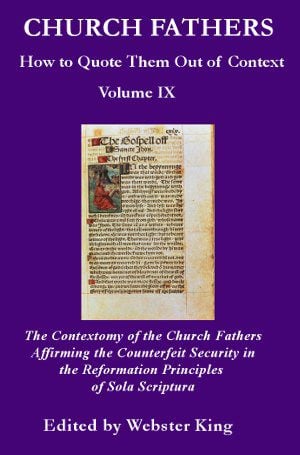
(11-9-13)
See Introduction and Part II.
In Vol. III, Ch. 2 (“The Ultimate Authority of Scripture”). Webster and King cite the following passages from St. Cyril:
Have thou ever in your mind this seal , which for the present has been lightly touched in my discourse, by way of summary, but shall be stated, should the Lord permit, to the best of my power with the proof from the Scriptures. For concerning the divine and holy mysteries of the Faith, not even a casual statement must be delivered without the Holy Scriptures; nor must we be drawn aside by mere plausibility and artifices of speech. Even to me, who tell you these things, give not absolute credence, unless thou receive the proof of the things which I announce from the Divine Scriptures. For this salvation which we believe depends not on ingenious reasoning , but on demonstration of the Holy Scriptures.
[Catechetical Lectures, IV: 17]
And first let us inquire for what cause Jesus came down. Now mind not my argumentations, for perhaps you may be misled but unless thou receive testimony of the Prophets on each matter, believe not what I say: unless thou learn from the Holy Scriptures concerning the Virgin, and the place, the time, and the manner, receive not testimony from man. For one who at present thus teaches may possibly be suspected: but what man of sense will suspect one that prophesied a thousand and more years beforehand? If then you seek the cause of Christ’s coming, go back to the first book of the Scriptures.
[Catechetical Lectures, XII:5]
Catholics have no problem with these statements. We only would if Cyril intended them to be in opposition to or in exclusion of the authority of the Church and tradition; but of course he doesn’t do that. In other passages that Webster and King conveniently omit, he acknowledges these.
In the same Lecture 4 (first quote above), St. Cyril writes at length about Holy Scripture (sections 33-36). How does he instruct a believer to determine which books are in the Bible? He does so by an extrabiblical authority: the Church:
Learn also diligently, and from the Church, what are the books of the Old Testament, and what those of the New. (IV:33)
Right off the bat, this is contrary to several of the tenets that the authors laid out in the Introduction to Vol. III:
3.) All doctrines must be proven from Scripture.
4.) What the Apostles taught orally has been handed down in Scripture.
5.) Scripture is the ultimate judge in all controversies.
6.) Scripture is the ultimate and supreme authority for the Church.
7.) If Scripture is silent on an issue it cannot be known.
The canon of Scripture is never listed in Scripture, which contradicts all five tenets above. Scripture is silent on that issue, and Webster and King say, therefore, that it can’t be known (#7). But the canon is known through the authority of the Catholic Church. The Church delivers Holy Scripture to the Christian believer. Protestantism has never been able to rationalize away this clear contradiction of sola Scriptura. Hence, Cyril states:
Study earnestly these only which we read openly in the Church. Far wiser and more pious than yourself were the Apostles, and the bishops of old time, the presidents of the Church who handed down these books. Being therefore a child of the Church, trench thou not upon its statutes. (IV:35)
Moreover, when Cyril lists the books of the Old Testament, delivered authoritatively by the Church, he includes “Jeremiah . . . including Baruch and Lamentations and the Epistle” (IV:35). Baruch was thrown out of Protestant Bibles, but accepted by the Church fathers and Catholics. The “Epistle of Jeremiah” is the last chapter of Baruch in Catholic Bibles, but excluded by Protestant ones. In the next section (IV:36), he lists all New Testament books except for Revelation, and states: “. . . whatever books are not read in Churches, these read not even by yourself,. . .”
Thus — so Cyril would say — , not only is Revelation not Scripture, but not to be read at all by an individual. This is because the canon of the Bible was itself a developing doctrine of the Church. Revelation was one of the last books accepted. Cyril died in the decade before the Church finalized the canon at the councils of Hippo (393) and Carthage (397). These included the deuterocanonical books (what Protestants call the “Apocrypha”: those that they arbitrarily reject).
This is an example of why Catholics don’t grant individual Church fathers binding authority: only the Church in its authoritative pronouncements (through councils and popes) has that. The fathers are guides when they agree en masse. The canon was still developed, and reached its final development shortly after Cyril. But neither what he said about the biblical canon, nor what the Church declared shortly afterwards, comports totally with what Protestants think, nor with sola Scriptura.
We know that St. Cyril cited deuterocanonical books in these same Catechetical Instructions; e.g., Wisdom of Solomon (9:2; 9:16; 12:5), Sirach (6:4; 11:19; 13:8), and the chapters of Daniel that Protestants discarded (14:25; 16:31).
Commenting on the Creed, Cyril again upholds a strong notion of the authority of the Catholic Church:
Now then let me finish what still remains to be said for the Article, In one Holy Catholic Church, on which, though one might say many things, we will speak but briefly.
It is called Catholic then because it extends over all the world, from one end of the earth to the other; and because it teaches universally and completely one and all the doctrines which ought to come to men’s knowledge, concerning things both visible and invisible, heavenly and earthly . . . (XVIII:22-23)
Now, imagine if Cyril had said this about Scripture, that it “teaches universally and completely one and all the doctrines which ought to come to men’s knowledge.” Webster and King would be all over that as proof that he was teaching material sufficiency of Scripture and also formal sufficiency (“complete”). But here he is stating these attributes with regard to the Church, not Scripture (the Church teaches with completeness, just as Scripture does); and so for that reason, Webster and King decided that this passage was not commensurate with their sophistical plan of “proving” that the Scripture alone provides this sort of sufficiency or “completeness” — and they deliberately omitted it.
This is their standard practice with all the Church fathers, and it’s intellectually dishonest, on the grounds that a half-truth or a partial truth is almost as bad as a lie. They habitually present one strain of patristic teaching that agrees with Catholicism: glowing remarks about Holy Scripture, while ignoring all that is said of the Church, tradition, apostolic succession, bishops, councils, popes, etc.
Even this would be acceptable if their stated intent was simply to show what the fathers believed about Scripture. We would have no beef with that. But this isn’t what they are doing. They claim that the fathers taught sola Scriptura: the notion that nothing is infallible or finally binding except scriptural teaching. That’s not true (as a matter of demonstrable fact), and it’s shown to not be true precisely by noting what these fathers thought about these other elements of authority (the Church, tradition, apostolic succession, bishops, councils, popes). St. Cyril rejects all sectarianism and denominationalism:
Concerning this Holy Catholic Church Paul writes to Timothy, That you may know how you ought to behave yourself in the House of God, which is the Church of the Living God, the pillar and ground of the truth [1 Tim 3:15].
But since the word Ecclesia is applied to different things (as also it is written of the multitude in the theatre of the Ephesians, And when he had thus spoken, he dismissed the Assembly [Acts 19:14], and since one might properly and truly say that there is a Church of evil doers, I mean the meetings of the heretics, the Marcionists and Manichees, and the rest, for this cause the Faith has securely delivered to you now the Article, And in one Holy Catholic Church; that you may avoid their wretched meetings, and ever abide with the Holy Church Catholic in which you were regenerated. And if ever you are sojourning in cities, inquire not simply where the Lord’s House is (for the other sects of the profane also attempt to call their own dens houses of the Lord), nor merely where the Church is, but where is the Catholic Church. For this is the peculiar name of this Holy Church, the mother of us all, which is the spouse of our Lord Jesus Christ, . . . (XVIII:25-26)
He teaches that salvation comes through the Catholic Church:
In this Holy Catholic Church receiving instruction and behaving ourselves virtuously, we shall attain the kingdom of heaven, and inherit eternal life; . . . (XVIII:28)
He refers to the passing-on of apostolic tradition:
And now, brethren beloved, the word of instruction exhorts you all, to prepare your souls for the reception of the heavenly gifts. As regards the Holy and Apostolic Faith delivered to you to profess, we have spoken through the grace of the Lord as many Lectures, as was possible,. . . (XVIII:32)
Make thou your fold with the sheep: flee from the wolves: depart not from the Church. . . . The truth of the Unity of God has been delivered to you: learn to distinguish the pastures of doctrine. (VI:36)
He refers to “the divine Scriptures used in the Church” and “the tradition of the Church’s interpreters” (XV:13). This goes against Webster and King’s typically Protestant notion that “Scripture interprets Scripture, i.e., it is self-interpreting.”
He regards the Church as the determinant of orthodoxy, insofar as what it holds, is apostolic Christianity:
And to be brief, let us neither separate them, nor make a confusion : neither say thou ever that the Son is foreign to the Father, nor admit those who say that the Father is at one time Father, and at another Son: for these are strange and impious statements, and not the doctrines of the Church. (XI:18)
And formerly the heretics were manifest; but now the Church is filled with heretics in disguise. For men have fallen away from the truth, and have itching ears. [2 Tim 4:3] Is it a plausible discourse? All listen to it gladly. Is it a word of correction? All turn away from it. Most have departed from right words, and rather choose the evil, than desire the good. This therefore is the falling away, and the enemy is soon to be looked for: and meanwhile he has in part begun to send forth his own forerunners , that he may then come prepared upon the prey. Look therefore to yourself, O man, and make safe your soul. The Church now charges you before the Living God; she declares to you the things concerning Antichrist before they arrive. Whether they will happen in your time we know not, or whether they will happen after you we know not; but it is well that, knowing these things, you should make yourself secure beforehand. (XV:9)
. . . the Catholic Church guarding you beforehand has delivered to you in the profession of the faith, . . . (XVII:3)
He speaks in terms of the Catholic “three-legged stool” rule of faith: tradition, Church, and Scripture: all harmonious:
But in learning the Faith and in professing it, acquire and keep that only, which is now delivered to you by the Church, and which has been built up strongly out of all the Scriptures. For since all cannot read the Scriptures, some being hindered as to the knowledge of them by want of learning, and others by a want of leisure, in order that the soul may not perish from ignorance, we comprise the whole doctrine of the Faith in a few lines. This summary I wish you both to commit to memory when I recite it , and to rehearse it with all diligence among yourselves, not writing it out on paper , but engraving it by the memory upon your heart , taking care while you rehearse it that no Catechumen chance to overhear the things which have been delivered to you. . . . for the present listen while I simply say the Creed , and commit it to memory; but at the proper season expect the confirmation out of Holy Scripture of each part of the contents. For the articles of the Faith were not composed as seemed good to men; but the most important points collected out of all the Scripture make up one complete teaching of the Faith. And just as the mustard seed in one small grain contains many branches, so also this Faith has embraced in few words all the knowledge of godliness in the Old and New Testaments. Take heed then, brethren, and hold fast the traditions which you now receive, and write them on the table of your heart.
Guard them with reverence, lest per chance the enemy despoil any who have grown slack; or lest some heretic pervert any of the truths delivered to you. For faith is like putting money into the bank , even as we have now done; but from you God requires the accounts of the deposit. I charge you, as the Apostle says, before God, who quickens all things, and Christ Jesus, who before Pontius Pilate witnessed the good confession, that you keep this faith which is committed to you, without spot, until the appearing of our Lord Jesus Christ. (V: 12-13)
At every turn, then, we see that St. Cyril is thoroughly Catholic, and does not teach sola Scriptura. Webster and King have misled their readers in claiming the contrary, by trotting out just two passages, while ignoring the many other relevant ones that I have highlighted above.
* * * * *
Browse Our Archives
Select a Category & Last Things About Me Anti-Catholicism Atheism & Agnosticism Baptism and Sacramentalism Bible and Tradition Blessed Virgin Mary Books by Dave Armstrong C. S. Lewis Calvinism & General Protestantism Catholic Apologetics Catholic Apologists Catholic conversion Catholic converts Christmas Church (Ecclesiology) Church History Conversion and Converts Development of Doctrine Eastern Orthodoxy Ecumenism & Christian Unity Eucharist & Liturgy Fathers of the Church French Translations G. K. Chesterton Hell Hell & Satan Hell & Satan & Last Things Heresies & Comparative Religion Holistic Health Inquisition & Crusades & Scandals James White Jews & Judaism & Old Testament John Calvin John Henry Newman Liberal / Modernist Theology Life Issues Literary Resume Lutheranism Mariology Martin Luther Music Orthodoxy Papacy & Infallibility Personal Page Philosophy & Science Political & Ethical & Moral Issues Protestant Persecution & Intolerance Protestantism Purgatory Purgatory & Penance Romantic & Imaginative Theology Saints & Purgatory & Penance Salvation Salvation & Justification Satan & Last Things Sexuality and Gender Issues Spanish Translations Traditionalism vs. Radical Catholic Reactionaries Traducciones al español / tradução para português Trinitarianism & Christology Uncategorized Videos
Select a Month October 2026 September 2026 August 2026 July 2026 June 2026 May 2026 April 2026 March 2026 February 2026 January 2026 December 2025 November 2025 October 2025 September 2025 August 2025 July 2025 June 2025 May 2025 April 2025 March 2025 February 2025 January 2025 December 2024 November 2024 October 2024 September 2024 August 2024 July 2024 June 2024 May 2024 April 2024 March 2024 February 2024 January 2024 December 2023 November 2023 October 2023 September 2023 August 2023 July 2023 June 2023 May 2023 April 2023 March 2023 February 2023 January 2023 December 2022 November 2022 October 2022 September 2022 August 2022 July 2022 June 2022 May 2022 April 2022 March 2022 February 2022 January 2022 December 2021 November 2021 October 2021 September 2021 August 2021 July 2021 June 2021 May 2021 April 2021 March 2021 February 2021 January 2021 December 2020 November 2020 October 2020 September 2020 August 2020 July 2020 June 2020 May 2020 April 2020 March 2020 February 2020 January 2020 December 2019 November 2019 October 2019 September 2019 August 2019 July 2019 June 2019 May 2019 April 2019 March 2019 February 2019 January 2019 December 2018 November 2018 October 2018 September 2018 August 2018 July 2018 June 2018 May 2018 April 2018 March 2018 February 2018 January 2018 December 2017 November 2017 October 2017 September 2017 August 2017 July 2017 June 2017 May 2017 April 2017 March 2017 February 2017 January 2017 December 2016 November 2016 October 2016 September 2016 August 2016 July 2016 June 2016 May 2016 April 2016 March 2016 February 2016 January 2016 December 2015 November 2015 October 2015 September 2015 August 2015 July 2015 June 2015 May 2015 April 2015 March 2015 February 2015 January 2015 December 2014 November 2014 October 2014 September 2014 August 2014 July 2014 June 2014 April 2014 March 2014 February 2014 January 2014 December 2013 November 2013 October 2013 September 2013 August 2013 July 2013 June 2013 April 2013 March 2013 February 2013 January 2013 December 2012 November 2012 October 2012 September 2012 August 2012 July 2012 June 2012 May 2012 April 2012 March 2012 February 2012 January 2012 December 2011 November 2011 October 2011 September 2011 August 2011 July 2011 June 2011 April 2011 March 2011 February 2011 October 2010 September 2010 August 2010 July 2010 April 2010 March 2010 December 2009 October 2009 August 2009 July 2009 June 2009 May 2009 March 2009 February 2009 October 2008 September 2008 April 2008 March 2008 February 2008 January 2008 December 2007 November 2007 October 2007 May 2007 March 2007 February 2007 January 2007 November 2006 October 2006 September 2006 August 2006 July 2006 June 2006 May 2006 April 2006 March 2006 February 2006 October 2005 June 2005 April 2005 February 2005 July 2004 May 2004 April 2004
Follow Us!
TAKE THE
Religious Wisdom Quiz
I am twelve stones taken from a riverbed and set up as a memorial to a miraculous crossing. What am I?
Select your answer to see how you score.
Altar stones The memorial stones The Stones of remembrance Bethel
Books by This Author Books by Dave Armstrong
Related posts from Biblical Evidence for Catholicism

Three More Anti-Catholic Lies About Catholicism (#6-4)
Biblical Evidence for Catholicism

Top Ten Anti-Catholic Lies (#10-7)
Biblical Evidence for Catholicism

A Few "Worst" & "Best" Arguments vs. Protestantism
Biblical Evidence for Catholicism

17 Church Fathers on Purgatory (Esp. 1 Cor...
Biblical Evidence for Catholicism
TRENDING AT PATHEOS Catholic

The Sermon on the Mount, Part I: Matthew...
The Sermon on the Mount, Part I (Matthew 4:12-5:12) St. Matthew moves...

What's up from Crossway: Reviewing some of their latest A few weeks...

Janie Learns the Way of the Cross: A...
Teaching children about Jesus' Passion can be challenging. Many parents and educators...

Looking For Good Catholic Writing - October 2026
He alone extends the heavens, and he walks upon the waves of...

In "Irreplaceable," our book on vocation and technology, Trevor Sutton and I...

I was strolling through the top floor of the brand new Parthenon...
view all Catholic blogs
Ad-Free & Subscriber Log-In Subscription Support
- About Us
- 2026 Calendar
- Videos
- Podcasts
- Library of World Religions
- Faith In Media Tracker
- Advertise With Us
- Write for Us
- Privacy Policy
- Terms of Service
- Do Not Sell My Data
- Contact Us
- Radiant Digital
- Manage Newsletter Subscriptions
- Unsubscribe From Notifications
- Sitemap
Copyright 2008-2026, Patheos. All rights reserved.
Subscription Support Ad-Free & Subscriber Log-In
Follow Patheos