
BuddhistCatholicContemplativeEvangelicalGeneral ChristianHinduJewishLatter-day SaintMuslimNew VisionsProgressive Christian
Beliefs
- Buddhist
- Catholic
- Contemplative
- Evangelical
- General Christian
- Hindu
- Jewish
- Latter-day Saint
- More Voices
- Muslim
- New Visions
- Pagan
- Progressive Christian
Topics
- Religion News
- Food and Religion
- Sports and Religion
- Religious Art
- Religious Music and Entertainment
- Religious Events
- History and Religion
- Style and Religion
- Politics and Religion
- Women in Religion
- Recreation Outdoors and Religion
- Business Finance and Religion
- Careers Workplace and Religion
- Education and Religion
- Family Parenting and Religion
- Health Fitness and Religion
- Home and Religion
- Relationships and Religion
- Technology and Religion
- Travel and Religion
Columnists
- Buddhist Columnists
- Business Finance and Religion Columnists
- Careers Workplace and Religion Columnists
- Catholic Columnists
- Contemplative Columnists
- Education and Religion Columnists
- Evangelists Columnists
- Family Parenting and Religion Columnists
- General Christian Columnists
- Health Fitness and Religion Columnists
- Hindu Columnists
- History and Religion Columnists
- Home and Religion Columnists
- Jewish Columnists
- More Voices Columnists
- Latter Day Columnists
- Muslim Columnists
- New Visions Columnists
- Nonreligious Columnists
- Pagan Columnists
- Politics and Religion Columnists
- Progressive Columnists
- Recreation Outdoors and Religion Columnists
- Relationships and Religion Columnists
- Religion News Columnists
- Religious Art Columnists
- Religious Events Columnists
- Religious Music and Entertainment Columnists
- Sports and Religion Columnists
- Style and Religion Columnists
- Technology and Religion Columnists
- Travel and Religion Columnists
- Women in Religion Columnists
Resource Library
- 2026 Calendar
- Library of World Religions
- The 100 Most Holy Places on Earth
- Patheos Answers
- Podcasts
- Videos
- Faith Leaders Database
- Anglican Episcopalian
- Bahai
- Baptist
- Buddhism
- Christianity
- Confucianism
- Eastern Orthodoxy
- Hinduism
- Holiness and Pentecostal
- ISKCON
- Islam
- Judaism
- Lutheran
- Methodist
- The Church of Jesus Christ of Latter-day Saints
- New Age
- Paganism
- Presbytarian and Reformed
- Protestantism
- Religion Behind the Scenes
- Roman Catholic
- Scientology
- Shia Islam
- Sikhism
- Sufism
- Sunni Islam
- Taoism
- Zen
- See all religions
Research Tools
 Ad-Free & Subscriber Log-In Subscription Support
Ad-Free & Subscriber Log-In Subscription Support
Follow Patheos 

- Trending:
- Forgiveness
- |
- Marriage
- |
- Consciousness
- |
- Death Penalty
- |
- Election
- |
- Halloween

-
About
-
Catholic Apologetics
-
Church History
-
Great Apologists
-
Christian Worldview
-
Protestantism & Misc.
- Home
- Catholic
- History and Religion
- Introduction to Dave Armstrong’s Book, “Debating James White”
Introduction to Dave Armstrong’s Book, “Debating James White”
Last updated on: May 25, 2017 at 7:31 pm by Dave Armstrong
Introduction to Dave Armstrong’s Book, “Debating James White” 2017-05-25T19:31:15-04:00 Dave Armstrong
Patheos Explore the world's faith through different perspectives on religion and spirituality! Patheos has the views of the prevalent religions and spiritualities of the world.
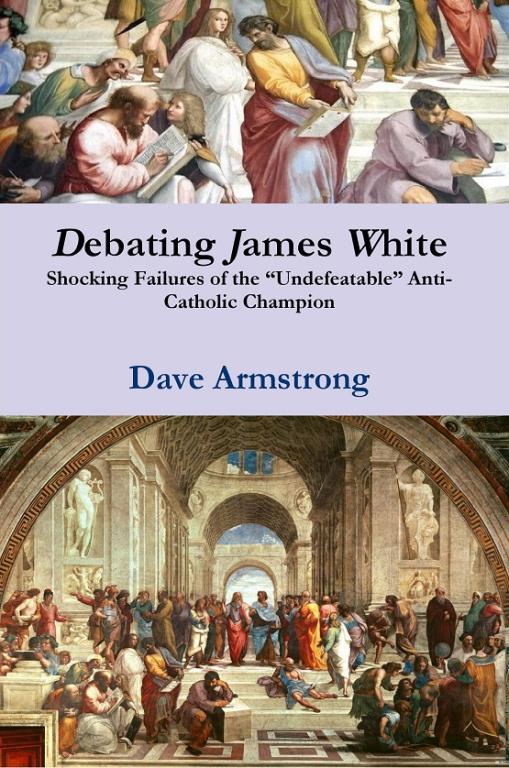
(10-28-13)
***
An anti-Catholic– in scholarly usage – is not merely a person who differs with Catholicism. Nor does it refer to someone who “hates” Catholics or opposes all things Catholic simply because they are Catholic. And it doesn’t refer to emotions or opposition to individuals, but rather, to Catholic theology.
The anti-Catholic is one who thinks that Catholicism is not a Christian system of theology and that to be a good Christian and get saved, one must be a bad Catholic; that is, reject several tenets of Catholicism that differ with Protestantism; or in the case of Orthodox anti-Catholics, with Orthodoxy.
But first let me introduce the man who is the subject of this book. James White (b. 1962) is a Reformed Baptist apologist, author, public speaker and debater, and elder at his church. He does many other things in his apologetics besides oppose Catholic theology, and many of these are good and worthwhile endeavors; for example, his critiques of Islam (his recent emphasis), the King James Only viewpoint, theological liberalism, Mormonism, and atheism.
By and large, in dealing with these topics, he does a good job, in my opinion, and I have often publicly commended him for it. When it comes to Catholicism, on the other hand, it’s quite a different story. In that domain he falls into the typical (and rather outrageous) errors of anti-Catholic thought.
Mr. White is the founder and director of Alpha and Omega Ministries, which began in 1983. In 1990 he started concentrating on critiquing Catholicism, and produced his first two books on the topic: The Fatal Flaw, and Answers to Catholic Claims (both by Crowne Publications: 1990). His other books (out of 26) that are devoted wholly or largely to Catholicism, include The Roman Catholic Controversy (1996), Mary – Another Redeemer? (1998), The God Who Justifies (2001), and Scripture Alone (2004): all published by Bethany House.
White obtained an M.A. Degree in theology from Fuller Theological seminary in 1989. During the mid-90s as the Internet began to flourish, he began devoting a lot of time and energy to that medium, and he started his weekly webcast, The Dividing Line, in September 1998. It often deals with Catholicism. He developed a website and blog, with voluminous writings, as well.
He is probably most known (and renowned) for his formal oral debates. According to his website he has done 117 of these, starting in August 1990, including 38 devoted to various Catholic beliefs: or 32% of all his debates. He engaged in more than one debate with apologists such as Fr. Mitch Pacwa (five), Robert Fastiggi (four), Tim Staples (three), and Patrick Madrid (two).
White also has challenged me to oral debate on three occasions: 1995, 2001, and 2007. Thus, he averages a request every six years (even though – oddly enough – he constantly asserts that I am a profound imbecile and ignoramus in theological and exegetical matters), and is due to ask me again before this year is out. Perhaps this book will be the impetus.
My answer was the same in every instance: I regard oral debates as vastly inferior to written debate and I don’t cultivate public speaking, in any event. I note that White is also a writer, whereas I am a writer only, so that the written medium is where we could and should best interact: the common ground.
“Debating” in the title of this volume is especially apt, as it highlights how Mr. White views himself and how he – by all appearances – especially wants to be known. I love debate and dialogue, myself, as a longtime socratic and apologist. Christian apologists (defenders of the faith: in either its Protestant, Catholic, or Orthodox forms) certainly debate; if they don’t, they are surely not apologists worth their salt.
The question at hand, however, is how to define a debate, what one’s intentions are in undertaking one, and whether the truth is being defended while debating.
Mr. White engages in habitual “boilerplate” regarding his debates and those who (for whatever reason) decline to participate in them with him. One very common theme is his notion that writers “hide behind their keyboards” – they are (he thinks) intellectual cowards and scared to death to face him — the Terrifying and Unanswerable Scourge of Catholics – behind a podium in a public oral debate. Here are three examples:
Dr. Stauffer: Brave Behind the Keyboard, Unwilling to Defend His Assertions (article title: 3-25-06 on his blog)
. . . Armstrong continues to refuse to debate man to man in person, and wishes only to hide behind his keyboard where he knows that no one, and I mean no one, can possibly force him to answer a direct question. As long as you can use the written forum, you can avoid the very essence of debate, the heart of debate, which is answering direct questions that test your position for consistency. Armstrong knows he is simply constitutionally incapable of the task, but he refuses to admit it, opting instead for this kind of rhetoric. (7-12-07 on his blog)
There are far too many folks who hide behind a keyboard on web forums . . . (2-3-09 on his blog)
Mr. White’s typical treatment of yours truly (since 1995) is clearly observed above. I will try as much as is possible in this book to avoid documenting his constant juvenile and sub-Christian resort to personal insult, so as not to afflict readers with silly tedium (I wish to stick solely to theological issues). But removing White’s ubiquitous insults of his Catholic opponents in written records is very often about as easy as removing the white stripe from a candy cane: it’s so intermingled as to be impossible to extricate from the substance. I’ll do my best!
The other frequent and annoying theme with regard to Mr. White’s debates and his “spin” about them, is the notion that when an oral debate did occur and the other party didn’t make it available in his venue, this “proves” a tacit admission of defeat. Here’s an absolutely classic instance of that polemic, from a website article (9-18-00) reprinted on 12-28-12 on his blog:
I have seen my opponents use many tactics to cover over poor performances in debates. You will find documented on this website at least one imaginative approach taken by Catholic Answers back in 1993 when Patrick Madrid attempted to do damage control after our sola scriptura debate in San Diego by writing “The White Man’s Burden” in This Rock magazine . . .
But never before have we seen such complete and utter admission of defeat than we are seeing from St. Joseph Communications regarding the July debate with Tim Staples on Papal Infallibility in Fullerton, California . . .
. . . we have learned that Saint Joseph’sis still not selling the audio tapes of the debate, and that more than two months after the encounter. We have been making the tapes available since the week after the debate. We made it available as soon as we possibly could. . . . you cannot, as of today (September 18th, 2000), order the debate from Saint Joseph’s. Why not?
Of course, White has never ever linked to our own first lengthy 1995 “postal debate.” He gave me permission to post it on my website, but he has never linked to it. Thus, if we follow his reasoning above, how is that not an admission that he lost the debate (especially given the fact that he left my final 36-page single-spaced response utterly unanswered)? Otherwise, why wouldn’t he encourage folks read our exchange, so they can see how marvelously he allegedly did and how miserably I did?
White would respond that our exchange was not a debate in the first place, because it wasn’t moderated or live in front of an audience. It would be tough to argue with a straight face that a debate must always be oral and can never be in writing. That would take out, for example, many of the famous debates in the 16th century between Catholics and Protestants, such as those between Erasmus and Martin Luther, or John Calvin and Cardinal Sadoleto. It would also entail the absurd position that the ancient philosopher Plato wrote no dialogues or debates (often reconstructions of the great Socrates engaging in dialogue).
For my part, I have had a consistent track record in favor of written, point-by-point exchanges where two parties seriously interact with each other and engage in several rounds of back-and-forth response. I have participated in well over 700 of these on my blog and earlier website, since 1996 when I first went online. I wrote at length about the relative merits of oral and written debate in a website paper dated January 2001:
It is said that in a public, oral debate, obfuscation, or “muddying the waters” is minimized by the other person’s ability to correct errors immediately, and to “call” the opponent on this, that, or the other fact or argument. But this assumes that immediate, spur-of-the-moment corrections are more compelling than a correction which resulted from hours of careful research with primary sources, Scripture, etc.
It is said that live oral debates are a better use of time; that things can be said quicker than they can in writing. But I respond that truth takes time to find and communicate. Propaganda, on the other hand (such as the norm of today’s political rhetoric) is very easy to quickly spout. Evangelicalism lends itself far more easily to shallow rhetoric and slogans; Catholicism does not. It is complex, nuanced, and requires much thought and study. And thought takes time, no matter how you slice the cake. Again, truth and the acquisition of knowledge and wisdom requires time.
It is claimed that there is more interest in oral public debates. I’m not so sure about that, especially with the advent of the Internet, but perhaps this is true. In any event, that has no bearing on my own objections. It is not public debate per se I am opposed to, but the perversion of it by unworthy tactics and methods, which is the usual result when one is dealing with anti-Catholics. So I am actually supporting what I consider to be true debate, not the pale imitations of it which pass for “debates.”
It is asserted that it’s harder to get away with lies and half-truths in the public arena. Quite the contrary, I would maintain; it is much easier to disinform and misinform, because one can put up an appearance of confidence and truth very easily, through rhetorical technique, catch-phrases, cleverness, playing to the crowd, etc. These things are by no means as “certain” as avid proponents of oral debate make them out to be.
It is stated (by anti-Catholics) that Catholics don’t fare well in public oral debates. Under my thesis, I could readily agree with that. It is true that the Catholic faith is not conducive to an environment where sophistical carnival-barker, used-car salesman types try to distort, twist, and misrepresent it at every turn (and this need not be deliberate at all: it matters not — the end result is the same).
In an earlier paper (11-27-00) I wrote:
The Catholic position is not well-presented at such “debates” (i.e., public, oratorical ones) because it is complex, highly interrelated, and (in its complexity, spiritual profundity, and inner logic) much more a “thinking man’s religion” than Protestantism is. Presenting such an outlook can’t very easily be done in a time-limited debate where our opponent is playing the audience like a carnival barker or a dishonest politician. It can be done in a book or a lengthy article, or in a website which deals with all the interrelated topics (or at least links to them), so that the inquirer can learn how they are thoroughly biblical, coherent, and true to history (and development of doctrine is also another huge and crucial, necessary factor not easily summarized or even understood by many).
Again, it has to do with the complexity and interrelatedness of the Catholic position, and the difficulty in promulgating it in sound-bytes, as is the case in so many brands of evangelicalism. Websites are uniquely designed to teach the faith, if this complexity is granted (with the technology of links). I think the only near-equivalent to this in live debate would be a series of debates, one after the other, so that the faith can be seen in its many dimensions and in its marvelous cohesiveness: what I would call a “cumulative apologetic argument.”
In a debate about papal infallibility, for instance, it would be necessary to also have debates on apostolic succession, episcopacy, the nature of the Church, indefectibility, the nature of authority, NT teaching on Tradition, development of doctrine, the self-defeating nature of sola Scriptura, etc. I don’t think the average Protestant has any hope of understanding papal infallibility (and “problems” like the Honorius case) without some knowledge of these other presuppositional issues.
In short, then, I think that any number of Catholic apologists could and would win such a debate on content (because our argument is true, and many apologists could convincingly present it), yet “lose” it in terms of impact on the audience, and in terms of the difficulty of persuading even those fair-minded or predisposed to be convinced of our side. We should take before and after surveys of people who attend these “debates” to see whether what I suspect is true or not (and make it a condition of the debate).
If we must debate these sophists and cynically clever men, at least we need to make sure they have to also defend their position and not just run ours down with the standard, garden-variety anti-Catholic gibberish, bolstered with “quasi-facts” and half-truths presented in a warped, distorted fashion. Those who don’t know any better will always be taken in by those tactics (which is exactly why anti-Catholics continue to use them, consciously or not).
Most public debate formats will not allow a fair exchange to occur, due to complexity of subject matter, and the stacked deck which requires us to defend complex truths, while the anti-Catholic escapes his responsibility of defending the generally unexamined absurdities and self-contradictions of his own position. Many anti-Catholics are never, ever willing to defend their own view beyond the usual trivial, sloganistic, sarcastic jibes.
It depends in large part on how one defines “debate” or being “good at it.” If by that is meant that a person is able to be quick on his feet and offer both objections and answers; sure, many anti-Catholics are (especially the more educated ones). If, however, one means by being a good debater, being honest with the facts and honestly dealing with one’s opponents best shots, most professional anti-Catholics are atrocious.
These are my opinions about the shortcomings of circus-like oral “debates” with anti-Catholic apologists, and the main rationale for why I don’t engage in them. If someone thinks that written debate is not debate, then this book is not for them, since it will mostly consist of written debates and point-by-point critiques. But for those who agree with me that written, back-and-forth, substantive exchanges are worthy of the name “debate,” this book will be a (hopefully helpful) close examination of the flawed theology of James White and his critiques of Catholicism.
In fact, despite his “oral debate only” rhetoric, Mr. White has written or contributed to at least two books that consisted of debates with others: Debating Calvinism vs. Dave Hunt (Multnomah: 2004), and The Plurality of Elders in Perspectives on Church Government: Five Views of Church Polity (Broadman-Holman: 2004). He’s surely debated me, too.
I’m happy, as always, to present both sides and let the reader judge. This is the beauty of dialogue or even non-dialogical exchanges where at least one person defends a true position. The truth will always shine through if one is open to following it wherever it may lead. White’s efforts at debunking Catholicism fail first and foremost because he is opposing what is true. “You can’t make a silk purse out of a sow’s ear.”
The material will be presented chronologically, and Mr. White’s words (excepting the first very long debate) will be italicized. If his position is so superior, it’ll withstand all this close scrutiny, But if not . . .
* * * * *
Previous Post
October 10, 2013
Dialogue on Faith & Works & Final Judgment (vs. Bethany Kerr)
Next Post
October 29, 2013 Books by Dave Armstrong: "Debating James White"
Browse Our Archives
Select a Category & Last Things About Me Anti-Catholicism Atheism & Agnosticism Baptism and Sacramentalism Bible and Tradition Blessed Virgin Mary Books by Dave Armstrong C. S. Lewis Calvinism & General Protestantism Catholic Apologetics Catholic Apologists Catholic conversion Catholic converts Christmas Church (Ecclesiology) Church History Conversion and Converts Development of Doctrine Eastern Orthodoxy Ecumenism & Christian Unity Eucharist & Liturgy Fathers of the Church French Translations G. K. Chesterton Hell Hell & Satan Hell & Satan & Last Things Heresies & Comparative Religion Holistic Health Inquisition & Crusades & Scandals James White Jews & Judaism & Old Testament John Calvin John Henry Newman Liberal / Modernist Theology Life Issues Literary Resume Lutheranism Mariology Martin Luther Music Orthodoxy Papacy & Infallibility Personal Page Philosophy & Science Political & Ethical & Moral Issues Protestant Persecution & Intolerance Protestantism Purgatory Purgatory & Penance Romantic & Imaginative Theology Saints & Purgatory & Penance Salvation Salvation & Justification Satan & Last Things Sexuality and Gender Issues Spanish Translations Traditionalism vs. Radical Catholic Reactionaries Traducciones al español / tradução para português Trinitarianism & Christology Uncategorized Videos
Select a Month October 2026 September 2026 August 2026 July 2026 June 2026 May 2026 April 2026 March 2026 February 2026 January 2026 December 2025 November 2025 October 2025 September 2025 August 2025 July 2025 June 2025 May 2025 April 2025 March 2025 February 2025 January 2025 December 2024 November 2024 October 2024 September 2024 August 2024 July 2024 June 2024 May 2024 April 2024 March 2024 February 2024 January 2024 December 2023 November 2023 October 2023 September 2023 August 2023 July 2023 June 2023 May 2023 April 2023 March 2023 February 2023 January 2023 December 2022 November 2022 October 2022 September 2022 August 2022 July 2022 June 2022 May 2022 April 2022 March 2022 February 2022 January 2022 December 2021 November 2021 October 2021 September 2021 August 2021 July 2021 June 2021 May 2021 April 2021 March 2021 February 2021 January 2021 December 2020 November 2020 October 2020 September 2020 August 2020 July 2020 June 2020 May 2020 April 2020 March 2020 February 2020 January 2020 December 2019 November 2019 October 2019 September 2019 August 2019 July 2019 June 2019 May 2019 April 2019 March 2019 February 2019 January 2019 December 2018 November 2018 October 2018 September 2018 August 2018 July 2018 June 2018 May 2018 April 2018 March 2018 February 2018 January 2018 December 2017 November 2017 October 2017 September 2017 August 2017 July 2017 June 2017 May 2017 April 2017 March 2017 February 2017 January 2017 December 2016 November 2016 October 2016 September 2016 August 2016 July 2016 June 2016 May 2016 April 2016 March 2016 February 2016 January 2016 December 2015 November 2015 October 2015 September 2015 August 2015 July 2015 June 2015 May 2015 April 2015 March 2015 February 2015 January 2015 December 2014 November 2014 October 2014 September 2014 August 2014 July 2014 June 2014 April 2014 March 2014 February 2014 January 2014 December 2013 November 2013 October 2013 September 2013 August 2013 July 2013 June 2013 April 2013 March 2013 February 2013 January 2013 December 2012 November 2012 October 2012 September 2012 August 2012 July 2012 June 2012 May 2012 April 2012 March 2012 February 2012 January 2012 December 2011 November 2011 October 2011 September 2011 August 2011 July 2011 June 2011 April 2011 March 2011 February 2011 October 2010 September 2010 August 2010 July 2010 April 2010 March 2010 December 2009 October 2009 August 2009 July 2009 June 2009 May 2009 March 2009 February 2009 October 2008 September 2008 April 2008 March 2008 February 2008 January 2008 December 2007 November 2007 October 2007 May 2007 March 2007 February 2007 January 2007 November 2006 October 2006 September 2006 August 2006 July 2006 June 2006 May 2006 April 2006 March 2006 February 2006 October 2005 June 2005 April 2005 February 2005 July 2004 May 2004 April 2004
Follow Us!
TAKE THE
Religious Wisdom Quiz
Who was cast into a fiery furnace but was unharmed?
Select your answer to see how you score.
Elijah and Elisha Moses, Aaron, and Joshua Daniel Shadrach, Meshach, and Abednego
Books by This Author Books by Dave Armstrong
Related posts from Biblical Evidence for Catholicism

Three More Anti-Catholic Lies About Catholicism (#6-4)
Biblical Evidence for Catholicism

Top Ten Anti-Catholic Lies (#10-7)
Biblical Evidence for Catholicism

"Baptism" & Romans 10 (Engwer's Silly Word Games)
Biblical Evidence for Catholicism

Jerusalem Council vs. James White & Sola Scriptura
Biblical Evidence for Catholicism
TRENDING AT PATHEOS Catholic

In "Irreplaceable," our book on vocation and technology, Trevor Sutton and I...

I was strolling through the top floor of the brand new Parthenon...

What Does Gêvâh Mean For Kimberley Guifoyle &...
This week, a lot of the news is focused on Kimberly Guilfoyle....

INNER CIRCLE: Profound Mystery (Of Christ In All...
Ephesians 5:31-32 “For this reason, a man will leave his father and...

Do Not Rejoice When Your Enemy Falls: The...
Turning an execution into a public spectacle is a disturbing expression of...

'The Chosen' S6 Trailer: The Passion Gets Very...
Not many watching 'The Chosen' worry about spoilers, but just because they...
view all Catholic blogs
Ad-Free & Subscriber Log-In Subscription Support
- About Us
- 2026 Calendar
- Videos
- Podcasts
- Library of World Religions
- Faith In Media Tracker
- Advertise With Us
- Write for Us
- Privacy Policy
- Terms of Service
- Do Not Sell My Data
- Contact Us
- Radiant Digital
- Manage Newsletter Subscriptions
- Unsubscribe From Notifications
- Sitemap
Copyright 2008-2026, Patheos. All rights reserved.
Subscription Support Ad-Free & Subscriber Log-In
Follow Patheos