
BuddhistCatholicContemplativeEvangelicalGeneral ChristianHinduJewishLatter-day SaintMuslimNew VisionsProgressive Christian
Beliefs
- Buddhist
- Catholic
- Contemplative
- Evangelical
- General Christian
- Hindu
- Jewish
- Latter-day Saint
- More Voices
- Muslim
- New Visions
- Pagan
- Progressive Christian
Topics
- Religion News
- Food and Religion
- Sports and Religion
- Religious Art
- Religious Music and Entertainment
- Religious Events
- History and Religion
- Style and Religion
- Politics and Religion
- Women in Religion
- Recreation Outdoors and Religion
- Business Finance and Religion
- Careers Workplace and Religion
- Education and Religion
- Family Parenting and Religion
- Health Fitness and Religion
- Home and Religion
- Relationships and Religion
- Technology and Religion
- Travel and Religion
Columnists
- Buddhist Columnists
- Business Finance and Religion Columnists
- Careers Workplace and Religion Columnists
- Catholic Columnists
- Contemplative Columnists
- Education and Religion Columnists
- Evangelists Columnists
- Family Parenting and Religion Columnists
- General Christian Columnists
- Health Fitness and Religion Columnists
- Hindu Columnists
- History and Religion Columnists
- Home and Religion Columnists
- Jewish Columnists
- More Voices Columnists
- Latter Day Columnists
- Muslim Columnists
- New Visions Columnists
- Nonreligious Columnists
- Pagan Columnists
- Politics and Religion Columnists
- Progressive Columnists
- Recreation Outdoors and Religion Columnists
- Relationships and Religion Columnists
- Religion News Columnists
- Religious Art Columnists
- Religious Events Columnists
- Religious Music and Entertainment Columnists
- Sports and Religion Columnists
- Style and Religion Columnists
- Technology and Religion Columnists
- Travel and Religion Columnists
- Women in Religion Columnists
Resource Library
- 2026 Calendar
- Library of World Religions
- The 100 Most Holy Places on Earth
- Patheos Answers
- Podcasts
- Videos
- Faith Leaders Database
- Anglican Episcopalian
- Bahai
- Baptist
- Buddhism
- Christianity
- Confucianism
- Eastern Orthodoxy
- Hinduism
- Holiness and Pentecostal
- ISKCON
- Islam
- Judaism
- Lutheran
- Methodist
- The Church of Jesus Christ of Latter-day Saints
- New Age
- Paganism
- Presbytarian and Reformed
- Protestantism
- Religion Behind the Scenes
- Roman Catholic
- Scientology
- Shia Islam
- Sikhism
- Sufism
- Sunni Islam
- Taoism
- Zen
- See all religions
Research Tools
 Ad-Free & Subscriber Log-In Subscription Support
Ad-Free & Subscriber Log-In Subscription Support
Follow Patheos 

- Trending:
- Forgiveness
- |
- Marriage
- |
- Consciousness
- |
- Death Penalty
- |
- Election
- |
- Halloween

-
About
-
Catholic Apologetics
-
Church History
-
Great Apologists
-
Christian Worldview
-
Protestantism & Misc.
- Home
- Catholic
- History and Religion
- Dialogue on Faith & Works & Final Judgment (vs. Bethany Kerr)
Dialogue on Faith & Works & Final Judgment (vs. Bethany Kerr)
Last updated on: May 25, 2017 at 7:34 pm by Dave Armstrong
Dialogue on Faith & Works & Final Judgment (vs. Bethany Kerr) 2017-05-25T19:34:47-04:00 Dave Armstrong
Patheos Explore the world's faith through different perspectives on religion and spirituality! Patheos has the views of the prevalent religions and spiritualities of the world.
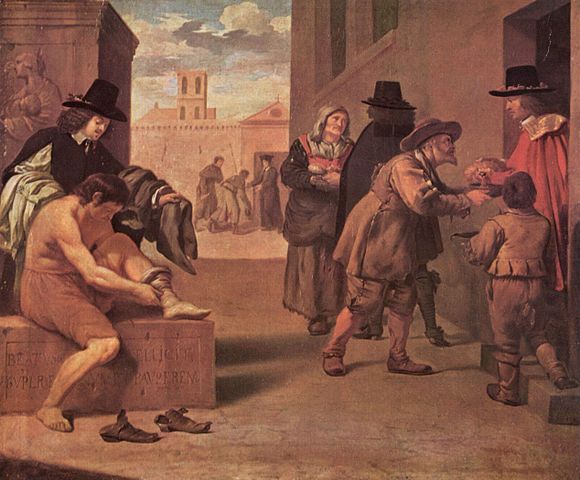
Works of Mercy (c. 1680), by Pierre Montallier (1643-1697) [public domain / Wikimedia Commons]
***
(10-10-13)
***
This took place spontaneously in a Facebook post announcing a new paper of mine. Bethany is a very friendly evangelical with Calvinist leanings. Her words will be in blue.
* * * * *
We are justified by our faith and our works, and it is not of ourselves. It’s not a contradiction when James says we are justified by works, because if we are saved we will necessarily have works…
For example, you can’t control your own conception or birth, and Jesus metaphorically explained salvation as being “born again”. A baby is born, not of his own will, but of God’s. A baby cannot will himself into existence, and neither can one dead in trespasses and sins will themselves into being made alive in Christ.
How do we know a baby is alive? By seeing if he is breathing, kicking, sucking, etc. By the baby’s works, we find evidence he has been born. This is the way we come to the conclusion that he is alive.
In the same way, our works “justify” in that they provide evidence for our rebirth. A baby can only be born once, and likewise one can be spiritually born only once.
We don’t disagree on those matters, as I noted.
So you don’t believe we in any way earn our salvation?
We can’t earn our salvation by our own efforts, considered in isolation from God’s grace (the heresy of Pelagianism). We can, however merit in God’s sight by applying the gift of God that He gave us (as St. Augustine put it: God “crowning His own gifts”), and working together with Him. After regeneration and initial justification we can do meritorious works, enabled and bathed in God’s grace.
These are not abstractly separated from salvation and put in a neat little box of “sanctification only,” as Reformed and other Protestants do. Since true biblical justification is infused and transformative, works are part of justification.
Hence we find that, e.g., in 50 Bible passages I’ve found about the final judgment, only works are mentioned and never faith. One cannot help but to find that striking.
If they’re not completely separated from salvation, isn’t that saying they play a role in achieving salvation?
Yes, in the sense I said. The problem is that Protestants almost always misunderstand the exact sense that Catholics believe in. 90% of all such discussions require time spent simply explaining what we believe, because the misunderstandings are so massive and systematic.
If you read my recent paper vs. James White, I explain much of this in it. I wrote in the paper, citing one of my own books [Bible Proofs for Catholic Truths]:
For the Catholic, justification is not the same thing as salvation or the attainment of eternal life. It can be lost or rejected by means of human free will and disobedience. So, to assert “justification by works,” even in a qualified sense, is not at all the same as asserting salvation by works. Therefore, it is scripturally improper to assert either salvation by works alone or salvation by faith alone. They are never taught in Holy Scripture, and are both denied more than once. Justification by faith or justification by works can be asserted in a limited sense, as Scripture does: always understood as hand-in-hand with the other two elements in the grace-faith-works triumvirate.
Also from the paper:
Catholics believe we are justified by faith and also by grace-based works done by the regenerate believer in conjunction with faith, as a co-laborer with God (1 Cor 3:9; 15:10; 2 Cor 6:1). . . . The Bible elsewhere freely places Rahab’s faith and works together. They are of a piece: neither can or should be ignored:
Hebrews 11:31 [RSV] By faith Rahab the harlot did not perish with those who were disobedient, because she had given friendly welcome to the spies.
Notice the “because” in the verse? Moreover, it is not foreign Scripture, to expressly state that works are the cause of justification or even a central criterion for eternal life. We’ve already noted this in Paul, above. Here it is again (repetition being a good teaching device):
Romans 2:13 For it is not the hearers of the law who are righteous before God, but the doers of the law who will be justified.
So you don’t believe the works themselves in any way merit salvation, except in the sense Protestants believe… That our works are the fruit of our salvation and not our means of earning or keeping it?
I did read most of the article… Okay I skimmed it… But I do feel confused about what you’re saying because it sounds like you’re saying two things.
I have talked to many Catholics who believe that you must work in order to enter heaven… Not as a result of salvation but the cause of it. I once had a friend who I asked, if you were standing before God and he asked you why he should let you into heaven, what would you say? She replied, not mentioning Christ once, but listing her various works.
And she was very scriptural, because that is what the Bible always gives as a reason to enter heaven. I found 50 of these passages.
But in the case of Rahab the harlot, the Bible also refers to her faith, which was the cause of her works.
I will send you my book on salvation: e-book in a PM. I also have lots of material on my Justification and Salvation page that goes over all these sorts of questions.
Thanks Dave, I’ll read it.
If we can tell God that he should let us in on the basis of our works, then that nullifies, “lest any man should boast.”
Why does Scripture mention works only every time it discusses the last judgment and being let into heaven or sent to hell? Matthew 25 is the classic . . . I wouldn’t argue that this means faith is no factor, but the fact remains that it is absent in all those accounts. Therefore, works cannot be separated from the equation of final salvation. But they are always accompanied by faith and enabled by God’s free grace.
It’s not boasting about works, but showing one’s genuine faith via works, as in James; showing that it is a real faith and not dead, lifeless, unfruitful faith.
It’s showing faith that on the basis of works, and not Christs atonement, God should allow you into heaven though. The question was “why should I let you in heaven”. If the answer to “why” is “because I was good”, that is boasting in your works to enter heaven.
The Bible talks about works the same reason I say a baby is alive because of his works (breathing, crying, etc.) Could a baby boast that he breathes? Or cries? Those abilities only came through the credit of God.
Whatever you call it; it’s scriptural. Our answer to God’s question of why we should go to heaven when we stand before Him, could incorporate any one or all of the following 50 responses: all perfectly biblical, and many right from the words of God Himself:
- I am characterized by righteousness.
- I have integrity.
- I’m not wicked.
- I’m upright in heart.
- I’ve done good deeds.
- I have good ways.
- I’m not committing abominations.
8 ) I have good conduct.- I’m not angry with my brother.
- I’m not insulting my brother.
- I’m not calling someone a fool.
- I have good fruits.
- I do the will of God.
- I hear Jesus’ words and do them.
- I endured to the end.
- I fed the hungry.
- I provided drink to the thirsty.
- I clothed the naked.
- I welcomed strangers.
- I visited the sick.
- I visited prisoners.
- I invited the poor and the maimed to my feast.
- I’m not weighed down with dissipation.
- I’m not weighed down with drunkenness.
- I’m not weighed down with the cares of this life.
- I’m not ungodly.
- I don’t suppress the truth.
- I’ve done good works.
- I obeyed the truth.
- I’m not doing evil.
- I have been a “doer of the law.”
- I’ve been a good laborer and fellow worker with God.
- I’m unblamable in holiness.
- I’ve been wholly sanctified.
- My spirit and soul and body are sound and blameless.
- I know God.
- I’ve obeyed the gospel.
- I’ve shared Christ’s sufferings.
- I’m without spot or blemish.
- I’ve repented.
- I’m not a coward.
- I’m not faithless.
- I’m not polluted.
- I’m not a murderer.
- I’m not a fornicator.
- I’m not a sorcerer.
- I’m not an idolater.
- I’m not a liar.
- I invited the lame to my feast.
- I invited the blind to my feast.
Where does Jesus get glory in all of that list?
It’s not boasting. We understand that it is from God. Yet we still did them, working with God’s grace, as Paul says: “working together with him . . . ” “Boasting” in the sense that Paul condemns would be saying that “I did these works with no help from God’s grace at all; therefore I have earned heaven.” That is the Pelagian heresy.
What he did on Calvary just seems ignored… And that is my main problem. He became sin for us. All of our sin was laid on him. By his stripes we were healed. Sin was inputed to him, and righteousness was imputed to us.
He gets the glory as the source of the grace that enabled all the works. This is what the Bible says: all that is straight from biblical accounts. If you say it is not giving God glory then your beef is with the Bible itself and Jesus and Paul’s and other’s words, not with Catholicism. Read Jesus’ words in Matthew 25:
Matthew 25:31-46 When the Son of man comes in his glory, and all the angels with him, then he will sit on his glorious throne. Before him will be gathered all the nations, and he will separate them one from another as a shepherd separates the sheep from the goats, and he will place the sheep at his right hand, but the goats at the left. Then the King will say to those at his right hand, `Come, O blessed of my Father, inherit the kingdom prepared for you from the foundation of the world; for I was hungry and you gave me food, I was thirsty and you gave me drink, I was a stranger and you welcomed me, I was naked and you clothed me, I was sick and you visited me, I was in prison and you came to me.’ Then the righteous will answer him, `Lord, when did we see thee hungry and feed thee, or thirsty and give thee drink? And when did we see thee a stranger and welcome thee, or naked and clothe thee? And when did we see thee sick or in prison and visit thee?’ And the King will answer them, `Truly, I say to you, as you did it to one of the least of these my brethren, you did it to me.’ Then he will say to those at his left hand, `Depart from me, you cursed, into the eternal fire prepared for the devil and his angels; for I was hungry and you gave me no food, I was thirsty and you gave me no drink, I was a stranger and you did not welcome me, naked and you did not clothe me, sick and in prison and you did not visit me.’ Then they also will answer, `Lord, when did we see thee hungry or thirsty or a stranger or naked or sick or in prison, and did not minister to thee?’ Then he will answer them, `Truly, I say to you, as you did it not to one of the least of these, you did it not to me.’ And they will go away into eternal punishment, but the righteous into eternal life.
But notice that the sheep asked him, when did we do these things? They did not recall their goodness for merit.
I hope you know I’m not trying to be annoying with these questions.
You’re not interacting with the biblical data . . . . this was the same problem with White’s chapter. He read into the text things that weren’t there, whereas I exegeted it and gave relevant cross-references.
When we stand before a righteous and holy God, can we really see ourselves as righteous except by his imputed righteousness? Isaiah cried, I am a man of unclean lips… Was he not a righteous man?
Yes, and now you’ve stumbled into why purgatory is so necessary. Thanks! We make it to heaven because we’ve exercised faith by God’s grace, in Jesus; accepting His death on the cross on our behalf; exhibited by works. Now we have to be made actually holy and without sin, and that’s where purgatory is necessary for almost all of us.
No; that is the reason that atonement is necessary. That is why when God asks, “why should I let you into heaven?” I can say , “thank you for providing a lamb to take place of me, taking on the full penalty for all of my sins, so that I could enter heaven. Thank you for your promise, your free gift.” Purgatory implies that Jesus payment was not enough.
You can say that; sure. My point was that whenever Scripture deals with this exact topic, that is never what it describes as being said; rather, it’s always works. And that is what you have to grapple with: why that is. The same Jesus also said:
Matthew 7:16-23 You will know them by their fruits. Are grapes gathered from thorns, or figs from thistles? [17] So, every sound tree bears good fruit, but the bad tree bears evil fruit. [18] A sound tree cannot bear evil fruit, nor can a bad tree bear good fruit. [19] Every tree that does not bear good fruit is cut down and thrown into the fire. [20] Thus you will know them by their fruits. [21] “Not every one who says to me, `Lord, Lord,’ shall enter the kingdom of heaven, but he who does the will of my Father who is in heaven. [22] On that day many will say to me, `Lord, Lord, did we not prophesy in your name, and cast out demons in your name, and do many mighty works in your name?’ [23] And then will I declare to them, `I never knew you; depart from me, you evildoers.’
Ok well I will agree to disagree for now.
Like I said, you’re not disagreeing with me, but multiple instances of inspired Scripture. All I’ve done is cite Scripture on this. James explains all of this nicely, and that was the topic of White’s chapter that I replied to:
James 2:14-26 What does it profit, my brethren, if a man says he has faith but has not works? Can his faith save him? [15] If a brother or sister is ill-clad and in lack of daily food, [16] and one of you says to them, “Go in peace, be warmed and filled,” without giving them the things needed for the body, what does it profit? [17] So faith by itself, if it has no works, is dead. [18] But some one will say, “You have faith and I have works.” Show me your faith apart from your works, and I by my works will show you my faith. [19] You believe that God is one; you do well. Even the demons believe — and shudder. [20] Do you want to be shown, you shallow man, that faith apart from works is barren? [21] Was not Abraham our father justified by works, when he offered his son Isaac upon the altar? [22] You see that faith was active along with his works, and faith was completed by works, [23] and the scripture was fulfilled which says, “Abraham believed God, and it was reckoned to him as righteousness”; and he was called the friend of God. [24] You see that a man is justified by works and not by faith alone. [25] And in the same way was not also Rahab the harlot justified by works when she received the messengers and sent them out another way? [26] For as the body apart from the spirit is dead, so faith apart from works is dead.
Echoed by Paul:
Romans 2:5-13 But by your hard and impenitent heart you are storing up wrath for yourself on the day of wrath when God’s righteous judgment will be revealed. [6] For he will render to every man according to his works: [7] to those who by patience in well-doing seek for glory and honor and immortality, he will give eternal life; [8] but for those who are factious and do not obey the truth, but obey wickedness, there will be wrath and fury. [9] There will be tribulation and distress for every human being who does evil, the Jew first and also the Greek, [10] but glory and honor and peace for every one who does good, the Jew first and also the Greek. [11] For God shows no partiality. [12] All who have sinned without the law will also perish without the law, and all who have sinned under the law will be judged by the law. [13] For it is not the hearers of the law who are righteous before God, but the doers of the law who will be justified.
I’m sorry I realized that sounded abrupt. I didn’t mean it to sound that way. I had a baby crying in the background so had to tend to him.
We have both cited Scripture. You more than me since I was basically asking questions, but I agree with all the scripture you post. We have disagreement on the interpretation of those scriptures. You agree there, I’m sure.
No problem, Bethany!
*****

Next Post
October 28, 2013 Introduction to Dave Armstrong's Book, "Debating James White"
Browse Our Archives
Select a Category & Last Things About Me Anti-Catholicism Atheism & Agnosticism Baptism and Sacramentalism Bible and Tradition Blessed Virgin Mary Books by Dave Armstrong C. S. Lewis Calvinism & General Protestantism Catholic Apologetics Catholic Apologists Catholic conversion Catholic converts Christmas Church (Ecclesiology) Church History Conversion and Converts Development of Doctrine Eastern Orthodoxy Ecumenism & Christian Unity Eucharist & Liturgy Fathers of the Church French Translations G. K. Chesterton Hell Hell & Satan Hell & Satan & Last Things Heresies & Comparative Religion Holistic Health Inquisition & Crusades & Scandals James White Jews & Judaism & Old Testament John Calvin John Henry Newman Liberal / Modernist Theology Life Issues Literary Resume Lutheranism Mariology Martin Luther Music Orthodoxy Papacy & Infallibility Personal Page Philosophy & Science Political & Ethical & Moral Issues Protestant Persecution & Intolerance Protestantism Purgatory Purgatory & Penance Romantic & Imaginative Theology Saints & Purgatory & Penance Salvation Salvation & Justification Satan & Last Things Sexuality and Gender Issues Spanish Translations Traditionalism vs. Radical Catholic Reactionaries Traducciones al español / tradução para português Trinitarianism & Christology Uncategorized Videos
Select a Month October 2026 September 2026 August 2026 July 2026 June 2026 May 2026 April 2026 March 2026 February 2026 January 2026 December 2025 November 2025 October 2025 September 2025 August 2025 July 2025 June 2025 May 2025 April 2025 March 2025 February 2025 January 2025 December 2024 November 2024 October 2024 September 2024 August 2024 July 2024 June 2024 May 2024 April 2024 March 2024 February 2024 January 2024 December 2023 November 2023 October 2023 September 2023 August 2023 July 2023 June 2023 May 2023 April 2023 March 2023 February 2023 January 2023 December 2022 November 2022 October 2022 September 2022 August 2022 July 2022 June 2022 May 2022 April 2022 March 2022 February 2022 January 2022 December 2021 November 2021 October 2021 September 2021 August 2021 July 2021 June 2021 May 2021 April 2021 March 2021 February 2021 January 2021 December 2020 November 2020 October 2020 September 2020 August 2020 July 2020 June 2020 May 2020 April 2020 March 2020 February 2020 January 2020 December 2019 November 2019 October 2019 September 2019 August 2019 July 2019 June 2019 May 2019 April 2019 March 2019 February 2019 January 2019 December 2018 November 2018 October 2018 September 2018 August 2018 July 2018 June 2018 May 2018 April 2018 March 2018 February 2018 January 2018 December 2017 November 2017 October 2017 September 2017 August 2017 July 2017 June 2017 May 2017 April 2017 March 2017 February 2017 January 2017 December 2016 November 2016 October 2016 September 2016 August 2016 July 2016 June 2016 May 2016 April 2016 March 2016 February 2016 January 2016 December 2015 November 2015 October 2015 September 2015 August 2015 July 2015 June 2015 May 2015 April 2015 March 2015 February 2015 January 2015 December 2014 November 2014 October 2014 September 2014 August 2014 July 2014 June 2014 April 2014 March 2014 February 2014 January 2014 December 2013 November 2013 October 2013 September 2013 August 2013 July 2013 June 2013 April 2013 March 2013 February 2013 January 2013 December 2012 November 2012 October 2012 September 2012 August 2012 July 2012 June 2012 May 2012 April 2012 March 2012 February 2012 January 2012 December 2011 November 2011 October 2011 September 2011 August 2011 July 2011 June 2011 April 2011 March 2011 February 2011 October 2010 September 2010 August 2010 July 2010 April 2010 March 2010 December 2009 October 2009 August 2009 July 2009 June 2009 May 2009 March 2009 February 2009 October 2008 September 2008 April 2008 March 2008 February 2008 January 2008 December 2007 November 2007 October 2007 May 2007 March 2007 February 2007 January 2007 November 2006 October 2006 September 2006 August 2006 July 2006 June 2006 May 2006 April 2006 March 2006 February 2006 October 2005 June 2005 April 2005 February 2005 July 2004 May 2004 April 2004
Follow Us!
TAKE THE
Religious Wisdom Quiz
What does "Paraclete," as used for the Holy Spirit, mean?
Select your answer to see how you score.
Helper or advocate Friend Sacrifice King
Books by This Author Books by Dave Armstrong
Related posts from Biblical Evidence for Catholicism

Bible & Catholicism on Mortal Sin (vs. John...
Biblical Evidence for Catholicism

Dialogue on Eternal Security / Absolute Assurance
Biblical Evidence for Catholicism

"Faith Alone" Dialogue with a Calvinist
Biblical Evidence for Catholicism

Exegesis of 75 NT Faith [Alone?] & Works...
Biblical Evidence for Catholicism
TRENDING AT PATHEOS Catholic

The Sermon on the Mount, Part I: Matthew...
The Sermon on the Mount, Part I (Matthew 4:12-5:12) St. Matthew moves...

What's up from Crossway: Reviewing some of their latest A few weeks...

Janie Learns the Way of the Cross: A...
Teaching children about Jesus' Passion can be challenging. Many parents and educators...

Looking For Good Catholic Writing - October 2026
He alone extends the heavens, and he walks upon the waves of...

In "Irreplaceable," our book on vocation and technology, Trevor Sutton and I...

I was strolling through the top floor of the brand new Parthenon...
view all Catholic blogs
Ad-Free & Subscriber Log-In Subscription Support
- About Us
- 2026 Calendar
- Videos
- Podcasts
- Library of World Religions
- Faith In Media Tracker
- Advertise With Us
- Write for Us
- Privacy Policy
- Terms of Service
- Do Not Sell My Data
- Contact Us
- Radiant Digital
- Manage Newsletter Subscriptions
- Unsubscribe From Notifications
- Sitemap
Copyright 2008-2026, Patheos. All rights reserved.
Subscription Support Ad-Free & Subscriber Log-In
Follow Patheos