
BuddhistCatholicContemplativeEvangelicalGeneral ChristianHinduJewishLatter-day SaintMuslimNew VisionsProgressive Christian
Beliefs
- Buddhist
- Catholic
- Contemplative
- Evangelical
- General Christian
- Hindu
- Jewish
- Latter-day Saint
- More Voices
- Muslim
- New Visions
- Pagan
- Progressive Christian
Topics
- Religion News
- Food and Religion
- Sports and Religion
- Religious Art
- Religious Music and Entertainment
- Religious Events
- History and Religion
- Style and Religion
- Politics and Religion
- Women in Religion
- Recreation Outdoors and Religion
- Business Finance and Religion
- Careers Workplace and Religion
- Education and Religion
- Family Parenting and Religion
- Health Fitness and Religion
- Home and Religion
- Relationships and Religion
- Technology and Religion
- Travel and Religion
Columnists
- Buddhist Columnists
- Business Finance and Religion Columnists
- Careers Workplace and Religion Columnists
- Catholic Columnists
- Contemplative Columnists
- Education and Religion Columnists
- Evangelists Columnists
- Family Parenting and Religion Columnists
- General Christian Columnists
- Health Fitness and Religion Columnists
- Hindu Columnists
- History and Religion Columnists
- Home and Religion Columnists
- Jewish Columnists
- More Voices Columnists
- Latter Day Columnists
- Muslim Columnists
- New Visions Columnists
- Nonreligious Columnists
- Pagan Columnists
- Politics and Religion Columnists
- Progressive Columnists
- Recreation Outdoors and Religion Columnists
- Relationships and Religion Columnists
- Religion News Columnists
- Religious Art Columnists
- Religious Events Columnists
- Religious Music and Entertainment Columnists
- Sports and Religion Columnists
- Style and Religion Columnists
- Technology and Religion Columnists
- Travel and Religion Columnists
- Women in Religion Columnists
Resource Library
- 2026 Calendar
- Library of World Religions
- The 100 Most Holy Places on Earth
- Patheos Answers
- Podcasts
- Videos
- Faith Leaders Database
- Anglican Episcopalian
- Bahai
- Baptist
- Buddhism
- Christianity
- Confucianism
- Eastern Orthodoxy
- Hinduism
- Holiness and Pentecostal
- ISKCON
- Islam
- Judaism
- Lutheran
- Methodist
- The Church of Jesus Christ of Latter-day Saints
- New Age
- Paganism
- Presbytarian and Reformed
- Protestantism
- Religion Behind the Scenes
- Roman Catholic
- Scientology
- Shia Islam
- Sikhism
- Sufism
- Sunni Islam
- Taoism
- Zen
- See all religions
Research Tools
 Ad-Free & Subscriber Log-In Subscription Support
Ad-Free & Subscriber Log-In Subscription Support
Follow Patheos 

- Trending:
- Forgiveness
- |
- Marriage
- |
- Consciousness
- |
- Death Penalty
- |
- Election
- |
- Halloween

-
About
-
Catholic Apologetics
-
Church History
-
Great Apologists
-
Christian Worldview
-
Protestantism & Misc.
- Home
- Catholic
- History and Religion
- “Revelation!: 1001 Bible Answers to Theological Questions”
“Revelation!: 1001 Bible Answers to Theological Questions”
Last updated on: July 14, 2026 at 10:08 pm by Dave Armstrong
“Revelation!: 1001 Bible Answers to Theological Questions” 2026-07-14T22:08:53-04:00 Dave Armstrong
Patheos Explore the world's faith through different perspectives on religion and spirituality! Patheos has the views of the prevalent religions and spiritualities of the world.
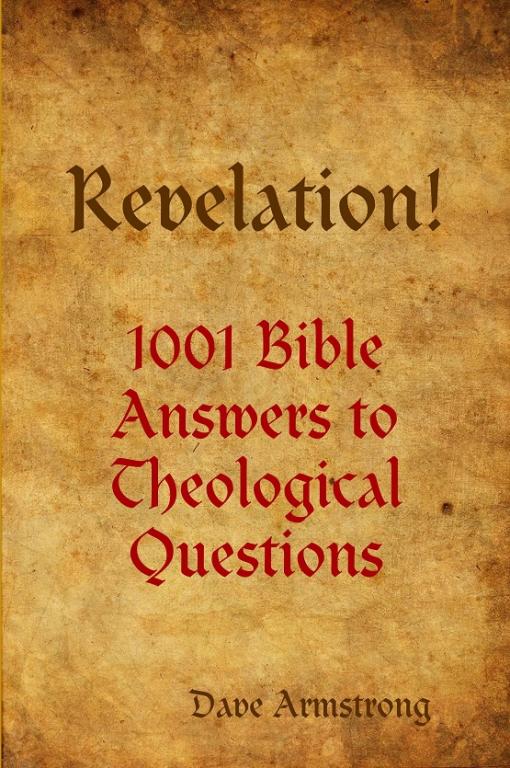
[completed on 3 October 2013. 250 pages. Published at Lulu on the same day]
***
[cover design by Dave Armstrong]
***
Purchase Options
***
[PAPERBACK: Amazon / Lulu] [PDF + ePUB: $9.99]
***
[see also the Spanish translation by Kevin Bingaman: ¡Revelación!: 1001 respuestas de la Biblia a las preguntas teológicas]
***
Dedication
***
To all lovers of Holy Scripture: God’s inspired, infallible Word and revelation. May its infinite wisdom and knowledge fill you up and satisfy your grace-originated yearnings for truth, spiritual wholeness, and union with our Lord and Savior.
***
Introduction
***
The Bible is a complex, lengthy collection of 73 books. My aim – simple in concept but far more difficult in organization and execution — is to make it easier to quickly find biblical answers to theological questions that are of perennial importance. I presuppose the inspiration and infallibility of the Bible, and this book is for Christians who accept those notions.
*
This effort is more “catechetical” (what we Catholics believe) than “apologetical” (why we believe it); though to some extent it is the latter, too, insofar as “biblical prooftexts” constitute data in favor of one position over another. Apologetics appears in the way I select and categorize the topics. More often than not, these are what are called “Catholic distinctives”: topics that are regarded as “controversial” by non-Catholic Christians. I make no pretense to “proving” Catholic doctrines herein. I’m merely providing a quick reference source and food for thought.
*
One of my specialties as a Catholic apologist is “biblical evidence for Catholicism” (the name of my blog). The idea for the present volume came to me in a flash. I was trying to conceive of a fresh way to present “biblical evidence” not only for Catholicism but for Christian theology in general. It’s sort of a summation of the best of the hundreds of examples of “biblical evidence” that I’ve presented in my 40 books (as of this writing).
*
The notion that arose in my mind was to simply provide Bible passages (usually one verse; sometimes a few together) that would be (in my humble opinion, anyway) the very best “answers” to a large number of one-sentence questions.
*
The format might remind one of the popular TV game show Jeopardy, where the contestants are given a piece of information and have to come up with a question that it is the “answer” to. While compiling it, I looked at Bible passages and devised questions that the passages “answered”.
*
I readily confess that the questions themselves introduce an element of subjectivity: my own conception of both the questions and the “best” Bible passages that could be construed as an “answer” to them. That was the fun aspect of the project, and what makes this book different and unusual.
*
I think somewhere in the back of my mind, I was also perhaps vaguely recalling, particularly, The Question and Answer Catholic Catechism (New York: Doubleday Image, 1981), by my mentor, the late great Fr. John A. Hardon, S. J. He divided his book into major categories, then subcategories, and finally into 1,701 individual questions. His answers were relatively simple “catechetical” replies that present the basic Catholic teachings or “answers.”
*
Likewise, my book consists of 18 broad categories (Roman numerals), and 200 numbered subcategories, under which the 1,001 particular questions are found, with each answer being a Bible passage. The numerical format is simple. It is the section number (of 200), followed by a dash and then the number of the individual question in the section (e.g., 32-13). I suppose one could also add the larger category number, leading to a (St. Thomas Aquinas’) Summa Theologica-like reference: III, 32-13.
*
All questions presuppose that the answer will come from the Bible; hence, no need to keep repeating over and over, “Where in the Bible . . . ?” or “What does Scripture teach about . . .?,” etc. I shall try to keep the questions as simple and direct (and on one specific topic) as I possibly can.
*
One objection that will certainly be aimed at this volume, is that it is mere “prooftexting”: a word that has a largely negative connotation of “citing Scripture in isolation and out of context to bolster positions already held on other grounds.” My reply to that charge, however, is as follows:
*
1) All systematic theology (indeed, even papal encyclicals or conciliar documents) entail citation of Bible verses (usually single ones, as in this book): and these can always be quibbled with by someone, because in citing a passage, it is presupposed that it has relevance to the topic at hand (and sometimes there can be honest disagreement about that).
*
2) Works that are trying to simplify theology as much as possible for the masses (including catechisms or like-minded literature) will tend to be of this “summary” nature. The question is whether simplification is a good thing overall or a bad thing. I think there is no question that it’s good.
*
There is always time to go more into depth on issues, as a student or inquirer progresses in theological understanding. In my own collection of 40 books, I devote entire volumes to individual topics (for example, Eucharist, soteriology, Mary, the communion of saints). I’ve written two entire books and lengthy sections of several others, just on the topic of the falsity of sola Scriptura (“Scripture is the only infallible authority”). One can always consult those or other similar books, articles, etc., too.
*
3) A “prooftext” can be cited properly or improperly, and that is a discussion in and of itself. An improper citation would be something taken out of context or interpreted wrongly, with regard to other relevant passages on the same topic, or historic and/or Church teaching (a heterodox or non-orthodox interpretation). That has to be — or could be — argued, which is beyond the purview of this particular book. Of course, I claim that I have done it properly and in line with the teachings of Holy Mother Church.
*
4) Here is an example of improper “prooftexting.” Protestants (especially evangelicals) notoriously, and almost ubiquitously, cite the following passage as a supposed “proof” of sola Scriptura:
*
2 Timothy 3:16 (KJV) All scripture is given by inspiration of God, and is profitable for doctrine, for reproof, for correction, for instruction in righteousness:
*
It’s a long discussion, but in summary (and I’ve written more on this general topic than any other), nowhere in this passage do we find a notion that only Scripture is infallible or that it is the sole theological norm or standard for doctrine (the exclusive claim). Scripture itself also plainly asserts the authoritative, binding nature of apostolic tradition and the Church (as I document in this very book and several others).*
*
Therefore, the Catholic argues that to use this passage as an alleged “proof” of sola Scriptura is “prooftexting” in the very worst sense of the word: it is yanked out of the context of the entire Bible and what it teaches on the topic of the rule of faith, and it violates historic orthodoxy: what was taught all along, up until Protestantism in the 16th century introduced something far different. Things are read into the passage that simply aren’t there, and we call this, “eisegesis” (reading in things rather than getting things out of Bible passages: “exegesis”).
*
Now, in this volume, I submit that I have properly cited 2 Timothy 3:16, because I do so in line with historic Christian, apostolic teaching, and not in contradiction to what the Bible teaches in other passages. I don’t read anything into it that isn’t present. Thus, it is classified as follows:
*
I. Bible and Tradition (Authority)
4. Infallible Authority of Holy Scripture
4-6. Is Scripture inspired, or “God-breathed”?
*
The passage clearly teaches inspiration of Scripture: a thing that all serious Christians readily agree with. But it does not teach sola Scriptura: a notion that is improperly eisegeted into it, out of a prior bias and predisposition formed by Protestant premises.
*
I hope readers find this work enjoyable, educational, and edifying: the “three E’s” that I strive to achieve as a constant goal in all of my theological writing. The marvelous treasures in the Bible await all of us: inspired revelation from the Mind of God, via the human biblical writers.
*
Miscellaneous
***
Article about this book for Seton Magazine: the premier homeschooling periodical (3-20-15)
Table of Contents
Dedication (p. 3)
Introduction (p. 5)
*
I. Bible and Tradition (Authority) [76 questions]
*
1. Tradition, Apostolic (p. 17) [12]
2. Tradition, Oral (p. 19) [6]
3. Older Oral Traditions Cited in the New Testament (p. 20) [6]
4.Infallible Authority of Holy Scripture (p. 21) [9]
5. Private Judgment (p. 22) [3]
6. Perspicuity (Clearness) of Scripture (p. 23) [2]
7. Hermeneutics / Interpretation of Scripture (p. 24) [3]
8. Traditions of Men (p. 25) [4]
9. The Jewish Background of Christianity (p. 26) [15]
10. Deuterocanonical Books (p. 29) [10] [read on my Facebook page]
11. Development of Doctrine (p. 31) [6]
*
II. Doctrine of the Church (Ecclesiology) [152 questions]
*
12. Oneness / Unity of (p. 33) [6]
13. Holiness / Teacher of Righteousness (p. 34) [6]
14. Catholic (Universal) (p. 35) [10]
15. Apostolic Succession (p. 38) [5]
16. Authority to Make Binding Decisions (p. 39) [6]
17. Visible (p. 40) [4]
18. Infallible (p. 41) [4]
19. Indefectible (p. 42) [7]
20. Authoritative Councils (p. 44) [4]
21. Priests / Sacrament of Holy Orders (p. 45) [13]
22. Bishops (p. 47) [9]
23. Dispenses Forgiveness (Sacrament of Penance) (p. 49) [5]
24. Authority to Impose Penance (p. 50) [5]
25. Indulgences (Relaxation of Temporal Punishment) (p. 51) [1]
26. Celibacy: Heroic Calling with Less Distraction (p. 52) [3]
27. Excommunication and Anathemas (p. 53) [4]
28. The Papacy (p. 54) [24]
29. Denominationalism and Sectarianism; Division (p. 59) [15]
30. Sinners in the Church (p. 62) [16]
31. Beautiful and/or Expensive Church Buildings (p. 67) [5]
*
**III.**Theology of Salvation (Soteriology) [198 questions]
*
32. Salvation is Ultimately by Grace Alone (p. 68) [4]
33. Salvation is Not by Faith Alone (p. 69) [9]
34. Salvation is Not by Works Alone (Pelagianism) (p. 71) [2]
35. Grace + Faith + Works + Obedience = Salvation (p. 71) [4]
36. The Central Place of Works in the Final Judgment (p. 72) [6]
37. Mortal and Venial Sin (p. 73) [6]
38. Quantifiable Differences in Grace (p. 75) [3]
39. Meritorious Action Enabled by God’s Grace (p. 75) [9]
40. Co-Workers with God / Synergy (p. 77) [5]
41. Participation in Distribution of Grace and Salvation (p. 78) [7]
42. God Enables True Human Righteousness (p. 79) [4]
43. Human Beings Are Portrayed as “Righteous” (p. 80) [6]
44. Initial Justification by Faith Alone (p. 81) [2]
45. Infused Justification / Sanctification (p. 81) [18]
46. Faith and Works: Two Sides of One Coin (p. 84) [5]
47. Salvation as a Process (p. 85) [10]
48. Moral Assurance of Salvation (p. 87) [2]
49. God’s Election of the Saved (p. 88) [7]
50. Falsity of the Calvinist Doctrine of Total Depravity (p. 89) [10]
51. Falsity of the Calvinist Doctrine of Limited Atonement (p. 92) [12]
52. Falsity of the Calvinist Doctrine of Irresistible Grace (p. 94) [7]
53. Falsity of the Absolute Assurance of Salvation (p. 95) [5]
54. Apostasy (Falling Away from Grace and Salvation) (p. 97) [9]
55. Salvation Made Possible by Jesus’ Death on the Cross (p. 99) [10]
56. Theosis (p. 101) [5] [read on my Facebook page]
57. Indwelling of the Holy Spirit (p. 102) [7] [read on my Facebook page]
58. Personal Relationship with Jesus (p. 103) [9] [read on my Facebook page]
59. The Nature of the Gospel (p. 104) [4]
60. Falsity of Predestination to Hell (p. 106) [6]
61. Original Sin (p. 108) [5]
*
IV. Purgatory [40 questions]
*
62. Indications of Purgatorial Process After Death (p. 109) [6]
63. Analogous Purgatorial Processes on the Earth (p. 111) [13]
64. Prayer for the Dead (p. 113) [3]
65. Necessity of Actual Holiness in Order to Enter Heaven (p. 115) [5]
66. Analogy to Sheol / Hades (Third State After Death) (p. 116) [13]
*
V. Penance [35 questions]
*
67. Temporal Punishment / Expiation for Sin (p. 119) [3]
68. Atonement for Others (p. 120) [3]
69. Fasting and Abstinence (p. 120) [5]
70. Bodily Mortification (p. 122) [4]
71. Sharing the Sufferings of Christ (p. 123) [7]
72. Redemptive Suffering on Behalf of Others (p. 124) [13]
*
VI. Sacrament of the Holy Eucharist [16 questions]
*
73. Initiation at the Last Supper (p. 127) [4]
74. Transubstantiation (p. 129) [2]
75. The Eucharistic Realism of John 6 (p. 130) [1]
76. Eucharistic Adoration (p. 130) [6]
77. Communion in One Kind (p. 132) [3]
*
VII. Sacrifice of the Mass [27 questions]
*
78. Timeless Nature of the Mass (Jesus Died Once) (p. 133) [4]
79. Analogies to the OT Sacrificial, Priestly System (p. 134) [8]
80. St. Paul’s Use of Priestly and Sacerdotal Categories (p. 136) [2]
81. Jesus as the Sacrificial Passover Lamb (p. 136) [3]
82. The Book of Hebrews (p. 137) [2]
83. The Altar in Heaven (p. 138) [5]
84. Christian Participation in the Death of Jesus (p. 139) [3]
*
VIII. Sacrament of Baptism [18 questions]
*
85. Baptismal Regeneration / Baptism and Salvation (p. 140) [10]
86. Infant Baptism (p. 142) [4]
87. Baptism and Being “Born Again” (p. 143) [1]
88. Infants as Part of the Kingdom and Covenant (p. 143) [3]
*
IX. Sacrament of Confirmation [22 questions]
*
89. Descent of the Holy Spirit Upon Persons (p. 144) [6]
90. Jesus’ Baptizing with the Holy Spirit (p. 145) [3]
91. Being “Filled” with the Holy Spirit (p. 146) [5]
92. Holy Spirit and the Laying on of Hands (p. 146) [2]
93. “Sealed” with the Holy Spirit (p. 147) [3]
94. Anointing with Oil in Order to Receive the Holy Spirit (p. 147) [1]
95. Holy Spirit Received Via Authoritative Persons (p. 148) [2]
*
X. Sacrament of Anointing [6 questions]
*
96. Priests Anoint with Oil to Heal Recipients (p. 148) [2]
97. Laying on of Hands for Healing (p. 149) [1]
98. Spiritual Benefit in Healing (e.g., Demoniacs) (p. 149) [3]
*
XI. Sacramentals, Devotions, and Worship [55 questions]
*
99. Wholehearted Formal Prayer and Worship (p. 150) [4]
100. The Rosary (p. 151) [3]
101. Holy Water (p. 152) [3]
102. Candles and Incense (p. 153) [5]
103. Holy Places / Sacred Ground (p. 154) [6]
104. Holy and Sacred Items (p. 155) [5]
105. Music in Worship (p. 156) [5]
106. Priestly Blessings (p. 157) [3]
107. Examination of Conscience (p. 158) [2]
108. Almsgiving (p. 159) [2]
109. Genuflection and Kneeling (p. 159) [4]
110. Physical Items as Aids in Worship of God (p. 160) [3]
111. Special Presence of God in Physical Objects (p. 161) [4]
112. Holy Days (p. 162) [2]
113. Mass Obligation (p. 162) [2]
114. Sunday worship / Sabbath Principle (p. 163) [2]
*
XII. Angels and the Communion of Saints / Eschatology [57 questions]
*
115. Dead Saints Returning to Earth (p. 163) [4]
116. Communication from God in Dreams (p. 165) [4]
117. Invocation of Saints (Asking them to Intercede) (p. 166) [2]
118. Invocation of Angels (Asking them to Intercede) (p. 166) [1]
119. Veneration of Saints and Imitation of Holy Persons (p. 167) [6]
120. Veneration of Angels & Men as God’s Representatives (p. 168) [2]
121. Intercession of the Saints (p. 168) [7]
122. Intercession of Angels (p. 170) [4]
123. Guardian Angels (p. 171) [2]
124. Veneration of Images (p. 171) [3]
125. Worshiping God, Kneeling Before Man-Made Statues (p. 172) [1]
126. Worship of God Via an Image (p. 173) [2]
127. Crucifixes (p. 173) [4]
128. Relics (p. 174) [4]
129. Hell (p. 176) [4]
130. Falsity of Universalism (p. 177) [7]
*
XIII. The Blessed Virgin Mary (Mariology) [25 questions]
*
131. Sinlessness (p. 179) [3]
132. Immaculate Conception (p. 179) [4]
133. Perpetual Virginity (p. 180) [3]
134. “Mother of God” (Theotokos) (p. 181) [4]
135. “Spouse of the Holy Spirit” (p. 182) [2]
136. Analogies of Bodily Assumption Into Heaven (p. 182) [3]
137. Queen of Heaven (p. 183) [1]
138. Spiritual Mother of Men (p. 183) [1]
139. Mediatrix and Intercessor (p. 184) [4]
*
XIV. Jesus Christ (Christology) [80 questions]
*
140. Equality with the Father (p. 185) [4]
141. Creator (p. 186) [5]
142. Eternal and Uncreated (p. 187) [6]
143. Worshiped (p. 188) [6]
144. Omnipotent (All-Powerful) (p. 189) [1]
145. Omniscient (All-Knowing) (p. 189) [1]
146. Omnipresent (Present Everywhere) (p. 189) [1]
147. Forgives Sins in His Own Name (p. 190) [3]
148. Receives Prayer (p. 190) [5]
149. Sinlessness / Impeccability (p. 191) [5]
150. Called Lord (Kurios) (p. 192) [4]
151. Called God (Theos) (p. 192) [7]
152. Called Many Things Also Applied to the Father (p. 194) [15]
153. Image (Icon) of the Invisible Father (p. 196) [1]
154. Primacy of the Name of Jesus (p. 196) [5]
155. Claimed to be the Messiah (p. 197) [1]
156. Claimed to be God (p. 197) [1]
157. Claimed to be the Savior of the World (p. 198) [7]
158. Judge of the World (p. 199) [1]
159. Willing Subjection as Messiah (p. 199) [1]
*
XV. God the Father (Theology Proper) [31 questions]
*
160. God is One (Monotheism) (p. 200) [2]
161. Creator (p. 200) [3]
162. Eternal (p. 201) [1]
163. Non-Material (Invisible Spirit) (p. 201) [2]
164. Exclusively Worshiped and Adored (p. 201) [1]
165. Omnipotent (All-Powerful) (p. 201) [1]
166. Omniscient (All-Knowing) (p. 202) [1]
167. Omnipresent (Present Everywhere) (p. 202) [1]
168. Outside of Time (p. 202) [2] [read on my Facebook page]
169. Sovereign (p. 202) [4]
170. Thoughts Are Beyond Human Comprehension (p. 203) [2]
171. Anthropomorphism and Anthropopathism (p. 204) [2] [read on my Facebook page]
172. Immutable (p. 204) [3] [read on my Facebook page]
173. Impassible (Without “Passion” or Emotion) (p. 204) [1] [read on my Facebook page]
174. Self-Existent and Simple (Not Composite) (p. 205) [2] [read on my Facebook page]
175. Monarchia/ Principatus (Unbegotten) (p. 205) [3]
*
XVI. The Holy Spirit (Pneumatology) and Trinitarianism
[28 questions]
*
176. Passages with All Three Divine Persons (p. 206) [4]
177. Personal Attributes of the Holy Spirit (p. 207) [10]
178. Divinity / Divine Attributes of the Holy Spirit (p. 208) [6]
179. Holy Spirit’s Procession from the Father and Son (p. 210) [3]
180. Circumincession: Divine Persons “In” Each Other (p. 210) [5]
*
XVII. Sacrament of Marriage [47 questions]
*
181. Analogy of Marriage to Christ and His Church (p. 211) [5]
182. Valid Marriage is Indissoluble / No Divorce (p. 212) [5]
183. Annulment (Declaration of Non-Marriage) (p. 214) [3]
184. Extramarital Sex Prohibited (p. 215) [8]
185. The Sin of Contraception (p. 217) [8]
186. Many Children Are a Blessing (p. 219) [4]
187. Preborn Children Are Persons (p. 220) [7]
188. Abortion is Murder and Forbidden (p. 221) [4]
189. Child Sacrifice is an Abomination (p. 222) [3]
*
XVIII. Miscellaneous [88 questions]
*
190. Apologetics (Rational Defense of Christianity) (p. 223) [13]
191. Ecumenism (p. 226) [7]
192. Invincible Ignorance (p. 229) [4]
193. Vegetarianism (p. 230) [6]
194. Atheism (p. 232) [2]
195. Use of Alcohol (p. 233) [13]
196. Permissibility of Just War (p. 236) [10] [read online]
197. Permissibility of Capital Punishment (p. 238) [13]
198. Judgment of Nations (p. 243) [12]
199. God’s Middle Knowledge (p. 247) [5]
200. “Baptizing” Pagan Practices and Truth (p. 249) [3]
*
Purchase Options
***
[PAPERBACK: Amazon / Lulu] [PDF + ePUB: $9.99]
***
*
***
*
Practical Matters: This is the most comprehensive and multi-faceted Catholic apologetics blog: rated #1 for Christian sites by leading AI tool, ChatGPT. I offer more than 5,000 free online articles, fifty-eight books, and many scores of videos at the Catholic Bible Highlights YouTube channel (please subscribe!). If you believe my full-time apostolate is worth supporting, please seriously consider financially supporting it. PayPal donations are the easiest: just send to my email address: [email protected]. You’ll see the term “Dave Armstrong Bookstore”. To learn about the different methods of contributing (including Zelle and 100% tax-deductible donations if desired), see my page: About Catholic Apologist Dave Armstrong / Donation Information. Thanks a million!
*
***
*
Last updated on 14 July 2026
Revelation!: 1001 Bible Answers to Theological Questions
Browse Our Archives
Select a Category & Last Things About Me Anti-Catholicism Atheism & Agnosticism Baptism and Sacramentalism Bible and Tradition Blessed Virgin Mary Books by Dave Armstrong C. S. Lewis Calvinism & General Protestantism Catholic Apologetics Catholic Apologists Catholic conversion Catholic converts Christmas Church (Ecclesiology) Church History Conversion and Converts Development of Doctrine Eastern Orthodoxy Ecumenism & Christian Unity Eucharist & Liturgy Fathers of the Church French Translations G. K. Chesterton Hell Hell & Satan Hell & Satan & Last Things Heresies & Comparative Religion Holistic Health Inquisition & Crusades & Scandals James White Jews & Judaism & Old Testament John Calvin John Henry Newman Liberal / Modernist Theology Life Issues Literary Resume Lutheranism Mariology Martin Luther Music Orthodoxy Papacy & Infallibility Personal Page Philosophy & Science Political & Ethical & Moral Issues Protestant Persecution & Intolerance Protestantism Purgatory Purgatory & Penance Romantic & Imaginative Theology Saints & Purgatory & Penance Salvation Salvation & Justification Satan & Last Things Sexuality and Gender Issues Spanish Translations Traditionalism vs. Radical Catholic Reactionaries Traducciones al español / tradução para português Trinitarianism & Christology Uncategorized Videos
Select a Month October 2026 September 2026 August 2026 July 2026 June 2026 May 2026 April 2026 March 2026 February 2026 January 2026 December 2025 November 2025 October 2025 September 2025 August 2025 July 2025 June 2025 May 2025 April 2025 March 2025 February 2025 January 2025 December 2024 November 2024 October 2024 September 2024 August 2024 July 2024 June 2024 May 2024 April 2024 March 2024 February 2024 January 2024 December 2023 November 2023 October 2023 September 2023 August 2023 July 2023 June 2023 May 2023 April 2023 March 2023 February 2023 January 2023 December 2022 November 2022 October 2022 September 2022 August 2022 July 2022 June 2022 May 2022 April 2022 March 2022 February 2022 January 2022 December 2021 November 2021 October 2021 September 2021 August 2021 July 2021 June 2021 May 2021 April 2021 March 2021 February 2021 January 2021 December 2020 November 2020 October 2020 September 2020 August 2020 July 2020 June 2020 May 2020 April 2020 March 2020 February 2020 January 2020 December 2019 November 2019 October 2019 September 2019 August 2019 July 2019 June 2019 May 2019 April 2019 March 2019 February 2019 January 2019 December 2018 November 2018 October 2018 September 2018 August 2018 July 2018 June 2018 May 2018 April 2018 March 2018 February 2018 January 2018 December 2017 November 2017 October 2017 September 2017 August 2017 July 2017 June 2017 May 2017 April 2017 March 2017 February 2017 January 2017 December 2016 November 2016 October 2016 September 2016 August 2016 July 2016 June 2016 May 2016 April 2016 March 2016 February 2016 January 2016 December 2015 November 2015 October 2015 September 2015 August 2015 July 2015 June 2015 May 2015 April 2015 March 2015 February 2015 January 2015 December 2014 November 2014 October 2014 September 2014 August 2014 July 2014 June 2014 April 2014 March 2014 February 2014 January 2014 December 2013 November 2013 October 2013 September 2013 August 2013 July 2013 June 2013 April 2013 March 2013 February 2013 January 2013 December 2012 November 2012 October 2012 September 2012 August 2012 July 2012 June 2012 May 2012 April 2012 March 2012 February 2012 January 2012 December 2011 November 2011 October 2011 September 2011 August 2011 July 2011 June 2011 April 2011 March 2011 February 2011 October 2010 September 2010 August 2010 July 2010 April 2010 March 2010 December 2009 October 2009 August 2009 July 2009 June 2009 May 2009 March 2009 February 2009 October 2008 September 2008 April 2008 March 2008 February 2008 January 2008 December 2007 November 2007 October 2007 May 2007 March 2007 February 2007 January 2007 November 2006 October 2006 September 2006 August 2006 July 2006 June 2006 May 2006 April 2006 March 2006 February 2006 October 2005 June 2005 April 2005 February 2005 July 2004 May 2004 April 2004
Follow Us!
TAKE THE
Religious Wisdom Quiz
Which apostle did Jesus say, "Get thee behind me, Satan…"
Select your answer to see how you score.
Peter Judas John James
Books by This Author Books by Dave Armstrong
Related posts from Biblical Evidence for Catholicism

Book: Martin Luther: Dissenter and Defender
Biblical Evidence for Catholicism
"Martin Luther: Dissenter & Defender": Introduction
Biblical Evidence for Catholicism

Why Wes Huff (and Everyone) Should Be Catholic
Biblical Evidence for Catholicism
Introducing "Faith Alone: The 'Theological Novum'”
Biblical Evidence for Catholicism
TRENDING AT PATHEOS Catholic

In "Irreplaceable," our book on vocation and technology, Trevor Sutton and I...

I was strolling through the top floor of the brand new Parthenon...

What Does Gêvâh Mean For Kimberley Guifoyle &...
This week, a lot of the news is focused on Kimberly Guilfoyle....

INNER CIRCLE: Profound Mystery (Of Christ In All...
Ephesians 5:31-32 “For this reason, a man will leave his father and...

Do Not Rejoice When Your Enemy Falls: The...
Turning an execution into a public spectacle is a disturbing expression of...

'The Chosen' S6 Trailer: The Passion Gets Very...
Not many watching 'The Chosen' worry about spoilers, but just because they...
view all Catholic blogs
Ad-Free & Subscriber Log-In Subscription Support
- About Us
- 2026 Calendar
- Videos
- Podcasts
- Library of World Religions
- Faith In Media Tracker
- Advertise With Us
- Write for Us
- Privacy Policy
- Terms of Service
- Do Not Sell My Data
- Contact Us
- Radiant Digital
- Manage Newsletter Subscriptions
- Unsubscribe From Notifications
- Sitemap
Copyright 2008-2026, Patheos. All rights reserved.
Subscription Support Ad-Free & Subscriber Log-In
Follow Patheos