
BuddhistCatholicContemplativeEvangelicalGeneral ChristianHinduJewishLatter-day SaintMuslimNew VisionsProgressive Christian
Beliefs
- Buddhist
- Catholic
- Contemplative
- Evangelical
- General Christian
- Hindu
- Jewish
- Latter-day Saint
- More Voices
- Muslim
- New Visions
- Pagan
- Progressive Christian
Topics
- Religion News
- Food and Religion
- Sports and Religion
- Religious Art
- Religious Music and Entertainment
- Religious Events
- History and Religion
- Style and Religion
- Politics and Religion
- Women in Religion
- Recreation Outdoors and Religion
- Business Finance and Religion
- Careers Workplace and Religion
- Education and Religion
- Family Parenting and Religion
- Health Fitness and Religion
- Home and Religion
- Relationships and Religion
- Technology and Religion
- Travel and Religion
Columnists
- Buddhist Columnists
- Business Finance and Religion Columnists
- Careers Workplace and Religion Columnists
- Catholic Columnists
- Contemplative Columnists
- Education and Religion Columnists
- Evangelists Columnists
- Family Parenting and Religion Columnists
- General Christian Columnists
- Health Fitness and Religion Columnists
- Hindu Columnists
- History and Religion Columnists
- Home and Religion Columnists
- Jewish Columnists
- More Voices Columnists
- Latter Day Columnists
- Muslim Columnists
- New Visions Columnists
- Nonreligious Columnists
- Pagan Columnists
- Politics and Religion Columnists
- Progressive Columnists
- Recreation Outdoors and Religion Columnists
- Relationships and Religion Columnists
- Religion News Columnists
- Religious Art Columnists
- Religious Events Columnists
- Religious Music and Entertainment Columnists
- Sports and Religion Columnists
- Style and Religion Columnists
- Technology and Religion Columnists
- Travel and Religion Columnists
- Women in Religion Columnists
Resource Library
- 2026 Calendar
- Library of World Religions
- The 100 Most Holy Places on Earth
- Patheos Answers
- Podcasts
- Videos
- Faith Leaders Database
- Anglican Episcopalian
- Bahai
- Baptist
- Buddhism
- Christianity
- Confucianism
- Eastern Orthodoxy
- Hinduism
- Holiness and Pentecostal
- ISKCON
- Islam
- Judaism
- Lutheran
- Methodist
- The Church of Jesus Christ of Latter-day Saints
- New Age
- Paganism
- Presbytarian and Reformed
- Protestantism
- Religion Behind the Scenes
- Roman Catholic
- Scientology
- Shia Islam
- Sikhism
- Sufism
- Sunni Islam
- Taoism
- Zen
- See all religions
Research Tools
 Ad-Free & Subscriber Log-In Subscription Support
Ad-Free & Subscriber Log-In Subscription Support
Follow Patheos 

- Trending:
- Forgiveness
- |
- Marriage
- |
- Consciousness
- |
- Death Penalty
- |
- Election
- |
- Halloween

-
About
-
Catholic Apologetics
-
Church History
-
Great Apologists
-
Christian Worldview
-
Protestantism & Misc.
- Home
- Catholic
- History and Religion
- Dialogue on Vatican II: Interpretation and Application
Dialogue on Vatican II: Interpretation and Application
Last updated on: May 27, 2017 at 11:37 am by Dave Armstrong
Dialogue on Vatican II: Interpretation and Application 2017-05-27T11:37:02-04:00 Dave Armstrong
Patheos Explore the world's faith through different perspectives on religion and spirituality! Patheos has the views of the prevalent religions and spiritualities of the world.
(with Patti Sheffield vs. traditionalist David Palm)
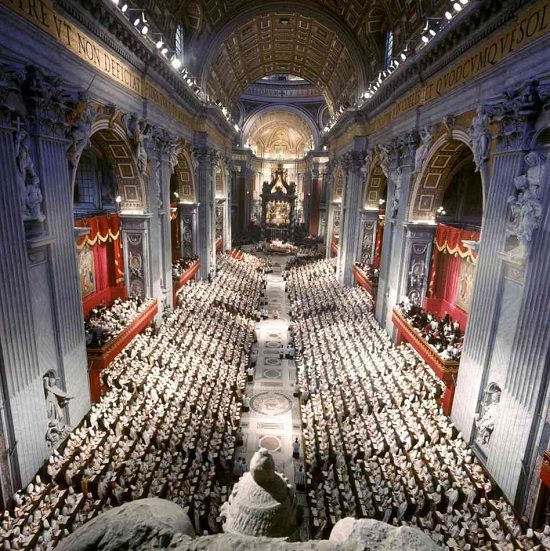
Opening of the Second Vatican Council, 11 October 1962 [Flickr / CC BY 2.0 license]
***
(9-15-13)
***
This is taken from a Facebook discussion on my page; later continued on another page. David Palm is a self-described “reluctant traditionalist” and a longtime friend of mine. His words will be in blue. Patti Sheffield’s words will be in green.
* * * * *
It’s when he [Michael Voris] attacks the Novus Ordo or implies that Vatican II is a bad thing, that I have a problem.
I don’t see how it would be contrary to the Catholic faith for an individual to conclude that, say, the introduction of the new Mass or Vatican II itself may have caused more harm than good. Is it really an article of faith that, “Vatican II was a good thing”? But perhaps that’s not what you’re saying.
Yes, I think it is the Catholic faith to accept that ecumenical councils are good things and that such councils are guided by the Holy Spirit in an extraordinary fashion.
As for the OF Mass, Pope Benedict XVI has made it clear that it is normative and on an equal level with the EF. Thus, that is the magisterium speaking.
“Traditionalists” continue to pick and choose and place their own judgment too high in the scheme of things. That’s most obvious in how they approach BXVI himself. When he says something they like, then he’s great (and that includes pre-papal utterances). When they disagree with what he says, he gets ditched along with other magisterial authorities (JPII, VCII). So it goes back to the individual, which is the same method (considered in and of itself) as Protestant private judgment.
Aside from solemn definitions of infallible dogma, where we would all agree that this is true, do you have any magisterial support to extend this view to any and every action of an ecumenical council?
I wasn’t arguing about every particular, but a general espousal. Since the discussion has been general up to that point, I see no good reason to now enter into particulars and “legal” elements. I was merely contending:
Ecumenical councils are good things.
Vatican II is an ecumenical council.
Therefore, Vatican II is a good thing.
You want to argue that Catholics can believe it caused more harm than good. At that point I have to say that this is not traditional Catholic belief: to take such a jaundiced view of an ecumenical council. But it sounds an awful lot like the way Luther argued.
I would disagree that Vatican II caused any harm. I would actually say that it was never found tried and wanting because it was not really tried—it was highjacked and its authority misused by modernists to run roughshod over the Church for a space of about forty years. To put it bluntly, to blame the council for what was done in its name would be like blaming a woman for being raped.
Sorry for the harsh and indelicate image, but an ecumenical council is generally followed by at least four to five decades of storms and upheavals. To suddenly notice this with Vatican II and blame it is to ignore the storms that followed Vatican I, Trent, and Nicea, to name a few. VCII is right on schedule, and is finally being implemented as it was meant to be—in line with Sacred Tradition and not opposed to or superseding it.
The tensions that developed after the Council (Vatican II) are not surprising to those who know the whole history of the Church. It is a historical fact that whenever there is an outpouring of the Holy Spirit as in a general council of the Church, there is always an extra show of force by the anti-Spirit or the demonic. Even at the beginning, immediately after Pentecost and the descent of the Spirit upon the apostles, there began a persecution and the murder of Stephen. If a general council did not provoke the spirit of turbulence, one might almost doubt the operation of the third Person of the Trinity over the assembly.
— Ven. Archbishop Fulton Sheen
We both know that the guidance by the Holy Spirit in an “extraordinary fashion” (your phrase) only pertains when an ecumenical council is defining dogma, just as this is true for the extraordinary exercise of the papal office. We also know, as we tell our Protestant friends all the time, that this is a negative protection, not guaranteeing that the right thing will be said but only that error will not be taught. But none of this pertains to Vatican II, which defined nothing. I think it is well within the bounds of orthodoxy to say that a council such as, say, Constantinople II, while not teaching error, was extremely confusing, greatly exacerbated the very problem that it was seeking to address, and therefore would have been best not convoked at all. I guess I would just suggest that unless you can cite actual magisterial support for an unqualified view that “ecumenical councils are [always] good things”, it would be better not to publicly challenge a fellow Catholic for holding a different one.
First of all, again you are speaking “legally” or “canonically” (as is the strong tendency of “traditionalists”), but I wasn’t. I wasn’t using “extraordinary” in the technical sense that you refer to; only in the ordinary sense (pun intended).
But very well; since you want to take this view, please give us quotations from saints and Doctors and (universally acknowledged) great theologians, or popes, to the effect that an ecumenical council can do more harm than good. Thanks! If you can find those, I’ll grant the point. I’ve never seen such a thing, myself, but of course, theology is such a vast endeavor that I could easily have missed it.
Blessed John Henry Cardinal Newman wrote:
Of course what the General Council speaks is the word of God – but still we may well feel indignant at the intrigue, trickery, and imperiousness which is the human side of its history – and it seems a dereliction of duty not to do one’s part to meet them. (Letter to Canon William Walker, 10 November 1867)
Of course there is a sense of the word “inspiration” in which it is common to all members of the Church, and therefore especially to its Bishops, and still more directly to those rulers, when solemnly called together in Council, after much prayer throughout Christendom, and in a frame of mind especially serious and earnest by reason of the work they have in hand. The Paraclete certainly is ever with them, and more effectively in a Council, as being “in Spiritu Sancto congregata;” but I speak of the special and promised aid necessary for their fidelity to Apostolic teaching; and, in order to secure this fidelity, no inward gift of infallibility is needed, such as the Apostles had, no direct suggestion of divine truth, but simply an external guardianship, keeping them off from error (as a man’s good Angel, without at all enabling him to walk, might, on a night journey, keep him from pitfalls in his way), a guardianship, saving them, as far as their ultimate decisions are concerned, from the effects of their inherent infirmities, from any chance of extravagance, of confusion of thought, of collision with former decisions or with Scripture, which in seasons of excitement might reasonably be feared. (Letter to the Duke of Norfolk, ch. 9, 1875)
Nice try Dave, but you know that’s not how it works. You’re the one insisting that something is so contrary to the faith that you’re going to take a fellow Catholic publicly to task for it. So it’s your burden to show magisterial support (which you didn’t, in the sources you cited.)
Yes, I do insist that this view that an ecumenical council does more harm than good is contrary to Catholicism, historically understood, and I believe this to be self-evident. I don’t believe I could find a magisterial statement that states, “ecumenical council X [i.e., in its actual teachings] did more harm than good” (what you seem to claim for Vatican II) because I don’t think it ever crossed anyone’s mind, except for folks like Luther and Calvin, who had already denounced the sublime authority of ecumenical councils.
Thus, it remains your burden to find such a thing if you want to adhere to it; or else it is only so much hooey, with no precedent in legitimate sacred tradition. You would claim it has that (being a “traditionalist”) so by all means, produce it for us. I deny that I could find a statement condemning it, because it’s understood that ecumenical councils have sublime authority, are guided by the Holy Spirit, and thus are, at the very least, more good than bad. For example:
The Second General Council of Constantinople (553) : Profession of Faith
We profess that we hold and preach the faith which from the beginning was given to the apostles by our great God and Saviour Jesus Christ, and was proclaimed by them to the whole world. The holy Fathers professed, explained and handed on this faith to the holy Church, particularly those Fathers who took part in the four holy Councils which we follow and accept entirely for everything . . .
The Council of Lateran (649): Canon 17
Whosoever does not confess, in accordance with the holy Fathers, by word and from heart, really and in truth, to the last word, all that has been handed down and proclaimed to the holy, catholic and apostolic Church by the holy Fathers and by the five venerable General Councils, condemnatus sit. (Denzinger 517)
Profession of Faith of Pius IV (Bull Iniunctum Nobis: 1564)
I unhesitatingly accept and profess also all other things transmitted, defined and declared by the sacred canons and the ecumenical Councils, especially by the most Holy Council of Trent . . . (Denzinger 1869)
I would argue that we have freedom to differ on matters not explicitly addressed by the Magisterium.
This is obvious, but the initial claim (i.e., your position staked out against mine to the contrary) was that an ecumenical council can cause more harm than good. I’m only holding you to that view. You may wish to concede that you have no reason whatsoever (in tradition or otherwise) to believe this. In the meantime, trying to shift the burden of proof to me doesn’t provide any traditional substantiation of your own opinion.
I have never heard any pope claim that Vatican II could be disregarded as somehow being a “mistake” or “more bad than good for the Church”. The quote by Pope Paul VI that is circulated about how the council avoided making any infallible dogmatic pronunciations came from one of his general audiences. It has no doctrinal or binding weight because it is not a magisterial statement, unlike his statement that closed each of the documents he ratified:
Each and every one of the things set forth in this [insert name of document] has won the consent of the fathers. We too, by the Apostolic Authority conferred on us by Christ, join with the venerable Fathers in approving, decreeing, and establishing these things in the Holy Spirit, and we direct that what has thus been enacted in Synod be published to God’s glory…I, Paul, Bishop of the Catholic Church.
And his statement at the closing of the council:
We decide moreover that all that has been established synodally is to be religiously observed by all the faithful, for the glory of God and the dignity of the Church… we have approved and established these things, decreeing that the present letters are and remain stable and valid, and are to have legal effectiveness, so that they be disseminated and obtain full and complete effect… [December 8, 1965]
[Here] is an article by someone [Dr. Jeff Mirus] whose opinion of Vatican II is that it was a very good council, guided by the Holy Spirit, and that it must be followed just like any other ecumenical council of the Catholic Church.
As for Vatican II supposedly defining nothing, that is false. Vatican II further developed the definition of infallibility, reaffirming papal infallibility while expanding on it, and defining the infallibility of the ordinary magisterium. This is an overlooked and ignored teaching, but it is in there.
This is an article [by Dr. Michael Liccione] that expounds well on the infallibility of the ordinary magisterium as defined by Vatican II.
* * *
Should there be a terminological difference between Catholics who, for example, believe that Tradition is to be interpreted in light of Vatican II, versus those who believe that Vatican II is to be interpreted in light of Tradition? That difference of approach, simply stated in one sentence, ends up in wide divergences of opinion on various issues. At times this can actually amount to a divergence of doctrine, as seen for example in the dust up many years ago in Catholic World Report concerning biblical inerrancy between Fr. Fessio and Cardinal Pell on the one hand and Fr. Brian Harrison and to a much lesser extent me on the other.
Primarily the latter (“Vatican II is to be interpreted in light of Tradition”), I think all would agree. But it is also true that Vatican II is the most highly developed theology of the Church (and recent encyclicals develop it even further). Unless one rejects development of doctrine and the ongoing Mind of the Church, I don’t see how that could be denied. Once development is accepted, there is a strong sense in which doctrine is “better” and more honed and understood as time goes on; therefore, Vatican II has a certain “edge” (in this one limited sense) compared to councils before it.
That itself is not something that comes from Vatican II, but it’s development of doctrine, that has been around (explicitly) since St. Vincent of Lerins, St. Augustine, St. Thomas Aquinas, and Cardinal Newman 170 years ago.
Yes, but it is also true that there are parts of the V2 documents that are interpreted even by the [otherwise] faithful in ways that are contrary to the prior teaching of the Magisterium. It would seem to be unique in the history of the Church that even 50 years later the faithful are still discussing how certain passages can even be harmonized with the Church’s Tradition, let alone what these statements might contribute to a development of doctrine. Constantinople II seems to have caused similar confusion, but I’m not sure there’s another example on this scale. Hence, in part, ongoing traditionalist concerns with Vatican II.
I agree that there are many places where its relevance has become limited due to the pastoral nature of the documents. I agree that there are places where it presents a given issue in a particularly good way and I gladly use those for learning and in discussion. And there are places where it is difficult to see how to harmonize the text with the prior Tradition–there I select the best proposed harmonization and insist that the mind of the Church is a “hermeneutic of continuity”, even if certain Catholic faithful have unfortunately taken views that are contrary to the prior Magisterium.
Since the most contested/criticized documents had a pastoral aim, they should not be treated as unmalleable. The Church has changed its mode of presenting the Gospel over the centuries to help reach more people.
One example: The use of the term “freedom” in Dignitatis Humanae is often criticized as a problem, since popes had vehemently rejected the concept of “liberty” prior to Vatican II. The two terms are not precisely identical, and what DH was discussing was not what was being condemned, which was the exaltation of human reason to seek anything at all, even error, over the duty for humanity to seek the truth found only in God. This type of “liberty” is illusory, and rightly termed as “insane”. DH was treating on the matter of being free to convert without coercion, and the rights of the Church to be free to preach the Gospel anywhere at anytime.
However, even if the two words are treated as precisely equal, that is not the first time that the Church apparently reversed prior Magisterial teaching. The term homoousios, rejected by the early Church for its use by the heretical sect of the Sabellians, was “baptized” by its use in the first Council at Nicea to define the Divinity of the Son of God. This is clearly a precedent for the shift in the Church’s use of the term “freedom” from that which is unacceptable in a secular use to that which is acceptable and harmonious with Tradition in the council’s use.
So, difficult in spots, useful in spots, but increasingly irrelevant due to its pastoral nature. Is that acceptable to non-traditionalists?
That is not acceptable to the recent popes who spent significant times in office since VCII closed. It is not acceptable because it is not how ecumenical councils get treated in the Tradition of the Church. It is also not acceptable because we have not until recently seen an orthodox application and teaching from those documents, which were abused by modernists to try to refashion the Church into their merely human ideas of what she should be. We are to grant Vatican II as the Church understands it the status it deserves, neither exalting it above the preceding councils as penultimate and somehow supplanting them, nor denigrating it as superfluous, or worse, a mistake, but accepting it in its rightful place as a continuation of Tradition, not a rupture from it.
No, because of what I wrote about development. That is the thing that can’t be gotten over in this analysis. You can’t say it is a corruption, which would be the only way to overcome these factors of development and the Mind of the Church. That can’t be said, granting orthodox Catholic ecclesiology, because Vatican II was clearly an ecumenical council (BXVI in The Ratzinger Report said that VCII had to be accepted on the same grounds that Trent was).
So if we take away the “out” of it being a corruption rather than a legitimate development, then I don’t see how we can’t conclude that it is the highest development, being the latest, as all councils develop what came prior to them.
If some folks find things hard to understand; what else is new? That’s how it has always been, too. Dollinger was a brilliant man, but couldn’t get his mind around papal infallibility. He was convinced that this contradicted prior Catholic history. But it didn’t. And the even more brilliant mind of Newman explained how it did not. Now we have brilliant men like Fr. Brian Harrison who explain how the council is harmonious with the history of doctrine and teaching.
The most vexed issues with regard to Vatican II are not dogmatic ones. Religious freedom and ecumenism are not dogmas; they are ways of relating to non-Catholics. Those can develop and even change to an extent, since (as far as I know) they aren’t dogmas. The Church used to exercise capital punishment in cases of heresy. Now it doesn’t. Is that an improvement? I think it is, because it is going back to the early Church. I don’t want to kill the heretic, but rather, try to reason with him and persuade him to become a Catholic. It’s not an absolute (capital punishment is not intrinsically evil), but there is room for debate on how to approach the heretic.
Likewise, with ecumenism and religious freedom . . .
Patti and Dave say no. I guess we’ll have to agree to disagree. I don’t think that this discussion boils down to a stark contrast between an inevitably beneficial “doctrinal development” on the one hand and flat out “corruption” on the other. Kevin [Tierney] asks a great question in his piece “Closing the Door (Finally) on Vatican II”: “Okay, now for everyone else, can you tell me how the Second Lateran and First Council of Lyons revolutionized Church life? Is there anything we remember concretely from the Fifth Lateran Council?”
Ecumenical councils are authoritative and binding, to be sure, but there’s no guarantee that they will, a) achieve that which they set out to achieve and b) remain highly relevant throughout the history of the Church. But I think that’s precisely what we’re being asked to hold with regard to Vatican II. And to be clear, I’m somewhat agnostic on the matter. I just don’t think it’s appropriate to be held to a particular view that isn’t itself magisterial. I think there’s a greater degree of freedom here than Dave and Patti are allowing.
It’s very helpful too to note, as Dave points out, that matters such as ecumenism and religious freedom, which he says are “the most vexed” today, aren’t dogmas at all but are “ways of relating to non-Catholics.” I would argue that “ways of relating” aren’t properly evaluated as true and false. You can’t attach an anathema to a “way of relating”. Rather, they’re more or less helpful and useful. And this utility can and does change under various historical circumstances. And precisely for that reason, there’s no intrinsic reason to suppose that the “ways” that are being applied now are the absolute best for now and for all time. I don’t think it’s a given that the “best” for another day might not be an approach already taken in the past, as Dave argues regarding capital punishment and heretics. But then traditionalists can hardly be censured for holding that, in certain of these non-dogmatic practices and approaches, the current practice may not be the best.
“there is room for debate….” Amen brother :-)
*****
Traditionalism vs. Radical Catholic Reactionaries
Previous Post

September 2, 2013
How Much Money Should Catholic Apologists Make?
Next Post
September 20, 2013 Conciliation: "Traditionalists" & Other Orthodox Catholics
Browse Our Archives
Select a Category & Last Things About Me Anti-Catholicism Atheism & Agnosticism Baptism and Sacramentalism Bible and Tradition Blessed Virgin Mary Books by Dave Armstrong C. S. Lewis Calvinism & General Protestantism Catholic Apologetics Catholic Apologists Catholic conversion Catholic converts Christmas Church (Ecclesiology) Church History Conversion and Converts Development of Doctrine Eastern Orthodoxy Ecumenism & Christian Unity Eucharist & Liturgy Fathers of the Church French Translations G. K. Chesterton Hell Hell & Satan Hell & Satan & Last Things Heresies & Comparative Religion Holistic Health Inquisition & Crusades & Scandals James White Jews & Judaism & Old Testament John Calvin John Henry Newman Liberal / Modernist Theology Life Issues Literary Resume Lutheranism Mariology Martin Luther Music Orthodoxy Papacy & Infallibility Personal Page Philosophy & Science Political & Ethical & Moral Issues Protestant Persecution & Intolerance Protestantism Purgatory Purgatory & Penance Romantic & Imaginative Theology Saints & Purgatory & Penance Salvation Salvation & Justification Satan & Last Things Sexuality and Gender Issues Spanish Translations Traditionalism vs. Radical Catholic Reactionaries Traducciones al español / tradução para português Trinitarianism & Christology Uncategorized Videos
Select a Month October 2026 September 2026 August 2026 July 2026 June 2026 May 2026 April 2026 March 2026 February 2026 January 2026 December 2025 November 2025 October 2025 September 2025 August 2025 July 2025 June 2025 May 2025 April 2025 March 2025 February 2025 January 2025 December 2024 November 2024 October 2024 September 2024 August 2024 July 2024 June 2024 May 2024 April 2024 March 2024 February 2024 January 2024 December 2023 November 2023 October 2023 September 2023 August 2023 July 2023 June 2023 May 2023 April 2023 March 2023 February 2023 January 2023 December 2022 November 2022 October 2022 September 2022 August 2022 July 2022 June 2022 May 2022 April 2022 March 2022 February 2022 January 2022 December 2021 November 2021 October 2021 September 2021 August 2021 July 2021 June 2021 May 2021 April 2021 March 2021 February 2021 January 2021 December 2020 November 2020 October 2020 September 2020 August 2020 July 2020 June 2020 May 2020 April 2020 March 2020 February 2020 January 2020 December 2019 November 2019 October 2019 September 2019 August 2019 July 2019 June 2019 May 2019 April 2019 March 2019 February 2019 January 2019 December 2018 November 2018 October 2018 September 2018 August 2018 July 2018 June 2018 May 2018 April 2018 March 2018 February 2018 January 2018 December 2017 November 2017 October 2017 September 2017 August 2017 July 2017 June 2017 May 2017 April 2017 March 2017 February 2017 January 2017 December 2016 November 2016 October 2016 September 2016 August 2016 July 2016 June 2016 May 2016 April 2016 March 2016 February 2016 January 2016 December 2015 November 2015 October 2015 September 2015 August 2015 July 2015 June 2015 May 2015 April 2015 March 2015 February 2015 January 2015 December 2014 November 2014 October 2014 September 2014 August 2014 July 2014 June 2014 April 2014 March 2014 February 2014 January 2014 December 2013 November 2013 October 2013 September 2013 August 2013 July 2013 June 2013 April 2013 March 2013 February 2013 January 2013 December 2012 November 2012 October 2012 September 2012 August 2012 July 2012 June 2012 May 2012 April 2012 March 2012 February 2012 January 2012 December 2011 November 2011 October 2011 September 2011 August 2011 July 2011 June 2011 April 2011 March 2011 February 2011 October 2010 September 2010 August 2010 July 2010 April 2010 March 2010 December 2009 October 2009 August 2009 July 2009 June 2009 May 2009 March 2009 February 2009 October 2008 September 2008 April 2008 March 2008 February 2008 January 2008 December 2007 November 2007 October 2007 May 2007 March 2007 February 2007 January 2007 November 2006 October 2006 September 2006 August 2006 July 2006 June 2006 May 2006 April 2006 March 2006 February 2006 October 2005 June 2005 April 2005 February 2005 July 2004 May 2004 April 2004
Follow Us!
TAKE THE
Religious Wisdom Quiz
What is the meaning of the word "Golgotha"?
Select your answer to see how you score.
Peaceful Garden River of Blood City of Bread Place of the Skull
Books by This Author Books by Dave Armstrong
Related posts from Biblical Evidence for Catholicism

Jesus Founded the [Catholic] Church. If Not Him,...
Biblical Evidence for Catholicism

Jerusalem Council vs. James White & Sola Scriptura
Biblical Evidence for Catholicism

Apostolic Succession: 40 Biblical Arguments
Biblical Evidence for Catholicism

350 Bible Passages vs. Sola Scriptura
Biblical Evidence for Catholicism
TRENDING AT PATHEOS Catholic

I was strolling through the top floor of the brand new Parthenon...

What Does Gêvâh Mean For Kimberley Guifoyle &...
This week, a lot of the news is focused on Kimberly Guilfoyle....

INNER CIRCLE: Profound Mystery (Of Christ In All...
Ephesians 5:31-32 “For this reason, a man will leave his father and...

Do Not Rejoice When Your Enemy Falls: The...
Turning an execution into a public spectacle is a disturbing expression of...

'The Chosen' S6 Trailer: The Passion Gets Very...
Not many watching 'The Chosen' worry about spoilers, but just because they...

The purpose-driven labor priest
A labor activist reads Rick Warren and it gets me wondering about...
view all Catholic blogs
Ad-Free & Subscriber Log-In Subscription Support
- About Us
- 2026 Calendar
- Videos
- Podcasts
- Library of World Religions
- Faith In Media Tracker
- Advertise With Us
- Write for Us
- Privacy Policy
- Terms of Service
- Do Not Sell My Data
- Contact Us
- Radiant Digital
- Manage Newsletter Subscriptions
- Unsubscribe From Notifications
- Sitemap
Copyright 2008-2026, Patheos. All rights reserved.
Subscription Support Ad-Free & Subscriber Log-In
Follow Patheos