
BuddhistCatholicContemplativeEvangelicalGeneral ChristianHinduJewishLatter-day SaintMuslimNew VisionsProgressive Christian
Beliefs
- Buddhist
- Catholic
- Contemplative
- Evangelical
- General Christian
- Hindu
- Jewish
- Latter-day Saint
- More Voices
- Muslim
- New Visions
- Pagan
- Progressive Christian
Topics
- Religion News
- Food and Religion
- Sports and Religion
- Religious Art
- Religious Music and Entertainment
- Religious Events
- History and Religion
- Style and Religion
- Politics and Religion
- Women in Religion
- Recreation Outdoors and Religion
- Business Finance and Religion
- Careers Workplace and Religion
- Education and Religion
- Family Parenting and Religion
- Health Fitness and Religion
- Home and Religion
- Relationships and Religion
- Technology and Religion
- Travel and Religion
Columnists
- Buddhist Columnists
- Business Finance and Religion Columnists
- Careers Workplace and Religion Columnists
- Catholic Columnists
- Contemplative Columnists
- Education and Religion Columnists
- Evangelists Columnists
- Family Parenting and Religion Columnists
- General Christian Columnists
- Health Fitness and Religion Columnists
- Hindu Columnists
- History and Religion Columnists
- Home and Religion Columnists
- Jewish Columnists
- More Voices Columnists
- Latter Day Columnists
- Muslim Columnists
- New Visions Columnists
- Nonreligious Columnists
- Pagan Columnists
- Politics and Religion Columnists
- Progressive Columnists
- Recreation Outdoors and Religion Columnists
- Relationships and Religion Columnists
- Religion News Columnists
- Religious Art Columnists
- Religious Events Columnists
- Religious Music and Entertainment Columnists
- Sports and Religion Columnists
- Style and Religion Columnists
- Technology and Religion Columnists
- Travel and Religion Columnists
- Women in Religion Columnists
Resource Library
- 2026 Calendar
- Library of World Religions
- The 100 Most Holy Places on Earth
- Patheos Answers
- Podcasts
- Videos
- Faith Leaders Database
- Anglican Episcopalian
- Bahai
- Baptist
- Buddhism
- Christianity
- Confucianism
- Eastern Orthodoxy
- Hinduism
- Holiness and Pentecostal
- ISKCON
- Islam
- Judaism
- Lutheran
- Methodist
- The Church of Jesus Christ of Latter-day Saints
- New Age
- Paganism
- Presbytarian and Reformed
- Protestantism
- Religion Behind the Scenes
- Roman Catholic
- Scientology
- Shia Islam
- Sikhism
- Sufism
- Sunni Islam
- Taoism
- Zen
- See all religions
Research Tools
 Ad-Free & Subscriber Log-In Subscription Support
Ad-Free & Subscriber Log-In Subscription Support
Follow Patheos 

- Trending:
- Forgiveness
- |
- Marriage
- |
- Consciousness
- |
- Death Penalty
- |
- Election
- |
- Halloween

-
About
-
Catholic Apologetics
-
Church History
-
Great Apologists
-
Christian Worldview
-
Protestantism & Misc.
- Home
- Catholic
- History and Religion
- Martin Luther: Catholicism is Christian
Martin Luther: Catholicism is Christian
Last updated on: May 27, 2017 at 4:40 pm by Dave Armstrong
Martin Luther: Catholicism is Christian 2017-05-27T16:40:48-04:00 Dave Armstrong
Patheos Explore the world's faith through different perspectives on religion and spirituality! Patheos has the views of the prevalent religions and spiritualities of the world.
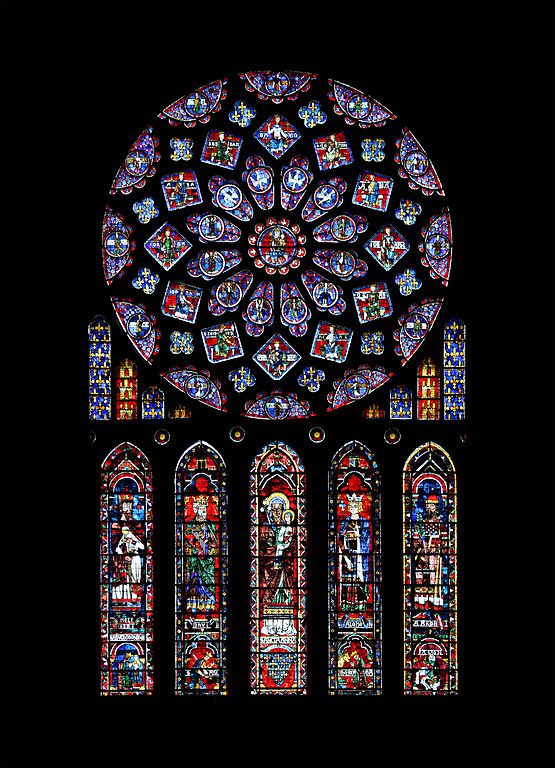
Chartres Cathedral: north transept rose window, c.1235. Photograph by Guillaume Piolle, 2-7-09 [public domain / Wikimedia Commons]

***
(6-12-13)
***
These are excerpts from a larger dialogue that also discussed Calvin’s view (with this new introduction and summary). All words are Luther’s except for a few comments from scholars on his views and positions, or my introductory comments, which will be in blue, and the bibliographical source information: in green. It should be noted that Luther also makes tons of negative statements about the Catholic Church, but these are mostly directed towards the hierarchy or the papacy, which he does not equate with the Catholic Church as a whole. He regards the latter as “antichrist,” etc.
Luther’s thought develops (from both true and false premises that he holds), and he is also quite capable of — and not infrequently guilty of — either self-contradiction or vacillation (on any topic). Moreover, it is always of the utmost importance in interpreting Luther, to take into consideration context and his particular “mood” or the literary technique he uses at any given time. He often utilizes sarcasm and hyperbole and other non-literal devices to get his point across. Because of this, he is often cited out of context, and unjustly so: making people think he taught something that he did not, in fact, teach.
Another relevant factor to take into consideration is Luther’s ravings when he was an old, embittered, sick man (disgusted even with most Protestants, including his own party, let alone Catholics): often regarded as from 1543 till his death in 1546. Many — if not most — Luther scholars think they should be taken with a large grain of salt: certainly not literally all down the line. Some of these rantings are blatantly anti-Catholic in nature; other famous pontifications from this period are his jeremiads against the “Sacramentarians” (Protestants who denied the Real Presence in the Eucharist) and the Jews.
[note: the above paragraph has become a bone of contention and was scathingly critiqued by the persistently slanderous anti-Catholic Reformed polemicist, James Swan. I replied at length, thoroughly backing myself up, in my paper, “Did the Older Luther’s Illness and Frustration Significantly Impact His Negative Rhetoric? “]
In any event, the positive statements documented below (mostly intended literally, as far as I can tell) mean what they mean, and have to be interpreted in their own right; not simply rationalized away or dismissed en masse because he said “bad stuff” somewhere else (as my opponent in the larger dialogue foolishly attempted to do, in classic anti-Catholic polemical form). Nor is it insignificant that leading Luther scholars back up my present point of view.
Amateurs and polemicists and wannabe apologists or historians on the Internet (with an agenda and ax to grind) can and do claim all sorts of things (often with a ludicrous and self-important dogmatism); what Luther scholars or Church historians believe, on the other hand, is quite a different story indeed. Thus, I always try to massively back up my contentions with scholars (and primary documentation), for this very reason: because I know full well that my opinion as an amateur historian and student of Church history carries little or no weight without them. Nor would I ever want to give the slightest impression that they had any weight, minus this documentation and whatever scholarly support I can find to aid my arguments.
* * * * *
Baptism is especially important with regard to Luther’s statements. He thought that the Catholic Church possessed true baptism. Now, when we analyze what Luther thought about baptism, it’s clear that he thought that Catholics could very well be saved by means of it. Here is what Luther expressed along these lines:
Little children . . . are free in every way, secure and saved solely through the glory of their baptism . . . Through the prayer of the believing church which presents it, . . . the infant is changed, cleansed, and renewed by inpoured faith. Nor should I doubt that even a godless adult could be changed, in any of the sacraments, if the same church prayed for and presented him, as we read of the paralytic in the Gospel, who was healed through the faith of others (Mark 2:3-12). I should be ready to admit that in this sense the sacraments of the New Law are efficacious in conferring grace, not only to those who do not, but even to those who do most obstinately present an obstacle.
(The Babylonian Captivity of the Church, 1520, from the translation of A.T.W. Steinhauser, Philadelphia: Fortress Press, revised edition, 1970, 197)
Likewise, in his Large Catechism (1529), Luther writes:
Expressed in the simplest form, the power, the effect, the benefit, the fruit and the purpose of baptism is to save. No one is baptized that he may become a prince, but, as the words declare [of Mark 16:16], that he may be saved. But to be saved, we know very well, is to be delivered from sin, death, and Satan, and to enter Christ’s kingdom and live forever with him . . . Through the Word, baptism receives the power to become the washing of regeneration, as St. Paul calls it in Titus 3:5 . . . Faith clings to the water and believes it to be baptism which effects pure salvation and life . . . When sin and conscience oppress us . . . you may say: It is a fact that I am baptized, but, being baptized, I have the promise that I shall be saved and obtain eternal life for both soul and body . . . Hence, no greater jewel can adorn our body or soul than baptism; for through it perfect holiness and salvation become accessible to us . . .
(From edition by Augsburg Publishing House [Minneapolis], 1935, sections 223-224, 230, pp. 162, 165)
1522
Ewald M. Plass’s magisterial 1667-page volume, What Luther Says (St. Louis: Concordia Publishing House, 1959) — I have it in my own library — provides more evidence. He writes, himself, on p. 128:
. . . while scoring papal innovations, Luther never ceased to confess indebtedness to the Church of Rome and to regard it as a Christian organization. He expresses this clearly in a Church Postil sermon on John 15:26 – 16:4, in connection with John 16:3. Between the Church of Rome and the Lutheran Church a relation exists similar to that which once existed between the Jewish Church and the apostolic Christian Church . . .
I found this sermon online. It dates from 1522. Here is an excerpt, with his “ecumenical” sentiments, in-between a mountain of hostility and his usual lies about the Catholic Church:
Accordingly, we concede to the papacy that they sit in the true Church, possessing the office instituted by Christ and inherited from the apostles, to teach, baptize, administer the sacrament, absolve, ordain, etc., just as the Jews sat in their synagogues or assemblies and were the regularly established priesthood and authority of the Church. We admit all this and do not attack the office, although they are not willing to admit as much for us; yea, we confess that we have received these things from them, even as Christ by birth descended from the Jews and the apostles obtained the Scriptures from them. . . .
Thus we say to the papists: We grant you, indeed, the name and office, and regard these as holy and precious, for the office is not yours, but has been established by Christ and given to the Church without regard for and distinction of the persons who occupy it. Therefore, whatever is exercised through this office as the institution of Christ, and in his name and that of the Church, is at all times right and proper, even though ungodly and unbelieving men may participate. We must distinguish between the office and the person exercising it, between rightful use and abuse. The name of God and of Christ is always holy in itself; but it may be abused and blasphemed. So also, the office of the Church is holy and precious, but the person occupying it may be accursed and belong to the devil. . . .
We admit that the papists also exercise the appointed offices of the Church, baptize, administer the sacrament etc., when they observe these things as the institution of Christ, in the name of Christ and by virtue of his command (just as in the Church we must regard as right and efficacious the offices of the Church and baptism administered by heretics), . . .
1528
In the first place I hear and see that such rebaptism is undertaken by some in order to spite the pope and to be free of any taint of the Antichrist. In the same way the foes of the sacrament want to believe only in bread and wine, in opposition to the pope, thinking thereby really to overthrow the papacy. It is indeed a shaky foundation on which they can build nothing good. On that basis we would have to disown the whole of Scripture and the office of the ministry, which of course we have received from the papacy. We would also have to make a new Bible. . . .
We on our part confess that there is much that is Christian and good under the papacy; indeed everything that is Christian and good is to be found there and has come to us from this source. For instance we confess that in the papal church there are the true holy Scriptures, true baptism, the true sacrament of the altar, the true keys to the forgiveness of sins, the true office of the ministry, the true catechism in the form of the Lord’s Prayer, the Ten Commandments, and the articles of the creed . . . I speak of what the pope and we have in common . . . I contend that in the papacy there is true Christianity, even the right kind of Christianity and many great and devoted saints.
. . . The Christendom that now is under the papacy is truly the body of Christ and a member of it. If it is his body, then it has the true spirit, gospel, faith, baptism, sacrament, keys, the office of the ministry, prayer, holy Scripture, and everything that pertains to Christendom. So we are all still under the papacy and therefrom have received our Christian treasures.
. . . We do not rave as do the rebellious spirits, so as to reject everything that is found in the papal church. For then we would cast out even Christendom from the temple of God, and all that it contained of Christ.
[251] . . . We recall that St. John was not averse to hearing the Word of God from Caiaphas and pays attention to his prophecy [John 11:49 f.] . . . Christ bids us hear the godless Pharisees in the seat of Moses, though they are godless teachers . . . Let God judge their evil lies. We can still listen to their godly words . . .
Still we must admit that the enthusiasts have the Scriptures and the Word of God in other doctrines. Whoever hears it from them and believes will be saved, even though they are unholy heretics and blasphemers of Christ.
. . . [256] if the first, or child, baptism were not right, it would follow that for more than a thousand years there was no baptism or any Christendom, which is impossible. For in that case the article of the creed, I believe in one holy Christian church, would be false . . . [257] If this baptism is wrong then for that long period Christendom would have been without baptism, and if it were without baptism it would not be Christendom.
(Concerning Rebaptism: A Letter to Two Pastors, 1528, Luther’s Works [“LW”], Vol. 40, 225-262; translated by Conrad Bergendoff, pp. 231-232, 251, 256-257)
1531
. . . even though it is in the midst of wolves and robbers, that is, spiritual tyrants, it nevertheless is the church. Although the city of Rome is worse than Sodom and Gomorrah, yet Baptism, the Sacrament of the Lord’s Supper, the reading (vox) and text of the Gospel, Holy Scriptures, the ministry, the name of Christ, and the name of God remain in her.
(Luther’s exposition of Galatians 1:2 in his 1531 commentary; quoted by Plass, ibid., p. 130, #375A)
1532
This testimony of the universal holy Christian Church, even if we had nothing else, would be a sufficient warrant for holding this article [on the sacrament] and refusing to suffer or listen to a sectary, for it is dangerous and fearful to hear or believe anything against the unanimous testimony, belief, and teaching of the universal holy Christian churches, unanimously held in all the world from the beginning until now over fifteen hundred years.
(Letter to Albrecht, Margrave of Brandenburg and Duke of Prussia, 1532; from Roland H. Bainton, Studies on the Reformation, Boston: Beacon Press, 1963, p. 26; WA, Vol. XXX, 552)
This letter, apparently passed over by Luther’s Works, Vol. 50 (Letters III), was, thankfully, cited at some length by the celebrated Protestant historian Philip Schaff, and refers to, as Schaff notes, “the real presence of Christ in the Lord’s Supper”:
Moreover, this article has been unanimously believed and held from the beginning of the Christian Church to the present hour, as may be shown from the books and writings of the dear fathers, both in the Greek and Latin languages, — which testimony of the entire holy Christian Church ought to be sufficient for us, even if we had nothing more. For it is dangerous and dreadful to hear or believe anything against the unanimous testimony, faith, and doctrine of the entire holy Christian Church, as it has been held unanimously in all the world up to this year 1500. Whoever now doubts of this, he does just as much as if he believed in no Christian Church, and condemns not only the entire holy Christian Church as a damnable heresy, but Christ Himself, and all the Apostles and Prophets, who founded this article, when we say, “I believe in a holy Christian Church,” to which Christ bears powerful testimony in Matt. 28.20: “Lo, I am with you alway, to the end of the world,” and Paul, in 1 Tim. 3.15: “The Church is the pillar and ground of the truth.”
(The Life and Labours of St. Augustine, Oxford University: 1854, 95. Italics are Schaff’s own; cf. abridged [?] version in Preserved Smith, The Life and Letters of Martin Luther, Boston and New York: Houghton Mifflin Co., 1911, pp. 290-292; cf. Johann Adam Mohler, Symbolism, 1844, 400)
Schaff, writing in The Reformed Quarterly Review (July, 1888, p. 295), cites the passage yet again, and translates one portion a little differently (my italics):
The testimony of the entire holy Christian Church (even without any other proof) should be sufficient for us to abide by this article and to listen to no sectaries against it.
1533
By His miraculous power God nonetheless preserved under the pope, first, Holy Baptism, then, in the pulpit, the text of the holy Gospel in the language of each country, thirdly, the forgiveness of sins and absolution in both private confession and the public services; fourthly, the holy Sacrament of the altar . . . fifthly, the calling and ordaining to the pastorate, the ministry, or the care of souls . . . finally, also prayer, the Psalter, the Lord’s Prayer, the Creed, and the Ten Commandments; likewise, many good hymns and songs . . . Therefore Christ with His Holy Spirit surely was with his own and sustained Christian faith in them . . .
(in Plass, ibid., p. 129, #375)
1538
The papacy has God’s word and the office of the apostles, and we have received the Holy Scriptures, baptism, the sacrament, and the office of preaching from them . . . we ourselves find it difficult to refute it . . . Then there come rushing into my heart thoughts like these: Now I see that I am in error. Oh, if only I had never started this and had never preached a word! For who dares oppose the church, of which we confess in the creed: I believe in a holy Christian church . . .
(Sermons on John 14-16, 1538 [on Jn 16:1-2], Paul Althaus, The Theology of Martin Luther, translated by Robert C. Schultz, Philadelphia: Fortress Press, 1966, 336; WA, Vol. 46, 5 ff. [edited by Cruciger]; cf. LW, Vol. XXIV, 304)
Thus we are also compelled to say: “I believe and am sure that the Christian Church has remained even in the papacy” . . . some of the papists are true Christians, even though they, too, have been led astray, as Christ foretold in Matt. 24:24. But by the grace of God and with His help they have been preserved in a wonderful manner.
(Sermons on John 14-16, 1538 [on Jn 16:1-2], LW, Vol. XXIV, 305)
[I]t is necessary to consider their beliefs and teachings. If I see that they preach and confess Christ as the One sent by God the Father to reconcile us to the Father through His death and to obtain grace for us, then we are in agreement, and I regard them as my dear brethren in Christ and as members of the Christian Church.
Yet the proclamation of this text – together with Baptism, the Sacrament of Christ, and the articles of the Creed – has remained even in the papacy, although many errors and devious paths have been introduced alongside it. . . . All errors notwithstanding, the true church has never perished.
(Ibid., 309)
1539
We know that Luther regarded Catholic baptism as valid; therefore, by ineluctable logic, Catholics are Christians, on that basis, if he regarded baptized people as such.
Luther (like Calvin) was not rebaptized as an adult (and excommunicated Protestant), and regarded his Catholic baptism as valid (since, after all, he himself argued against rebaptism). Luther clarified his opinion on baptism in his 1539 treatise, On the Councils and the Church:
I excuse St. Cyprian . . . for he held that the heretics had no sacrament at all and that therefore they had to be baptized like other heathen. . . . But our Anabaptists admit that our baptism and that of the papacy is a true baptism, but since it is administered and received by unworthy people, it is no baptism at all. St. Cyprian would never have concurred in this, much less practiced it.
(Selected Writings of Martin Luther: 1529-1546, Fortress Press, 1967, p. 238)
* * *
That Luther regarded properly baptized persons as Christians is backed-up by the most well-known Luther biographer, Roland H. Bainton. Referring to his opinion in 1526, he stated:
. . . he had relinquished the hope of gathering the ardent and had turned to the education of the masses. There should be neither a sect nor a cell, but the Church should coincide with the community and all those baptized in infancy should be accounted Christian.
(Studies on the Reformation, Boston: Beacon Press, 1963, p. 38)
*****
Previous Post
June 4, 2013
Did Luther and Calvin Think Catholicism was Christian?
Next Post
June 12, 2013 Older Luther's Illness and Frustrations and His Writing
Browse Our Archives
Select a Category & Last Things About Me Anti-Catholicism Atheism & Agnosticism Baptism and Sacramentalism Bible and Tradition Blessed Virgin Mary Books by Dave Armstrong C. S. Lewis Calvinism & General Protestantism Catholic Apologetics Catholic Apologists Catholic conversion Catholic converts Christmas Church (Ecclesiology) Church History Conversion and Converts Development of Doctrine Eastern Orthodoxy Ecumenism & Christian Unity Eucharist & Liturgy Fathers of the Church French Translations G. K. Chesterton Hell Hell & Satan Hell & Satan & Last Things Heresies & Comparative Religion Holistic Health Inquisition & Crusades & Scandals James White Jews & Judaism & Old Testament John Calvin John Henry Newman Liberal / Modernist Theology Life Issues Literary Resume Lutheranism Mariology Martin Luther Music Orthodoxy Papacy & Infallibility Personal Page Philosophy & Science Political & Ethical & Moral Issues Protestant Persecution & Intolerance Protestantism Purgatory Purgatory & Penance Romantic & Imaginative Theology Saints & Purgatory & Penance Salvation Salvation & Justification Satan & Last Things Sexuality and Gender Issues Spanish Translations Traditionalism vs. Radical Catholic Reactionaries Traducciones al español / tradução para português Trinitarianism & Christology Uncategorized Videos
Select a Month October 2026 September 2026 August 2026 July 2026 June 2026 May 2026 April 2026 March 2026 February 2026 January 2026 December 2025 November 2025 October 2025 September 2025 August 2025 July 2025 June 2025 May 2025 April 2025 March 2025 February 2025 January 2025 December 2024 November 2024 October 2024 September 2024 August 2024 July 2024 June 2024 May 2024 April 2024 March 2024 February 2024 January 2024 December 2023 November 2023 October 2023 September 2023 August 2023 July 2023 June 2023 May 2023 April 2023 March 2023 February 2023 January 2023 December 2022 November 2022 October 2022 September 2022 August 2022 July 2022 June 2022 May 2022 April 2022 March 2022 February 2022 January 2022 December 2021 November 2021 October 2021 September 2021 August 2021 July 2021 June 2021 May 2021 April 2021 March 2021 February 2021 January 2021 December 2020 November 2020 October 2020 September 2020 August 2020 July 2020 June 2020 May 2020 April 2020 March 2020 February 2020 January 2020 December 2019 November 2019 October 2019 September 2019 August 2019 July 2019 June 2019 May 2019 April 2019 March 2019 February 2019 January 2019 December 2018 November 2018 October 2018 September 2018 August 2018 July 2018 June 2018 May 2018 April 2018 March 2018 February 2018 January 2018 December 2017 November 2017 October 2017 September 2017 August 2017 July 2017 June 2017 May 2017 April 2017 March 2017 February 2017 January 2017 December 2016 November 2016 October 2016 September 2016 August 2016 July 2016 June 2016 May 2016 April 2016 March 2016 February 2016 January 2016 December 2015 November 2015 October 2015 September 2015 August 2015 July 2015 June 2015 May 2015 April 2015 March 2015 February 2015 January 2015 December 2014 November 2014 October 2014 September 2014 August 2014 July 2014 June 2014 April 2014 March 2014 February 2014 January 2014 December 2013 November 2013 October 2013 September 2013 August 2013 July 2013 June 2013 April 2013 March 2013 February 2013 January 2013 December 2012 November 2012 October 2012 September 2012 August 2012 July 2012 June 2012 May 2012 April 2012 March 2012 February 2012 January 2012 December 2011 November 2011 October 2011 September 2011 August 2011 July 2011 June 2011 April 2011 March 2011 February 2011 October 2010 September 2010 August 2010 July 2010 April 2010 March 2010 December 2009 October 2009 August 2009 July 2009 June 2009 May 2009 March 2009 February 2009 October 2008 September 2008 April 2008 March 2008 February 2008 January 2008 December 2007 November 2007 October 2007 May 2007 March 2007 February 2007 January 2007 November 2006 October 2006 September 2006 August 2006 July 2006 June 2006 May 2006 April 2006 March 2006 February 2006 October 2005 June 2005 April 2005 February 2005 July 2004 May 2004 April 2004
Follow Us!
TAKE THE
Religious Wisdom Quiz
What valley did David face Goliath in?
Select your answer to see how you score.
Valley of Elah Valley of Jezreel Valley of Achor Kidron Valley
Books by This Author Books by Dave Armstrong
Related posts from Biblical Evidence for Catholicism

Jesus Founded the [Catholic] Church. If Not Him,...
Biblical Evidence for Catholicism

Jerusalem Council vs. James White & Sola Scriptura
Biblical Evidence for Catholicism

Book: Martin Luther: Dissenter and Defender
Biblical Evidence for Catholicism
Luther’s Anfechtung vs. Paul’s Spiritual Confidence
Biblical Evidence for Catholicism
TRENDING AT PATHEOS Catholic

Nearly every morning, I make the drive to Detroit with my high-school-age...

The Real AI Story Is Adoption Without Trust
Artificial intelligence has crossed a political threshold. It is no longer a...

A new article, written by Jeff Lindsay and Gale L. Pooley,...

Swimfan: Forgotten Aughts Pleasures
This is a recovery effort. In 2002, My Big Fat Greek Wedding...

Top Three Anti-Catholic Lies About Catholicism
This is my initial transcript for the video, "THE 3 WORST...

Pope Leo Celebrates Mass for Nurses & Docs...
I don't have any idea how he did it, but Pope Leo...
view all Catholic blogs
Ad-Free & Subscriber Log-In Subscription Support
- About Us
- 2026 Calendar
- Videos
- Podcasts
- Library of World Religions
- Faith In Media Tracker
- Advertise With Us
- Write for Us
- Privacy Policy
- Terms of Service
- Do Not Sell My Data
- Contact Us
- Radiant Digital
- Manage Newsletter Subscriptions
- Unsubscribe From Notifications
- Sitemap
Copyright 2008-2026, Patheos. All rights reserved.
Subscription Support Ad-Free & Subscriber Log-In
Follow Patheos