
BuddhistCatholicContemplativeEvangelicalGeneral ChristianHinduJewishLatter-day SaintMuslimNew VisionsProgressive Christian
Beliefs
- Buddhist
- Catholic
- Contemplative
- Evangelical
- General Christian
- Hindu
- Jewish
- Latter-day Saint
- More Voices
- Muslim
- New Visions
- Pagan
- Progressive Christian
Topics
- Religion News
- Food and Religion
- Sports and Religion
- Religious Art
- Religious Music and Entertainment
- Religious Events
- History and Religion
- Style and Religion
- Politics and Religion
- Women in Religion
- Recreation Outdoors and Religion
- Business Finance and Religion
- Careers Workplace and Religion
- Education and Religion
- Family Parenting and Religion
- Health Fitness and Religion
- Home and Religion
- Relationships and Religion
- Technology and Religion
- Travel and Religion
Columnists
- Buddhist Columnists
- Business Finance and Religion Columnists
- Careers Workplace and Religion Columnists
- Catholic Columnists
- Contemplative Columnists
- Education and Religion Columnists
- Evangelists Columnists
- Family Parenting and Religion Columnists
- General Christian Columnists
- Health Fitness and Religion Columnists
- Hindu Columnists
- History and Religion Columnists
- Home and Religion Columnists
- Jewish Columnists
- More Voices Columnists
- Latter Day Columnists
- Muslim Columnists
- New Visions Columnists
- Nonreligious Columnists
- Pagan Columnists
- Politics and Religion Columnists
- Progressive Columnists
- Recreation Outdoors and Religion Columnists
- Relationships and Religion Columnists
- Religion News Columnists
- Religious Art Columnists
- Religious Events Columnists
- Religious Music and Entertainment Columnists
- Sports and Religion Columnists
- Style and Religion Columnists
- Technology and Religion Columnists
- Travel and Religion Columnists
- Women in Religion Columnists
Resource Library
- 2026 Calendar
- Library of World Religions
- The 100 Most Holy Places on Earth
- Patheos Answers
- Podcasts
- Videos
- Faith Leaders Database
- Anglican Episcopalian
- Bahai
- Baptist
- Buddhism
- Christianity
- Confucianism
- Eastern Orthodoxy
- Hinduism
- Holiness and Pentecostal
- ISKCON
- Islam
- Judaism
- Lutheran
- Methodist
- The Church of Jesus Christ of Latter-day Saints
- New Age
- Paganism
- Presbytarian and Reformed
- Protestantism
- Religion Behind the Scenes
- Roman Catholic
- Scientology
- Shia Islam
- Sikhism
- Sufism
- Sunni Islam
- Taoism
- Zen
- See all religions
Research Tools
 Ad-Free & Subscriber Log-In Subscription Support
Ad-Free & Subscriber Log-In Subscription Support
Follow Patheos 

- Trending:
- Forgiveness
- |
- Marriage
- |
- Consciousness
- |
- Death Penalty
- |
- Election
- |
- Halloween

-
About
-
Catholic Apologetics
-
Church History
-
Great Apologists
-
Christian Worldview
-
Protestantism & Misc.
- Home
- Catholic
- History and Religion
- Informal Worship vs. Formal Catholic Liturgy
Informal Worship vs. Formal Catholic Liturgy
Last updated on: June 5, 2026 at 11:38 pm by Dave Armstrong
Informal Worship vs. Formal Catholic Liturgy 2026-06-05T23:38:55-04:00 Dave Armstrong
Patheos Explore the world's faith through different perspectives on religion and spirituality! Patheos has the views of the prevalent religions and spiritualities of the world.
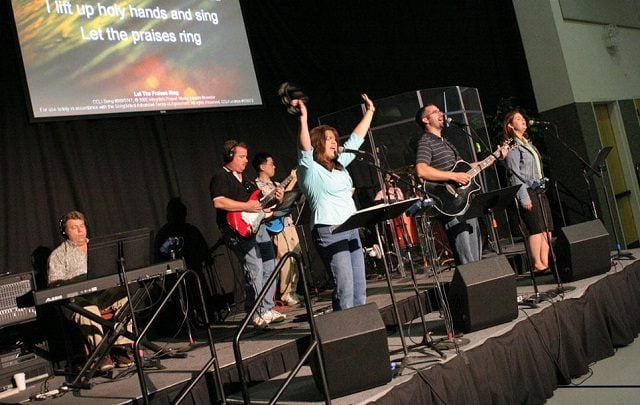
A modern Western worship team leading a contemporary worship session. Photo by David Ball (Sep. 2006) [Wikipedia / Creative Commons Attribution-ShareAlike 3.0 license]

***
(3-4-13)
***
The following are remarks come from a Facebook thread. Others’ words (all Catholics) will be in different colors. All of my Facebook posts are public, so there is no violation of confidence or privacy.
* * * * *
In my non-denom, “Jesus people” / “Jesus movement” days, that’s exactly what we did: rock music and sermons; no liturgy at all . . . It’s not all bad, because worship comes from the heart (and we did so back then), but it’s not the biblical model of worship, either.
hmm…worship comes from the heart, but not biblical…
What do you mean? I think you may have misunderstood what I wrote. I was saying that I was worshiping from my heart in this fashion as a Protestant (which is good and not a bad thing), but that the “model” or structure of that sort of service is not biblical, because biblical worship is not sermon-centered, it’s sacrifice [OT] / [NT] eucharistically-centered.
I know you are saying this type of worship is not all bad…but if it comes from the heart…how is that not biblical..I am older, a revert, found Jesus in many types of worships…if your heart is there, you will find Him and he will know it…just seems the smaller we make the box, the harder it is to fit in it…
I didn’t say the “from the heart” aspect was not biblical. It’s the distinction between spirit and form. The form of rock music + sermon (minus liturgy) is not the biblical norm. Worshiping from the heart is very much the biblical injunction. So one part is right and the other is not what we normally see in Scripture.
We can differentiate between good and bad things in one act. It’s not completely black and white. God honored our worship as non-denom Protestants insofar as our hearts were right with Him and our worship truly directed towards Him (and I know that mine was, and my wife’s was: for the most part). But it wasn’t the Mass. So it’s a mixed bag.
I was trying to avoid the judgmental legalism of saying that those types of worship are utterly bad.
I’ve also had very wonderful and spiritual worship experiences at charismatic Catholic Masses (and defend that movement in several papers of mine). But they are Masses, which is the point . . .
The deepest emotion I have felt has been at reverent, calm celebrations of the Mass–as Nessa says, preferably Latin.They concentrate the mind and heart wonderfully so that it’s possible to pray the Liturgy. That often brings me to tears, when I realize what is happening before me.
For a lot of people, this pic’s message is like slapping their momma … Disagree as I do with rock n’ roll (or even Catholic folk rock) services, people take their own brand of worship so personally that it’s difficult to ask them to think about it or question it …
Indeed; yet it is a valid point, and if one claims to be so in-tune with what is “biblical” (and most Protestants — like myself, very much so, in those days — assume that they “own” the Bible, over against Catholicism), then they ought to apply biblical models of worship as well. This is only holding them to their own ostensible standard (sola Scriptura).
It’s not so much what they do as what they omit and look down on. Many Protestants assume (again, I was one) that formal worship is inherently impious and inferior. This is utterly unbiblical.
It’s true that one can be formal without the heart, just as they can worship from the heart minus liturgy. People fall short in all sorts of ways. The key is to get the heart right towards God, and worship according to the liturgy as it has been passed down through the centuries. Both/and . . .
No one was less “liturgical” than I used to be. When I was going to a Lutheran church (1977-1980), I only went to the Bible studies: didn’t even go on Sundays (amazing, as I think back on that). I’ve come full circle on this issue.
Dave, here’s an observation. As an evangelical, all I saw in the book of Acts were sermons and miracles. The letters we have from St. Paul and the others are sermons or instructional. Outside of the Last Supper and St. Paul’s mention of it in ! Corinthians, we didn’t see much stress in the NT on the Eucharist at all. There wasn’t a set liturgy in the NT, or something explicit about worship styles – just a lot of preaching. We saw it as a kind of free for all, and would have considered a liturgy centered around the Eucharist as even stranger than the church down the street that didn’t allow music because it’s not in the NT. I see all of that now, but I can understand why it would be a hard sell for some people.
I think that what finally woke me up was the day I visited a Dayton-area “mega church,” and they were having the Lord’s Supper with lunch trays and juice boxes. That stunned me in a way that I didn’t completely understand, and it made me rethink the kind of well intentioned foolishness that I had been participating in. Thank God for His Church.
This is a great discussion. Agree not completely black and white . . . we were the only Catholic family there [at a non-denom school] ..we had the best of both worlds…we learned alot from others traditions, as they did about Catholicism…made us better Catholics..so I have a great respect for worship in all forms …don’t feel like we can truly know the best and most perfect way to worship Our Lord…just have to trust in the Lord and be careful about respecting other forms of Christian worship.
I agree that you have to dig deeper into Scripture to see liturgy. I certainly did, myself. But we see plenty of it in Revelation, in Hebrews (with the theme of Jesus as high priest), in Paul’s use of sacerdotal language and references to “altars” and explicit real presence language, in the Last Supper, and John 6 (where sermonizing and the Eucharist are strikingly combined), in the post-Resurrection appearance to the disciples on the way to Emmaus, where Jesus disappears after they break bread; in the motif of Jesus as Lamb, and as our sacrifice . . . Also, after the apostles preached, they often baptized as well (e.g., notably, Acts 2), which combined the sacramental and supernatural transformation with the preaching.
I would say about sermons, that they are great (I wish homilies were far better in the Catholic Church: that every priest could preach like Cardinal Newman). I have nothing against them per se: only with placing them at the center or apex of a worship service. I’ve loved good sermons both as a Protestant and as a catholic, because I’m a big “ideas” and intellectually-oriented guy. It’s the sermon emphasis to the complete exclusion (oftentimes) of the Eucharist (or even any liturgy at all) which is objectionable.
Obviously, Protestants differ in this respect, and there are degrees. The point of the meme was to critique the “low church” form of worship, that I happened to practice myself for 13 years.
Oh, I fully agree, Dave. I think it could be said with some fairness that I knew what the Bible said back then, but in spite of the intensive amount of theology, history and word study that I did, it all lacked the framework that the Church provides for it. I also did not have the slightest clue as to how *often* the Deuterocanonicals are referenced in the NT. That goes along with all of the rest of the things you mentioned.
I am always very thankful for the many great and true things I learned as an evangelical. Since I critique lots of things within Protestantism, as an apologist, sometimes folks get the completely erroneous impression that I am somehow “anti-Protestant.” Not at all: not in the sense that these folks think: as if I think it is a fundamentally “bad” thing. No! It’s a good thing (i.e., non-liberal forms of Protestantism) that has some serious errors contained in it, but is mostly incomplete or skeletal, rather than bad through and through.
One proof of that (among many) is the fact that the Protestant publisher, Beacon Hill Press, will be publishing my Quotable Wesley in the fall. I’ve signed the contract and have already received my advance.
As a former Protestant, I’ll admit something. I use to use the “heart” argument a lot myself, but then I eventually saw something. I’d say that worship, the clothes I wore, church selection, and doctrinal differences were okay as long as my heart was right with God. All my friends agreed. But then we’d turn around and condemn Mormons and Jehovah’s Witnesses — despite their basing their beliefs on their hearts. I was very inconsistent. Furthermore, I also couldn’t find any biblical passage that says everything’s up to our individual hearts. Now I see things differently. Now I see that one’s heart is only “in the right place” when it’s following the biblical standard, and not oneself. Ones own view is what got us kicked out of the Garden.
“in spite of the intensive amount of theology, history and word study that I did, it all lacked the framework that the Church provides for it.”
Yes, yes, YES!
This is a supremely important point. Everyone has an “interpretive grid” or framework or set of presuppositions in how they view things. This largely determines what we see, and how much relative attention we give to things. This is where tradition and Church play a crucial role. They show us so often that what we thought was “self-evident” on our own, might indeed be false, and that what we never thought about or noticed much at all, is actually quite important and sometimes even central.
Christianity cannot be, is not, never was — was never intended to be — some individualistic thing. It was always communitarian and structured, both in hierarchy and liturgy.
Yet as evangelicals and (the smaller subgroup of) “Jesus people” evangelicals we had this axiomatic assumption of individualism. That came far more from the “Reformation” (so-called) and even more so from (so-called) “Enlightenment” anti-traditionalism and anti-institutionalism and the good ol’ rugged American individualistic ideal than it ever came from the Bible or the apostles or early Church. We had adopted the premise prior to approaching the Bible, and then used it as our grid; thus leading in turn to eisegesis on many points (reading into Scripture rather than drawing out of it).
I read more of “Dakes Annotated Reference Notes” than I did the bible back then! Goes to show ya that while I could not swallow the Pope being infallible, I had no problem with Dake being infallible! Or Keith Green, God rest his misinformed soul.
What I can’t fathom now, is when some Protestants or Evangelicals say about Catholics “You worship a man” or “You worship the Saints” or “You worship Mary!” But then, they follow Joyce Meyer around the country like panting puppies and other teachers of “the Word” like fan clubs when I was 10 and loved Paul McCartney I thought I’d marry him one day! They chase after these ‘charismatic’ speakers more than I ever seen Catholics doing…but then I now have sacramental eyes and that’s opened a whole new world for me. All people have to be careful not to cling to “people” however, that goes for some Catholics, too, in all fairness, I’ve encountered some fans of a certain popular alleged Marian apparition that have not been the least bit humble or the least like Mary when I expressed my skepticism. . . .
We’ve been Catholic now for 8 years and it’s the BEST!!! Even with all the problems in the Church, I’d rather be in the barque of Peter than sailing in some man-made little skiff!
We’re all prone to following mere men (or women) and building cults around them. There are a number of instances of that among Catholics, with celebrity figures being out of full submission to the Church, yet having rabid followers, who defend them, no mater what. I am thinking of two in particular, but I won’t name them, because then we’ll see the same nonsense occur right in this thread!
I dared to mention one in a recent post, and it was a free-for-all (since deleted). But I will be refuting this person in the future, again (most likely) and I don’t care if people don’t like that. They can lump it! It’s my duty to refute error, by God’s grace. Whether what I write is “popular” or not, has never had the slightest effect on me. I just don’t want this great thread to be hijacked and to descend into that kind of silliness.
What do we know about the earliest liturgies and how early do we [have] records of early worship? A reference would be helpful. . . .
We know quite a bit, I think, from biblical indications, and early writings. I would recommend The Mass of the Early Christians, by Mike Aquilina.
Jesus never said to praise him with incense and repeated prayers and solemness and where specific Holy garments are worn and to be in only Latin or a variety of other things that many people use during their worship.
True, but beside the point, because He didn’t have to say all these things for them to be true and good. Incense was used in OT worship and is again seen in Revelation, and in, e.g., the gift of frankincense for the infant Jesus. Jesus participated in Temple worship and observed all the Jewish laws: highly ritualized worship in every respect. The Last Supper was a passover meal. So did Paul, and Paul and other apostles attended synagogue worship as well. So these things were assumed. Paul presupposes it when he talks about Christian worship, referring to “the altar” and sacrifice, etc.
Holy garments and items were also long-established in the tradition of Jewish worship, and this continued into the new covenant. Latin is a “sacred language” insofar as it was adopted for worship and liturgical use. At the time, it was widely spoken. But it served the same purpose as Greek (NT) and Hebrew (OT). When Greek was widely spoken, they produced the Septuagint. When Latin was universal, St. Jerome’s Vulgate, etc.
Repeated prayers were modeled by Jesus Himself (and in the Psalms), as I have written about. Nor does the Bible oppose formality to the heart in worship.
Many people feel more comfortable with what is considered a more traditional style of worship. Something that is quieter and uses a more classical style music and that is fine. there is nothing wrong with that for those who want to worship in that manner. The problem comes when I hear people talk about this is a holy style of music or this is the only way to worship our God.
Well, arguments can be made as to what is appropriate music at Mass. I don’t think it has to be classical, but it has to be in line with the purpose of worship. So (to use an absurd example), we would no more play Stravinsky’s Rite of Spring at Mass than we would, Rubber Biscuit. Obviously there are matters of aesthetics as well as solemnity in play. We can oppose legalism or judgmentalism without denying that there is good and bad music to be heard at Mass. It’s not merely subjective.
That is just ridiculous and only of one opinion.
Excessive legalism is; what I have just noted is not.
This is not just towards Catholics but all of us in Christendom together. How much do any of our services resemble what Jesus did on the hillsides outside of Jerusalem?
That’s a non sequitur. Jesus preaching in the fields is not, technically, a Christian service and the facilities for same were not present. It would be similar to John Wesley preaching in the fields in the 18th century. It’s not a valid analogy to what a Mass ought to be like.
Think about that.
I did, and have many times in the past!
Did Jesus use sacred artifacts and utensils when he broke bread and multiplied bread and fish and fed the 5000?
Again, this is beside the point. He sanctioned use of same when He worshiped in the Temple and in synagogues. There are “holy items” in the NT as well, such as Paul’s handkerchief, that healed people.
* * * * *
And a few more related or somewhat related comments of mine from a Facebook thread today:
I always thought the giant congregations were stupid and little fiefdoms, and said so as an evangelical, too. I would say back then (now 22+ years ago) that the goal is individual spiritual growth, not numerical growth of having ten times more butts in the pews (i.e., if they are attracted to such a huge congregation by the wrong reasons: merely looking for a wife or suchlike). I’ve never been known to mince words at any time.
When people say organized religion is so lousy, we can reply that it’s a Hades of a lot better than disorganized religion.
[Informal or contemporary or non-liturgical worship is] not all bad, as I argued recently. We used to praise and worship God from our hearts in those days. But it’s not inherently superior to form or traditional worship. That’s where we must hold our ground: the extreme “either/or” legalistic mentality.
I should be careful not to judge people’s motives about their music. But I don’t like it and it angers me a bit when Christians tout it as the only way to praise God. My cousin accused my Church’s worship as being “nothing like the worship of the Bible” yet they insist on music the apostles would have found foreign to the worship service.
Exactly: “the only way . . . ” We shouldn’t say that the Catholic Mass is the only way, either. We can say we believe it is the best way; the way most rooted in Christian tradition for 2,000 years, but “only” would exclude lots of people who are also sincerely worshiping God: many not knowing any different way in their experience.
As I’ve always said, we can be both ecumenical and apologetical. There is no self-contradiction there: say we believe that our way is best, but other ways have good in them, too, and ain’t all bad. We can do all that without compromising our own principles or beliefs at all.
Those of us who weren’t born Catholic were worshiping God according to all we knew at the time. It’s not all bad. I didn’t start worshiping God or loving Him, or the Bible, when I became a Catholic. I had been doing that for years. Protestantism partakes of much of the truths of Catholicism. In other ways it is in serious error. Those who are saved, are saved by Jesus, through the Catholic Church.
All I was saying is that we should rejoice in the large amount of good and truth that reside in non-Catholic Christianity.
* * * * *
Previous Post
February 18, 2013
Dialogue with a Lutheran on the Immaculate Conception
Next Post
March 11, 2013 "Dialogue" on Obamanomics (vs. Bruce Townley)
Browse Our Archives
Select a Category & Last Things About Me Anti-Catholicism Atheism & Agnosticism Baptism and Sacramentalism Bible and Tradition Blessed Virgin Mary Books by Dave Armstrong C. S. Lewis Calvinism & General Protestantism Catholic Apologetics Catholic Apologists Catholic conversion Catholic converts Christmas Church (Ecclesiology) Church History Conversion and Converts Development of Doctrine Eastern Orthodoxy Ecumenism & Christian Unity Eucharist & Liturgy Fathers of the Church French Translations G. K. Chesterton Hell Hell & Satan Hell & Satan & Last Things Heresies & Comparative Religion Holistic Health Inquisition & Crusades & Scandals James White Jews & Judaism & Old Testament John Calvin John Henry Newman Liberal / Modernist Theology Life Issues Literary Resume Lutheranism Mariology Martin Luther Music Orthodoxy Papacy & Infallibility Personal Page Philosophy & Science Political & Ethical & Moral Issues Protestant Persecution & Intolerance Protestantism Purgatory Purgatory & Penance Romantic & Imaginative Theology Saints & Purgatory & Penance Salvation Salvation & Justification Satan & Last Things Sexuality and Gender Issues Spanish Translations Traditionalism vs. Radical Catholic Reactionaries Traducciones al español / tradução para português Trinitarianism & Christology Uncategorized Videos
Select a Month October 2026 September 2026 August 2026 July 2026 June 2026 May 2026 April 2026 March 2026 February 2026 January 2026 December 2025 November 2025 October 2025 September 2025 August 2025 July 2025 June 2025 May 2025 April 2025 March 2025 February 2025 January 2025 December 2024 November 2024 October 2024 September 2024 August 2024 July 2024 June 2024 May 2024 April 2024 March 2024 February 2024 January 2024 December 2023 November 2023 October 2023 September 2023 August 2023 July 2023 June 2023 May 2023 April 2023 March 2023 February 2023 January 2023 December 2022 November 2022 October 2022 September 2022 August 2022 July 2022 June 2022 May 2022 April 2022 March 2022 February 2022 January 2022 December 2021 November 2021 October 2021 September 2021 August 2021 July 2021 June 2021 May 2021 April 2021 March 2021 February 2021 January 2021 December 2020 November 2020 October 2020 September 2020 August 2020 July 2020 June 2020 May 2020 April 2020 March 2020 February 2020 January 2020 December 2019 November 2019 October 2019 September 2019 August 2019 July 2019 June 2019 May 2019 April 2019 March 2019 February 2019 January 2019 December 2018 November 2018 October 2018 September 2018 August 2018 July 2018 June 2018 May 2018 April 2018 March 2018 February 2018 January 2018 December 2017 November 2017 October 2017 September 2017 August 2017 July 2017 June 2017 May 2017 April 2017 March 2017 February 2017 January 2017 December 2016 November 2016 October 2016 September 2016 August 2016 July 2016 June 2016 May 2016 April 2016 March 2016 February 2016 January 2016 December 2015 November 2015 October 2015 September 2015 August 2015 July 2015 June 2015 May 2015 April 2015 March 2015 February 2015 January 2015 December 2014 November 2014 October 2014 September 2014 August 2014 July 2014 June 2014 April 2014 March 2014 February 2014 January 2014 December 2013 November 2013 October 2013 September 2013 August 2013 July 2013 June 2013 April 2013 March 2013 February 2013 January 2013 December 2012 November 2012 October 2012 September 2012 August 2012 July 2012 June 2012 May 2012 April 2012 March 2012 February 2012 January 2012 December 2011 November 2011 October 2011 September 2011 August 2011 July 2011 June 2011 April 2011 March 2011 February 2011 October 2010 September 2010 August 2010 July 2010 April 2010 March 2010 December 2009 October 2009 August 2009 July 2009 June 2009 May 2009 March 2009 February 2009 October 2008 September 2008 April 2008 March 2008 February 2008 January 2008 December 2007 November 2007 October 2007 May 2007 March 2007 February 2007 January 2007 November 2006 October 2006 September 2006 August 2006 July 2006 June 2006 May 2006 April 2006 March 2006 February 2006 October 2005 June 2005 April 2005 February 2005 July 2004 May 2004 April 2004
Follow Us!
TAKE THE
Religious Wisdom Quiz
I made a rash vow that cost me my only child after a military victory. Who am I?
Select your answer to see how you score.
Jephthah Samson Gideon Barak
Books by This Author Books by Dave Armstrong
Related posts from Biblical Evidence for Catholicism

The Mass & Development of Doctrine (vs. Wes...
Biblical Evidence for Catholicism

Miraculous Eucharist (vs. Francois Turretin #4)
Biblical Evidence for Catholicism

God's Presence, the Ark, the Eucharist, & Death
Biblical Evidence for Catholicism
Protestant Eucharistic Objections Fail (Turretin)
Biblical Evidence for Catholicism
TRENDING AT PATHEOS Catholic

The Sermon on the Mount, Part I: Matthew...
The Sermon on the Mount, Part I (Matthew 4:12-5:12) St. Matthew moves...

What's up from Crossway: Reviewing some of their latest A few weeks...

Janie Learns the Way of the Cross: A...
Teaching children about Jesus' Passion can be challenging. Many parents and educators...

Looking For Good Catholic Writing - October 2026
He alone extends the heavens, and he walks upon the waves of...

In "Irreplaceable," our book on vocation and technology, Trevor Sutton and I...

I was strolling through the top floor of the brand new Parthenon...
view all Catholic blogs
Ad-Free & Subscriber Log-In Subscription Support
- About Us
- 2026 Calendar
- Videos
- Podcasts
- Library of World Religions
- Faith In Media Tracker
- Advertise With Us
- Write for Us
- Privacy Policy
- Terms of Service
- Do Not Sell My Data
- Contact Us
- Radiant Digital
- Manage Newsletter Subscriptions
- Unsubscribe From Notifications
- Sitemap
Copyright 2008-2026, Patheos. All rights reserved.
Subscription Support Ad-Free & Subscriber Log-In
Follow Patheos