
BuddhistCatholicContemplativeEvangelicalGeneral ChristianHinduJewishLatter-day SaintMuslimNew VisionsProgressive Christian
Beliefs
- Buddhist
- Catholic
- Contemplative
- Evangelical
- General Christian
- Hindu
- Jewish
- Latter-day Saint
- More Voices
- Muslim
- New Visions
- Pagan
- Progressive Christian
Topics
- Religion News
- Food and Religion
- Sports and Religion
- Religious Art
- Religious Music and Entertainment
- Religious Events
- History and Religion
- Style and Religion
- Politics and Religion
- Women in Religion
- Recreation Outdoors and Religion
- Business Finance and Religion
- Careers Workplace and Religion
- Education and Religion
- Family Parenting and Religion
- Health Fitness and Religion
- Home and Religion
- Relationships and Religion
- Technology and Religion
- Travel and Religion
Columnists
- Buddhist Columnists
- Business Finance and Religion Columnists
- Careers Workplace and Religion Columnists
- Catholic Columnists
- Contemplative Columnists
- Education and Religion Columnists
- Evangelists Columnists
- Family Parenting and Religion Columnists
- General Christian Columnists
- Health Fitness and Religion Columnists
- Hindu Columnists
- History and Religion Columnists
- Home and Religion Columnists
- Jewish Columnists
- More Voices Columnists
- Latter Day Columnists
- Muslim Columnists
- New Visions Columnists
- Nonreligious Columnists
- Pagan Columnists
- Politics and Religion Columnists
- Progressive Columnists
- Recreation Outdoors and Religion Columnists
- Relationships and Religion Columnists
- Religion News Columnists
- Religious Art Columnists
- Religious Events Columnists
- Religious Music and Entertainment Columnists
- Sports and Religion Columnists
- Style and Religion Columnists
- Technology and Religion Columnists
- Travel and Religion Columnists
- Women in Religion Columnists
Resource Library
- 2026 Calendar
- Library of World Religions
- The 100 Most Holy Places on Earth
- Patheos Answers
- Podcasts
- Videos
- Faith Leaders Database
- Anglican Episcopalian
- Bahai
- Baptist
- Buddhism
- Christianity
- Confucianism
- Eastern Orthodoxy
- Hinduism
- Holiness and Pentecostal
- ISKCON
- Islam
- Judaism
- Lutheran
- Methodist
- The Church of Jesus Christ of Latter-day Saints
- New Age
- Paganism
- Presbytarian and Reformed
- Protestantism
- Religion Behind the Scenes
- Roman Catholic
- Scientology
- Shia Islam
- Sikhism
- Sufism
- Sunni Islam
- Taoism
- Zen
- See all religions
Research Tools
 Ad-Free & Subscriber Log-In Subscription Support
Ad-Free & Subscriber Log-In Subscription Support
Follow Patheos 

- Trending:
- Forgiveness
- |
- Marriage
- |
- Consciousness
- |
- Death Penalty
- |
- Election
- |
- Halloween

-
About
-
Catholic Apologetics
-
Church History
-
Great Apologists
-
Christian Worldview
-
Protestantism & Misc.
- Home
- Catholic
- History and Religion
- Dialogue with a Lutheran on the Immaculate Conception
Dialogue with a Lutheran on the Immaculate Conception
Last updated on: June 6, 2026 at 12:26 am by Dave Armstrong
Dialogue with a Lutheran on the Immaculate Conception 2026-06-06T00:26:05-04:00 Dave Armstrong
Patheos Explore the world's faith through different perspectives on religion and spirituality! Patheos has the views of the prevalent religions and spiritualities of the world.
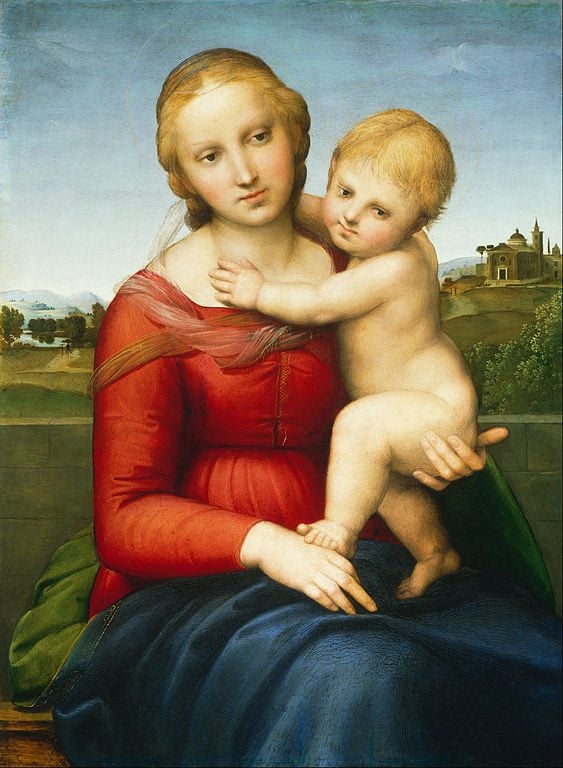
The Small Cowper Madonna (c. 1505), by Raphael (1483-1520) [public domain / Wikimedia Commons]

***
(2-18-13)
* * *
Chuck Wiese (Lutheran) wrote an article on his blog (The Lamb on the Altar), entitled, “Dave Armstrong’s Doctrine of the Immaculate Conception” (17 February 2013). I shall cite it in its entirety below and reply to it, point-by-point. His words will be in blue.
* * * * *
The Roman church teaches that when Mary was conceived in the womb she was kept free from original sin and filled with sanctifying grace. It wasn’t until 1854 that this doctrine became an official teaching of the Roman church.
It is never sufficient to simply cite a “late date” and leave it at that. It’s great polemics and propaganda, but lousy historical argumentation. First of all, it isn’t as if the doctrine came out of thin air in 1854. It was believed, by and large, for many centuries. 1854 simply made it dogma at the very highest levels: de fide or ex cathedra (as the Catholic Church has many levels of authority of dogmas).
What must be determined is if doctrines that are defined at much later dates are consistent developments or truly innovative novelties, that have no legitimate historical precursors. The Immaculate Conception is the former, and is a straightforward development of the belief in the sinlessness of Mary, that was the consensus of the Church fathers.
To find doctrinal novelties and corruptions one must go to folks like the so-called “reformers”: people like Martin Luther, who introduced (as I have documented) at least 50 novel doctrines in his treatises of 1520, even before he was excommunicated. One can also point to sola Scriptura: the Protestant rule of faith, that was not taught by the Church fathers at all, as I have demonstrated numerous times. Nor can it be proven at all from Scripture. I’ve written two books about that. St. Augustine’s teachings were Catholic, not proto-Protestant. I devoted an entire book to documenting that fact, too.
This teaching was not established by appealing to the Scriptures but rather by appealing to “implicit” teachings in the church fathers.
To some extent that is true, but biblical arguments were also utilized, as in all Catholic argumentation in favor of particular doctrines. It was largely an argument from tradition, but then, this is perfectly permissible on the biblical, apostolic, patristic, and medieval assumption that sola Scriptura is not the rule of faith in Christianity. St. Augustine and St. Thomas Aquinas both noted many times that a doctrine can legitimately develop from tradition alone, or primarily.
Unlike the doctrine of the perpetual virginity of Mary which is not contradicted by the Scriptures and which is very strongly and unanimously taught by the church fathers, the immaculate conception contradicts the Scriptures and has very weak support among the church fathers.
It doesn’t contradict the Bible at all. Nothing in the Bible denies that Mary was or could have been sinless (like Adam and Eve were before the fall, and like the angels are), nor that she could have been conceived without original sin. It’s one thing to assert that there is not explicit evidence of it in Scripture, or perhaps not even much implicit or indirect evidence; quite another to assert contradiction, which is a far greater claim, in need of demonstration.
As for the fathers, well, yes and no. It’s not explicitly asserted, but its developmental kernels are: Mary as sinless, the new ark of the covenant, and second Eve, all are repeatedly asserted by the fathers. Thus, this question goes back to the issue of development of doctrine.
Even in the middle ages significant theologians like Bernard of Clairvaux and Thomas Aquinas denied the immaculate conception.
We always hear about this . . . First of all, St. Thomas didn’t believe that the soul was united to the human body until 40-80 days after conception. He had a deficient understanding of biology and did not hold to the Church’s current beliefs about ensoulment (i.e., a soul is supernaturally created by God at the moment of conception). Therefore, he could not have held to the Immaculate Conception as the Church does today, based on this false premise.
Secondly, Thomas believed that Mary was extraordinarily sanctified in the womb: just not at conception, per the above, and particularly sanctified at the time of the conception of Jesus.
Thirdly, he believed that she committed no actual sin. In all these things he was followed by Martin Luther, as I have documented. But none of these things are held by Lutherans today. Thus, St. Thomas was far closer to present Catholicism in this (and Luther) than to Lutherans or Protestants generally. I recently completed my book, The Quotable Summa Theologica, and devoted almost six pages to his teaching in these matters. I won’t cite his teaching here, but if this debate intensifies, I’d be happy to produce them.
The doctrine most likely developed as an attempt to safeguard the doctrine of the sinlessness of Christ but as Thomas Aquinas points out, if Mary were sinless Christ could not be her redeemer.
The Catholic Church wholeheartedly agrees that Mary was in need of a redeemer, like all human beings since the fall. She herself calls God her savior in the magnificat. We contend that she was saved by being prevented (by an act of God’s grace at her conception) from falling into the “pit” of sin, rather than rescued out of it, as the rest of us are, if we are saved. St. Thomas neglected to draw this distinction, therefore made a fallacious argument (even he could do that on occasion). In this way, the Immaculate Conception is perfectly consistent with Mary’s need of a savior, and to be rescued (in a special and unique act of God’s grace) from the original sin she would have inherited, like every other human being.
But more recent Roman apologists in an attempt to win over evangelicals have tried to defend the doctrine immaculate conception from the Scriptures. On page 178 of A Biblical Defense of Catholicism, Dave Armstrong discusses the use of the term “full of grace” and says:
It is permissible, on Greek grammatical and linguistic grounds, to paraphrase kecharitomene as completely, perfectly, enduringly endowed with grace.
In the book, Armstrong does not treat the above as a direct quotation from any particular source but he does provide a footnote that says
Blass and DeBrunner, Greek Grammar of the New Testament (Chicago: University of Chicago Press, 1961), 166; H.W. Smyth, Greek Grammar (Cambridge: Harvard University Press, 1968), sect 1852:b.
The book does not cite Blass and DeBrunner as a direct quotation . . .
All correct so far . . .
. . . but if you search the internet, you’ll find plenty of people quoting this as if it were a direct quotation from Blass and DeBrunner including Dave Armstrong on his blog.
Sometimes folks utilize my materials incorrectly. I checked out Chuck’s assertion that I myself cited it wrongly as well. I did find one 2011 paper where I made this mistake (my book above was completed in 1996). I promptly corrected that and thank Chuck for directing my attention to it. Human errors can happen when one has written almost 2,500 blog posts.
But page 166 doesn’t say anything that resembles what Armstrong is saying here. Blass and DeBrunner simply mention that the perfect stem is used to denote “a condition or state as the result of a past action.” The passage cited by Smyth says, “Completed action with permanent result is denoted by the perfect stem.” None of this sounds anything like what Armstrong is saying. The passage clearly says that God graced Mary but it’s rather insane to try to derive the doctrine of the immaculate conception from that.
I love the use of exaggerated, dramatic rhetoric (“insane”). It is also important to note “what Armstrong is saying” in the first place. In my book, I didn’t claim that Luke 1:28 and kecharitomene “proved” the Immaculate Conception. Immediately after my words above, that Chuck cited, I wrote:
Thus, in just this one verse, pregnant with meaning and far-reaching implications, the uniqueness of Mary is strongly indicated, and the Immaculate Conception can rightly be deemed entirely consistent with the meaning of this passage.
The Bible speaks only implicitly of many things that Protestants strongly believe, such as the proper mode of Baptism (immersion, sprinkling, or pouring?). The Immaculate Conception is entirely possible within scriptural presuppositions.
The words “consistent” and “entirely possible” are obviously not the same as assertion of outright proof, or demonstration. Since my first book (written over 16 years ago) I have made additional scriptural arguments that are based on explicit texts, having to do with grace and sin. I would love for Chuck to take these on, if he is looking to have a biblically-based discussion of the Immaculate Conception.
The ever-virgin Mary can truly be called the Queen of Heaven. She was given the most important position of any human being by being chosen by God to be the Mother of God.
Quite true.
But Mary was a sinner who needed Christ to suffer and die for her just as well all do.
The second thing is not denied by Catholics. The first clause is an unproven assertion derived from mere traditions of men, and neither from the Bible nor the consensus of patristic teachings.
[cross-posted to my Facebook page]
* * * * *
Previous Post
February 15, 2013
Definition of "Sola Scriptura" (We Must Get it Right!)
Next Post
March 4, 2013 Informal Worship vs. Formal Catholic Liturgy
Browse Our Archives
Select a Category & Last Things About Me Anti-Catholicism Atheism & Agnosticism Baptism and Sacramentalism Bible and Tradition Blessed Virgin Mary Books by Dave Armstrong C. S. Lewis Calvinism & General Protestantism Catholic Apologetics Catholic Apologists Catholic conversion Catholic converts Christmas Church (Ecclesiology) Church History Conversion and Converts Development of Doctrine Eastern Orthodoxy Ecumenism & Christian Unity Eucharist & Liturgy Fathers of the Church French Translations G. K. Chesterton Hell Hell & Satan Hell & Satan & Last Things Heresies & Comparative Religion Holistic Health Inquisition & Crusades & Scandals James White Jews & Judaism & Old Testament John Calvin John Henry Newman Liberal / Modernist Theology Life Issues Literary Resume Lutheranism Mariology Martin Luther Music Orthodoxy Papacy & Infallibility Personal Page Philosophy & Science Political & Ethical & Moral Issues Protestant Persecution & Intolerance Protestantism Purgatory Purgatory & Penance Romantic & Imaginative Theology Saints & Purgatory & Penance Salvation Salvation & Justification Satan & Last Things Sexuality and Gender Issues Spanish Translations Traditionalism vs. Radical Catholic Reactionaries Traducciones al español / tradução para português Trinitarianism & Christology Uncategorized Videos
Select a Month October 2026 September 2026 August 2026 July 2026 June 2026 May 2026 April 2026 March 2026 February 2026 January 2026 December 2025 November 2025 October 2025 September 2025 August 2025 July 2025 June 2025 May 2025 April 2025 March 2025 February 2025 January 2025 December 2024 November 2024 October 2024 September 2024 August 2024 July 2024 June 2024 May 2024 April 2024 March 2024 February 2024 January 2024 December 2023 November 2023 October 2023 September 2023 August 2023 July 2023 June 2023 May 2023 April 2023 March 2023 February 2023 January 2023 December 2022 November 2022 October 2022 September 2022 August 2022 July 2022 June 2022 May 2022 April 2022 March 2022 February 2022 January 2022 December 2021 November 2021 October 2021 September 2021 August 2021 July 2021 June 2021 May 2021 April 2021 March 2021 February 2021 January 2021 December 2020 November 2020 October 2020 September 2020 August 2020 July 2020 June 2020 May 2020 April 2020 March 2020 February 2020 January 2020 December 2019 November 2019 October 2019 September 2019 August 2019 July 2019 June 2019 May 2019 April 2019 March 2019 February 2019 January 2019 December 2018 November 2018 October 2018 September 2018 August 2018 July 2018 June 2018 May 2018 April 2018 March 2018 February 2018 January 2018 December 2017 November 2017 October 2017 September 2017 August 2017 July 2017 June 2017 May 2017 April 2017 March 2017 February 2017 January 2017 December 2016 November 2016 October 2016 September 2016 August 2016 July 2016 June 2016 May 2016 April 2016 March 2016 February 2016 January 2016 December 2015 November 2015 October 2015 September 2015 August 2015 July 2015 June 2015 May 2015 April 2015 March 2015 February 2015 January 2015 December 2014 November 2014 October 2014 September 2014 August 2014 July 2014 June 2014 April 2014 March 2014 February 2014 January 2014 December 2013 November 2013 October 2013 September 2013 August 2013 July 2013 June 2013 April 2013 March 2013 February 2013 January 2013 December 2012 November 2012 October 2012 September 2012 August 2012 July 2012 June 2012 May 2012 April 2012 March 2012 February 2012 January 2012 December 2011 November 2011 October 2011 September 2011 August 2011 July 2011 June 2011 April 2011 March 2011 February 2011 October 2010 September 2010 August 2010 July 2010 April 2010 March 2010 December 2009 October 2009 August 2009 July 2009 June 2009 May 2009 March 2009 February 2009 October 2008 September 2008 April 2008 March 2008 February 2008 January 2008 December 2007 November 2007 October 2007 May 2007 March 2007 February 2007 January 2007 November 2006 October 2006 September 2006 August 2006 July 2006 June 2006 May 2006 April 2006 March 2006 February 2006 October 2005 June 2005 April 2005 February 2005 July 2004 May 2004 April 2004
Follow Us!
TAKE THE
Religious Wisdom Quiz
What city did David capture and make the capital of Israel?
Select your answer to see how you score.
Bethlehem Samaria Jerusalem Hebron
Books by This Author Books by Dave Armstrong
Related posts from Biblical Evidence for Catholicism

Does Catholic Intercession of Saints Require Omniscience?
Biblical Evidence for Catholicism

Holy Ground: Why Mary Had NO Other Children...
Biblical Evidence for Catholicism
Protestant Confessions & "Ever-Virgin" Mary
Biblical Evidence for Catholicism

Jesus Founded the [Catholic] Church. If Not Him,...
Biblical Evidence for Catholicism
TRENDING AT PATHEOS Catholic

I was strolling through the top floor of the brand new Parthenon...

What Does Gêvâh Mean For Kimberley Guifoyle &...
This week, a lot of the news is focused on Kimberly Guilfoyle....

INNER CIRCLE: Profound Mystery (Of Christ In All...
Ephesians 5:31-32 “For this reason, a man will leave his father and...

Do Not Rejoice When Your Enemy Falls: The...
Turning an execution into a public spectacle is a disturbing expression of...

'The Chosen' S6 Trailer: The Passion Gets Very...
Not many watching 'The Chosen' worry about spoilers, but just because they...

The purpose-driven labor priest
A labor activist reads Rick Warren and it gets me wondering about...
view all Catholic blogs
Ad-Free & Subscriber Log-In Subscription Support
- About Us
- 2026 Calendar
- Videos
- Podcasts
- Library of World Religions
- Faith In Media Tracker
- Advertise With Us
- Write for Us
- Privacy Policy
- Terms of Service
- Do Not Sell My Data
- Contact Us
- Radiant Digital
- Manage Newsletter Subscriptions
- Unsubscribe From Notifications
- Sitemap
Copyright 2008-2026, Patheos. All rights reserved.
Subscription Support Ad-Free & Subscriber Log-In
Follow Patheos