
BuddhistCatholicContemplativeEvangelicalGeneral ChristianHinduJewishLatter-day SaintMuslimNew VisionsProgressive Christian
Beliefs
- Buddhist
- Catholic
- Contemplative
- Evangelical
- General Christian
- Hindu
- Jewish
- Latter-day Saint
- More Voices
- Muslim
- New Visions
- Pagan
- Progressive Christian
Topics
- Religion News
- Food and Religion
- Sports and Religion
- Religious Art
- Religious Music and Entertainment
- Religious Events
- History and Religion
- Style and Religion
- Politics and Religion
- Women in Religion
- Recreation Outdoors and Religion
- Business Finance and Religion
- Careers Workplace and Religion
- Education and Religion
- Family Parenting and Religion
- Health Fitness and Religion
- Home and Religion
- Relationships and Religion
- Technology and Religion
- Travel and Religion
Columnists
- Buddhist Columnists
- Business Finance and Religion Columnists
- Careers Workplace and Religion Columnists
- Catholic Columnists
- Contemplative Columnists
- Education and Religion Columnists
- Evangelists Columnists
- Family Parenting and Religion Columnists
- General Christian Columnists
- Health Fitness and Religion Columnists
- Hindu Columnists
- History and Religion Columnists
- Home and Religion Columnists
- Jewish Columnists
- More Voices Columnists
- Latter Day Columnists
- Muslim Columnists
- New Visions Columnists
- Nonreligious Columnists
- Pagan Columnists
- Politics and Religion Columnists
- Progressive Columnists
- Recreation Outdoors and Religion Columnists
- Relationships and Religion Columnists
- Religion News Columnists
- Religious Art Columnists
- Religious Events Columnists
- Religious Music and Entertainment Columnists
- Sports and Religion Columnists
- Style and Religion Columnists
- Technology and Religion Columnists
- Travel and Religion Columnists
- Women in Religion Columnists
Resource Library
- 2026 Calendar
- Library of World Religions
- The 100 Most Holy Places on Earth
- Patheos Answers
- Podcasts
- Videos
- Faith Leaders Database
- Anglican Episcopalian
- Bahai
- Baptist
- Buddhism
- Christianity
- Confucianism
- Eastern Orthodoxy
- Hinduism
- Holiness and Pentecostal
- ISKCON
- Islam
- Judaism
- Lutheran
- Methodist
- The Church of Jesus Christ of Latter-day Saints
- New Age
- Paganism
- Presbytarian and Reformed
- Protestantism
- Religion Behind the Scenes
- Roman Catholic
- Scientology
- Shia Islam
- Sikhism
- Sufism
- Sunni Islam
- Taoism
- Zen
- See all religions
Research Tools
 Ad-Free & Subscriber Log-In Subscription Support
Ad-Free & Subscriber Log-In Subscription Support
Follow Patheos 

- Trending:
- Forgiveness
- |
- Marriage
- |
- Consciousness
- |
- Death Penalty
- |
- Election
- |
- Halloween

-
About
-
Catholic Apologetics
-
Church History
-
Great Apologists
-
Christian Worldview
-
Protestantism & Misc.
- Home
- Catholic
- History and Religion
- “Cult” as a Synonym for “Heretical Sect”: Controversial?
“Cult” as a Synonym for “Heretical Sect”: Controversial?
Last updated on: May 28, 2017 at 5:35 pm by Dave Armstrong
“Cult” as a Synonym for “Heretical Sect”: Controversial? 2017-05-28T17:35:14-04:00 Dave Armstrong
Patheos Explore the world's faith through different perspectives on religion and spirituality! Patheos has the views of the prevalent religions and spiritualities of the world.
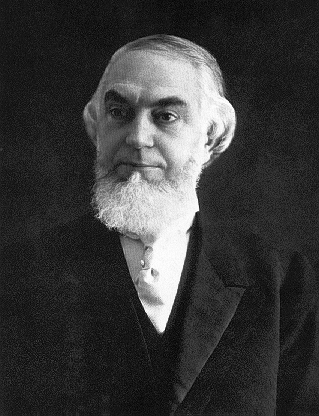
Charles Taze Russell (1852-1916), founder of the Jehovah’s Witnesses, an Arian cult, c. 1915 [public domain / Wikimedia Commons]

***
(11-8-12)
***
This came about as a result of a person reading the dedication (posted online) from my book, Theology of God: Biblical, Chalcedonian Trinitarianism and Christology. Here it is:
To the evangelical Protestant “cult watchers” and “cult researchers” (especially the late Dr. Walter Martin): among whom I first began utilizing the Bible in order to refute non-trinitarian heresies such as Jehovah’s Witnesses, Mormonism, Unitarianism, Christian Science, and the United Pentecostal Church, way back in 1981. May your “tribe” increase and flourish.
Someone then came into the combox for the book info-page with a gripe about how I used the word “cult.” He appears to be a Catholic, but markedly anti-Protestant (leading me to highly suspect that he may be a radical Catholic reactionary or quasi-schismatic Catholic, who, among other things, rejects Vatican II). But I can learn nothing else about him (as so often in these foolish disputes). The dispute follows, with his words in blue:
Since the word cult comes from the Latin cultus “divine service”, shouldn’t a different word be used [of] groups with divergent Christology? Like heresy, for instance? Every group is a cult in its own mind in the sense that it thinks it worships God properly, offers the correct divine service. The weirdo usage of the word cult in English to mean a group with non-standard Christology is really silly.
This is the word that the evangelicals use themselves. Since I was referring to them in the dedication, I used it. I put it in quotes and indicated that it was defined as we would define “heresy.”
But its not an entirely foreign usage, let alone “really silly.” E.g., Modern Catholic Dictionary by Fr. John A. Hardon, S. J., gives as a secondary definition:
a particular religious group centered around some unusual belief, generally transient in duration and featuring some exotic or imported ritual and other practices.
Outside usage by the uneducated and illiterate Protestant rednecks, the only two usages of the word cult that come readily to mind are scholars calling the priests “the temple cult” and referring to “the cult of Mary.” In neither case is the word intended as a pejorative, although redneck Prots probably read it that way. Its a back idea to let illiterate Prots design your definitions. After all, if you did that, the word sovereignty would mean micromanagement which it, of course, does not.
Sheer nonsense. Fr. Hardon was a Catholic scholar, and he contradicts you. There is a legitimate sociological use for the term in this fashion. Nor is your uncharitable characterization accurate. These are some of the most honorable and dedicated Protestants: fighting heresy and defending the Holy Trinity.
No one has “designed” my definitions, as explained. My preferred term is “heresy.”
Blessed Pope John Paul II used the word “cult” in this secondary sense in his apostolic exhortation, Ecclesia in America (22 January 1999):
Although the Second Vatican Council refers to all those who are baptized and believe in Christ as “brothers and sisters in the Lord”, (188) it is necessary to distinguish clearly between Christian communities, with which ecumenical relations can be established, and sects, cults and other pseudo-religious movements.
Likewise, the Congregation for the Clergy: General Directory for Catechesis (approved by Blessed Pope John Paul II, 11 August 1997):
- In a climate of cultural and religious relativism, and sometime because of the inappropriate conduct of Christians, a proliferation of “new religious movements” has occurred. These are sometimes called sects or cults but, because of the abundance of names and tendencies, are difficult to categorize in a comprehensive and precise framework. From available data, movements of Christian origin can be identified, while others derive from oriental religions, and others again appear to be connected with esoteric traditions. Their doctrines and their practices are of concern because they are alien to the content of the Christian faith.
What word does the Latin text use in those places?
I imagine, cultus. But that’s irrelevant, as words can have many meanings. Check out any dictionary to confirm that. Merriam-Webster Online, for example, gives five different uses for cult. Its third is the one we are debating: “a religion regarded as unorthodox or spurious; also: its body of adherents.”
The way cult was used in both citations I gave made it clear what was being discussed: “pseudo-religious” sects with non-Christian or anti-Christian elements or origins; “alien” to Christianity.
* * * * *
Heresies & Comparative Religion
Previous Post
October 23, 2012
Books by Dave Armstrong: "A Biblical Critique of Calvinism"
Next Post

November 27, 2012 Dialogue on Newman's Kingsley / "Apologia" Controversy
Browse Our Archives
Select a Category & Last Things About Me Anti-Catholicism Atheism & Agnosticism Baptism and Sacramentalism Bible and Tradition Blessed Virgin Mary Books by Dave Armstrong C. S. Lewis Calvinism & General Protestantism Catholic Apologetics Catholic Apologists Catholic conversion Catholic converts Christmas Church (Ecclesiology) Church History Conversion and Converts Development of Doctrine Eastern Orthodoxy Ecumenism & Christian Unity Eucharist & Liturgy Fathers of the Church French Translations G. K. Chesterton Hell Hell & Satan Hell & Satan & Last Things Heresies & Comparative Religion Holistic Health Inquisition & Crusades & Scandals James White Jews & Judaism & Old Testament John Calvin John Henry Newman Liberal / Modernist Theology Life Issues Literary Resume Lutheranism Mariology Martin Luther Music Orthodoxy Papacy & Infallibility Personal Page Philosophy & Science Political & Ethical & Moral Issues Protestant Persecution & Intolerance Protestantism Purgatory Purgatory & Penance Romantic & Imaginative Theology Saints & Purgatory & Penance Salvation Salvation & Justification Satan & Last Things Sexuality and Gender Issues Spanish Translations Traditionalism vs. Radical Catholic Reactionaries Traducciones al español / tradução para português Trinitarianism & Christology Uncategorized Videos
Select a Month October 2026 September 2026 August 2026 July 2026 June 2026 May 2026 April 2026 March 2026 February 2026 January 2026 December 2025 November 2025 October 2025 September 2025 August 2025 July 2025 June 2025 May 2025 April 2025 March 2025 February 2025 January 2025 December 2024 November 2024 October 2024 September 2024 August 2024 July 2024 June 2024 May 2024 April 2024 March 2024 February 2024 January 2024 December 2023 November 2023 October 2023 September 2023 August 2023 July 2023 June 2023 May 2023 April 2023 March 2023 February 2023 January 2023 December 2022 November 2022 October 2022 September 2022 August 2022 July 2022 June 2022 May 2022 April 2022 March 2022 February 2022 January 2022 December 2021 November 2021 October 2021 September 2021 August 2021 July 2021 June 2021 May 2021 April 2021 March 2021 February 2021 January 2021 December 2020 November 2020 October 2020 September 2020 August 2020 July 2020 June 2020 May 2020 April 2020 March 2020 February 2020 January 2020 December 2019 November 2019 October 2019 September 2019 August 2019 July 2019 June 2019 May 2019 April 2019 March 2019 February 2019 January 2019 December 2018 November 2018 October 2018 September 2018 August 2018 July 2018 June 2018 May 2018 April 2018 March 2018 February 2018 January 2018 December 2017 November 2017 October 2017 September 2017 August 2017 July 2017 June 2017 May 2017 April 2017 March 2017 February 2017 January 2017 December 2016 November 2016 October 2016 September 2016 August 2016 July 2016 June 2016 May 2016 April 2016 March 2016 February 2016 January 2016 December 2015 November 2015 October 2015 September 2015 August 2015 July 2015 June 2015 May 2015 April 2015 March 2015 February 2015 January 2015 December 2014 November 2014 October 2014 September 2014 August 2014 July 2014 June 2014 April 2014 March 2014 February 2014 January 2014 December 2013 November 2013 October 2013 September 2013 August 2013 July 2013 June 2013 April 2013 March 2013 February 2013 January 2013 December 2012 November 2012 October 2012 September 2012 August 2012 July 2012 June 2012 May 2012 April 2012 March 2012 February 2012 January 2012 December 2011 November 2011 October 2011 September 2011 August 2011 July 2011 June 2011 April 2011 March 2011 February 2011 October 2010 September 2010 August 2010 July 2010 April 2010 March 2010 December 2009 October 2009 August 2009 July 2009 June 2009 May 2009 March 2009 February 2009 October 2008 September 2008 April 2008 March 2008 February 2008 January 2008 December 2007 November 2007 October 2007 May 2007 March 2007 February 2007 January 2007 November 2006 October 2006 September 2006 August 2006 July 2006 June 2006 May 2006 April 2006 March 2006 February 2006 October 2005 June 2005 April 2005 February 2005 July 2004 May 2004 April 2004
Follow Us!
TAKE THE
Religious Wisdom Quiz
At a well in Samaria, I asked a woman for a drink and told her about living water. How many husbands had she had?
Select your answer to see how you score.
Two Five Three Seven
Books by This Author Books by Dave Armstrong
Related posts from Biblical Evidence for Catholicism

I Never Regarded Bp. Strickland or Cdl. Burke...
Biblical Evidence for Catholicism
“Catholic Verses” #5: Denominationalism
Biblical Evidence for Catholicism
Lucas Banzoli Holds to a Seventh-Day Adventist Eschatology...
Biblical Evidence for Catholicism
Semi-Pelagianism & Catholicism (vs. Francisco Tourinho)
Biblical Evidence for Catholicism
TRENDING AT PATHEOS Catholic

Janie Learns the Way of the Cross: A...
Teaching children about Jesus' Passion can be challenging. Many parents and educators...

Looking For Good Catholic Writing - October 2026
He alone extends the heavens, and he walks upon the waves of...

In "Irreplaceable," our book on vocation and technology, Trevor Sutton and I...

I was strolling through the top floor of the brand new Parthenon...

What Does Gêvâh Mean For Kimberley Guifoyle &...
This week, a lot of the news is focused on Kimberly Guilfoyle....

INNER CIRCLE: Profound Mystery (Of Christ In All...
Ephesians 5:31-32 “For this reason, a man will leave his father and...
view all Catholic blogs
Ad-Free & Subscriber Log-In Subscription Support
- About Us
- 2026 Calendar
- Videos
- Podcasts
- Library of World Religions
- Faith In Media Tracker
- Advertise With Us
- Write for Us
- Privacy Policy
- Terms of Service
- Do Not Sell My Data
- Contact Us
- Radiant Digital
- Manage Newsletter Subscriptions
- Unsubscribe From Notifications
- Sitemap
Copyright 2008-2026, Patheos. All rights reserved.
Subscription Support Ad-Free & Subscriber Log-In
Follow Patheos