
BuddhistCatholicContemplativeEvangelicalGeneral ChristianHinduJewishLatter-day SaintMuslimNew VisionsProgressive Christian
Beliefs
- Buddhist
- Catholic
- Contemplative
- Evangelical
- General Christian
- Hindu
- Jewish
- Latter-day Saint
- More Voices
- Muslim
- New Visions
- Pagan
- Progressive Christian
Topics
- Religion News
- Food and Religion
- Sports and Religion
- Religious Art
- Religious Music and Entertainment
- Religious Events
- History and Religion
- Style and Religion
- Politics and Religion
- Women in Religion
- Recreation Outdoors and Religion
- Business Finance and Religion
- Careers Workplace and Religion
- Education and Religion
- Family Parenting and Religion
- Health Fitness and Religion
- Home and Religion
- Relationships and Religion
- Technology and Religion
- Travel and Religion
Columnists
- Buddhist Columnists
- Business Finance and Religion Columnists
- Careers Workplace and Religion Columnists
- Catholic Columnists
- Contemplative Columnists
- Education and Religion Columnists
- Evangelists Columnists
- Family Parenting and Religion Columnists
- General Christian Columnists
- Health Fitness and Religion Columnists
- Hindu Columnists
- History and Religion Columnists
- Home and Religion Columnists
- Jewish Columnists
- More Voices Columnists
- Latter Day Columnists
- Muslim Columnists
- New Visions Columnists
- Nonreligious Columnists
- Pagan Columnists
- Politics and Religion Columnists
- Progressive Columnists
- Recreation Outdoors and Religion Columnists
- Relationships and Religion Columnists
- Religion News Columnists
- Religious Art Columnists
- Religious Events Columnists
- Religious Music and Entertainment Columnists
- Sports and Religion Columnists
- Style and Religion Columnists
- Technology and Religion Columnists
- Travel and Religion Columnists
- Women in Religion Columnists
Resource Library
- 2026 Calendar
- Library of World Religions
- The 100 Most Holy Places on Earth
- Patheos Answers
- Podcasts
- Videos
- Faith Leaders Database
- Anglican Episcopalian
- Bahai
- Baptist
- Buddhism
- Christianity
- Confucianism
- Eastern Orthodoxy
- Hinduism
- Holiness and Pentecostal
- ISKCON
- Islam
- Judaism
- Lutheran
- Methodist
- The Church of Jesus Christ of Latter-day Saints
- New Age
- Paganism
- Presbytarian and Reformed
- Protestantism
- Religion Behind the Scenes
- Roman Catholic
- Scientology
- Shia Islam
- Sikhism
- Sufism
- Sunni Islam
- Taoism
- Zen
- See all religions
Research Tools
 Ad-Free & Subscriber Log-In Subscription Support
Ad-Free & Subscriber Log-In Subscription Support
Follow Patheos 

- Trending:
- Forgiveness
- |
- Marriage
- |
- Consciousness
- |
- Death Penalty
- |
- Election
- |
- Halloween

-
About
-
Catholic Apologetics
-
Church History
-
Great Apologists
-
Christian Worldview
-
Protestantism & Misc.
- Home
- Catholic
- History and Religion
- Temporal Punishment After Forgiveness (vs. John Calvin)
Temporal Punishment After Forgiveness (vs. John Calvin)
Last updated on: May 28, 2017 at 5:40 pm by Dave Armstrong
Temporal Punishment After Forgiveness (vs. John Calvin) 2017-05-28T17:40:08-04:00 Dave Armstrong
Patheos Explore the world's faith through different perspectives on religion and spirituality! Patheos has the views of the prevalent religions and spiritualities of the world.
(10-18-12)
***
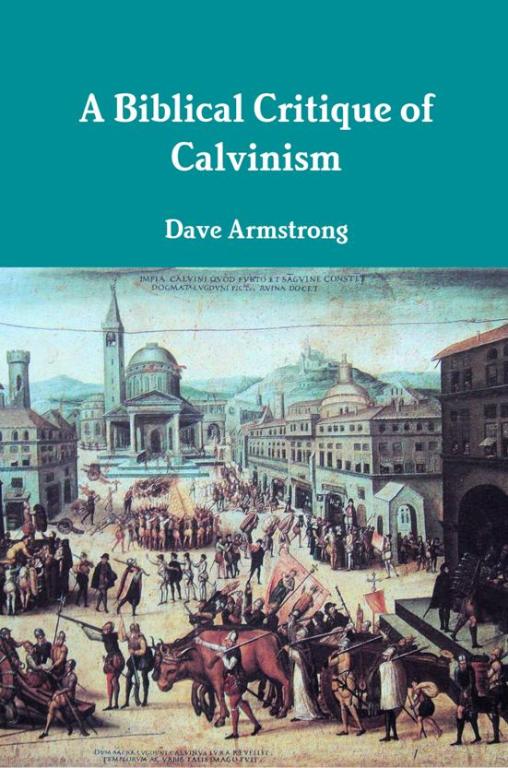
[portion of my book, A Biblical Critique of Calvinism]
***
They endeavor, indeed, to disentangle themselves, but it is impossible. They pretend a distinction between penalty and guilt, holding that the guilt is forgiven by the mercy of God; but that though the guilt is remitted, the punishment which divine justice requires to be paid remains. Satisfactions then properly relate to the remission of the penalty. How ridiculous this levity! They now confess that the remission of guilt is gratuitous; and yet they are ever and anon telling as to merit it by prayers and tears, and other preparations of every kind. Still the whole doctrine of Scripture regarding the remission of sins is diametrically opposed to that distinction. But although I think I have already done more than enough to establish this, I will subjoin some other passages, by which these slippery snakes will be so caught as to be afterwards unable to writhe even the tip of their tail: “Behold, the days come, saith the Lord, that I will make a new covenant with the house of Israel, and with the house of Judah.” “I will forgive their iniquity, and I will remember their sin no more,” (Jer. 31:31, 34). What this means we learn from another Prophet, when the Lord says, “When the righteous turneth away from his righteousness” “all his righteousness that he has done shall not be mentioned.” “Again, when the wicked man turneth away from his wickedness that he has committed, and does that which is lawful and right, he shall save his soul alive,” (Ezek. 18:24, 27). When he declares that he will not remember righteousness, the meaning is, that he will take no account of it to reward it. In the same way, not to remember sins is not to bring them to punishment. The same thing is denoted in other passages, by casting them behind his back, blotting them out as a cloud, casting them into the depths of the sea, not imputing them, hiding them. By such forms of expression the Holy Spirit has explained his meaning not obscurely, if we would lend a willing ear. Certainly if God punishes sins, he imputes them; if he avenges, he remembers; if he brings them to judgment, he has not hid them; if he examines, he has not cast them behind his back; if he investigates, he has not blotted them out like a cloud; if he exposes them, he has not thrown them into the depths of the sea. (Institutes, III, 4:29)
What, pray, did Christ perform for us if the punishment of sin is still exacted? For when we say that he “bare our sins in his own body on the tree,” (1 Pet. 2:24), all we mean is, that he endured the penalty and punishment which was due to our sins. This is more significantly declared by Isaiah, when he says that the “chastisement (or correction) of our peace was upon him,” (Isaiah 53:5). But what is the correction of our peace, unless it be the punishment due to our sins, and to be paid by us before we could be reconciled to God, had he not become our substitute? Thus you clearly see that Christ bore the punishment of sin that he might thereby exempt his people from it. . . . The passages which we have quoted above say expressly that the terms on which God receives us into favor are these—viz. he remits all the punishment which we deserved by pardoning our guilt. . . . In short, if we are freed from guilt by Christ, the punishment consequent upon guilt must cease with it. (III, 4:30)
Since Calvin wants to cite a lot of Old Testament passages in this portion of his work, I will cite three that contradict his erroneous and characteristically too-sweeping interpretation of what he presents. These show that sometimes temporal punishment or chastisement still occurs after God has forgiven or pardoned:
Numbers 14:17-24 [RSV] And now, I pray thee, let the power of the LORD be great as thou hast promised, saying, [18] `The LORD is slow to anger, and abounding in steadfast love, forgiving iniquity and transgression, but he will by no means clear the guilty, visiting the iniquity of fathers upon children, upon the third and upon the fourth generation.’ [19] Pardon the iniquity of this people, I pray thee, according to the greatness of thy steadfast love, and according as thou hast forgiven this people, from Egypt even until now.” [20] Then the LORD said, “I have pardoned, according to your word; [21] but truly, as I live, and as all the earth shall be filled with the glory of the LORD, [22] none of the men who have seen my glory and my signs which I wrought in Egypt and in the wilderness, and yet have put me to the proof these ten times and have not hearkened to my voice, [23] shall see the land which I swore to give to their fathers; and none of those who despised me shall see it. [24] But my servant Caleb, because he has a different spirit and has followed me fully, I will bring into the land into which he went, and his descendants shall possess it.
Deuteronomy 32:48-52 And the LORD said to Moses that very day, [49] “Ascend this mountain of the Ab’arim, Mount Nebo, which is in the land of Moab, opposite Jericho; and view the land of Canaan, which I give to the people of Israel for a possession; [50] and die on the mountain which you ascend, and be gathered to your people, as Aaron your brother died in Mount Hor and was gathered to his people; [51] because you broke faith with me in the midst of the people of Israel at the waters of Mer’i-bath-ka’desh, in the wilderness of Zin; because you did not revere me as holy in the midst of the people of Israel. [52] For you shall see the land before you; but you shall not go there, into the land which I give to the people of Israel.” (cf. Num 20:10-12)
2 Samuel 12:13-14 David said to Nathan, “I have sinned against the LORD.” And Nathan said to David, “The LORD also has put away your sin; you shall not die. [14] Nevertheless, because by this deed you have utterly scorned the LORD, the child that is born to you shall die.” (cf. ch. 24)
Oddly enough, after his statements above that go too far and bring him in conflict with Scripture, Calvin becomes much more nuanced and “arrives” at a view not unlike the Catholic one in these matters of penance and chastisement:
Had they observed, what certainly they ought not to have overlooked, that there are two kinds of divine judgment, they would have seen in the correction of David a very different form of punishment from that which must be thought designed for vengeance. . . . For the sake of distinction, we may call the one kind of judgment punishment, the other chastisement. . . . By divine punishment, properly so called, let us then understand punishment accompanied with indignation. In judicial chastisement, he is offended, but not in wrath; he does not punish by destroying or striking down as with a thunderbolt. Hence it is not properly punishment or vengeance, but correction and admonition. The one is the act of a judge, the other of a father. When the judge punishes a criminal, he animadverts upon the crime, and demands the penalty. When a father corrects his son sharply, it is not to mulct or avenge, but rather to teach him, and make him more cautious for the future. (III, 4:31)
We Catholics are well aware of this rather obvious scriptural distinction, and Calvin was smart enough to realize and grasp this. He even treats one of the most compelling Catholic prooftexts in this regard: King David’s case (2 Samuel 12:13-14 above) at some length:
The sons of God are beaten with rods, not that they may pay the punishment due to their faults, but that they may thereby be led to repent. . . . Thus, when he rejected Saul from the kingdoms he punished in vengeance (1 Sam. 15:23); when he deprived David of his child, he chastised for amendment (2 Sam. 12:18). (III, 4:33)
All, if I mistake not, now see what view the Lord had in chastening David, namely, to prove that murder and adultery are most offensive to God, and to manifest this offensiveness in a beloved and faithful servant, that David himself might be taught never again to dare to commit such wickedness; still, however, it was not a punishment designed in payment of a kind of compensation to God. In the same way are we to judge of that other correction, in which the Lord subjects his people to a grievous pestilence, for the disobedience of David in forgetting himself so far as to number the people. He indeed freely forgave David the guilt of his sin; but because it was necessary, both as a public example to all ages and also to humble David himself, not to allow such an offense to go unpunished, he chastened him most sharply with his whip. We ought also to keep this in view in the universal curse of the human race. For since after obtaining grace we still continue to endure the miseries denounced to our first parent as the penalty of transgression, we ought thereby to be reminded, how offensive to God is the transgression of his law, that thus humbled and dejected by a consciousness of our wretched condition, we may aspire more ardently to true happiness. (III, 4:35)
Frustratingly, often when Calvin expresses a view that is scarcely different from the Catholic perspective, he doesn’t realize it, and continues to think that Catholics believe something fundamentally different. Sadly, this is a general tendency in historic Protestant exegesis and dogmatic theology. Frequently, Calvin prefers to war against a straw man of his own making, rather than admit agreement with Catholics.
In this instance (analyzing his treatment of David’s punishment), arguably it is a case of a “distinction without a difference.” Calvin wants to split hairs and call this “chastisement” rather than “temporal punishment.” That’s fine, but it is what it is, whatever one calls it, and Catholics conceptually agree with him, for the most part. Our “temporal punishment” or “satisfaction” or (more broadly) “penance” is roughly the same as what he (and we) would call “chastisement.”
But Calvin, wishing to always paint Catholicism in the worst light, and missing many relevant distinctions in Catholic theology, caricatures our position on penance as equivalent to divine wrath or vengeance, which is properly applied only to reprobates, on their way to hell. Nice try, but no cigar . . .
* * * * *
Previous Post
October 17, 2012
Books by Dave Armstrong: "Theology of God"
Next Post
October 23, 2012 Books by Dave Armstrong: "A Biblical Critique of Calvinism"
Browse Our Archives
Select a Category & Last Things About Me Anti-Catholicism Atheism & Agnosticism Baptism and Sacramentalism Bible and Tradition Blessed Virgin Mary Books by Dave Armstrong C. S. Lewis Calvinism & General Protestantism Catholic Apologetics Catholic Apologists Catholic conversion Catholic converts Christmas Church (Ecclesiology) Church History Conversion and Converts Development of Doctrine Eastern Orthodoxy Ecumenism & Christian Unity Eucharist & Liturgy Fathers of the Church French Translations G. K. Chesterton Hell Hell & Satan Hell & Satan & Last Things Heresies & Comparative Religion Holistic Health Inquisition & Crusades & Scandals James White Jews & Judaism & Old Testament John Calvin John Henry Newman Liberal / Modernist Theology Life Issues Literary Resume Lutheranism Mariology Martin Luther Music Orthodoxy Papacy & Infallibility Personal Page Philosophy & Science Political & Ethical & Moral Issues Protestant Persecution & Intolerance Protestantism Purgatory Purgatory & Penance Romantic & Imaginative Theology Saints & Purgatory & Penance Salvation Salvation & Justification Satan & Last Things Sexuality and Gender Issues Spanish Translations Traditionalism vs. Radical Catholic Reactionaries Traducciones al español / tradução para português Trinitarianism & Christology Uncategorized Videos
Select a Month October 2026 September 2026 August 2026 July 2026 June 2026 May 2026 April 2026 March 2026 February 2026 January 2026 December 2025 November 2025 October 2025 September 2025 August 2025 July 2025 June 2025 May 2025 April 2025 March 2025 February 2025 January 2025 December 2024 November 2024 October 2024 September 2024 August 2024 July 2024 June 2024 May 2024 April 2024 March 2024 February 2024 January 2024 December 2023 November 2023 October 2023 September 2023 August 2023 July 2023 June 2023 May 2023 April 2023 March 2023 February 2023 January 2023 December 2022 November 2022 October 2022 September 2022 August 2022 July 2022 June 2022 May 2022 April 2022 March 2022 February 2022 January 2022 December 2021 November 2021 October 2021 September 2021 August 2021 July 2021 June 2021 May 2021 April 2021 March 2021 February 2021 January 2021 December 2020 November 2020 October 2020 September 2020 August 2020 July 2020 June 2020 May 2020 April 2020 March 2020 February 2020 January 2020 December 2019 November 2019 October 2019 September 2019 August 2019 July 2019 June 2019 May 2019 April 2019 March 2019 February 2019 January 2019 December 2018 November 2018 October 2018 September 2018 August 2018 July 2018 June 2018 May 2018 April 2018 March 2018 February 2018 January 2018 December 2017 November 2017 October 2017 September 2017 August 2017 July 2017 June 2017 May 2017 April 2017 March 2017 February 2017 January 2017 December 2016 November 2016 October 2016 September 2016 August 2016 July 2016 June 2016 May 2016 April 2016 March 2016 February 2016 January 2016 December 2015 November 2015 October 2015 September 2015 August 2015 July 2015 June 2015 May 2015 April 2015 March 2015 February 2015 January 2015 December 2014 November 2014 October 2014 September 2014 August 2014 July 2014 June 2014 April 2014 March 2014 February 2014 January 2014 December 2013 November 2013 October 2013 September 2013 August 2013 July 2013 June 2013 April 2013 March 2013 February 2013 January 2013 December 2012 November 2012 October 2012 September 2012 August 2012 July 2012 June 2012 May 2012 April 2012 March 2012 February 2012 January 2012 December 2011 November 2011 October 2011 September 2011 August 2011 July 2011 June 2011 April 2011 March 2011 February 2011 October 2010 September 2010 August 2010 July 2010 April 2010 March 2010 December 2009 October 2009 August 2009 July 2009 June 2009 May 2009 March 2009 February 2009 October 2008 September 2008 April 2008 March 2008 February 2008 January 2008 December 2007 November 2007 October 2007 May 2007 March 2007 February 2007 January 2007 November 2006 October 2006 September 2006 August 2006 July 2006 June 2006 May 2006 April 2006 March 2006 February 2006 October 2005 June 2005 April 2005 February 2005 July 2004 May 2004 April 2004
Follow Us!
TAKE THE
Religious Wisdom Quiz
What city did David capture and make the capital of Israel?
Select your answer to see how you score.
Bethlehem Samaria Jerusalem Hebron
Books by This Author Books by Dave Armstrong
Related posts from Biblical Evidence for Catholicism

Bible & Catholicism on Mortal Sin (vs. John...
Biblical Evidence for Catholicism

Does Catholic Intercession of Saints Require Omniscience?
Biblical Evidence for Catholicism

Capabilities of Heavenly Saints: Protestant Commentaries
Biblical Evidence for Catholicism

Revelation 5 & 8 (Intercession of Saints &...
Biblical Evidence for Catholicism
TRENDING AT PATHEOS Catholic

I was strolling through the top floor of the brand new Parthenon...

What Does Gêvâh Mean For Kimberley Guifoyle &...
This week, a lot of the news is focused on Kimberly Guilfoyle....

INNER CIRCLE: Profound Mystery (Of Christ In All...
Ephesians 5:31-32 “For this reason, a man will leave his father and...

Do Not Rejoice When Your Enemy Falls: The...
Turning an execution into a public spectacle is a disturbing expression of...

'The Chosen' S6 Trailer: The Passion Gets Very...
Not many watching 'The Chosen' worry about spoilers, but just because they...

The purpose-driven labor priest
A labor activist reads Rick Warren and it gets me wondering about...
view all Catholic blogs
Ad-Free & Subscriber Log-In Subscription Support
- About Us
- 2026 Calendar
- Videos
- Podcasts
- Library of World Religions
- Faith In Media Tracker
- Advertise With Us
- Write for Us
- Privacy Policy
- Terms of Service
- Do Not Sell My Data
- Contact Us
- Radiant Digital
- Manage Newsletter Subscriptions
- Unsubscribe From Notifications
- Sitemap
Copyright 2008-2026, Patheos. All rights reserved.
Subscription Support Ad-Free & Subscriber Log-In
Follow Patheos