
BuddhistCatholicContemplativeEvangelicalGeneral ChristianHinduJewishLatter-day SaintMuslimNew VisionsProgressive Christian
Beliefs
- Buddhist
- Catholic
- Contemplative
- Evangelical
- General Christian
- Hindu
- Jewish
- Latter-day Saint
- More Voices
- Muslim
- New Visions
- Pagan
- Progressive Christian
Topics
- Religion News
- Food and Religion
- Sports and Religion
- Religious Art
- Religious Music and Entertainment
- Religious Events
- History and Religion
- Style and Religion
- Politics and Religion
- Women in Religion
- Recreation Outdoors and Religion
- Business Finance and Religion
- Careers Workplace and Religion
- Education and Religion
- Family Parenting and Religion
- Health Fitness and Religion
- Home and Religion
- Relationships and Religion
- Technology and Religion
- Travel and Religion
Columnists
- Buddhist Columnists
- Business Finance and Religion Columnists
- Careers Workplace and Religion Columnists
- Catholic Columnists
- Contemplative Columnists
- Education and Religion Columnists
- Evangelists Columnists
- Family Parenting and Religion Columnists
- General Christian Columnists
- Health Fitness and Religion Columnists
- Hindu Columnists
- History and Religion Columnists
- Home and Religion Columnists
- Jewish Columnists
- More Voices Columnists
- Latter Day Columnists
- Muslim Columnists
- New Visions Columnists
- Nonreligious Columnists
- Pagan Columnists
- Politics and Religion Columnists
- Progressive Columnists
- Recreation Outdoors and Religion Columnists
- Relationships and Religion Columnists
- Religion News Columnists
- Religious Art Columnists
- Religious Events Columnists
- Religious Music and Entertainment Columnists
- Sports and Religion Columnists
- Style and Religion Columnists
- Technology and Religion Columnists
- Travel and Religion Columnists
- Women in Religion Columnists
Resource Library
- 2026 Calendar
- Library of World Religions
- The 100 Most Holy Places on Earth
- Patheos Answers
- Podcasts
- Videos
- Faith Leaders Database
- Anglican Episcopalian
- Bahai
- Baptist
- Buddhism
- Christianity
- Confucianism
- Eastern Orthodoxy
- Hinduism
- Holiness and Pentecostal
- ISKCON
- Islam
- Judaism
- Lutheran
- Methodist
- The Church of Jesus Christ of Latter-day Saints
- New Age
- Paganism
- Presbytarian and Reformed
- Protestantism
- Religion Behind the Scenes
- Roman Catholic
- Scientology
- Shia Islam
- Sikhism
- Sufism
- Sunni Islam
- Taoism
- Zen
- See all religions
Research Tools
 Ad-Free & Subscriber Log-In Subscription Support
Ad-Free & Subscriber Log-In Subscription Support
Follow Patheos 

- Trending:
- Forgiveness
- |
- Marriage
- |
- Consciousness
- |
- Death Penalty
- |
- Election
- |
- Halloween

-
About
-
Catholic Apologetics
-
Church History
-
Great Apologists
-
Christian Worldview
-
Protestantism & Misc.
- Home
- Catholic
- History and Religion
- “The Quotable Newman” (Foreword by Joseph Pearce)
“The Quotable Newman” (Foreword by Joseph Pearce)
Last updated on: July 11, 2026 at 1:34 pm by Dave Armstrong
“The Quotable Newman” (Foreword by Joseph Pearce) 2026-07-11T13:34:23-04:00 Dave Armstrong
Patheos Explore the world's faith through different perspectives on religion and spirituality! Patheos has the views of the prevalent religions and spiritualities of the world.
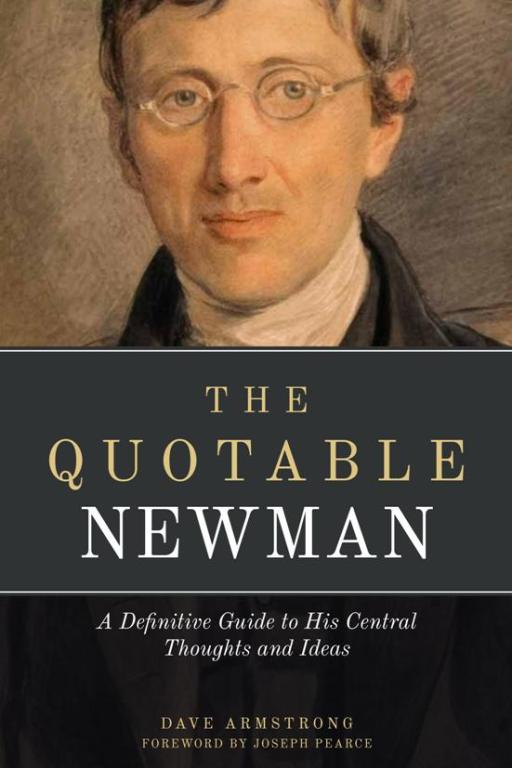
(9-5-12)
***
[link to book info-page]
***
Joseph Pearce (b. 1961) is a noted Catholic biographer (arguably the most eminent one writing today). He has written books about Chesterton, Belloc, Tolkien, C. S. Lewis, Solzhenitsyn, Shakespeare, and Wilde, as well as the volumes, Literary Converts and Literary Giants, Literary Catholics.
* * * * *
In 2010, I was honored to be among the official press commentators for Pope Benedict XVI’s visit to Britain. It was indeed a joy and a privilege to follow the Pope as he visited venues in London which resonated with Catholic significance. He visited Westminster Hall, in which St. Thomas More had stood trial, and visited Westminster Abbey to pray at the shrine of St. Edward the Confessor. He blessed the crowds in Hyde Park, only a stone’s throw from the site of Tyburn Tree, the Machiavellian altar on which numerous Catholic Martyrs were slain. It was as though the places selected for the Pope’s visit had been carefully chosen to remind Englishmen of their Catholic heritage and to warn of the dangers inherent in secularist intolerance towards the Church. The purpose of the Pope’s visit, however, was not primarily to celebrate England’s Catholic heritage but to beatify John Henry Newman. In so doing, the Pope was not so much celebrating history as making it. Newman was the first Englishman, other than the Martyrs, to be beatified since the Reformation; he was also the first Englishman born since the 17th century to be raised to the altar.*
John Henry Newman was born in 1801, at the very dawn of the 19th century, and lived until 1890 as the sun began to set on this most catalytic and cataclysmic of epochs. During Newman’s long and eventful life, new ideas would cause seismic shifts in the way that modern man perceived himself. Karl Marx adapted the ideas of Hegel in the service of revolutionary politics, thereby unleashing an ideology which would claim the lives of tens of millions of people in the following century. Charles Darwin proposed the evolution of species from primitive beginnings, thereby initiating the notion of biological progressivism and the chronological snobbery which is its consequence. Friedrich Nietzsche declared brazenly that God was dead, thereby deifying Man. Sigmund Freud supplanted the conscious will with subconscious complexes, thereby supplanting rational moral choices with irrational psychological urges. Revolutions swept across Europe as nationalism and socialism threatened the old order, sowing the seeds of National Socialism and its international communist Big Brother. The British Empire swept across the world, laying the foundations of globalism. It was a time of change and uncertainty and yet, at the same time and as the life of Newman testifies, it was also a time of religious revival and resurgent traditionalism.*
Newman’s own place within the Catholic Revival is paramount. He is indeed the very Father of the Revival itself.*
At the time of Newman’s birth, the Catholic Church in England had been largely rooted out of the national life and consciousness. Between the 1530s and 1680s countless Catholics had been put to death for their faith. There are more than a hundred canonized and beatified English martyrs and many others whose final sacrifice for the Faith has not been officially recognized by the Church. In the wake of the so-called “Glorious” Revolution of 1688, which deposed the Catholic monarch, James II, two Jacobite uprisings sought the return of the true King’s heirs to the throne. In the second of these uprisings the followers of Bonnie Prince Charlie were finally defeated at the Battle of Culloden in 1746, crushing any realistic hope of the return of a Catholic monarchy. At this point, after more than 200 years of relentless persecution, all seemed lost for England’s shrinking Catholic population. A small number of recusant families, who had clung on to the Faith doggedly and dogmatically in defiance of the ongoing war of attrition against them, had resigned themselves to a place on the margins of English life, excluded from preferment in politics and society by the ingrained and institutionalized prejudice of their fellow countrymen. This was the world in which Newman was born and in which he was due to play a major role.*
Newman’s conversion in 1845, sixteen years after Catholic Emancipation and five years before the re-establishment of the Catholic hierarchy in England, heralded the birth of a Revival which would see the resurrection of the Faith in the English-speaking world. Prior to Newman’s conversion, Catholicism had been perceived by the British as a foreign religion, espoused by swarthy and superstitious Mediterranean types. As the power of Britain waxed into the fullness of Empire and as the power of Italy, Spain and Portugal waned into relative impotence, it was easy for the British to feel superior and supercilious. Catholicism was a primitive and backward religion for primitive and backward people. Such snobbery was thrown into confusion by Newman’s reception into the Catholic Church. Known as possessing one of the finest intellects of his day, it was difficult to dismiss the submission of such an intellectual giant to the historical and dogmatic claims of Rome.*
Newman had made an intensive study of the early Church and had concluded that the faith of the Church Fathers was the same holy, Catholic and Apostolic Faith as that preached and taught by the Catholic Church of his own day. Newman’s scholarship and his eloquence in expressing it shook the Anglican establishment, throwing into question the presumptions and prejudices on which the foundations of the Church of England were built.*
A wave of converts from the higher echelons of society crossed the Tiber in Newman’s wake as conversion became almost fashionable. At the same time, a huge influx of Irish immigrants, fleeing the potato famine, greatly increased the number of working class Catholics. Almost overnight, Catholicism was becoming a significant force in British society, the presence of a growing number of erudite converts coinciding with the growing plebian presence of the Irish immigrants. The result would be a Catholic Revival which would last for more than a century.*
The first period of this revival could be called the Newman period, stretching from the great man’s conversion in 1845 until his death in 1890. The second period, or what might be called the Decadent interlude, spanned the final decade of the century in which the writers and artists of the fin de siècle flirted with Rome and ultimately succumbed to the charms of the Church. Amongst the converts from this decade were Oscar Wilde, Aubrey Beardsley, Ernest Dowson and Lionel Johnson. The next major period of the revival could be called the Chesterbelloc period, in which the giant figures of Belloc and Chesterton loomed large, which spanned from 1900, the year in which Chesterton was first published, until 1936, the year of his death. The final period called be called the Inklings period in which the figures of Tolkien and Lewis dominated, spanning from 1937, the year The Hobbit was published, until 1973, the year of Tolkien’s death.*
It is arguable that the enormity of the Catholic Revival, which placed Catholicism at the centre and even at the pinnacle of the artistic and cultural life of Britain, would not have happened had it not been for Newman’s conversion, the catalytic nature of which can hardly be overstated.*
Having placed Newman’s importance within its historical context, it is also necessary to look albeit briefly at his influence as an historian, theologian, philosopher, educationist, apologist, novelist and poet.*
Newman’s importance as an historian is rooted in his pioneering work on the Early Church, which convinced him, as it has convinced generations of those who have read him, that a study of the Fathers and of the early heresies provides convincing evidence of the truth claims of Catholicism. Newman claimed and his work has shown that the more one is steeped in history the more one becomes a Catholic.*
As a theologian, Newman is rightly celebrated for his Essay on the Development of Christian Doctrine (1845), which has been hugely influential in the Church’s understanding of how its doctrine develops without ever changing in its essentials. The most succinct encapsulation of this understanding of the development of Church doctrine was given by Tolkien in a letter to his son in which he likened the Church to a tree. It was wrong to see the full-grown tree, i.e. the Church after two millennia of development, as being inferior to the seed from which it grew or the sapling that it had once been, i.e. the early Church. The tree (Church) is the same throughout all the ages, developing and growing organically without ever changing its essential “treeness” (i.e., the truth that the Church teaches and the truth that it is).*
In philosophy, Newman is best known for An Essay in Aid of the Grammar of Assent (1870), which shows the inadequacy of reductionist reasoning, such as logic, as a means of comprehending the fullness of truth. Faith is arrived at by the correlation of converging probabilities to which the will must assent. As an educationist, Newman championed the liberal arts in The Idea of a University (1852), uniting the classics of pagan antiquity to the inheritance of Christendom. As an apologist, his seminal Apologia pro Vita Sua (1864) remains one of the greatest spiritual autobiographies ever written, perhaps the greatest with the obvious exception of Augustine’s Confessions. The role of the apologist is also manifested in his novels, Loss and Gain (1845) and Callista (1855), as well as in his sermons and his theological engagement with the errors of Anglicanism. Last but indubitably not least is Newman’s position as a prose stylist of the highest order and a poet of the first rank.*
Before concluding, passing reference must be made to later generations of famous converts for whom Newman was a major influence. These include Gerard Manley Hopkins, arguably the greatest poet in an age of great poets, who was received into the Church by Newman himself in 1866. Others who were helped significantly on their paths to Rome by Newman include Oscar Wilde, Maurice Baring, R. H. Benson, Christopher Dawson, Ronald Knox, Evelyn Waugh, Graham Greene, Muriel Spark, and Alec Guinness, to name but an illustrious few. Mention should also be made of Hilaire Belloc and J. R. R. Tolkien, two of the giants of the Catholic Revival, who were both educated at the Oratory School in Birmingham which Newman had founded.*
In so many multifarious ways, John Henry Newman has been a blessing to the Church. How appropriate, therefore, that the Church has now conferred a great blessing upon Newman by raising him to the altar. The beatified Newman is in the Presence of the Beatific Vision. He has achieved the only goal for which life is worth living. As such, praise should make way for prayers.*
Blessed John Henry Newman, historian, theologian, philosopher and poet, pray for us.
*
* * * * *
Previous Post
September 2, 2012
Books by Dave Armstrong: "Pillars of Sola Scriptura"
Next Post

September 24, 2012 John Calvin Did NOT Deny the Sphericity of the Earth
Browse Our Archives
Select a Category & Last Things About Me Anti-Catholicism Atheism & Agnosticism Baptism and Sacramentalism Bible and Tradition Blessed Virgin Mary Books by Dave Armstrong C. S. Lewis Calvinism & General Protestantism Catholic Apologetics Catholic Apologists Catholic conversion Catholic converts Christmas Church (Ecclesiology) Church History Conversion and Converts Development of Doctrine Eastern Orthodoxy Ecumenism & Christian Unity Eucharist & Liturgy Fathers of the Church French Translations G. K. Chesterton Hell Hell & Satan Hell & Satan & Last Things Heresies & Comparative Religion Holistic Health Inquisition & Crusades & Scandals James White Jews & Judaism & Old Testament John Calvin John Henry Newman Liberal / Modernist Theology Life Issues Literary Resume Lutheranism Mariology Martin Luther Music Orthodoxy Papacy & Infallibility Personal Page Philosophy & Science Political & Ethical & Moral Issues Protestant Persecution & Intolerance Protestantism Purgatory Purgatory & Penance Romantic & Imaginative Theology Saints & Purgatory & Penance Salvation Salvation & Justification Satan & Last Things Sexuality and Gender Issues Spanish Translations Traditionalism vs. Radical Catholic Reactionaries Traducciones al español / tradução para português Trinitarianism & Christology Uncategorized Videos
Select a Month October 2026 September 2026 August 2026 July 2026 June 2026 May 2026 April 2026 March 2026 February 2026 January 2026 December 2025 November 2025 October 2025 September 2025 August 2025 July 2025 June 2025 May 2025 April 2025 March 2025 February 2025 January 2025 December 2024 November 2024 October 2024 September 2024 August 2024 July 2024 June 2024 May 2024 April 2024 March 2024 February 2024 January 2024 December 2023 November 2023 October 2023 September 2023 August 2023 July 2023 June 2023 May 2023 April 2023 March 2023 February 2023 January 2023 December 2022 November 2022 October 2022 September 2022 August 2022 July 2022 June 2022 May 2022 April 2022 March 2022 February 2022 January 2022 December 2021 November 2021 October 2021 September 2021 August 2021 July 2021 June 2021 May 2021 April 2021 March 2021 February 2021 January 2021 December 2020 November 2020 October 2020 September 2020 August 2020 July 2020 June 2020 May 2020 April 2020 March 2020 February 2020 January 2020 December 2019 November 2019 October 2019 September 2019 August 2019 July 2019 June 2019 May 2019 April 2019 March 2019 February 2019 January 2019 December 2018 November 2018 October 2018 September 2018 August 2018 July 2018 June 2018 May 2018 April 2018 March 2018 February 2018 January 2018 December 2017 November 2017 October 2017 September 2017 August 2017 July 2017 June 2017 May 2017 April 2017 March 2017 February 2017 January 2017 December 2016 November 2016 October 2016 September 2016 August 2016 July 2016 June 2016 May 2016 April 2016 March 2016 February 2016 January 2016 December 2015 November 2015 October 2015 September 2015 August 2015 July 2015 June 2015 May 2015 April 2015 March 2015 February 2015 January 2015 December 2014 November 2014 October 2014 September 2014 August 2014 July 2014 June 2014 April 2014 March 2014 February 2014 January 2014 December 2013 November 2013 October 2013 September 2013 August 2013 July 2013 June 2013 April 2013 March 2013 February 2013 January 2013 December 2012 November 2012 October 2012 September 2012 August 2012 July 2012 June 2012 May 2012 April 2012 March 2012 February 2012 January 2012 December 2011 November 2011 October 2011 September 2011 August 2011 July 2011 June 2011 April 2011 March 2011 February 2011 October 2010 September 2010 August 2010 July 2010 April 2010 March 2010 December 2009 October 2009 August 2009 July 2009 June 2009 May 2009 March 2009 February 2009 October 2008 September 2008 April 2008 March 2008 February 2008 January 2008 December 2007 November 2007 October 2007 May 2007 March 2007 February 2007 January 2007 November 2006 October 2006 September 2006 August 2006 July 2006 June 2006 May 2006 April 2006 March 2006 February 2006 October 2005 June 2005 April 2005 February 2005 July 2004 May 2004 April 2004
Follow Us!
TAKE THE
Religious Wisdom Quiz
Who prayed in a den of lions?
Select your answer to see how you score.
Elijah Noah Daniel David
Books by This Author Books by Dave Armstrong
Related posts from Biblical Evidence for Catholicism

Book: Martin Luther: Dissenter and Defender
Biblical Evidence for Catholicism
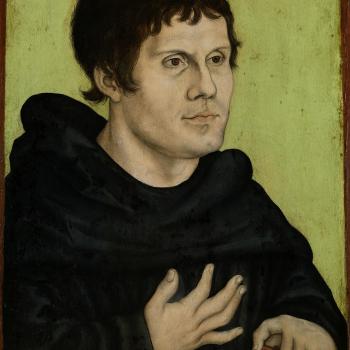
"Martin Luther: Dissenter & Defender": Introduction
Biblical Evidence for Catholicism
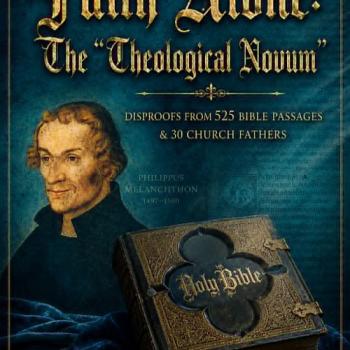
Introducing "Faith Alone: The 'Theological Novum'”
Biblical Evidence for Catholicism
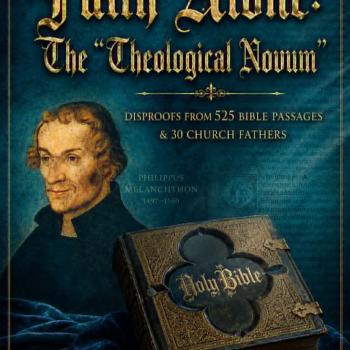
Faith Alone: The "Theological Novum" (Dave Armstrong Book)
Biblical Evidence for Catholicism
TRENDING AT PATHEOS Catholic

Swimfan: Forgotten Aughts Pleasures
This is a recovery effort. In 2002, My Big Fat Greek Wedding...

Top Three Anti-Catholic Lies About Catholicism
This is my initial transcript for the video, "THE 3 WORST...

Pope Leo Celebrates Mass for Nurses & Docs...
I don't have any idea how he did it, but Pope Leo...

The Sermon on the Mount, Part I: Matthew...
The Sermon on the Mount, Part I (Matthew 4:12-5:12) St. Matthew moves...

What's up from Crossway: Reviewing some of their latest A few weeks...

Janie Learns the Way of the Cross: A...
Teaching children about Jesus' Passion can be challenging. Many parents and educators...
view all Catholic blogs
Ad-Free & Subscriber Log-In Subscription Support
- About Us
- 2026 Calendar
- Videos
- Podcasts
- Library of World Religions
- Faith In Media Tracker
- Advertise With Us
- Write for Us
- Privacy Policy
- Terms of Service
- Do Not Sell My Data
- Contact Us
- Radiant Digital
- Manage Newsletter Subscriptions
- Unsubscribe From Notifications
- Sitemap
Copyright 2008-2026, Patheos. All rights reserved.
Subscription Support Ad-Free & Subscriber Log-In
Follow Patheos