
BuddhistCatholicContemplativeEvangelicalGeneral ChristianHinduJewishLatter-day SaintMuslimNew VisionsProgressive Christian
Beliefs
- Buddhist
- Catholic
- Contemplative
- Evangelical
- General Christian
- Hindu
- Jewish
- Latter-day Saint
- More Voices
- Muslim
- New Visions
- Pagan
- Progressive Christian
Topics
- Religion News
- Food and Religion
- Sports and Religion
- Religious Art
- Religious Music and Entertainment
- Religious Events
- History and Religion
- Style and Religion
- Politics and Religion
- Women in Religion
- Recreation Outdoors and Religion
- Business Finance and Religion
- Careers Workplace and Religion
- Education and Religion
- Family Parenting and Religion
- Health Fitness and Religion
- Home and Religion
- Relationships and Religion
- Technology and Religion
- Travel and Religion
Columnists
- Buddhist Columnists
- Business Finance and Religion Columnists
- Careers Workplace and Religion Columnists
- Catholic Columnists
- Contemplative Columnists
- Education and Religion Columnists
- Evangelists Columnists
- Family Parenting and Religion Columnists
- General Christian Columnists
- Health Fitness and Religion Columnists
- Hindu Columnists
- History and Religion Columnists
- Home and Religion Columnists
- Jewish Columnists
- More Voices Columnists
- Latter Day Columnists
- Muslim Columnists
- New Visions Columnists
- Nonreligious Columnists
- Pagan Columnists
- Politics and Religion Columnists
- Progressive Columnists
- Recreation Outdoors and Religion Columnists
- Relationships and Religion Columnists
- Religion News Columnists
- Religious Art Columnists
- Religious Events Columnists
- Religious Music and Entertainment Columnists
- Sports and Religion Columnists
- Style and Religion Columnists
- Technology and Religion Columnists
- Travel and Religion Columnists
- Women in Religion Columnists
Resource Library
- 2026 Calendar
- Library of World Religions
- The 100 Most Holy Places on Earth
- Patheos Answers
- Podcasts
- Videos
- Faith Leaders Database
- Anglican Episcopalian
- Bahai
- Baptist
- Buddhism
- Christianity
- Confucianism
- Eastern Orthodoxy
- Hinduism
- Holiness and Pentecostal
- ISKCON
- Islam
- Judaism
- Lutheran
- Methodist
- The Church of Jesus Christ of Latter-day Saints
- New Age
- Paganism
- Presbytarian and Reformed
- Protestantism
- Religion Behind the Scenes
- Roman Catholic
- Scientology
- Shia Islam
- Sikhism
- Sufism
- Sunni Islam
- Taoism
- Zen
- See all religions
Research Tools
 Ad-Free & Subscriber Log-In Subscription Support
Ad-Free & Subscriber Log-In Subscription Support
Follow Patheos 

- Trending:
- Forgiveness
- |
- Marriage
- |
- Consciousness
- |
- Death Penalty
- |
- Election
- |
- Halloween

-
About
-
Catholic Apologetics
-
Church History
-
Great Apologists
-
Christian Worldview
-
Protestantism & Misc.
- Home
- Catholic
- History and Religion
- Luther & Lutherans on the Duration of the Real Presence
Luther & Lutherans on the Duration of the Real Presence
Last updated on: May 29, 2017 at 2:46 pm by Dave Armstrong
Luther & Lutherans on the Duration of the Real Presence 2017-05-29T14:46:54-04:00 Dave Armstrong
Patheos Explore the world's faith through different perspectives on religion and spirituality! Patheos has the views of the prevalent religions and spiritualities of the world.
. . . in the Eucharist, the Elevation, and Adoration
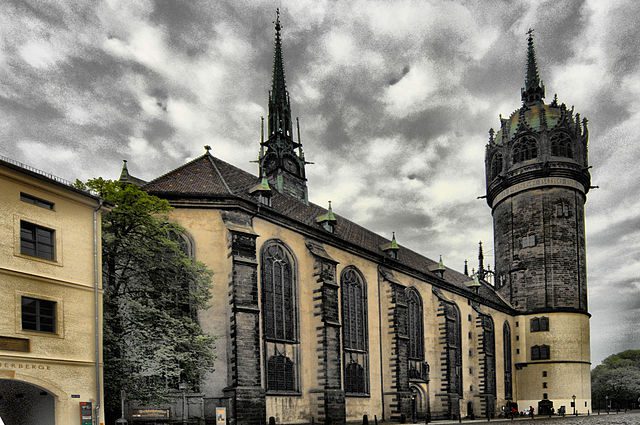
All Saints’ Church, Wittenberg, Germany (built bet. 1490-1511), where Luther nailed his 95 Theses to the door [Wikimedia Commons / Creative Commons Attribution-Share Alike 3.0 Unported license]

***
(1-27-12)
***
From Bishop Bossuet, The History of the Variations of the Protestant Churches, Vol. 1 (New York: John Doyle, 1842), pp. 193-197; further primary source information can be found by following the link for the book. A few minor variations of proper names were added, in order to adopt more standard usage.
* * * * *
Although Luther permitted Melanchthon to say whatever he pleased against the Mass, yet he in nowise departed from his former notions, nor did he reduce the presence of Jesus Christ in the Eucharist to the bare reception of it. It is even plain that Melanchthon shifted with him on this subject; and there are two of Luther’s letters, in 1543, wherein he commends a saying of Melanchthon’s, “that the presence was in the action of the Supper, but not in a precise and mathematical point.” As for Luther, he determined the time to be from the Pater Noster which was said in the Lutheran Mass immediately after the Consecration, until all the people had communicated, and all the remaining particles were consumed.
But why stops he there? If, at that instant, the communion had been carried to the absent, as St. Justin tells us was done in his time, what reason would there have been to say, that Jesus Christ had immediately withdrawn his sacred presence? But why should he not continue it for some days after, when the Holy Sacrament should be reserved for the communion of the sick? It is nothing but mere caprice to take away the presence of Jesus Christ in this case; and Luther and the Lutherans had no longer any rule, when, out of the actual reception, they admitted the use of it but for never so short a time.
But what made still more against them is, that the Mass and Oblation always remained; and, had there been but one moment of presence before the communion, this presence of Jesus Christ could not be deprived of any of the advantages which attended it. For which reason Melanchthon always aimed, whatever he might say to Luther, at placing the presence in the precise time of the reception alone, and this only way could he find of destroying the Oblation and Mass.
Nor was there any other way for destroying the Elevation and Adoration. It has been shown that, at taking away the Elevation, Luther, so far from condemning it, approved the principle of it. I repeat once more his words:—”The Elevation,” he says, “may be preserved, as a testimonial of the real and corporal presence; since the doing that is saying to the people, Behold, Christians, this is the body of Jesus Christ, which was given for you.” This was what Luther wrote after abolishing the Elevation; but why, then, one may say, did he abolish it?
The reason is worthy of the man; and we learn from himself, “that if he attacked the Elevation, it was only out of spite to the Papacy; and, if he retained it so long, it was out of spite to Carlstadt. In a word,” concludes he, “it should be retained when it was rejected as impious, and it should be rejected when commanded as necessary.” But, upon the whole, he acknowledged what, indeed, is not to be doubted—that there could be no difficulty in showing to the people this divine body from the very time it began to be present.
As to the Adoration, after having one while held it as indifferent, and another laid it down as necessary, he at length adhered to his last conclusion; and in the positions which he published against the Doctors of Louvain in 1545, that is, a year before his death, he called the Eucharist “the adorable sacrament.” The Sacramentarian party, who had so much triumphed when he set aside the Elevation, was in a consternation; and Calvin wrote, “that, by this decision, he had raised up the idol in God’s temple.”
Melanchthon was then more than ever convinced that it was impossible to destroy the Adoration, or the Mass, without reducing the whole Real Presence to the precise moment of the manducation. He saw, even, that it was necessary to go further, and that all the points of Catholic doctrine relating to the Eucharist returned upon them one alter another, if they did not find out a way to separate the body and blood from the bread and wine. He then pushed the principle already spoken of so far as that nothing was done for the bread and wine, but all for man: insomuch, that in man only was the body and blood to be really found.
[see Facebook post, “Melanchthon’s Silly Argument for a Temporary Real Presence“]
Melanchthon has never explained in what manner he would have this to be done: but as to the foundation of this doctrine, he never left off insinuating it with great secrecy, and in the most artful manner he was able: for there were no hopes, as long as Luther lived, of making him relent on this point, nor of being able to speak freely what men thought: but Melanchthon so deeply rooted this doctrine in the minds of the Wittenberg and Leipzig divines, that, after Luther and he were dead, they plainly explained themselves in favor of it in an Assembly, which, by the Elector’s orders, they held at Dresden, in 1561.
There they feared not to reject Luther’s proper doctrine, and the Real Presence which he admitted in the bread; and finding no other means of defending themselves against Transubstantiation, the Adoration, and Sacrifice, they went over to the Real Presence taught them by Melanchthon; not in the bread and wine, but in the faithful who received them.
They declared, therefore, “That the true substantial body was truly and substantially given in the Supper, although there was no necessity of saying that the bread was the essential body or the proper body of Jesus Christ, or that it was corporally and carnally taken by die corporeal mouth; that ubiquity raised a horror in them; that it was a subject of astonishment that men should be so positive in affirming that the body was present in the bread, since it was of much more importance to consider what is done in man, for whom, and not for the bread, Jesus Christ rendered himself present.”
After that they explained their sentiments concerning the Adoration, and maintained that it could not be denied, admitting the Real Presence in the bread, although it should even be explained that the body is not present in it except in the actual use: “That the Monks would always have the same reason for beseeching the eternal Father to hear them through his Son, whom they rendered present in this action; that the Supper having been instituted for the remembrance of Jesus Christ, as he could not be taken nor remembered without believing in, and calling on him, the addressing one’s self to him in the Supper as present, and as placing himself in the hands of sacrificing priests after the words of Consecration, could by no means be hindered.”
By the same reason they maintained that, admitting this Real Presence of the body in the bread, the sacrifice could not be rejected, and they proved it by this example: “It was,” said they, ” the ancient custom of all suppliants, to take in their arms the children of those whose assistance they implored, and present them to their fathers, in order to prevail with them by their interposition.”
They said, in the same manner, that having Jesus Christ present in the bread and wine of the Supper, nothing could hinder us from presenting him to his Father, in order to render him propitious to us; and, lastly, they concluded “that it would be much more easy for the monks to establish their Transubstantiation, than for those to impugn it, who, rejecting it in word, affirmed, nevertheless, that the bread was the essential body, that is, the proper body of Jesus Christ.”
Luther had said at Smalkald, and made the whole party subscribe to it, that the bread was the true body of our Lord equally received by saints and sinners: he himself had said, in his last “Confession of Faith,” approved by the whole party, ” that the bread of the Eucharist is the true natural body of our Lord.” Melanchthon and all Saxony had received this doctrine with all the rest, for Luther would be obeyed: but, after his death, they fell off from it, and owned with us, that these words, “the bread is the true body,” import necessarily the change of bread into the body; since, it being impossible for the bread to be the body by nature, it could not become so but by a change; thus they openly rejected their master’s doctrine.
But they went much further in the above declaration, and confess that, admitting, as Lutherans had hitherto done, the Real Presence in the bread, there could be no objection to the sacrifice, which Catholics offer to God, nor to the adoration they pay to Jesus Christ in the Eucharist.
Their proofs are convincing. If Jesus Christ is believed to be in the bread, if faith lays hold of him in this state, can this faith subsist without adoration*?* Does not this faith itself necessarily imply the highest adoration, since it draws after it the invocation of Jesus Christ, as Son of God, and as there present? The proof of the sacrifice is not less conclusive: for, as these divines say, if, by the sacramental words, Jesus Christ is rendered present in the bread, is not this presence of Jesus Christ of itself agreeable to the Father, and can our prayers be sanctified by a more holy oblation than that of Jesus Christ present?
What do Catholics say more, and what is their sacrifice else but Jesus Christ present in the sacrament of the Eucharist, and representing himself to his Father the victim by which he had been appeased? There is no way, then, of avoiding the sacrifice, no more than the adoration and transubstantiation, without denying this real presence of Jesus Christ in the bread.
Thus the Church of Wittenberg, the Mother of the Reformation, and whence, according to Calvin, the light of the Gospel proceeded in our days as it proceeded formerly from Jerusalem, no longer can maintain the sentiments of Luther, her first founder. The whole doctrine of this head of the Reformation contradicts itself: he invincibly establishes the literal sense and Real Presence: he rejects the necessary consequences therefrom, as maintained by Catholics. If, with him, the Real Presence is admitted in the bread, the whole Mass, with the Catholic doctrine, must of course be admitted without reserve.
This seems too grating to these new Reformers; for what good have they been doing, if they must be forced to approve these things, with the whole worship of the Church of Rome? but, on the other side, what more chimerical than a Real Presence separated from the bread and wine? Was it not, in showing the bread and wine, that Jesus Christ said, “This is my body”? Has he said, we should receive his body and blood divided from those things wherein it was his pleasure they should be contained; and if we are to receive the proper substance of them, must it not be after such a manner as he declared at the institution of this mystery?
In these inextricable difficulties, the desire of abolishing the Mass prevailed; but the method which Melanchthon and the Saxons had taken to destroy it was so bad, that it could not subsist. Those of Wittenberg and Leipzig themselves soon after came back, and Luther’s opinion, which placed the body in the bread, kept its ground.
***
Previous Post

December 29, 2011
Blaise Pascal on Biblical Paradox vs. False Dichotomies
Next Post
January 27, 2012 Sola Scriptura, 2 Timothy 3:16-17, and "Man of God"
Browse Our Archives
Select a Category & Last Things About Me Anti-Catholicism Atheism & Agnosticism Baptism and Sacramentalism Bible and Tradition Blessed Virgin Mary Books by Dave Armstrong C. S. Lewis Calvinism & General Protestantism Catholic Apologetics Catholic Apologists Catholic conversion Catholic converts Christmas Church (Ecclesiology) Church History Conversion and Converts Development of Doctrine Eastern Orthodoxy Ecumenism & Christian Unity Eucharist & Liturgy Fathers of the Church French Translations G. K. Chesterton Hell Hell & Satan Hell & Satan & Last Things Heresies & Comparative Religion Holistic Health Inquisition & Crusades & Scandals James White Jews & Judaism & Old Testament John Calvin John Henry Newman Liberal / Modernist Theology Life Issues Literary Resume Lutheranism Mariology Martin Luther Music Orthodoxy Papacy & Infallibility Personal Page Philosophy & Science Political & Ethical & Moral Issues Protestant Persecution & Intolerance Protestantism Purgatory Purgatory & Penance Romantic & Imaginative Theology Saints & Purgatory & Penance Salvation Salvation & Justification Satan & Last Things Sexuality and Gender Issues Spanish Translations Traditionalism vs. Radical Catholic Reactionaries Traducciones al español / tradução para português Trinitarianism & Christology Uncategorized Videos
Select a Month October 2026 September 2026 August 2026 July 2026 June 2026 May 2026 April 2026 March 2026 February 2026 January 2026 December 2025 November 2025 October 2025 September 2025 August 2025 July 2025 June 2025 May 2025 April 2025 March 2025 February 2025 January 2025 December 2024 November 2024 October 2024 September 2024 August 2024 July 2024 June 2024 May 2024 April 2024 March 2024 February 2024 January 2024 December 2023 November 2023 October 2023 September 2023 August 2023 July 2023 June 2023 May 2023 April 2023 March 2023 February 2023 January 2023 December 2022 November 2022 October 2022 September 2022 August 2022 July 2022 June 2022 May 2022 April 2022 March 2022 February 2022 January 2022 December 2021 November 2021 October 2021 September 2021 August 2021 July 2021 June 2021 May 2021 April 2021 March 2021 February 2021 January 2021 December 2020 November 2020 October 2020 September 2020 August 2020 July 2020 June 2020 May 2020 April 2020 March 2020 February 2020 January 2020 December 2019 November 2019 October 2019 September 2019 August 2019 July 2019 June 2019 May 2019 April 2019 March 2019 February 2019 January 2019 December 2018 November 2018 October 2018 September 2018 August 2018 July 2018 June 2018 May 2018 April 2018 March 2018 February 2018 January 2018 December 2017 November 2017 October 2017 September 2017 August 2017 July 2017 June 2017 May 2017 April 2017 March 2017 February 2017 January 2017 December 2016 November 2016 October 2016 September 2016 August 2016 July 2016 June 2016 May 2016 April 2016 March 2016 February 2016 January 2016 December 2015 November 2015 October 2015 September 2015 August 2015 July 2015 June 2015 May 2015 April 2015 March 2015 February 2015 January 2015 December 2014 November 2014 October 2014 September 2014 August 2014 July 2014 June 2014 April 2014 March 2014 February 2014 January 2014 December 2013 November 2013 October 2013 September 2013 August 2013 July 2013 June 2013 April 2013 March 2013 February 2013 January 2013 December 2012 November 2012 October 2012 September 2012 August 2012 July 2012 June 2012 May 2012 April 2012 March 2012 February 2012 January 2012 December 2011 November 2011 October 2011 September 2011 August 2011 July 2011 June 2011 April 2011 March 2011 February 2011 October 2010 September 2010 August 2010 July 2010 April 2010 March 2010 December 2009 October 2009 August 2009 July 2009 June 2009 May 2009 March 2009 February 2009 October 2008 September 2008 April 2008 March 2008 February 2008 January 2008 December 2007 November 2007 October 2007 May 2007 March 2007 February 2007 January 2007 November 2006 October 2006 September 2006 August 2006 July 2006 June 2006 May 2006 April 2006 March 2006 February 2006 October 2005 June 2005 April 2005 February 2005 July 2004 May 2004 April 2004
Follow Us!
TAKE THE
Religious Wisdom Quiz
What is the distinctive cup used in receiving communion in many traditions?
Select your answer to see how you score.
Plate Jug Bowl Chalice
Books by This Author Books by Dave Armstrong
Related posts from Biblical Evidence for Catholicism

Does Catholic Intercession of Saints Require Omniscience?
Biblical Evidence for Catholicism

Protestant Confessions & "Ever-Virgin" Mary
Biblical Evidence for Catholicism

Jesus Founded the [Catholic] Church. If Not Him,...
Biblical Evidence for Catholicism
Chrysostom vs. Faith Alone (vs. Lutheran Will Weedon)
Biblical Evidence for Catholicism
TRENDING AT PATHEOS Catholic

Janie Learns the Way of the Cross: A...
Teaching children about Jesus' Passion can be challenging. Many parents and educators...

Looking For Good Catholic Writing - October 2026
He alone extends the heavens, and he walks upon the waves of...

In "Irreplaceable," our book on vocation and technology, Trevor Sutton and I...

I was strolling through the top floor of the brand new Parthenon...

What Does Gêvâh Mean For Kimberley Guifoyle &...
This week, a lot of the news is focused on Kimberly Guilfoyle....

INNER CIRCLE: Profound Mystery (Of Christ In All...
Ephesians 5:31-32 “For this reason, a man will leave his father and...
view all Catholic blogs
Ad-Free & Subscriber Log-In Subscription Support
- About Us
- 2026 Calendar
- Videos
- Podcasts
- Library of World Religions
- Faith In Media Tracker
- Advertise With Us
- Write for Us
- Privacy Policy
- Terms of Service
- Do Not Sell My Data
- Contact Us
- Radiant Digital
- Manage Newsletter Subscriptions
- Unsubscribe From Notifications
- Sitemap
Copyright 2008-2026, Patheos. All rights reserved.
Subscription Support Ad-Free & Subscriber Log-In
Follow Patheos