
BuddhistCatholicContemplativeEvangelicalGeneral ChristianHinduJewishLatter-day SaintMuslimNew VisionsProgressive Christian
Beliefs
- Buddhist
- Catholic
- Contemplative
- Evangelical
- General Christian
- Hindu
- Jewish
- Latter-day Saint
- More Voices
- Muslim
- New Visions
- Pagan
- Progressive Christian
Topics
- Religion News
- Food and Religion
- Sports and Religion
- Religious Art
- Religious Music and Entertainment
- Religious Events
- History and Religion
- Style and Religion
- Politics and Religion
- Women in Religion
- Recreation Outdoors and Religion
- Business Finance and Religion
- Careers Workplace and Religion
- Education and Religion
- Family Parenting and Religion
- Health Fitness and Religion
- Home and Religion
- Relationships and Religion
- Technology and Religion
- Travel and Religion
Columnists
- Buddhist Columnists
- Business Finance and Religion Columnists
- Careers Workplace and Religion Columnists
- Catholic Columnists
- Contemplative Columnists
- Education and Religion Columnists
- Evangelists Columnists
- Family Parenting and Religion Columnists
- General Christian Columnists
- Health Fitness and Religion Columnists
- Hindu Columnists
- History and Religion Columnists
- Home and Religion Columnists
- Jewish Columnists
- More Voices Columnists
- Latter Day Columnists
- Muslim Columnists
- New Visions Columnists
- Nonreligious Columnists
- Pagan Columnists
- Politics and Religion Columnists
- Progressive Columnists
- Recreation Outdoors and Religion Columnists
- Relationships and Religion Columnists
- Religion News Columnists
- Religious Art Columnists
- Religious Events Columnists
- Religious Music and Entertainment Columnists
- Sports and Religion Columnists
- Style and Religion Columnists
- Technology and Religion Columnists
- Travel and Religion Columnists
- Women in Religion Columnists
Resource Library
- 2026 Calendar
- Library of World Religions
- The 100 Most Holy Places on Earth
- Patheos Answers
- Podcasts
- Videos
- Faith Leaders Database
- Anglican Episcopalian
- Bahai
- Baptist
- Buddhism
- Christianity
- Confucianism
- Eastern Orthodoxy
- Hinduism
- Holiness and Pentecostal
- ISKCON
- Islam
- Judaism
- Lutheran
- Methodist
- The Church of Jesus Christ of Latter-day Saints
- New Age
- Paganism
- Presbytarian and Reformed
- Protestantism
- Religion Behind the Scenes
- Roman Catholic
- Scientology
- Shia Islam
- Sikhism
- Sufism
- Sunni Islam
- Taoism
- Zen
- See all religions
Research Tools
 Ad-Free & Subscriber Log-In Subscription Support
Ad-Free & Subscriber Log-In Subscription Support
Follow Patheos 

- Trending:
- Forgiveness
- |
- Marriage
- |
- Consciousness
- |
- Death Penalty
- |
- Election
- |
- Halloween

-
About
-
Catholic Apologetics
-
Church History
-
Great Apologists
-
Christian Worldview
-
Protestantism & Misc.
- Home
- Catholic
- History and Religion
- Quibble About Lutheran Dislike of the Term “Consubstantiation”
Quibble About Lutheran Dislike of the Term “Consubstantiation”
Last updated on: September 21, 2017 at 2:00 pm by Dave Armstrong
Quibble About Lutheran Dislike of the Term “Consubstantiation” 2017-09-21T14:00:35-04:00 Dave Armstrong
Patheos Explore the world's faith through different perspectives on religion and spirituality! Patheos has the views of the prevalent religions and spiritualities of the world.
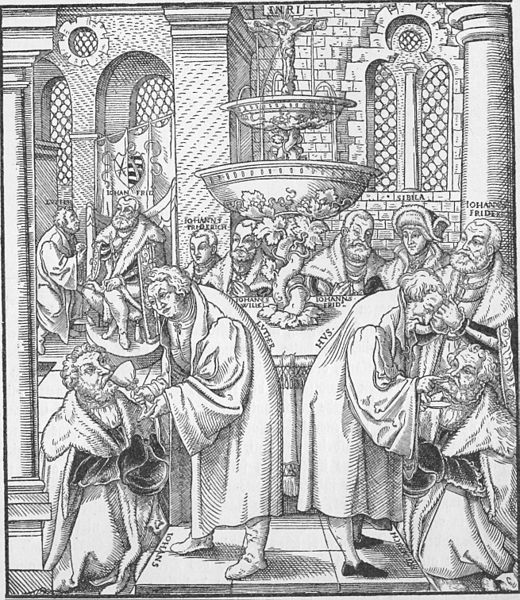
Allegoric representation of Sacramental union, the Lutheran doctrine of Real Presence of Christ in the Eucharist, after a woodcut by Lucas Cranach the Elder (1472-1553). In the front Communion under both kinds is pictured with (on the left) Martin Luther giving the chalice to John, Elector of Saxony. [public domain / Wikimedia Commons]

***
(4-20-11)
***
A former Lutheran, not-sure-what-he-believes-now-but-attends-Mass friend of mine stated in my comboxes:
Catholics have this bad tendency to try to label other people. E.g., Catholics call the Lutheran view of the presence of Christ in the sacrament “consubstantiation,” but Lutherans just call it “real presence.”
This is a reasonable point, since it is largely true (though Catholics aren’t the only ones who do this: other Protestants do, too).
*
In this instance, however, it is mostly a matter of semantics. Lutherans believe Christ is “in, with, and under” the bread and wine. This is precisely what non-Lutherans usually mean by “consubstantiation” (bread and wine are present and so is Christ at the same time). It’s just substituting one word for a phrase, where they mean the same. Lutherans don’t like the term, as far as I can tell, because of its association with both Aristotelian metaphysics and the linguistic connection with the Catholic transubstantiation.
*
Martin Luther didn’t care for the term “Lutherans” either, and I doubt that Wesley would have appreciated “Wesleyans” or Calvin, “Calvinists”, but that didn’t stop their followers from adopting those terms, anyway, since Protestantism often suffers from overly man-centered tendencies. To me it is more offensive to go against the wishes of your own founder than it is to use the description “consubstantiation.”
*
The larger problem of terminology with regard to the Eucharist is use of the same words in different ways. Thus an Anglican (or Lutheran) may say “real presence” but they don’t mean by that what the Church historically believed for 1500 years (in this regard, see the excellent article, What Do We Mean by ‘The Real Presence’?, by Fr. Dwight Longenecker).
*
This raises a conundrum when a Catholic refers to it, because in order to properly educate and to accurately note proper distinctions, we have to point out that meanings are different. “Consubstantiation” seems to be accurate enough for that purpose. If Lutherans don’t like it, then I suggest that they give us some term to use other than the vague, wax-nose “real presence.” The problem is the absence of another similarly descriptive word. “Real presence” is insufficient, since several denominations use it, and mean different things by it. Perhaps I could describe the Lutheran eucharistic view as “in, with, and underism”. But would that be preferable? Of course it would be a silly terminology.
This (humorously) illustrates the problem: the need for accurate description of various theological views. No one has any doubt as to where Catholics stand: transubstantiation means, literally, “change of substance.” No ambiguity, no confusion or unclearness. A person may disagree with that, but they know exactly what it is, by the term, and looking up what the term literally means.
Lutherans don’t like consubstantiation, but they haven’t offered us anything else besides “real presence” — a description that doesn’t convey in the slightest the distinctive Lutheran take on the Eucharist. Descriptive terms and labels are used precisely as “technical terms”: in order to avoid the need for a paragraph explanation of concepts, when a word can suffice (and a dictionary as well, if one wants to get the precise definition).
Nor is consubstantiation nearly as offensive, in my opinion, as the usual “Romanists” and “papists” that we are habitually called by the more anti-Catholic wing of Lutheranism. For example, here is Rev. Paul T. McCain, writing on his very prominent Lutheran website, Cyberbrethren:
Seems I have touched a bit of a nerve with my remarks about the “Corpus Christi” festival, which I regard as Romanist bunk and tomfoolery,. . . (6-16-06)
It is not we who call ourselves Lutherans. Rather, our adversaries call us that. We allow this to the extent that this title is an indication of the consensus that our churches have with the orthodox and catholic doctrine that Luther set forth from Holy Writ. Therefore we allow ourselves to be named after Luther, not as the inventor of a new faith but as the asserter of the old faith and the cleanser of the church from the stains of Papist dogmas. (10-31-10)
The second paragraph is quite remarkable, in that it uses papist: a term that any idiot knows is not what Catholics call themselves, while at the same time claiming that Lutherans have adopted their name because of the use of “adversaries.” But no one has forced them at gunpoint to use this name. It’s a voluntary matter. They chose it and use it. So they have no right now to protest that it derived from their “adversaries”.
I am unaware of a book called The Catechism of the Papist Church or a self-described category of “Romanist apologetics.” Plenty of our adversaries use those terms but it doesn’t follow that we do ourselves. Yet I am supposed to believe that Lutherans had no choice but to use a term they themselves object to? It’s beyond ludicrous and it strikes one as after-the-fact spin and rationalizing.
I should also note in passing that this notion that Luther “reformed” the Catholic Church and took it back to some supposed “old faith” (McCain’s words above) is factually untrue. It’s the fundamental “Protestant Myth.” The fact of the matter is that Luther was for the most part a revolutionary (one who overthrows and introduces brand-new elements), not a reformer (one who restores former things that have been lost or corrupted).
Lutherans (and other Protestants) know we don’t call ourselves by those terms (papist, Romanist) but no matter, they are used, anyway. And that is a question of preferred title (an ethical issue of rudimentary courtesy universally acknowledged), whereas the other involves complicated metaphysical-theological distinctions, and so, by virtue of that, is not nearly as straightforward or simple a matter compared to the alternate names Catholics are called.
Previous Post
March 7, 2011
Anglican Newman on the Falsity of Perspicuity (Clearness) of Scripture
Next Post
June 16, 2011 My "Orthodoxy & Catholicism" Read by Czech Bishops & Priests
Browse Our Archives
Select a Category & Last Things About Me Anti-Catholicism Atheism & Agnosticism Baptism and Sacramentalism Bible and Tradition Blessed Virgin Mary Books by Dave Armstrong C. S. Lewis Calvinism & General Protestantism Catholic Apologetics Catholic Apologists Catholic conversion Catholic converts Christmas Church (Ecclesiology) Church History Conversion and Converts Development of Doctrine Eastern Orthodoxy Ecumenism & Christian Unity Eucharist & Liturgy Fathers of the Church French Translations G. K. Chesterton Hell Hell & Satan Hell & Satan & Last Things Heresies & Comparative Religion Holistic Health Inquisition & Crusades & Scandals James White Jews & Judaism & Old Testament John Calvin John Henry Newman Liberal / Modernist Theology Life Issues Literary Resume Lutheranism Mariology Martin Luther Music Orthodoxy Papacy & Infallibility Personal Page Philosophy & Science Political & Ethical & Moral Issues Protestant Persecution & Intolerance Protestantism Purgatory Purgatory & Penance Romantic & Imaginative Theology Saints & Purgatory & Penance Salvation Salvation & Justification Satan & Last Things Sexuality and Gender Issues Spanish Translations Traditionalism vs. Radical Catholic Reactionaries Traducciones al español / tradução para português Trinitarianism & Christology Uncategorized Videos
Select a Month October 2026 September 2026 August 2026 July 2026 June 2026 May 2026 April 2026 March 2026 February 2026 January 2026 December 2025 November 2025 October 2025 September 2025 August 2025 July 2025 June 2025 May 2025 April 2025 March 2025 February 2025 January 2025 December 2024 November 2024 October 2024 September 2024 August 2024 July 2024 June 2024 May 2024 April 2024 March 2024 February 2024 January 2024 December 2023 November 2023 October 2023 September 2023 August 2023 July 2023 June 2023 May 2023 April 2023 March 2023 February 2023 January 2023 December 2022 November 2022 October 2022 September 2022 August 2022 July 2022 June 2022 May 2022 April 2022 March 2022 February 2022 January 2022 December 2021 November 2021 October 2021 September 2021 August 2021 July 2021 June 2021 May 2021 April 2021 March 2021 February 2021 January 2021 December 2020 November 2020 October 2020 September 2020 August 2020 July 2020 June 2020 May 2020 April 2020 March 2020 February 2020 January 2020 December 2019 November 2019 October 2019 September 2019 August 2019 July 2019 June 2019 May 2019 April 2019 March 2019 February 2019 January 2019 December 2018 November 2018 October 2018 September 2018 August 2018 July 2018 June 2018 May 2018 April 2018 March 2018 February 2018 January 2018 December 2017 November 2017 October 2017 September 2017 August 2017 July 2017 June 2017 May 2017 April 2017 March 2017 February 2017 January 2017 December 2016 November 2016 October 2016 September 2016 August 2016 July 2016 June 2016 May 2016 April 2016 March 2016 February 2016 January 2016 December 2015 November 2015 October 2015 September 2015 August 2015 July 2015 June 2015 May 2015 April 2015 March 2015 February 2015 January 2015 December 2014 November 2014 October 2014 September 2014 August 2014 July 2014 June 2014 April 2014 March 2014 February 2014 January 2014 December 2013 November 2013 October 2013 September 2013 August 2013 July 2013 June 2013 April 2013 March 2013 February 2013 January 2013 December 2012 November 2012 October 2012 September 2012 August 2012 July 2012 June 2012 May 2012 April 2012 March 2012 February 2012 January 2012 December 2011 November 2011 October 2011 September 2011 August 2011 July 2011 June 2011 April 2011 March 2011 February 2011 October 2010 September 2010 August 2010 July 2010 April 2010 March 2010 December 2009 October 2009 August 2009 July 2009 June 2009 May 2009 March 2009 February 2009 October 2008 September 2008 April 2008 March 2008 February 2008 January 2008 December 2007 November 2007 October 2007 May 2007 March 2007 February 2007 January 2007 November 2006 October 2006 September 2006 August 2006 July 2006 June 2006 May 2006 April 2006 March 2006 February 2006 October 2005 June 2005 April 2005 February 2005 July 2004 May 2004 April 2004
Follow Us!
TAKE THE
Religious Wisdom Quiz
Who was cast into a fiery furnace but was unharmed?
Select your answer to see how you score.
Elijah and Elisha Moses, Aaron, and Joshua Daniel Shadrach, Meshach, and Abednego
Books by This Author Books by Dave Armstrong
Related posts from Biblical Evidence for Catholicism

Does Catholic Intercession of Saints Require Omniscience?
Biblical Evidence for Catholicism

Protestant Confessions & "Ever-Virgin" Mary
Biblical Evidence for Catholicism

Jesus Founded the [Catholic] Church. If Not Him,...
Biblical Evidence for Catholicism
Chrysostom vs. Faith Alone (vs. Lutheran Will Weedon)
Biblical Evidence for Catholicism
TRENDING AT PATHEOS Catholic

In "Irreplaceable," our book on vocation and technology, Trevor Sutton and I...

I was strolling through the top floor of the brand new Parthenon...

What Does Gêvâh Mean For Kimberley Guifoyle &...
This week, a lot of the news is focused on Kimberly Guilfoyle....

INNER CIRCLE: Profound Mystery (Of Christ In All...
Ephesians 5:31-32 “For this reason, a man will leave his father and...

Do Not Rejoice When Your Enemy Falls: The...
Turning an execution into a public spectacle is a disturbing expression of...

'The Chosen' S6 Trailer: The Passion Gets Very...
Not many watching 'The Chosen' worry about spoilers, but just because they...
view all Catholic blogs
Ad-Free & Subscriber Log-In Subscription Support
- About Us
- 2026 Calendar
- Videos
- Podcasts
- Library of World Religions
- Faith In Media Tracker
- Advertise With Us
- Write for Us
- Privacy Policy
- Terms of Service
- Do Not Sell My Data
- Contact Us
- Radiant Digital
- Manage Newsletter Subscriptions
- Unsubscribe From Notifications
- Sitemap
Copyright 2008-2026, Patheos. All rights reserved.
Subscription Support Ad-Free & Subscriber Log-In
Follow Patheos