
BuddhistCatholicContemplativeEvangelicalGeneral ChristianHinduJewishLatter-day SaintMuslimNew VisionsProgressive Christian
Beliefs
- Buddhist
- Catholic
- Contemplative
- Evangelical
- General Christian
- Hindu
- Jewish
- Latter-day Saint
- More Voices
- Muslim
- New Visions
- Pagan
- Progressive Christian
Topics
- Religion News
- Food and Religion
- Sports and Religion
- Religious Art
- Religious Music and Entertainment
- Religious Events
- History and Religion
- Style and Religion
- Politics and Religion
- Women in Religion
- Recreation Outdoors and Religion
- Business Finance and Religion
- Careers Workplace and Religion
- Education and Religion
- Family Parenting and Religion
- Health Fitness and Religion
- Home and Religion
- Relationships and Religion
- Technology and Religion
- Travel and Religion
Columnists
- Buddhist Columnists
- Business Finance and Religion Columnists
- Careers Workplace and Religion Columnists
- Catholic Columnists
- Contemplative Columnists
- Education and Religion Columnists
- Evangelists Columnists
- Family Parenting and Religion Columnists
- General Christian Columnists
- Health Fitness and Religion Columnists
- Hindu Columnists
- History and Religion Columnists
- Home and Religion Columnists
- Jewish Columnists
- More Voices Columnists
- Latter Day Columnists
- Muslim Columnists
- New Visions Columnists
- Nonreligious Columnists
- Pagan Columnists
- Politics and Religion Columnists
- Progressive Columnists
- Recreation Outdoors and Religion Columnists
- Relationships and Religion Columnists
- Religion News Columnists
- Religious Art Columnists
- Religious Events Columnists
- Religious Music and Entertainment Columnists
- Sports and Religion Columnists
- Style and Religion Columnists
- Technology and Religion Columnists
- Travel and Religion Columnists
- Women in Religion Columnists
Resource Library
- 2026 Calendar
- Library of World Religions
- The 100 Most Holy Places on Earth
- Patheos Answers
- Podcasts
- Videos
- Faith Leaders Database
- Anglican Episcopalian
- Bahai
- Baptist
- Buddhism
- Christianity
- Confucianism
- Eastern Orthodoxy
- Hinduism
- Holiness and Pentecostal
- ISKCON
- Islam
- Judaism
- Lutheran
- Methodist
- The Church of Jesus Christ of Latter-day Saints
- New Age
- Paganism
- Presbytarian and Reformed
- Protestantism
- Religion Behind the Scenes
- Roman Catholic
- Scientology
- Shia Islam
- Sikhism
- Sufism
- Sunni Islam
- Taoism
- Zen
- See all religions
Research Tools
 Ad-Free & Subscriber Log-In Subscription Support
Ad-Free & Subscriber Log-In Subscription Support
Follow Patheos 

- Trending:
- Forgiveness
- |
- Marriage
- |
- Consciousness
- |
- Death Penalty
- |
- Election
- |
- Halloween

-
About
-
Catholic Apologetics
-
Church History
-
Great Apologists
-
Christian Worldview
-
Protestantism & Misc.
- Home
- Catholic
- History and Religion
- Luther & the Immaculate Conception: More Non-Catholic Historians & Scholars
Luther & the Immaculate Conception: More Non-Catholic Historians & Scholars
Last updated on: June 5, 2026 at 11:40 pm by Dave Armstrong
Luther & the Immaculate Conception: More Non-Catholic Historians & Scholars 2026-06-05T23:40:09-04:00 Dave Armstrong
Patheos Explore the world's faith through different perspectives on religion and spirituality! Patheos has the views of the prevalent religions and spiritualities of the world.
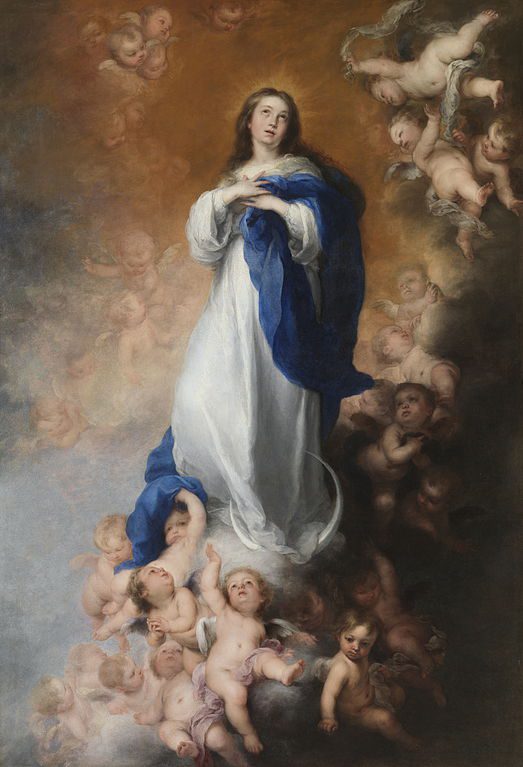
The Immaculate Conception (c. 1678), by Bartolomé Esteban Murillo (1617-1682) [public domain / Wikimedia Commons]

***
(9-30-10)
***
[Luther’s own words are in blue]
***
I have compiled more opinions from Luther scholars and other historians with regard to Luther’s acceptance of the doctrine, and particularly whether he modified his views sometime after 1527 (some think he did so).
* * * * *
1) Donald G. Bloesch, The Church: Sacraments, Worship, Ministry, Mission (Downers Grove, Illinois: InterVarsity Press: 2002).
[I]t is important to consider that Luther was remarkably open to some of the Marian doctrines, including Mary’s assumption, perpetual virginity and immaculate conception. While his formulation of the immaculate conception varied from the more traditional formulation, he steadfastly affirmed Mary’s complete purity. (pp. 258-259)
2) Julius Köstlin, The Theology of Luther in its Historical Development and Inner Harmony, Volume 2 (Philadelphia: Lutheran Publication Society: 1897), translated from the second German edition by Charles E. Hay.
Luther clung also to the opinion, prevalent in the Middle Ages, that, as Mary conceived without sin, so she brought forth also without pain or physical injury, and always remained a virgin. As a bee deftly extracts the honey from a flower without injuring the latter, so the Holy Spirit caused Christ to emerge from the womb of the Virgin, because He brought with Him a true fleshly nature, but without sin. But Luther maintains most stoutly, that the Child in the womb of its mother received from her everything which any natural child receives from its mother, only without sin—that the Virgin “was required to contribute of her seed and natural blood” — that He did not pass through her like a reflection, or shadow, or as a ray of the sun passes through painted glass — that, in the act of delivery itself, the womb of Mary fulfilled its natural office (only without receiving any injury) — that a body was not made in heaven for Christ, and then passed through the body of Mary. (pp. 370-371)
3) Julius Köstlin, Life of Luther (New York: Charles Scribner’s Sons: 1883), translated from German.
The doctrine of the Immaculate Conception, which Pius IX., in our own days, first ventured to raise into a dogma of the Church, was zealously defended by the Augustinians, and firmly maintained by Luther himself, even after the beginning of his war of Reformation. (p. 45)
4) Bridget Heal, The Cult of the Virgin Mary in Early Modern Germany: Protestant and Catholic Piety, 1500-1648 (Cambridge University Press: 2007).
While Luther, Zwingli and even Calvin defended Mary’s perpetual virginity, Luther’s very traditional teaching on other key medieval Marian doctrines set him apart not only from Zwingli and the other leading proponents of the Swiss and upper German Reformations, but also from many of his own followers. Luther, for example, continued to describe Mary as sinless, though he emphasized that this state was achieved through God’s grace rather than through her own merit. [151] His exact position on the Immaculate Conception has been the subject of extensive debate. [152] Belief in Mary’s sinlessness did not necessarily imply belief in her Immaculate Conception, [153] but Luther does seem to have held that Mary had been purified from sin by the Holy Spirit at some point before Christ’s incarnation. [154] His sermon on the feast day of Mary’s conception in 1520 put him firmly on the immaculist side of the medieval controversy: Mary’s first conception was, he argued, normal but at her second conception, when the soul informed the body, she was purified from original sin. ‘So that from the first moment that she began to live, she was without all sin.’ [155] His later position wavered somewhat, and in later sermons dating from 1539 and 1540 he stated that Mary was conceived and born in sin like all men. [156] Yet he still, in 1543, felt able to write that Mary was ‘a holy virgin, who was saved and purified from Original Sin by the Holy Ghost’, although he no longer specified at what point this purification took place. [157] (pp. 58-59)[151] See especially WA, vol. 52, p. 633 (Hauspostille, 1544); Kreitzer, ‘Reforming Mary’, pp. 73-4.
[152] Dufel, Luthers Stellung, pp. 164-6; Campi, Zwingli und Maria, pp. 59-60.
[153] Kreitzer, ‘Reforming Mary’, p. 73.
[154] Ibid., p. 76.
[155] WA, vol. 17, part II, p. 288 (Festpostille, 1527); Kreitzer, ‘Reforming Mary’, pp. 241-5.
[156] WA, vol. 47, p. 860 and vol. 49, p. 173.
[157] WA, vol. 53, p. 640.
5) Beth Kreitzer, “Luther Regarding the Virgin Mary,” in Timothy J. Wengert (editor),The Pastoral Luther: Essays on Martin Luther’s Practical Theology (Grand Rapids, Michigan: Wm. B. Eerdmans Publishing Co.: 2009). Her chapter appeared originally in Lutheran Quarterly 17 (2003), 249-266.
In Luther’s final sermon on the holiday of her conception, preached in 1520, he complains that the debate about her conception has caused a great deal of trouble among the monks, even though “there is not a single letter about it in the gospels or otherwise in the Scriptures.” [41]
In this sermon Luther outlines his views on Mary’s conception and clearly leans toward the immaculist side of the debate, but takes the middle position favored by most theologians. His explanation rests on the common medieval division of generation into two conceptions: the “first conception,” that of the body, is during the act of intercourse, necessarily infected by concupiscence and thus sin; the “second conception” is at a later point when the newly formed soul enters the fetus, also called animation. . . . Mary . . . was born through the usual means of a father and a mother, and thus experienced a physical conception tainted with sin. It was at her second conception, when her soul entered her body, that she was “purified from original sin and decorated with God’s gifts.” [42] Because this second conception is more important than the first, and is the moment at which one is said to live, Luther can say that “from the first moment that she began to live, she was without all sin,” placing Mary in the “middle between Christ and other men.” [43] However, Luther insists that no required doctrine can be made about Mary’s conception, as it is not expressly mentioned in the Bible. (pp. 246-247)
[41] WA 17II:280, Festpostille (1527).
[42] WA 17II:288. The words Luther uses, “von der erbsunnde sey gerainneget worden,” clearly indicate the idea of cleansing Mary from sin rather than preserving her from it.
[43] WA 17II:288. Some scholars have doubted whether Luther maintained this belief throughout his life, and there are several ambiguous statements in later texts. He did not comment directly on the matter again.
6) Beth Kreitzer, Reforming Mary: Changing Images of the Virgin Mary in Lutheran Sermons of the Sixteenth Century (Oxford University Press: 2004).
Albert Ebneter, a Jesuit priest, also criticizes the earlier works on Luther’s views of Mary, not only for their extreme positions but also for mistakes in interpretation, for removing quotations from their contexts, and for generally twisting the evidence to support their own ends. The problems are most evident in the various presentations of Luther’s stance on the immaculate conception: the authors who tend to see Luther as devoted to Mary present his adherence to the commonly held theory, while those who find that Luther’s mind and practice changed concerning Mary present him as eventually rejecting Mary’s immaculate conception. [30] Ebneter tries to maintain a more nuanced view, by suggesting that while Luther definitely held to the immaculate conception until the early 1530s, certain statements made after that time call into question his final views on the matter. . . . Ebneter, despite his attempts to present a balanced view of Luther’s position on the immaculate conception, fails to consider the context of Luther’s statements on the queenship of Mary and insists that Luther maintained a strong Marian devotion throughout his life. (pp. 7-8)
[p. 156: footnote 30] See Ebneter [“Martin Luthers Marienbild,” Orientierung 20 (1956), 77-80, 85-87], 78-79.
Saturnin Pauleser [Catholic], in his book, Maria und die Reformation, indicates that Luther remained a devotee of Mary his entire life, at least in essentials, and even suggests that Luther continued to call Mary mediatrix. [34] (p. 8)
[p. 156: footnote 34] Saturnin Pauleser, Maria und die Reformation (Miltenberg, 1951); cited in Cole, 105-106.
Luther’s position in the 1527 Festpostille is clearly in favor if the immaculate conception . . . However, some of Luther’s later texts do call into question whether he held this position throughout the remainder of his life. In several sermons in 1532 he mentions that Mary was somehow healed from sin when she conceived through the Holy Spirit so “that she was without all sin.” [97] In a Christmas sermon from 1540, Luther stresses that Christ’s sinlessness did not simply come from the Virgin Mary’s purity [Dave: Catholics have never asserted this, since we hold that Christ was inherently sinless and indeed incapable of sin, being God] but from the working of the Spirit: Mary was “born from her parents in sin like all men.” [98] In a later writing Luther insists that Mary was “saved and purified from original sin through the Holy Spirit” at some point before Christ’s incarnation, although he does not specify when this happened. [99] These ambiguous statements do not allow for a definitive answer to the question of whether or not Luther always held to the immaculate conception of Mary, . . . (p. 124)
[three footnotes from p. 205]:
[97] Hauspostille 1544 (Christmas, 1532), WA 52, 39: “das sie ohne alle Sund gewesen ist.”
[98] Sermon on Christmas Eve, 1540, WA 49, 173: “Ideo describitue, quod natus ex virgine, nec tantum sic, quia Maria ist auch nicht zu rein, quia nata a parentibusin peccato utalii homines.”
[99] Vom Schem Hamphoras und vom Geschlecht Christi, 1543, WA 53, 640: “[Maria ist] ein heilige Jungfraw, die, von der Erbsunde erloset und gereiniget, durch den heiligen Geist.” Ebtener thinks that because this statement falls in the context of a defense of the incarnation, Luther means that Mary was purified at that point. Others (e.g., Schimmelpfennig) believe that this phrase still supports the immaculate conception. See Ebneter, “Martin Luthers Marienbild,” 78-79.
[Dave: the English translation of the key phrase from Gerhard Falk, in his book, The Jew in Christian Theology: Martin Luther’s Anti-Jewish Vom Schem Hamphoras (McFarland & Co.: 1992) is “a holy virgin . . . freed of original sin and cleansed by the Holy Ghost” (p. 217) ]
[from footnote 94 on from p. 205]:
Duns [Scotus] stresses . . . that Mary was preserved by Christ from any original sin, rather than restored to grace. Luther’s “sey gerainniget worden” may only be a manner of speaking rather than a technical explanation — it is difficult to judge, as evidenced by the number of scholars who have disagreed on Luther’s views on Mary’s conception. See, for example, Algermissen, Heiler, Schimmelpfennig, and Cole in favor of Luther holding, throughout his life, the immaculate conception of Mary; see H. Preuss and Delius in favor of Luther’s position shifting. Luther does speak of Mary as “in Erbsunden empfangen” (WA 17-2, 287) but distinguishes between the physical conception (act of the parents) and the animation by the soul, at which point the person is in existence. The reinigung of which he speaks refers, it seems, to the original sin present in the body . . . Max Thurian suggests that, when Luther speaks of Mary having original sin, he is referring both to her body before its union with her soul and to the presence of the effects of original sin in Mary’s body (fatigue, etc.). See Thurian, Mary, Mother of the Lord, Figure of the Church (London: Faith, 1963) . . .
Luther makes a number of comments about Mary’s freedom from sin, and even seems to have held to the immaculate conception, despite certain later ambiguous statements. (p. 137)
Even if one holds strictly to the doctrine of the immaculate conception, which Luther apparently did not always do . . . (p. 179)
Addendum: shortly after I compiled this paper, I became persuaded that Luther did change his later view, to a position which I describe as “immaculate purification.” Briefly, the later Luther (sometime after 1527) thought that Mary was purified at the time of the birth or conception of Jesus, rather than at her own conception.
***
Meta Description: Extensive survey of Martin Luther’s opinions on whether Mary was immaculately conceived.
Meta Keywords: Blessed Virgin Mary, Catholic Mariology, Immaculate Conception, Immaculate purification, Luther and Mary, Luther’s Mariology, Lutheran Mariology, Marian doctrines, Mariology, Mary mother of Jesus, Mother of God, Theotokos, Virgin Mary
Previous Post
September 30, 2010
Luther & Mary's Immaculate Conception: Lutheran Scholars' Opinions
Next Post

October 18, 2010 Surveys of Religious Beliefs of Scientists
Browse Our Archives
Select a Category & Last Things About Me Anti-Catholicism Atheism & Agnosticism Baptism and Sacramentalism Bible and Tradition Blessed Virgin Mary Books by Dave Armstrong C. S. Lewis Calvinism & General Protestantism Catholic Apologetics Catholic Apologists Catholic conversion Catholic converts Christmas Church (Ecclesiology) Church History Conversion and Converts Development of Doctrine Eastern Orthodoxy Ecumenism & Christian Unity Eucharist & Liturgy Fathers of the Church French Translations G. K. Chesterton Hell Hell & Satan Hell & Satan & Last Things Heresies & Comparative Religion Holistic Health Inquisition & Crusades & Scandals James White Jews & Judaism & Old Testament John Calvin John Henry Newman Liberal / Modernist Theology Life Issues Literary Resume Lutheranism Mariology Martin Luther Music Orthodoxy Papacy & Infallibility Personal Page Philosophy & Science Political & Ethical & Moral Issues Protestant Persecution & Intolerance Protestantism Purgatory Purgatory & Penance Romantic & Imaginative Theology Saints & Purgatory & Penance Salvation Salvation & Justification Satan & Last Things Sexuality and Gender Issues Spanish Translations Traditionalism vs. Radical Catholic Reactionaries Traducciones al español / tradução para português Trinitarianism & Christology Uncategorized Videos
Select a Month October 2026 September 2026 August 2026 July 2026 June 2026 May 2026 April 2026 March 2026 February 2026 January 2026 December 2025 November 2025 October 2025 September 2025 August 2025 July 2025 June 2025 May 2025 April 2025 March 2025 February 2025 January 2025 December 2024 November 2024 October 2024 September 2024 August 2024 July 2024 June 2024 May 2024 April 2024 March 2024 February 2024 January 2024 December 2023 November 2023 October 2023 September 2023 August 2023 July 2023 June 2023 May 2023 April 2023 March 2023 February 2023 January 2023 December 2022 November 2022 October 2022 September 2022 August 2022 July 2022 June 2022 May 2022 April 2022 March 2022 February 2022 January 2022 December 2021 November 2021 October 2021 September 2021 August 2021 July 2021 June 2021 May 2021 April 2021 March 2021 February 2021 January 2021 December 2020 November 2020 October 2020 September 2020 August 2020 July 2020 June 2020 May 2020 April 2020 March 2020 February 2020 January 2020 December 2019 November 2019 October 2019 September 2019 August 2019 July 2019 June 2019 May 2019 April 2019 March 2019 February 2019 January 2019 December 2018 November 2018 October 2018 September 2018 August 2018 July 2018 June 2018 May 2018 April 2018 March 2018 February 2018 January 2018 December 2017 November 2017 October 2017 September 2017 August 2017 July 2017 June 2017 May 2017 April 2017 March 2017 February 2017 January 2017 December 2016 November 2016 October 2016 September 2016 August 2016 July 2016 June 2016 May 2016 April 2016 March 2016 February 2016 January 2016 December 2015 November 2015 October 2015 September 2015 August 2015 July 2015 June 2015 May 2015 April 2015 March 2015 February 2015 January 2015 December 2014 November 2014 October 2014 September 2014 August 2014 July 2014 June 2014 April 2014 March 2014 February 2014 January 2014 December 2013 November 2013 October 2013 September 2013 August 2013 July 2013 June 2013 April 2013 March 2013 February 2013 January 2013 December 2012 November 2012 October 2012 September 2012 August 2012 July 2012 June 2012 May 2012 April 2012 March 2012 February 2012 January 2012 December 2011 November 2011 October 2011 September 2011 August 2011 July 2011 June 2011 April 2011 March 2011 February 2011 October 2010 September 2010 August 2010 July 2010 April 2010 March 2010 December 2009 October 2009 August 2009 July 2009 June 2009 May 2009 March 2009 February 2009 October 2008 September 2008 April 2008 March 2008 February 2008 January 2008 December 2007 November 2007 October 2007 May 2007 March 2007 February 2007 January 2007 November 2006 October 2006 September 2006 August 2006 July 2006 June 2006 May 2006 April 2006 March 2006 February 2006 October 2005 June 2005 April 2005 February 2005 July 2004 May 2004 April 2004
Follow Us!
TAKE THE
Religious Wisdom Quiz
Who urged Esther to approach the king, saying, "For such a time as this"?
Select your answer to see how you score.
Haggai Nehemiah Mordecai Ezra
Books by This Author Books by Dave Armstrong
Related posts from Biblical Evidence for Catholicism

Holy Ground: Why Mary Had NO Other Children...
Biblical Evidence for Catholicism
Protestant Confessions & "Ever-Virgin" Mary
Biblical Evidence for Catholicism

Mary Wife of Clopas (Jn 19:25): Mary's Sister-in-Law?
Biblical Evidence for Catholicism

Jesus Had Four Brothers? The Bible Sez No!
Biblical Evidence for Catholicism
TRENDING AT PATHEOS Catholic

In "Irreplaceable," our book on vocation and technology, Trevor Sutton and I...

I was strolling through the top floor of the brand new Parthenon...

What Does Gêvâh Mean For Kimberley Guifoyle &...
This week, a lot of the news is focused on Kimberly Guilfoyle....

INNER CIRCLE: Profound Mystery (Of Christ In All...
Ephesians 5:31-32 “For this reason, a man will leave his father and...

Do Not Rejoice When Your Enemy Falls: The...
Turning an execution into a public spectacle is a disturbing expression of...

'The Chosen' S6 Trailer: The Passion Gets Very...
Not many watching 'The Chosen' worry about spoilers, but just because they...
view all Catholic blogs
Ad-Free & Subscriber Log-In Subscription Support
- About Us
- 2026 Calendar
- Videos
- Podcasts
- Library of World Religions
- Faith In Media Tracker
- Advertise With Us
- Write for Us
- Privacy Policy
- Terms of Service
- Do Not Sell My Data
- Contact Us
- Radiant Digital
- Manage Newsletter Subscriptions
- Unsubscribe From Notifications
- Sitemap
Copyright 2008-2026, Patheos. All rights reserved.
Subscription Support Ad-Free & Subscriber Log-In
Follow Patheos