
BuddhistCatholicContemplativeEvangelicalGeneral ChristianHinduJewishLatter-day SaintMuslimNew VisionsProgressive Christian
Beliefs
- Buddhist
- Catholic
- Contemplative
- Evangelical
- General Christian
- Hindu
- Jewish
- Latter-day Saint
- More Voices
- Muslim
- New Visions
- Pagan
- Progressive Christian
Topics
- Religion News
- Food and Religion
- Sports and Religion
- Religious Art
- Religious Music and Entertainment
- Religious Events
- History and Religion
- Style and Religion
- Politics and Religion
- Women in Religion
- Recreation Outdoors and Religion
- Business Finance and Religion
- Careers Workplace and Religion
- Education and Religion
- Family Parenting and Religion
- Health Fitness and Religion
- Home and Religion
- Relationships and Religion
- Technology and Religion
- Travel and Religion
Columnists
- Buddhist Columnists
- Business Finance and Religion Columnists
- Careers Workplace and Religion Columnists
- Catholic Columnists
- Contemplative Columnists
- Education and Religion Columnists
- Evangelists Columnists
- Family Parenting and Religion Columnists
- General Christian Columnists
- Health Fitness and Religion Columnists
- Hindu Columnists
- History and Religion Columnists
- Home and Religion Columnists
- Jewish Columnists
- More Voices Columnists
- Latter Day Columnists
- Muslim Columnists
- New Visions Columnists
- Nonreligious Columnists
- Pagan Columnists
- Politics and Religion Columnists
- Progressive Columnists
- Recreation Outdoors and Religion Columnists
- Relationships and Religion Columnists
- Religion News Columnists
- Religious Art Columnists
- Religious Events Columnists
- Religious Music and Entertainment Columnists
- Sports and Religion Columnists
- Style and Religion Columnists
- Technology and Religion Columnists
- Travel and Religion Columnists
- Women in Religion Columnists
Resource Library
- 2026 Calendar
- Library of World Religions
- The 100 Most Holy Places on Earth
- Patheos Answers
- Podcasts
- Videos
- Faith Leaders Database
- Anglican Episcopalian
- Bahai
- Baptist
- Buddhism
- Christianity
- Confucianism
- Eastern Orthodoxy
- Hinduism
- Holiness and Pentecostal
- ISKCON
- Islam
- Judaism
- Lutheran
- Methodist
- The Church of Jesus Christ of Latter-day Saints
- New Age
- Paganism
- Presbytarian and Reformed
- Protestantism
- Religion Behind the Scenes
- Roman Catholic
- Scientology
- Shia Islam
- Sikhism
- Sufism
- Sunni Islam
- Taoism
- Zen
- See all religions
Research Tools
 Ad-Free & Subscriber Log-In Subscription Support
Ad-Free & Subscriber Log-In Subscription Support
Follow Patheos 

- Trending:
- Forgiveness
- |
- Marriage
- |
- Consciousness
- |
- Death Penalty
- |
- Election
- |
- Halloween

-
About
-
Catholic Apologetics
-
Church History
-
Great Apologists
-
Christian Worldview
-
Protestantism & Misc.
- Home
- Catholic
- History and Religion
- Errors of Galileo & 16th-17th Century Cosmologies
Errors of Galileo & 16th-17th Century Cosmologies
Last updated on: June 5, 2026 at 11:40 pm by Dave Armstrong
Errors of Galileo & 16th-17th Century Cosmologies 2026-06-05T23:40:09-04:00 Dave Armstrong
Patheos Explore the world's faith through different perspectives on religion and spirituality! Patheos has the views of the prevalent religions and spiritualities of the world.
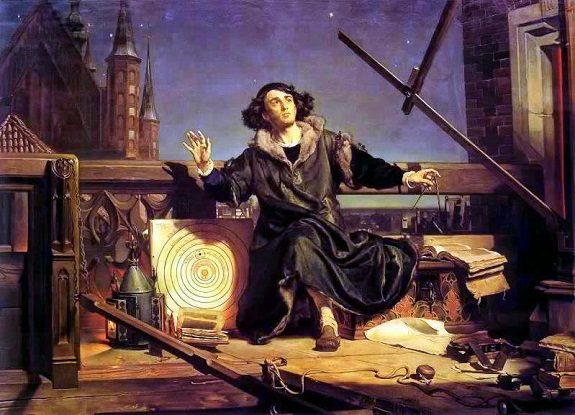
Astronomer Copernicus, conversation with God (1872), by Jan Matejko (1838-1893) [public domain / Wikimedia Commons]

***
(7-29-10)
***
Why is it that one always hears about the notorious trials of Galileo and the errors made by (one faction of) the Catholic Church (on a sub-magisterial, sub-infallible level) about science in the early 17th century, but never about Galileo’s own misguided dogmatism in some areas, and several flat-out errors? Some of those were held by Galileo even in the face of current superior research from other scientists and thinkers, like Johannes Kepler. The Catholic Church made a mistake; we’ve admitted it; we no longer deny the truth of heliocentrism, etc.
Protestants, by the way, are not without their own embarrassing errors in this regard. Luther, Calvin, and Melanchthon (and the later Calvinist Francois Turretin) all opposed Copernicus. Luther’s successor Philip Melanchthon and even the renowned Lutheran theologian Martin Chemnitz were enthusiastic advocates of astrology (whereas St. Thomas Aquinas had opposed it 300 years earlier). Leibniz, the Lutheran philosopher (1646-1716) attacked Newton’s theory of gravitation. Lutherans as a whole (at least as much as the entirety of Catholics, if not more so) were very slow to come around to heliocentrism.
But for some reason many of the more loudmouthed and absurdly overconfident advocates of (what they consider essentially materialistic) science and/or critics of Christianity are not so quick to admit that there is more than enough error here (hindsight is 20/20) to go around. Most Catholics in that early period of modern astronomy didn’t get everything right, but neither did anyone else (including even the best scientists) get even some very basic facts of astronomy right. So why is one party excoriated, while the errors of the vaunted (and indeed brilliant) scientists are ignored, unknown, or suppressed, in a cynical effort at one-sided presentation?
The objective observer will note, I submit (upon a complete perusal of the relevant facts), that in most cases of supposed stark opposition of two competing ideas (especially ones as complex as those involved in science and philosophy), there is truth and error to be found on both sides. The reality of various conflicts in the realm of the history of ideas is not usually “good vs. evil.” Just as individuals are radical mixtures, so are sets of ideas: with some falsehood mixed in.
Let me present, if I may, some basic facts:
Copernicus (1473-1543) erred in asserting circular orbits and in holding that the sun was the stationary center of the universe, with not only the earth and the other planets of the solar system, but also all the other stars, moving around it. He also believed that transparent rotating crystalline spheres carried the planets in their orbits.
Tycho Brahe (1546–1601) erred insofar as he was a geocentrist and held (Tychonic “geoheliocentric” system) that the sun and moon revolve around the earth, and the other five planets revolve around the sun: all in circular, not elliptical orbits. Also, in his system the earth did not rotate.
Johannes Kepler (1571-1630) was correct in asserting elliptical orbits of the planets around the sun, at varying speeds (both notions having been foreseen by the Catholic Cardinal Nicholas of Cusa in the 15th century), but continued to err in thinking that the sun was the center of the entire universe. The idea that the sun was but one of innumerable stars, was strongly advocated by the mystic heretic and scientist Giordano Bruno (1548-1600). According to the Wikipedia entry, Bruno understood several aspects of cosmology that even Copernicus, Kepler, Galileo, and Tycho neglected to see:
Bruno believed . . . that the Earth revolves around the sun, and that the apparent diurnal rotation of the heavens is an illusion caused by the rotation of the Earth around its axis. Bruno also held (following Nicholas of Cusa) that because God is infinite the universe would reflect this fact in boundless immensity. Bruno also asserted that the stars in the sky were really other suns like our own, around which orbited other planets. . . .
Bruno’s infinite universe was filled with a substance—a “pure air,” aether, or spiritus — that offered no resistance to the heavenly bodies which, in Bruno’s view, rather than being fixed, moved under their own impetus. Most dramatically, he completely abandoned the idea of a hierarchical universe. The Earth was just one more heavenly body, as was the Sun. . . .
Under this model, the Sun was simply one more star, and the stars all suns, each with its own planets. Bruno saw a solar system of a sun/star with planets as the fundamental unit of the universe. According to Bruno, infinite God necessarily created an infinite universe, formed of an infinite number of solar systems, separated by vast regions full of Aether, because empty space could not exist. (Bruno did not arrive at the concept of a galaxy.)
Galileo (1564-1642) disbelieved in Kepler’s elliptical orbits of the planets, considering the circle the “perfect” shape for planetary orbits:
Galileo’s two main published works were Dialogue Concerning the Two Chief World Systems in 1629 and Discourses and Demonstrations Concerning Two New Sciences in 1638. The first of these was fully ten years after Kepler published his third law of planetary motion, and twenty years after the publication of Kepler’s first and second laws, yet Galileo seemed oblivious to those developments – despite the fact that he was very familiar with Kepler’s works and had high regard for him (referring to him as “a person of independent genius”). Einstein described Galileo’s failure to take account of Kepler’s laws as “a grotesque illustration of the fact that creative individuals are often not receptive”. [source: “Math Pages”]
R. R. Reno referred to this error on 26 July 2010, on the blog First Thoughts (connected with the magazine First Things):
These days no educated person “acknowledges” Galileo’s heliocentric theory as “correct.” Galileo adopted Copernicus’s theory, which presumed lovely circular orbits, but that turns out to be wrong. Tycho Brahe painstakingly collected data about the positions of the planets in the sky, which was theorized by Johannes Kepler as eliptical rather than circular motion.
Interestingly, Kepler and Galileo corresponded, but Galileo insisted on defending Copernicus’ views. On this point, Galileo was mistaken, and not just because he did not have access to the scientific data and good arguments. He was, like many brilliant individuals, a vain and willful man.
Scott Rosmarin, in his article, “Galileo’s Lapse – The Fallibility of Scientists” (29 March 2010), noted:
Johannes Kepler had provided plausible evidence that the planets move in elliptical, nor circular orbits, and not at uniform speeds, but variable speeds, depending on their distance from the sun. This seriously challenged the Copernican view. Galileo . . . simply rejected Kepler’s view, clinging instead to the ancient belief that circular motion was “beautiful” and, therefore, privileged. . . . Galileo believed dogmatically in the Copernican view, not merely as a good starting hypothesis, or true subject to possible modifications, such as those offered by Kepler.
Galileo was also wrong in following Copernicus’s (and Kepler’s) view that the sun was the stationary center of the universe, with the earth and other planets of the solar system, and also all the other stars, moving around it. In this respect, he and Copernicus had hardly advanced beyond what was already posited by the ancient Greek astronomer Aristarchus (d. c. 230 B. C.). All three had merely moved the center of the universe 93 million miles from the earth, to the sun.
That is not all that different (knowing how large the universe is) from positing that the earth is the center. Both are vastly erroneous positions. But, oddly enough, we only hear about one error and not the other. Nicholas of Cusa (a Catholic Cardinal) and Giordano Bruno were closer to the truth in these respects than Copernicus, Galileo, and Kepler. Truth is stranger than fiction.
Galileo, moreover, argued vehemently in his 1623 book The Assayer that the comets of 1618 were merely an optical illusion. The Wikipedia entry on the book states:
The book was a polemic against the treatise on the comets of 1618 by Orazio Grassi, a Jesuit mathematician at the Collegio Romano. In this matter Grassi, for all his Aristotelianism, was right and Galileo was wrong. Galileo incorrectly treated the comets as a play of light rather than as real objects. . . .
Although The Assayer contains a magnificent polemic for mathematical physics, ironically its main point was to ridicule a mathematical astronomer. This time, the target of Galileo’s wit and sarcasm was the cometary theory of a Jesuit, Orazio Grassi, who argued from parallax that comets move above the Moon. Galileo mistakenly countered that comets are an optical illusion.
The Wikipedia article, “Comet,” observed that Galileo “rejected Tycho’s parallax measurements and held to the Aristotelian notion of comets moving on straight lines through the upper atmosphere.”
Furthermore, Galileo dismissed as a “useless fiction” the idea, held by his contemporary Johannes Kepler, that the moon caused the tides. He thought they were caused by the rotation of the earth. The Stanford Encyclopedia of Philosophy entry on Galileo comments on this notion and how it figured in the overall picture:
This argument, about the tides, Galileo believed provided proof of the truth of the Copernican theory. . . . Galileo argues that the motion of the earth (diurnal and axial) is the only conceivable (or maybe plausible) physical cause for the reciprocal regular motion of the tides. He restricts the possible class of causes to mechanical motions, and so rules out Kepler’s attribution of the moon as a cause. How could the moon without any connection to the seas cause the tides to ebb and flow? Such an explanation would be the invocation of magic or occult powers. So the motion of the earth causes the waters in the basins of the seas to slosh back and forth, and since the earth’s diurnal and axial rotation is regular, so are the periods of the tides; the backward movement is due to the residual impetus built up in the water during its slosh. Differences in tidal flows are due to the differences in the physical conformations of the basins in which they flow . . . .
One can see why Galileo thinks he has some sort of proof for the motion of the earth, and therefore for Copernicanism. Yet one can also see why Bellarmine and the instrumentalists would not be impressed. First, they do not accept Galileo’s restriction of possible causes to mechanically intelligible causes. Second, the tidal argument does not directly deal with the annual motion of the earth about the sun. And third, the argument does not touch anything about the central position of the sun or about the periods of the planets as calculated by Copernicus.
Galileo (like Kepler) was an avid proponent of astrology (see “Galileo’s Astrology,” by Nick Kollerstrom). For example, he wrote in a letter to Piero Dini, dated 21 May, 1611:
If, therefore, of the inferior causes, those which arouse boldness of heart are diametrically contrary to those which inspire intellectual speculation, it is also most reasonable that the superior causes (if indeed they operate on us) be utterly different from those on which courage and the speculative faculty depend; and if the stars do operate and influence principally by their light, perchance it might be possible with some probable conjecture to deduce courage and boldness of heart from very large and vehement stars, and acuteness and perspicacity of wit from the thinnest and almost invisible lights.
(From Kollerstrom; Opere XI pp.105-116,111; translation by Mike Edwards)
Galileo drew up astrological charts for his two illegitimate daughters, and composed character-judgments based upon them. For his oldest, Virginia, he noted:
The Moon is very debilitated and in a sign which obeys. She is dominated by family relationships. Saturn signifies submission and severe customs which gives her a sad demeanour, but Jupiter is very well with Mercury, and well-aspected corrects this. (Ibid.)
Galileo was not always right in his controversies with the Church. Eminent philosopher and historian of science Thomas Kuhn observed:
Most of Galileo’s opponents behaved more rationally. Like Bellarmine, they agreed that the phenomena were in the sky but denied that they proved Galileo’s contentions. In this, of course, they were quite right. Though the telescope argued much, it proved nothing.
[The Copernican Revolution (New York: Vintage Books / Random House, 1959), p. 226]
I wrote elsewhere:
But the scientist (though basically correct) was overconfident and quite obstinate in proclaiming his scientific theory as absolute truth, and this was a major concern. Accordingly, St. Robert Bellarmine, who was directly involved in the controversy, made it clear that heliocentrism was not irreversibly condemned, and also that a not-yet proven theory was not an unassailable fact. Bellarmine actually had the superior understanding of the nature of a scientific hypothesis. Galileo was scientifically fallible, too. He held that the entire universe revolved around the sun in circular (not elliptical) orbits, and that tides were caused by the rotation of the earth. True heliocentrism wasn’t conclusively proven until some 200 years later.
Lastly, in my treatment of Galileo in my book, The One-Minute Apologist (p. 31), I dealt with the common notion that Galileo was tortured and maliciously handled by the Church:
In 1633 Galileo was “incarcerated” in the palace of one Niccolini, the ambassador to the Vatican from Tuscany, who admired Galileo. He spent five months with Archbishop Piccolomini in Siena, and then lived in comfortable environments with friends for the rest of his life (although technically under “house arrest”). No evidence exists to prove that he was ever subjected to torture or even discomfort until his death nine years later. Nor is there any evidence, as another myth goes, that he was deliberately blinded (he lost his sight naturally in 1637). Stories of Galileo’s “torture” are myths invented and proliferated by a strange alliance of (anti-Catholic) fundamentalist and (anti-religion) skeptics.
Previous Post

July 13, 2010
Reply to Atheist Scientist Jerry Coyne: Science vs. Religion?
Next Post
August 4, 2010 Christian Influence on Science (Copious Resources)
Browse Our Archives
Select a Category & Last Things About Me Anti-Catholicism Atheism & Agnosticism Baptism and Sacramentalism Bible and Tradition Blessed Virgin Mary Books by Dave Armstrong C. S. Lewis Calvinism & General Protestantism Catholic Apologetics Catholic Apologists Catholic conversion Catholic converts Christmas Church (Ecclesiology) Church History Conversion and Converts Development of Doctrine Eastern Orthodoxy Ecumenism & Christian Unity Eucharist & Liturgy Fathers of the Church French Translations G. K. Chesterton Hell Hell & Satan Hell & Satan & Last Things Heresies & Comparative Religion Holistic Health Inquisition & Crusades & Scandals James White Jews & Judaism & Old Testament John Calvin John Henry Newman Liberal / Modernist Theology Life Issues Literary Resume Lutheranism Mariology Martin Luther Music Orthodoxy Papacy & Infallibility Personal Page Philosophy & Science Political & Ethical & Moral Issues Protestant Persecution & Intolerance Protestantism Purgatory Purgatory & Penance Romantic & Imaginative Theology Saints & Purgatory & Penance Salvation Salvation & Justification Satan & Last Things Sexuality and Gender Issues Spanish Translations Traditionalism vs. Radical Catholic Reactionaries Traducciones al español / tradução para português Trinitarianism & Christology Uncategorized Videos
Select a Month October 2026 September 2026 August 2026 July 2026 June 2026 May 2026 April 2026 March 2026 February 2026 January 2026 December 2025 November 2025 October 2025 September 2025 August 2025 July 2025 June 2025 May 2025 April 2025 March 2025 February 2025 January 2025 December 2024 November 2024 October 2024 September 2024 August 2024 July 2024 June 2024 May 2024 April 2024 March 2024 February 2024 January 2024 December 2023 November 2023 October 2023 September 2023 August 2023 July 2023 June 2023 May 2023 April 2023 March 2023 February 2023 January 2023 December 2022 November 2022 October 2022 September 2022 August 2022 July 2022 June 2022 May 2022 April 2022 March 2022 February 2022 January 2022 December 2021 November 2021 October 2021 September 2021 August 2021 July 2021 June 2021 May 2021 April 2021 March 2021 February 2021 January 2021 December 2020 November 2020 October 2020 September 2020 August 2020 July 2020 June 2020 May 2020 April 2020 March 2020 February 2020 January 2020 December 2019 November 2019 October 2019 September 2019 August 2019 July 2019 June 2019 May 2019 April 2019 March 2019 February 2019 January 2019 December 2018 November 2018 October 2018 September 2018 August 2018 July 2018 June 2018 May 2018 April 2018 March 2018 February 2018 January 2018 December 2017 November 2017 October 2017 September 2017 August 2017 July 2017 June 2017 May 2017 April 2017 March 2017 February 2017 January 2017 December 2016 November 2016 October 2016 September 2016 August 2016 July 2016 June 2016 May 2016 April 2016 March 2016 February 2016 January 2016 December 2015 November 2015 October 2015 September 2015 August 2015 July 2015 June 2015 May 2015 April 2015 March 2015 February 2015 January 2015 December 2014 November 2014 October 2014 September 2014 August 2014 July 2014 June 2014 April 2014 March 2014 February 2014 January 2014 December 2013 November 2013 October 2013 September 2013 August 2013 July 2013 June 2013 April 2013 March 2013 February 2013 January 2013 December 2012 November 2012 October 2012 September 2012 August 2012 July 2012 June 2012 May 2012 April 2012 March 2012 February 2012 January 2012 December 2011 November 2011 October 2011 September 2011 August 2011 July 2011 June 2011 April 2011 March 2011 February 2011 October 2010 September 2010 August 2010 July 2010 April 2010 March 2010 December 2009 October 2009 August 2009 July 2009 June 2009 May 2009 March 2009 February 2009 October 2008 September 2008 April 2008 March 2008 February 2008 January 2008 December 2007 November 2007 October 2007 May 2007 March 2007 February 2007 January 2007 November 2006 October 2006 September 2006 August 2006 July 2006 June 2006 May 2006 April 2006 March 2006 February 2006 October 2005 June 2005 April 2005 February 2005 July 2004 May 2004 April 2004
Follow Us!
TAKE THE
Religious Wisdom Quiz
Who was cast into a fiery furnace but was unharmed?
Select your answer to see how you score.
Elijah and Elisha Moses, Aaron, and Joshua Daniel Shadrach, Meshach, and Abednego
Books by This Author Books by Dave Armstrong
Related posts from Biblical Evidence for Catholicism

God, Modern Physics, & Dark Energy: An Analogy
Biblical Evidence for Catholicism

Parting of the Red Sea & Lake Erie...
Biblical Evidence for Catholicism

Deus me curou! (Úlcera, alergias alimentares)
Biblical Evidence for Catholicism
God Has Healed Me! (Ulcer, Irritable Bowel Syndrome)
Biblical Evidence for Catholicism
TRENDING AT PATHEOS Catholic

In "Irreplaceable," our book on vocation and technology, Trevor Sutton and I...

I was strolling through the top floor of the brand new Parthenon...

What Does Gêvâh Mean For Kimberley Guifoyle &...
This week, a lot of the news is focused on Kimberly Guilfoyle....

INNER CIRCLE: Profound Mystery (Of Christ In All...
Ephesians 5:31-32 “For this reason, a man will leave his father and...

Do Not Rejoice When Your Enemy Falls: The...
Turning an execution into a public spectacle is a disturbing expression of...

'The Chosen' S6 Trailer: The Passion Gets Very...
Not many watching 'The Chosen' worry about spoilers, but just because they...
view all Catholic blogs
Ad-Free & Subscriber Log-In Subscription Support
- About Us
- 2026 Calendar
- Videos
- Podcasts
- Library of World Religions
- Faith In Media Tracker
- Advertise With Us
- Write for Us
- Privacy Policy
- Terms of Service
- Do Not Sell My Data
- Contact Us
- Radiant Digital
- Manage Newsletter Subscriptions
- Unsubscribe From Notifications
- Sitemap
Copyright 2008-2026, Patheos. All rights reserved.
Subscription Support Ad-Free & Subscriber Log-In
Follow Patheos