
BuddhistCatholicContemplativeEvangelicalGeneral ChristianHinduJewishLatter-day SaintMuslimNew VisionsProgressive Christian
Beliefs
- Buddhist
- Catholic
- Contemplative
- Evangelical
- General Christian
- Hindu
- Jewish
- Latter-day Saint
- More Voices
- Muslim
- New Visions
- Pagan
- Progressive Christian
Topics
- Religion News
- Food and Religion
- Sports and Religion
- Religious Art
- Religious Music and Entertainment
- Religious Events
- History and Religion
- Style and Religion
- Politics and Religion
- Women in Religion
- Recreation Outdoors and Religion
- Business Finance and Religion
- Careers Workplace and Religion
- Education and Religion
- Family Parenting and Religion
- Health Fitness and Religion
- Home and Religion
- Relationships and Religion
- Technology and Religion
- Travel and Religion
Columnists
- Buddhist Columnists
- Business Finance and Religion Columnists
- Careers Workplace and Religion Columnists
- Catholic Columnists
- Contemplative Columnists
- Education and Religion Columnists
- Evangelists Columnists
- Family Parenting and Religion Columnists
- General Christian Columnists
- Health Fitness and Religion Columnists
- Hindu Columnists
- History and Religion Columnists
- Home and Religion Columnists
- Jewish Columnists
- More Voices Columnists
- Latter Day Columnists
- Muslim Columnists
- New Visions Columnists
- Nonreligious Columnists
- Pagan Columnists
- Politics and Religion Columnists
- Progressive Columnists
- Recreation Outdoors and Religion Columnists
- Relationships and Religion Columnists
- Religion News Columnists
- Religious Art Columnists
- Religious Events Columnists
- Religious Music and Entertainment Columnists
- Sports and Religion Columnists
- Style and Religion Columnists
- Technology and Religion Columnists
- Travel and Religion Columnists
- Women in Religion Columnists
Resource Library
- 2026 Calendar
- Library of World Religions
- The 100 Most Holy Places on Earth
- Patheos Answers
- Podcasts
- Videos
- Faith Leaders Database
- Anglican Episcopalian
- Bahai
- Baptist
- Buddhism
- Christianity
- Confucianism
- Eastern Orthodoxy
- Hinduism
- Holiness and Pentecostal
- ISKCON
- Islam
- Judaism
- Lutheran
- Methodist
- The Church of Jesus Christ of Latter-day Saints
- New Age
- Paganism
- Presbytarian and Reformed
- Protestantism
- Religion Behind the Scenes
- Roman Catholic
- Scientology
- Shia Islam
- Sikhism
- Sufism
- Sunni Islam
- Taoism
- Zen
- See all religions
Research Tools
 Ad-Free & Subscriber Log-In Subscription Support
Ad-Free & Subscriber Log-In Subscription Support
Follow Patheos 

- Trending:
- Forgiveness
- |
- Marriage
- |
- Consciousness
- |
- Death Penalty
- |
- Election
- |
- Halloween

-
About
-
Catholic Apologetics
-
Church History
-
Great Apologists
-
Christian Worldview
-
Protestantism & Misc.
- Home
- Catholic
- History and Religion
- Dave Armstrong: “Biblical Catholic Answers for John Calvin”
Dave Armstrong: “Biblical Catholic Answers for John Calvin”
Last updated on: July 11, 2026 at 1:17 pm by Dave Armstrong
Dave Armstrong: “Biblical Catholic Answers for John Calvin” 2026-07-11T13:17:50-04:00 Dave Armstrong
Patheos Explore the world's faith through different perspectives on religion and spirituality! Patheos has the views of the prevalent religions and spiritualities of the world.
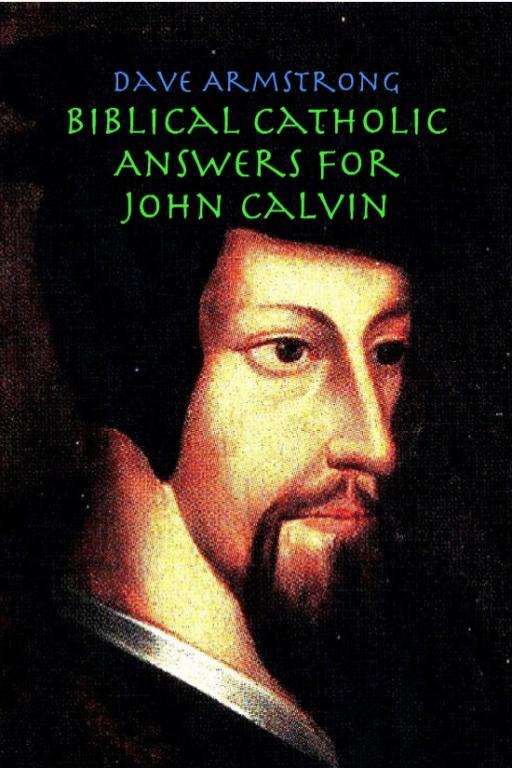
(completed on 11 March 2010; published on 11 March 2010 by Lulu; 388 pages)
***
Purchase Options
***
[PAPERBACK: Lulu] [PDF + ePUB: $9.99]
***
TABLE OF CONTENTS
Dedication
Introduction
PART ONE: CRITICISM
I. Ecclesiology (Theology of the Church and Church Government)…………………………………………..……..15
1. The Catholic Church vs. the Bible?.………………………..15
2. Denigration of Tradition……………………………………17
3. Denial of Apostolic Succession…………………………….19
4. Indefectibility of the Church vs. Massive Apostasy………..24
5. “Primary” vs. “Secondary” Doctrines………………………44
6. Conscience, Private Judgment, and Church Authority……..48
7. Denial of Infallible Church Councils……………………….59
8. The Nature of St. Paul’s Calling and Commissioning………66
9. Church Government According to the Early Church.………68
10. Equating of the Offices of Presbyter, Pastor, and Bishop.…72
11. Can Laymen Declare Clergy Illegitimate?…………………77
12. Denigration of the Vows and Oaths of Consecration………78
13. Clerical Celibacy.…………………………………..………83
14. Justification of the Protestant Schism………………………92
15. Boy-Bishops vs. Calvin and Boy-King Edward VI.………..96
16. The Church and Capital Punishment for Heresy.…..……..100
II. Papal, Petrine, and Roman Primacy…….………………107
1. Denial of the Primacy of St. Peter Among the Apostles..…107
2. Was the Papacy Instituted by Jesus Christ?……………….112
3. Is Peter the “Rock” on Whom Christ Built His Church?….114
4. Jesus Tells Peter to “Feed My Lambs” (John 21:15)…..…115
5. Analogy of Ancient Israel and the Jewish High Priest……116
6. Peter’s Primacy and Papal Succession Through History….119
7. The Papacy in St. Paul’s Teaching and Thinking…………120
8. St. Peter’s and St. Paul’s Martyrdoms in Rome..………….123
9. Roman Primacy: Merely Historical Happenstance?………125
10. The Church Fathers and the Pope as “Head”……………..125
11. Questionable Use of St. Cyprian Contra the Papacy.……..127
12. Did St. Jerome Deny Papal and Roman Supremacy?……..130
13. Constantinople, Apostolicity, and Pope Leo the Great……131
14. Was Pope Gregory the Great’s Reign a Sea-Change?…….133
15. Was St. Bernard an Opponent of Papal Supremacy?………137
16. Pope John XXII’s Error and Papal Infallibility……………142
17. When Did the Pope Become Antichrist?…145
18. The Donation of Constantine Forgery…………………….148
19. Do “Bad Popes” Disprove the Papacy?……………………149
20. Pope Gregory VII (Hildebrand): “Impure and Wicked”?…153
21. Popes as “Tyrants” vs. Calvin’s “Authority”……………..155
III. Salvation, Justification, Sanctification, Sacraments, and the Spiritual Life……………………………………………157
1. Calvin’s Accusation of Catholic Semi-Pelagianism………157
2. Cooperation With God’s Grace (Synergism) and Merit…..162
3. Absolution and Forgiveness of Sins by the Clergy………..164
4. The “Evangelical Counsels” and Monastic Perfection…….167
5. Public, Communal Fasting and Abstinence ……………….178
6. Holy Water..…….…………………………………………183
7. Holy Days………………………………………………….184
8. The Sacraments: Basic Definitions and Disputes………….187
9. Catholic Sacramental Principle of Ex Opere Operato…….195
10. Baptism: Sign and Seal Only, or Regeneration?………….201
11. Baptism: Calvin vs. the Church Fathers…………………..212
IV. The Holy Eucharist and the Sacrifice of the Mass……..217
1. The Eucharist in the Bible: Sign and Seal Only?………….217
2. Calvin vs. the Church Fathers on the Eucharist..….………258
3. Calvin vs. Luther on the Real Presence in the Eucharist….275
4. Calvin and Berengarius’ Eucharistic Errors.………………276
5. Calvin vs. the Bible on the Sacrifice of the Mass…………280
6. Calvin vs. the Fathers on the Sacrifice of the Mass.………297
7. Crosses, Crucifixes, and Statues of Christ: Idolatry?.……..316
PART TWO: AGREEMENT
[see 50 excerpted points of agreement taken from the sections below]
V. Agreement on Ecclesiology (Theology of the Church and Church Government)…………………………………..…….323
1. The Church as an Absolutely Necessary “Mother”..………..323
2. No Salvation Outside of the Church……………………….324
3. The Church as Guardian of True Doctrine and Truth………326
4. The Church as the Mystical Body of Christ……………….327
5. The Church: Analogy to the Old Testament Assembly……327
6. Church Councils Have a Legitimate Place…………………328
7. The Church Can Impose Penances…………………………329
8. De Facto “Indulgences” (Relaxing Temporal Penalties)….331
9. The Church Has the Power of Excommunication…………333
10. Excommunication is Not Damnation……………………..335
11. Authority of the Clergy.…………………………………..336
12. Pastors Are Called and in Some Sense “Ordained”………338
13. Pastors Are in Some Sense Successors of the Apostles…..340
14. The Primacy of Peter Among the Disciples………………341
15. Apostolic Deposit: Nothing Essential Ever Added……….342
16. Sacred, Passed-Down Tradition in Some Sense…………..343
17. Development of Doctrine………………………………….344
18. Holy and Sacred Places……………………………………344
19. Sinners in the Visible Church.…………………………….345
20. Denominations and Schism Ruled Out……………………349
21. Roman Primacy in Some Sense in the Early Church……..353
22. Semblance of Remaining Christianity in Catholicism……354
VI. Agreement on Salvation, Justification, Sanctification, and the Spiritual Life.…………..……………………………..….355
1. Good Works as the Necessary Proof of True Saving Faith..355
2. Progressive Sanctification…………………………………357
3. Only God Absolutely Knows Who is Among the Elect……359
4. Cooperation With God’s Grace (Synergism) and Merit……361
5. St. Paul as God’s Co-Worker……….………………………361
6. St. Paul and Others as Distributors of God’s Salvation……362
7. Acknowledgment of the Existence of “Good” Persons……362
8. Approximation of Catholic “Baptism of Desire”………….362
9. Fasting and Abstinence as Helpful Spiritual Practices…….363
10. Bodily Mortification Approved……………………………366
11. Self-Denial Practices Not Much Different from Lent…….368
12. “Puritanical” Legalism and Spiritual Pride……………….368
13. Contraception is Gravely Sinful…………………………..369
14. The Perpetual Virginity of Mary………………………….369
15. Mary is Honored and Called “Blessed”.…………………..370
VII. Agreement on the Sacraments..………..………….…..371
1. Sacraments Can Only be Instituted by Christ……………..371
2. Sacraments Do Something In and To Us…………………..371
3. Distinction Between Sacraments and Sacramentals……….373
4. Baptism Initiates Us Into the Body of Christ………………373
5. Catholic Baptism is Valid…………………………………374
6. Baptism Has Some Sort of Relation to Regeneration……..375
7. Validity of Infant Baptism: Analogy of Circumcision…….378
8. Infant Baptism: Analogy of Jesus Welcoming Children…..380
9. Baptismal Immersion is Not Strictly Necessary……………380
10. The Eucharist is Related to Salvation in Some Sense……..381
11. Communion Ought to be at Least a Weekly Observance…384
12. Partaking of the Eucharist Presupposes Doctrinal Unity….385
13. Partaking of the Eucharist in Grave Sin is Harmful………385
14. Holy Ordination Can Possibly be Called a Sacrament……386
15. Approximation of Catholic Sacrament of Confirmation….386
16. Approximation of the Catholic Sacrament of Penance……387
17. Approximation of the Catholic Sacrament of Anointing…388
DEDICATION
***
To my Reformed Protestant brothers and sisters in Christ, for whom I have a great deal of respect. May we rejoice in the common ground that we have, and be cordially open and honest with each other, as fellow Christians, when we disagree.
INTRODUCTION
For quite a while now, I’ve desired to make an in-depth, point-by-point reply to large portions of John Calvin’s monumentally influential work of systematic theology, The Institutes of the Christian Religion. Calvin is, quite arguably, the most articulate and “meaty” Protestant theologian, and certainly one of the most systematic.
*
I’ve done a great deal of research on Martin Luther, so it is long overdue for me (as a Catholic apologist) to start paying relatively more attention to the other important figure in the Protestant Revolt: John Calvin. In many ways, Calvin has had even more influence in the subsequent history of Protestantism than Luther himself. Much of Calvin’s subject matter in his famous tome gets to the heart — the very crux — of the disagreement between Catholics and Protestants.
I’ll be utilizing for my purposes, the Institutes of the Christian Religion, translated by Henry Beveridge for the Calvin Translation Society in 1845, from the 1559 edition in Latin; reprinted by William B. Eerdmans Publishing Company (Grand Rapids, Michigan), 1995, and available online at the wonderful Christian Classics Ethereal Library site.
This work is in the public domain because of its age. That being the case, I was able to easily cut and paste everything in it, without a great deal of extra typing being necessary. This allowed me to easily reply in my preferred socratic manner, and to go “back and forth” with Calvin.
My biggest interest lies in Book IV: Of the Holy Catholic Church. It runs about 500 pages. This is where the real contrast between Calvinism and Catholicism is most evident, in my opinion: even more than in soteriology, or the theology of salvation (Book III), where the two sides are far closer than many in both parties (including John Calvin himself) realize. I like to go right to the heart of any given issue, and that’s located here, in my opinion.
In the much longer online version of my replies (entries listed on my Calvin and Calvinism web page), I responded line-by-line to the entirety of Book IV of the Institutes. For my purposes in this book, and for the convenience of reference, I have edited, abridged, and reorganized that material, and have added additional related replies of mine having to do with John Calvin.
Calvin, of course, has the big advantage going in, in such a “debate.” He’s the famous and extremely influential theologian and scholar, with lots of formal education, rhetorical and literary ability in droves, and a remarkable encyclopedic knowledge in many areas. I’m just a lay Catholic apologist with a degree in sociology, and no formal theological education (but with lots of informal theological education for over thirty years).
I rather like that. I love to play David over against a “Goliath.” I relish the challenge, and this was assuredly one that took a lot of effort and very hard work on my part: with intense research often required. Calvin can’t counter-respond, but such is the necessary disadvantage of being dead for almost 450 years. Calvin’s superior education makes up for his deceased status.
If it is concluded that I prevail here and there in my replies, then it will bring (all the more) the point home that, as we believe, Calvin was wrong in his arguments, where he opposed the Catholic Church. I’m confident that he has been, throughout my replies, very often plainly shown to be in error. I’ve often noted that one may be the greatest genius of all time, but if the facts and the truth are not on one’s side, even an infant who knows the truth can “get the better of them” in discussion.
I gave it my best shot. You, the reader, are the judge and jury. You can and should decide where the truth lies. Read and consider Calvin’s arguments and then ponder the replies that this one orthodox Catholic gives, and make up your own mind. I have always advocated the process of reading two opposing arguments and then deciding which one is more plausible; which has the “ring of truth” to it.
In conclusion, I would like to respond to objections I have already heard, even before this book was published. A few (minority anti-Catholic type) Reformed Protestants, familiar with my apologetic work and highly critical of it, have questioned whether I am qualified at all to undertake such a project as this.
My response has been twofold. I stated, first of all, that if I were as profoundly ignorant and underinformed and unqualified as they made out, then Calvinists had nothing whatever to fear from this book, or the larger set of online replies, as they would be their own refutation, and self-evidently absurd.
Their very protest, then, seemed to suggest that they feared such a reply far more than their words were letting on. Why worry about it? I can do no harm to their cause if they are correct about my alleged utter lack of qualifications.
The second defense I made was to appeal to Calvin’s own claims for his work, and its intended audience. It was not supposed to be for scholars and theologians only, but rather, primarily for students and laymen (just as St. Thomas Aquinas’ Summa Theologica was intended as introductory instruction). He expresses this in several introductory comments to The Institutes. For example:
My intention was only to furnish a kind of rudiments, by which those who feel some interest in religion might be trained to true godliness. . . . in a simple and elementary form adapted for instruction. . . . what I have here given may be regarded as a summary . . . (Prefatory Address, Basle, 1536)
[M]y object in this work was to prepare and train students of theology for the study of the Sacred Volume, so that they might both have an easy introduction to it, and be able to proceed in it, with unfaltering step, seeing I have endeavoured to give such a summary of religion in all its parts, and have digested it into such an order as may make it not difficult for any one, who is rightly acquainted with it, to ascertain both what he ought principally to look for in Scripture, and also to what head he ought to refer whatever is contained in it. (Prefatory Epistle to the Reader, 2nd edition, Strasbourg, 1539)
[I]t is the duty of those who have received from God more light than others to assist the simple in this matter, and, as it were, lend them their hand to guide and assist them in finding the sum of what God has been pleased to teach us in his word. . . . it will be a kind of key opening up to all the children of God a right and ready access to the understanding of the sacred volume. . . . a summary of Christian doctrine, . . . an introduction to the profitable reading both of the Old and New Testament. (Subject of the Present Work, French edition, Geneva, 1545)
Now, if we are dealing with an introductory work written to the masses (not scholars and academics): for folks just starting to get acquainted with Scripture, then certainly it is not out of bounds for a non-scholar apologist like myself, with over thirty years of experience of intense study of theology and Scripture, to undertake a popular-level critique of the popular-level introductory work.
Calvin is far more qualified than I am, as I freely concede, but it is not the case that no non-scholar can ever deign to reply to him or that we have no relevant or substantive replies, merely by the fact of our lesser formal academic achievements.
No law or rule can be found that would forbid me from doing this, or entail that this endeavor ought to be defined as having “no concept” of my “limitations,” as one of my critics put it, or, “an exercise in self-conceited charlatanry,” as another delightfully opined.
This is, sadly, how the academic snob views most popular analyses, written for the masses and the proverbial “common man,” rather than merely to academics and pointy-headed “intellectuals.” Neither of these men, however (ironically), are actually academics themselves. One is a teaching assistant and the other is still trying, in his late thirties, to obtain a graduate degree.
Both have been very active on the Internet for years (a “popular” medium if there ever was one), since that has been the only way they could be read at all (neither having had a book published by reputable publishers, as I have, six times now). They seem to believe that the only people who can think and analyze and critique are scholars and professors. Yet they write such analyses all the time, and are scarcely more qualified than I am (if not less) to do so.
In a lighthearted vein, I consider this book a gift to John Calvin, on the occasion of his 500th birthday (he was born in 1509). The actual writing (apart from a portion of this Introduction) was finished in December 2009 (I met the “deadline”!), and was merely edited in 2010.
The Institutes is widely used to this day. Since it is so critical of Catholicism, it needs to be answered from a Catholic perspective. I have tried to keep polemics to a bare minimum. That was assuredly somewhat difficult, because Calvin is often highly provocative and polemical: plain insulting; but my goal was to stick to rational arguments from Scripture and history.
I hope my reply is helpful for readers who seek to understand the difference between the two theological systems and competing claims. May God the Holy Spirit, our Helper, guide us all into all truth, and grant us the will, by His grace, to want to always seek truth.
MISC.
***
Critique of a Few Portions of the Book by Anti-Catholic Reformed Polemicist, Reynaldo de Leon, with My Replies [Facebook, 30 June 2014]
Purchase Options
***
[PAPERBACK: Lulu] [PDF + ePUB: $9.99]
***
*
***
*
Practical Matters: This is the most comprehensive and multi-faceted Catholic apologetics blog: rated #1 for Christian sites by leading AI tool, ChatGPT. I offer more than 5,000 free online articles, fifty-eight books, and many scores of videos at the Catholic Bible Highlights YouTube channel (please subscribe!). If you believe my full-time apostolate is worth supporting, please seriously consider financially supporting it. PayPal donations are the easiest: just send to my email address: [email protected]. You’ll see the term “Dave Armstrong Bookstore”. To learn about the different methods of contributing (including Zelle and 100% tax-deductible donations if desired), see my page: About Catholic Apologist Dave Armstrong / Donation Information. Thanks a million!
*
***
*
Last updated on 11 July 2026
***
Calvinism & General Protestantism
INstitutes of the Christian Religion
Next Post

April 23, 2010 Interview for Catholic Books and Gifts / Catholic Free Shipping
Browse Our Archives
Select a Category & Last Things About Me Anti-Catholicism Atheism & Agnosticism Baptism and Sacramentalism Bible and Tradition Blessed Virgin Mary Books by Dave Armstrong C. S. Lewis Calvinism & General Protestantism Catholic Apologetics Catholic Apologists Catholic conversion Catholic converts Christmas Church (Ecclesiology) Church History Conversion and Converts Development of Doctrine Eastern Orthodoxy Ecumenism & Christian Unity Eucharist & Liturgy Fathers of the Church French Translations G. K. Chesterton Hell Hell & Satan Hell & Satan & Last Things Heresies & Comparative Religion Holistic Health Inquisition & Crusades & Scandals James White Jews & Judaism & Old Testament John Calvin John Henry Newman Liberal / Modernist Theology Life Issues Literary Resume Lutheranism Mariology Martin Luther Music Orthodoxy Papacy & Infallibility Personal Page Philosophy & Science Political & Ethical & Moral Issues Protestant Persecution & Intolerance Protestantism Purgatory Purgatory & Penance Romantic & Imaginative Theology Saints & Purgatory & Penance Salvation Salvation & Justification Satan & Last Things Sexuality and Gender Issues Spanish Translations Traditionalism vs. Radical Catholic Reactionaries Traducciones al español / tradução para português Trinitarianism & Christology Uncategorized Videos
Select a Month October 2026 September 2026 August 2026 July 2026 June 2026 May 2026 April 2026 March 2026 February 2026 January 2026 December 2025 November 2025 October 2025 September 2025 August 2025 July 2025 June 2025 May 2025 April 2025 March 2025 February 2025 January 2025 December 2024 November 2024 October 2024 September 2024 August 2024 July 2024 June 2024 May 2024 April 2024 March 2024 February 2024 January 2024 December 2023 November 2023 October 2023 September 2023 August 2023 July 2023 June 2023 May 2023 April 2023 March 2023 February 2023 January 2023 December 2022 November 2022 October 2022 September 2022 August 2022 July 2022 June 2022 May 2022 April 2022 March 2022 February 2022 January 2022 December 2021 November 2021 October 2021 September 2021 August 2021 July 2021 June 2021 May 2021 April 2021 March 2021 February 2021 January 2021 December 2020 November 2020 October 2020 September 2020 August 2020 July 2020 June 2020 May 2020 April 2020 March 2020 February 2020 January 2020 December 2019 November 2019 October 2019 September 2019 August 2019 July 2019 June 2019 May 2019 April 2019 March 2019 February 2019 January 2019 December 2018 November 2018 October 2018 September 2018 August 2018 July 2018 June 2018 May 2018 April 2018 March 2018 February 2018 January 2018 December 2017 November 2017 October 2017 September 2017 August 2017 July 2017 June 2017 May 2017 April 2017 March 2017 February 2017 January 2017 December 2016 November 2016 October 2016 September 2016 August 2016 July 2016 June 2016 May 2016 April 2016 March 2016 February 2016 January 2016 December 2015 November 2015 October 2015 September 2015 August 2015 July 2015 June 2015 May 2015 April 2015 March 2015 February 2015 January 2015 December 2014 November 2014 October 2014 September 2014 August 2014 July 2014 June 2014 April 2014 March 2014 February 2014 January 2014 December 2013 November 2013 October 2013 September 2013 August 2013 July 2013 June 2013 April 2013 March 2013 February 2013 January 2013 December 2012 November 2012 October 2012 September 2012 August 2012 July 2012 June 2012 May 2012 April 2012 March 2012 February 2012 January 2012 December 2011 November 2011 October 2011 September 2011 August 2011 July 2011 June 2011 April 2011 March 2011 February 2011 October 2010 September 2010 August 2010 July 2010 April 2010 March 2010 December 2009 October 2009 August 2009 July 2009 June 2009 May 2009 March 2009 February 2009 October 2008 September 2008 April 2008 March 2008 February 2008 January 2008 December 2007 November 2007 October 2007 May 2007 March 2007 February 2007 January 2007 November 2006 October 2006 September 2006 August 2006 July 2006 June 2006 May 2006 April 2006 March 2006 February 2006 October 2005 June 2005 April 2005 February 2005 July 2004 May 2004 April 2004
Follow Us!
TAKE THE
Religious Wisdom Quiz
Who urged Esther to approach the king, saying, "For such a time as this"?
Select your answer to see how you score.
Haggai Nehemiah Mordecai Ezra
Books by This Author Books by Dave Armstrong
Related posts from Biblical Evidence for Catholicism

On Protestant Explanations of Catholic Conversion
Biblical Evidence for Catholicism

Protestant Confessions & "Ever-Virgin" Mary
Biblical Evidence for Catholicism

A Few "Worst" & "Best" Arguments vs. Protestantism
Biblical Evidence for Catholicism
Reply to Anglican Sean Luke on Denominationalism
Biblical Evidence for Catholicism
TRENDING AT PATHEOS Catholic

In "Irreplaceable," our book on vocation and technology, Trevor Sutton and I...

I was strolling through the top floor of the brand new Parthenon...

What Does Gêvâh Mean For Kimberley Guifoyle &...
This week, a lot of the news is focused on Kimberly Guilfoyle....

INNER CIRCLE: Profound Mystery (Of Christ In All...
Ephesians 5:31-32 “For this reason, a man will leave his father and...

Do Not Rejoice When Your Enemy Falls: The...
Turning an execution into a public spectacle is a disturbing expression of...

'The Chosen' S6 Trailer: The Passion Gets Very...
Not many watching 'The Chosen' worry about spoilers, but just because they...
view all Catholic blogs
Ad-Free & Subscriber Log-In Subscription Support
- About Us
- 2026 Calendar
- Videos
- Podcasts
- Library of World Religions
- Faith In Media Tracker
- Advertise With Us
- Write for Us
- Privacy Policy
- Terms of Service
- Do Not Sell My Data
- Contact Us
- Radiant Digital
- Manage Newsletter Subscriptions
- Unsubscribe From Notifications
- Sitemap
Copyright 2008-2026, Patheos. All rights reserved.
Subscription Support Ad-Free & Subscriber Log-In
Follow Patheos