
BuddhistCatholicContemplativeEvangelicalGeneral ChristianHinduJewishLatter-day SaintMuslimNew VisionsProgressive Christian
Beliefs
- Buddhist
- Catholic
- Contemplative
- Evangelical
- General Christian
- Hindu
- Jewish
- Latter-day Saint
- More Voices
- Muslim
- New Visions
- Pagan
- Progressive Christian
Topics
- Religion News
- Food and Religion
- Sports and Religion
- Religious Art
- Religious Music and Entertainment
- Religious Events
- History and Religion
- Style and Religion
- Politics and Religion
- Women in Religion
- Recreation Outdoors and Religion
- Business Finance and Religion
- Careers Workplace and Religion
- Education and Religion
- Family Parenting and Religion
- Health Fitness and Religion
- Home and Religion
- Relationships and Religion
- Technology and Religion
- Travel and Religion
Columnists
- Buddhist Columnists
- Business Finance and Religion Columnists
- Careers Workplace and Religion Columnists
- Catholic Columnists
- Contemplative Columnists
- Education and Religion Columnists
- Evangelists Columnists
- Family Parenting and Religion Columnists
- General Christian Columnists
- Health Fitness and Religion Columnists
- Hindu Columnists
- History and Religion Columnists
- Home and Religion Columnists
- Jewish Columnists
- More Voices Columnists
- Latter Day Columnists
- Muslim Columnists
- New Visions Columnists
- Nonreligious Columnists
- Pagan Columnists
- Politics and Religion Columnists
- Progressive Columnists
- Recreation Outdoors and Religion Columnists
- Relationships and Religion Columnists
- Religion News Columnists
- Religious Art Columnists
- Religious Events Columnists
- Religious Music and Entertainment Columnists
- Sports and Religion Columnists
- Style and Religion Columnists
- Technology and Religion Columnists
- Travel and Religion Columnists
- Women in Religion Columnists
Resource Library
- 2026 Calendar
- Library of World Religions
- The 100 Most Holy Places on Earth
- Patheos Answers
- Podcasts
- Videos
- Faith Leaders Database
- Anglican Episcopalian
- Bahai
- Baptist
- Buddhism
- Christianity
- Confucianism
- Eastern Orthodoxy
- Hinduism
- Holiness and Pentecostal
- ISKCON
- Islam
- Judaism
- Lutheran
- Methodist
- The Church of Jesus Christ of Latter-day Saints
- New Age
- Paganism
- Presbytarian and Reformed
- Protestantism
- Religion Behind the Scenes
- Roman Catholic
- Scientology
- Shia Islam
- Sikhism
- Sufism
- Sunni Islam
- Taoism
- Zen
- See all religions
Research Tools
 Ad-Free & Subscriber Log-In Subscription Support
Ad-Free & Subscriber Log-In Subscription Support
Follow Patheos 

- Trending:
- Forgiveness
- |
- Marriage
- |
- Consciousness
- |
- Death Penalty
- |
- Election
- |
- Halloween

-
About
-
Catholic Apologetics
-
Church History
-
Great Apologists
-
Christian Worldview
-
Protestantism & Misc.
- Home
- Catholic
- History and Religion
- Books by Dave Armstrong: “Bible Proofs for Catholic Truths”
Books by Dave Armstrong: “Bible Proofs for Catholic Truths”
Last updated on: July 11, 2026 at 1:14 pm by Dave Armstrong
Books by Dave Armstrong: “Bible Proofs for Catholic Truths” 2026-07-11T13:14:56-04:00 Dave Armstrong
Patheos Explore the world's faith through different perspectives on religion and spirituality! Patheos has the views of the prevalent religions and spiritualities of the world.
“. . . A Source Book for Apologists and Inquirers“
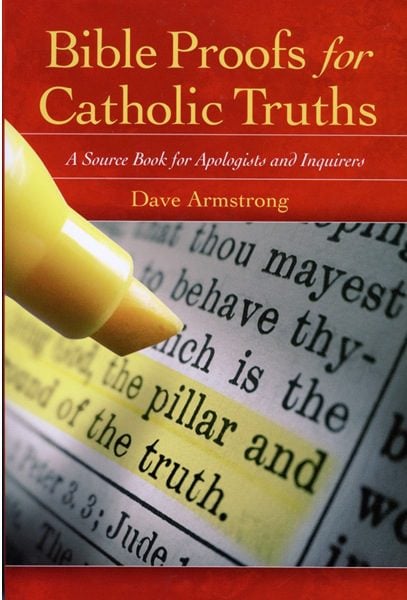
[completed on 18 April 2009; 445 pages; published on 15 August 2009 by Sophia Institute Press]
[cover design by Theodore Schluenderfritz]
***
Purchase Options
***
[PAPERBACK (Amazon variable prices for used copies)] [ePUB + PDF: $9.99]
***
[2051 Bible Passages entirely written out: KJV with RSV alternate versions added where necessary to clarify meaning]
***
Doubtless, were only the Scripture allowed its own authority, there are none of these things respecting which our adversaries would not be constrained to be mute. . . . Though they may kiss the closed copies of the Scripture as a kind of worship, . . . they allow it no more authority than if no part of it existed in writing.
— John Calvin, dedication of his Commentary on the General Epistles, January 1551
***
TABLE OF CONTENTS
***
(follow linked words for online excerpts; most excerpts use RSV rather than KJV and several are somewhat different from the final version in the book)
Dedication
Introduction [read below]
1. The Authority of Apostolic Tradition
(295 Passages)
***
Authoritative sacred tradition
Authoritative oral tradition / “word of God” [50 Passages]
Authoritative oral teaching not recorded in scripture
New Testament citations of older non-biblical oral traditions
“The Faith” is synonymous with sacred tradition
“The truth” is synonymous with sacred tradition
“The commandment” is synonymous with sacred tradition
“The doctrine” is synonymous with sacred tradition
“Teaching” is synonymous with sacred tradition
“Gospel” or “good news” is synonymous with sacred tradition
“The message” is synonymous with sacred tradition
The New Covenant is synonymous with sacred tradition
Authoritative interpretation / scripture is not always self-interpreting
Doctrine develops over time
Christianity has developed out of Judaism
2. The Authority of the Catholic Church
(377 Passages)
***
Jesus deliberately established a visible, institutional, universal Church
Priests are called by Jesus or the Holy Spirit
Priests are given authority by Jesus or the Holy Spirit
The Church calls and commissions men for the work of ministry
Men are ordained through the laying on of hands
Priests are direct representatives of Jesus
Priests are God’s fellow workers for the Kingdom
Jesus’ followers are God’s servants
Priests preside over the Eucharist and the Mass
Priests’ authority to forgive sins, grant indulgences, and impose penances
Priests administer the sacraments
Ministry calls for sacrifice
Celibacy fosters undistracted devotion to the Lord
God’s ministers are entitled to pay
Priests are appropriately called “Father”
Priests are successors to the Apostles
Bishops have special authority
The authority of the Church and its councils is infallible
The Church has authority to excommunicate and to pronounce anathemas
Priests have authority to cast out demons (exorcism)
Unity is vital to the Church/ denominationalism and divisiveness
Sinners are part of the Church in an imperfect fashion
Sacred buildings of worship are worthy of extravagant beauty
Churches and sacred sites are “holy places”
Sacred items are part of worship
3. The Authority of Popes
(84 Passages)
***
Peter was the first pope
Peter’s letters are like papal encyclicals
St. Peter acted as a pope
Scripture offers examples of the infallibility of individuals
4. The Theology of Salvation
(473 Passages)
***
We are saved through grace
Salvation is not by faith alone
Salvation is not by works alone
Grace, faith, works, action, and obedience lead to salvation [50 Passages]
Final judgment is always associated with works [50 Passages]
Some sins are more serious than others
Quantifiable differences in grace
Our merit is based on our response to God’s grace
We are God’s coworkers
We can participate in the distribution of grace and in the salvation of others
The Psalms proclaim God’s righteousness
God enables and establishes human righteousness (Psalms) [50 Passages]
The Psalms speak of human righteousness
God’s grace enables us to be righteous (prophets)
Sanctification is part of salvation [50 Passages]
Faith shows itself in obedience and in good works
Salvation is a process and not absolutely assured
We may have a vigilant moral assurance of salvation with perseverance, in hope
5. Purgatory
(58 Passages)
***
Perfect holiness requires purification [50 Passages]
We should pray for the dead
6. The Holy Eucharist and the Sacrifice of the Mass
(47 Passages)
***
The Last Supper was the first Mass
Jesus teaches us about the Eucharist
The Mass is a sacrifice
7. The Sacrament of Baptism
(46 Passages)
***
Our sins are washed away in Baptism
Infants were baptized even in the early Church
Infants are part of the covenant and salvation
8. The Sacrament of Confirmation
(59 Passages)
***
The Holy Spirit descends upon persons
Jesus baptizes with the Holy Spirit
Persons may be “filled” with the Holy Spirit
The Holy Spirit comes through the laying on of hands
We are “sealed” with the Holy Spirit
Persons are anointed with oil for a sacred purpose or to receive the Holy Spirit
The Holy Spirit received through authoritative persons
9. The Sacrament of Anointing
(18 Passages)
***
Priests anoint with oil to heal
The laying on of hands can bring healing
Some who touched Christ were healed
Spiritual benefit in healing (demoniacs)
10. Sacramentals, Liturgy, and Devotional Practice
(235 Passages)
***
Formal prayer is not “vain repetition”
Holy water
Candles and incense
Fasting, abstinence, and Lent [50 Passages]
We use ashes to show our penitence
We must examine our consciences
Almsgiving is more than mere tithing
We show reverence by genuflecting and kneeling in God’s presence
Priests may impart blessings
Relics can be channels of grace and healing
Physical objects can aid us in worship
11. Penance, Redemptive Suffering, and Atonement on Behalf of Others
(37 Passages)
***
We may make atonement
Our sufferings can be penitential and redemptive
12. Angels and the Communion of Saints
(66 Passages)
***
Dead saints have returned to earth
We should venerate saints and angels
Saints and angels intercede for us
Guardian angels watch over us
Men have spoken to angels (analogy to intercession of the saints)
13. The Blessed Virgin Mary
(54 Passages)
***
Jesus was Mary’s only child
Mary was free from sin from the moment of conception
Mary was assumed, body and soul, into heaven
14. Marriage and Sexuality
(115 Passages)
***
Matrimony reflects the relationship between Christ and his Church
Marriage is indissoluble
Premarital sex and cohabitation are not permissible
Annulment is not Catholic divorce
Homosexual acts are not permissible
Contraception is not permissible
15. Abortion
(87 Passages)
***
The child in the womb is fully a person
Killing the innocent is forbidden
Child sacrifice is an abomination
It is sinful to perform or even to support abortion
We must rescue children being led to slaughter
INTRODUCTION
***
The aim of this book is very simple (hence the short introduction), and it reflects much of the emphasis in my Catholic apologetic efforts for the last 18 years. I want to provide the biblical rationale for Catholic beliefs. The subject matter is as endless as the riches, wisdom, and depths of the Bible itself.
*
My immediate goal is to simply present categorized Bible passages. My own commentary will be kept to a minimum and used only in instances where I am straightforwardly reiterating what Holy Scripture itself states, noting relevant contextual considerations, Greek or Hebrew meanings of words (as explicated by linguistic scholars), or scriptural cross-references.
I have, of course, selected the passages and classified them. Insofar as I did that, I was engaging in “systematic theology.” Human input (something beyond God’s own words) is necessary as soon as one goes beyond simply placing a Bible on a table in front of someone and saying, “read all of this: it completely supports what Catholics teach.” In all reasonable argumentation whatever, selective presentation takes place, and in systematic theology, it is necessary to locate the relevant biblical texts and to collect them for the purpose of illustrating that “the Bible teaches thus and so about this particular topic.” And that involves judgment, which in turn includes a bias.
In that sense, this book is not just the Bible. My input and editing and orthodox Catholic presuppositions are present. But the central, essential focus is “just the Bible.” Holy, Sacred Scripture is thoroughly “Catholic,” as I hope to demonstrate in great detail. Praise God for His wonderful, materially sufficient revelation and His aid in helping us to understand and live by it.
Some Catholic teachings are less well-attested by direct scriptural indications than others. Yet I believe that those doctrines are also “soaked” in the spirit of the Bible. The comprehensive selection of texts herein repeatedly demonstrates this, in my opinion. A multitude of pointers can be as compelling as a single unambiguous signpost, to show us our way. Readers are free to decide the relative strength of individual textual evidence.
Reading these extracts in their full context is even more rewarding and illuminating. The Bible is a harmonious whole: “living and active”, and should be interpreted as such, rather than picked apart into fragments. For the purpose of systematic doctrinal study, however, it is quite helpful to categorize texts. Moreover, Catholics emphasize that the Bible is organically related to the tradition and the Church in which it is received and interpreted. If this book helps readers to move beyond arguments into a deeper appreciation of the Word of God, in which lies our salvation, I will be more than happy.
For my purposes in this work, I’ve chosen the Authorised (King James Version) of the Bible, due to its familiarity among Protestants. Its lofty, poetic prose is deeply embedded in the heritage of English literature and thinking, and Catholic readers will also find it inspiring. In cases of archaic expression, I have clarified in parentheses with the Revised Standard Version: one of the most accurate and beloved modern translations.
Lastly, Catholics and Protestants notoriously disagree as to which books constitute the biblical canon. The number of the inspired books accepted by the universal Church prior to the onset of Protestantism was disputed by Martin Luther and other non-Catholic Christians, and seven books were eventually omitted altogether in most Protestant editions of the Bible, or included separately as sub-canonical “apocryphal” texts. Some of these refer directly to distinctively Catholic doctrines (most notably, purgatory). I’ve included relatively few citations from these “disputed” books, but for the Catholic, they are Scripture, too, and ought not be excluded. If the non-Catholic reader wishes to pass over them, more than ample texts remain as “evidences.”
* * * * * * * * *
Purchase Options
***
[PAPERBACK (Amazon variable prices for used copies)] [ePUB + PDF: $9.99]
*
***
*
Practical Matters: This is the most comprehensive and multi-faceted Catholic apologetics blog: rated #1 for Christian sites by leading AI tool, ChatGPT. I offer more than 5,000 free online articles, fifty-eight books, and many scores of videos at the Catholic Bible Highlights YouTube channel (please subscribe!). If you believe my full-time apostolate is worth supporting, please seriously consider financially supporting it. PayPal donations are the easiest: just send to my email address: [email protected]. You’ll see the term “Dave Armstrong Bookstore”. To learn about the different methods of contributing (including Zelle and 100% tax-deductible donations if desired), see my page: About Catholic Apologist Dave Armstrong / Donation Information. Thanks a million!
*
***
*
Last updated on 11 July 2026
***
Bible Proofs for Catholic Truths
biblical proofs of Catholicism
Previous Post
February 16, 2009
Candles, Incense, and Symbolism for Prayer in the Bible
Next Post
May 13, 2009 Cardinal Newman's Philosophical & Epistemological Commitments
Browse Our Archives
Select a Category & Last Things About Me Anti-Catholicism Atheism & Agnosticism Baptism and Sacramentalism Bible and Tradition Blessed Virgin Mary Books by Dave Armstrong C. S. Lewis Calvinism & General Protestantism Catholic Apologetics Catholic Apologists Catholic conversion Catholic converts Christmas Church (Ecclesiology) Church History Conversion and Converts Development of Doctrine Eastern Orthodoxy Ecumenism & Christian Unity Eucharist & Liturgy Fathers of the Church French Translations G. K. Chesterton Hell Hell & Satan Hell & Satan & Last Things Heresies & Comparative Religion Holistic Health Inquisition & Crusades & Scandals James White Jews & Judaism & Old Testament John Calvin John Henry Newman Liberal / Modernist Theology Life Issues Literary Resume Lutheranism Mariology Martin Luther Music Orthodoxy Papacy & Infallibility Personal Page Philosophy & Science Political & Ethical & Moral Issues Protestant Persecution & Intolerance Protestantism Purgatory Purgatory & Penance Romantic & Imaginative Theology Saints & Purgatory & Penance Salvation Salvation & Justification Satan & Last Things Sexuality and Gender Issues Spanish Translations Traditionalism vs. Radical Catholic Reactionaries Traducciones al español / tradução para português Trinitarianism & Christology Uncategorized Videos
Select a Month October 2026 September 2026 August 2026 July 2026 June 2026 May 2026 April 2026 March 2026 February 2026 January 2026 December 2025 November 2025 October 2025 September 2025 August 2025 July 2025 June 2025 May 2025 April 2025 March 2025 February 2025 January 2025 December 2024 November 2024 October 2024 September 2024 August 2024 July 2024 June 2024 May 2024 April 2024 March 2024 February 2024 January 2024 December 2023 November 2023 October 2023 September 2023 August 2023 July 2023 June 2023 May 2023 April 2023 March 2023 February 2023 January 2023 December 2022 November 2022 October 2022 September 2022 August 2022 July 2022 June 2022 May 2022 April 2022 March 2022 February 2022 January 2022 December 2021 November 2021 October 2021 September 2021 August 2021 July 2021 June 2021 May 2021 April 2021 March 2021 February 2021 January 2021 December 2020 November 2020 October 2020 September 2020 August 2020 July 2020 June 2020 May 2020 April 2020 March 2020 February 2020 January 2020 December 2019 November 2019 October 2019 September 2019 August 2019 July 2019 June 2019 May 2019 April 2019 March 2019 February 2019 January 2019 December 2018 November 2018 October 2018 September 2018 August 2018 July 2018 June 2018 May 2018 April 2018 March 2018 February 2018 January 2018 December 2017 November 2017 October 2017 September 2017 August 2017 July 2017 June 2017 May 2017 April 2017 March 2017 February 2017 January 2017 December 2016 November 2016 October 2016 September 2016 August 2016 July 2016 June 2016 May 2016 April 2016 March 2016 February 2016 January 2016 December 2015 November 2015 October 2015 September 2015 August 2015 July 2015 June 2015 May 2015 April 2015 March 2015 February 2015 January 2015 December 2014 November 2014 October 2014 September 2014 August 2014 July 2014 June 2014 April 2014 March 2014 February 2014 January 2014 December 2013 November 2013 October 2013 September 2013 August 2013 July 2013 June 2013 April 2013 March 2013 February 2013 January 2013 December 2012 November 2012 October 2012 September 2012 August 2012 July 2012 June 2012 May 2012 April 2012 March 2012 February 2012 January 2012 December 2011 November 2011 October 2011 September 2011 August 2011 July 2011 June 2011 April 2011 March 2011 February 2011 October 2010 September 2010 August 2010 July 2010 April 2010 March 2010 December 2009 October 2009 August 2009 July 2009 June 2009 May 2009 March 2009 February 2009 October 2008 September 2008 April 2008 March 2008 February 2008 January 2008 December 2007 November 2007 October 2007 May 2007 March 2007 February 2007 January 2007 November 2006 October 2006 September 2006 August 2006 July 2006 June 2006 May 2006 April 2006 March 2006 February 2006 October 2005 June 2005 April 2005 February 2005 July 2004 May 2004 April 2004
Follow Us!
TAKE THE
Religious Wisdom Quiz
Who visited baby Jesus in the manger?
Select your answer to see how you score.
Fishermen Shepherds Roman guards Scribes
Books by This Author Books by Dave Armstrong
Related posts from Biblical Evidence for Catholicism

A Few "Worst" & "Best" Arguments vs. Protestantism
Biblical Evidence for Catholicism

Jerusalem Council vs. James White & Sola Scriptura
Biblical Evidence for Catholicism

Book: Martin Luther: Dissenter and Defender
Biblical Evidence for Catholicism

Biblical Perspicuity: Absurd Anti-Catholic "Defense"
Biblical Evidence for Catholicism
TRENDING AT PATHEOS Catholic

Swimfan: Forgotten Aughts Pleasures
This is a recovery effort. In 2002, My Big Fat Greek Wedding...

Top Three Anti-Catholic Lies About Catholicism
This is my initial transcript for the video, "THE 3 WORST...

Pope Leo Celebrates Mass for Nurses & Docs...
I don't have any idea how he did it, but Pope Leo...

The Sermon on the Mount, Part I: Matthew...
The Sermon on the Mount, Part I (Matthew 4:12-5:12) St. Matthew moves...

What's up from Crossway: Reviewing some of their latest A few weeks...

Janie Learns the Way of the Cross: A...
Teaching children about Jesus' Passion can be challenging. Many parents and educators...
view all Catholic blogs
Ad-Free & Subscriber Log-In Subscription Support
- About Us
- 2026 Calendar
- Videos
- Podcasts
- Library of World Religions
- Faith In Media Tracker
- Advertise With Us
- Write for Us
- Privacy Policy
- Terms of Service
- Do Not Sell My Data
- Contact Us
- Radiant Digital
- Manage Newsletter Subscriptions
- Unsubscribe From Notifications
- Sitemap
Copyright 2008-2026, Patheos. All rights reserved.
Subscription Support Ad-Free & Subscriber Log-In
Follow Patheos