
BuddhistCatholicContemplativeEvangelicalGeneral ChristianHinduJewishLatter-day SaintMuslimNew VisionsProgressive Christian
Beliefs
- Buddhist
- Catholic
- Contemplative
- Evangelical
- General Christian
- Hindu
- Jewish
- Latter-day Saint
- More Voices
- Muslim
- New Visions
- Pagan
- Progressive Christian
Topics
- Religion News
- Food and Religion
- Sports and Religion
- Religious Art
- Religious Music and Entertainment
- Religious Events
- History and Religion
- Style and Religion
- Politics and Religion
- Women in Religion
- Recreation Outdoors and Religion
- Business Finance and Religion
- Careers Workplace and Religion
- Education and Religion
- Family Parenting and Religion
- Health Fitness and Religion
- Home and Religion
- Relationships and Religion
- Technology and Religion
- Travel and Religion
Columnists
- Buddhist Columnists
- Business Finance and Religion Columnists
- Careers Workplace and Religion Columnists
- Catholic Columnists
- Contemplative Columnists
- Education and Religion Columnists
- Evangelists Columnists
- Family Parenting and Religion Columnists
- General Christian Columnists
- Health Fitness and Religion Columnists
- Hindu Columnists
- History and Religion Columnists
- Home and Religion Columnists
- Jewish Columnists
- More Voices Columnists
- Latter Day Columnists
- Muslim Columnists
- New Visions Columnists
- Nonreligious Columnists
- Pagan Columnists
- Politics and Religion Columnists
- Progressive Columnists
- Recreation Outdoors and Religion Columnists
- Relationships and Religion Columnists
- Religion News Columnists
- Religious Art Columnists
- Religious Events Columnists
- Religious Music and Entertainment Columnists
- Sports and Religion Columnists
- Style and Religion Columnists
- Technology and Religion Columnists
- Travel and Religion Columnists
- Women in Religion Columnists
Resource Library
- 2026 Calendar
- Library of World Religions
- The 100 Most Holy Places on Earth
- Patheos Answers
- Podcasts
- Videos
- Faith Leaders Database
- Anglican Episcopalian
- Bahai
- Baptist
- Buddhism
- Christianity
- Confucianism
- Eastern Orthodoxy
- Hinduism
- Holiness and Pentecostal
- ISKCON
- Islam
- Judaism
- Lutheran
- Methodist
- The Church of Jesus Christ of Latter-day Saints
- New Age
- Paganism
- Presbytarian and Reformed
- Protestantism
- Religion Behind the Scenes
- Roman Catholic
- Scientology
- Shia Islam
- Sikhism
- Sufism
- Sunni Islam
- Taoism
- Zen
- See all religions
Research Tools
 Ad-Free & Subscriber Log-In Subscription Support
Ad-Free & Subscriber Log-In Subscription Support
Follow Patheos 

- Trending:
- Forgiveness
- |
- Marriage
- |
- Consciousness
- |
- Death Penalty
- |
- Election
- |
- Halloween

-
About
-
Catholic Apologetics
-
Church History
-
Great Apologists
-
Christian Worldview
-
Protestantism & Misc.
- Home
- Catholic
- History and Religion
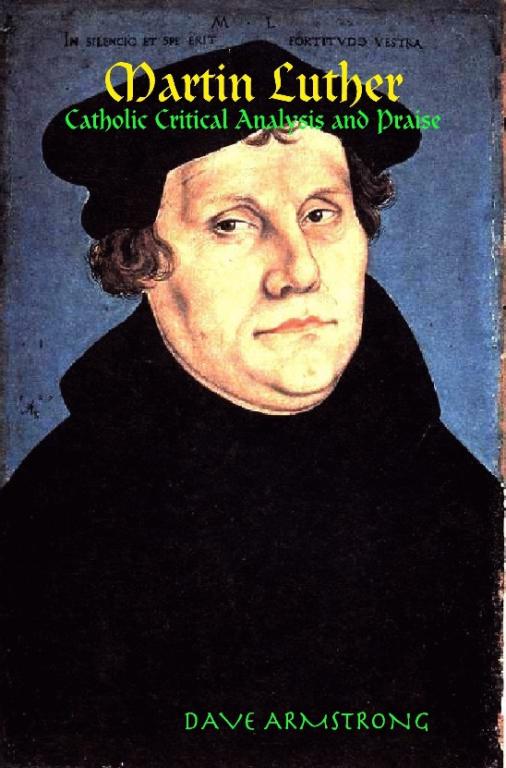
- Intro. to “Martin Luther: Catholic Critical Analysis and Praise”
Intro. to “Martin Luther: Catholic Critical Analysis and Praise”
Last updated on: June 2, 2017 at 4:43 pm by Dave Armstrong
Intro. to “Martin Luther: Catholic Critical Analysis and Praise” 2017-06-02T16:43:30-04:00 Dave Armstrong
Patheos Explore the world's faith through different perspectives on religion and spirituality! Patheos has the views of the prevalent religions and spiritualities of the world.
***
(4-17-08)
***
The question always arises with regard to a work such as this, written from a Catholic perspective: why write about Martin Luther at all? Such an endeavor is viewed in many quarters as “stirring up a hornet’s nest” or as an unnecessary provoking of undesirable tension between Christians. Life is tough enough without further quarreling, we are told. We are supposed to be beyond all that, seeing that this is an “enlightened” age of tolerance and ecumenism.
My question in return is: “why are we required to pit legitimate ecumenism and the honorable quest for Christian unity against honest, critical analysis of competing theological claims and historical inquiry?” I’m a thoroughly ecumenical Christian, and readers may rest assured that I have great respect for my Protestant and Orthodox brothers and sisters in Christ. Indications of this on my blog (see the front pages of this book) are innumerable. Thus I need not “prove” my “ecumenical good faith”.
That said, I fail to see how it is improper — or in any way unbiblical — to contend for one’s own Christian position, or to engage in apologetics (my own vocation). The effort need not be acrimonious at all. It can be done with the utmost cordiality. I try very hard to do so — not that I always succeed.
In fact, Martin Luther himself – it seems to me — would not frown upon a vigorous advocacy of a theological position (since he often did that). He certainly disagreed strongly with other viewpoints if he felt they were in error, and was not all that inclined to accept criticism of himself or his own opinions, but I doubt that he would ever say that a person shouldn’t state their disagreement or principled theological positions at all, for fear of being accused of creating yet more division amongst Christians.
That is a peculiarly modern perspective. And it derives, in my opinion, mostly from the fact that people (as a general trend of the last two hundred years or so) have a less robust Christian faith, compared to their theological ancestors. Therefore, they have less motivation to contend for the relatively few things they continue to strongly believe. In other words, the fewer theological tenets one accepts, the more they tend to make the abstract of “tolerance” the highest goal, rather than the concrete goal of pursuit of truth. This can frequently be observed today.
Indeed, all of the original Protestant leaders would have strictly opposed such a mentality. They contended for their distinctive viewpoints with great enthusiasm and a felt sense of vision. It was rare in the 16th century to hear of the current fashionable notions of “secondary doctrines”: where all parties concede that they cannot be resolved one way or the other (so that they should be ignored or consigned to relative irrelevance).
The subject matter and positions taken in this book will, no doubt, be offensive to some or even many Protestant readers. It is difficult to write about such a delicate topic: one that elicits deep feelings of allegiance. But this work is not meant to be an “attack” on Martin Luther. Apologetics isn’t political campaigning (an apt analogy in this presidential election year in America). It is, rather, a very straightforward examination of Martin Luther: the founder of Protestantism, with a concentration on massive citation of his own words.
Some “controversy,” although painful at times, is necessary and useful for the purpose of determining the relative merits of competing truth claims. I think it is self-evident that Martin Luther, as the founder of an important and influential movement within Christianity, should be held up to the utmost scrutiny, given the fact that so many basic Protestant assumptions originate (largely or solely) from him. This work is, accordingly, an analysis of the roots of present-day Protestant theology.
It is foolish for any Protestant (some of whom reject even the appellation “Protestant”) to deny the inescapable link between current-day denominational Protestantism (even beyond Lutheranism) and Martin Luther. To do so is to be uninformed about a crucial element in Protestant thought: its own root presuppositions. Any Christian body claiming to be a (or the) legitimate manifestation of historical Christianity must have a coherent story to tell. This necessarily involves historical study and some kind of theological interpretation of the history of one’s own group.
I strongly contend that no Protestant can deny an organic relationship to Martin Luther, any more than a Catholic can disavow all ties to the historic papacy, the Crusades and Inquisition, etc. Both sides must have the courage to fairly acknowledge their own shortcomings and the other side’s positive, godly attributes. We’re all products of the past.
The views set forth here are certainly one-sided, and purposely so, in order to form a conscious counter-argument to the accepted Protestant “mythology,” so to speak, of Martin Luther. His many commendable qualities are well covered in any Protestant biography (and some can be rightly classified as virtual “hagiographies”).
The objective Christian student of Church history needs to consult works written from a critical Catholic perspective as well, in order to foster a closer examination and perhaps a partial reappraisal of Luther. The full, multi-faceted, complex truth concerning important historical figures is invariably more fascinating than the usual myths that circulate about. I aim to present Luther as he was: no more, no less: as fairly as I can, but “warts and all,” too.
Lastly, the reader may wonder (in all fairness) about my own personal opinion (as a committed orthodox Catholic, and Catholic apologist) of Martin Luther. I’m happy to comply with such a desire. I disagree with the man’s theology (that is, where he departs from Catholic orthodoxy) and some of the ways in which he went about things. But I do not regard Luther (like many Catholic biographers and critics throughout history) as an essentially “evil” or “bad” man. I don’t deny his good intentions and sincerity at all (though I often question his wisdom and foresight, as will be evident).
I actually admire Martin Luther in many ways. I love his passion and boldness and bravery in standing up for what he believed. I always admire people who do that, unless the stand they take is unquestionably evil. One can respect such a person without necessarily agreeing with the specific cause or belief that he or she espouses. One can be wrong for the right reasons, and right for the wrong reasons.
I’ve written extensively about Martin Luther, and maintain perhaps the largest web page on the Internet devoted to Luther and Lutheranism, from a Catholic perspective. It may surprise some to learn that among these many papers (written over the past seventeen years) are about twenty, as of writing, where I defend Luther against myths and bum raps, cite him in agreement, or take a fairly neutral stance towards his opinion.
In one fictional, Plato-inspired dialogue I even portrayed Martin Luther quite positively (and downright affectionately), as a sort of (saved) “wise old man”. I’ve even – on occasion — received unsolicited letters of commendation from Lutheran pastors for such efforts. These aspects of my research will be utilized in the Part Two “praise” section of this book (which runs 83 pages, or about 34% of all the material — 245 pages — from Chapter One to the Bibliography).
I’ve engaged in many cordial dialogues with Lutheran scholars or pastors or informed layman, and enjoyed them very much. I’ve defended Lutheranism as well, against false charges from other Christians (for example, the bogus accusation of semi-Pelagianism, or unfounded criticism from Calvinists).
So this book is not about “Luther-bashing” or attempted “historical revisionism” or any such thing. It is simply a Catholic examination of Martin Luther: critical where I feel I must be so, in light of my own heartfelt theological adherence as a Catholic, but also appreciative of the several areas where I can wholeheartedly agree with Luther, and rejoice in those instances where he is an eloquent proponent of a position that Catholics also hold.
*****
Meta Description: Introduction to the critical + ecumenical book about Martin Luther by Catholic apologist Dave Armstrong.
Meta Keywords: Luther, Martin Luther, founder of Protestantism, origin of Protestantism, Protestant Reformation, Reformation, Protestant reformers, Reformers, Lutheranism, religious wars, 16th century Germany, Protestant revolt, Protestant Revolution, 95 Theses, Here I stand, Diet of Worms, Philip Melanchthon, Counter-Reformation, Catholic Reformation, Bondage of the Will, Peasants’ Revolt
Previous Post

March 20, 2008
Richard Dawkins and the "Religion vs. Science" Mentality
Next Post
April 17, 2008 Book: "Martin Luther: Catholic Critical Analysis & Praise"
Browse Our Archives
Select a Category & Last Things About Me Anti-Catholicism Atheism & Agnosticism Baptism and Sacramentalism Bible and Tradition Blessed Virgin Mary Books by Dave Armstrong C. S. Lewis Calvinism & General Protestantism Catholic Apologetics Catholic Apologists Catholic conversion Catholic converts Christmas Church (Ecclesiology) Church History Conversion and Converts Development of Doctrine Eastern Orthodoxy Ecumenism & Christian Unity Eucharist & Liturgy Fathers of the Church French Translations G. K. Chesterton Hell Hell & Satan Hell & Satan & Last Things Heresies & Comparative Religion Holistic Health Inquisition & Crusades & Scandals James White Jews & Judaism & Old Testament John Calvin John Henry Newman Liberal / Modernist Theology Life Issues Literary Resume Lutheranism Mariology Martin Luther Music Orthodoxy Papacy & Infallibility Personal Page Philosophy & Science Political & Ethical & Moral Issues Protestant Persecution & Intolerance Protestantism Purgatory Purgatory & Penance Romantic & Imaginative Theology Saints & Purgatory & Penance Salvation Salvation & Justification Satan & Last Things Sexuality and Gender Issues Spanish Translations Traditionalism vs. Radical Catholic Reactionaries Traducciones al español / tradução para português Trinitarianism & Christology Uncategorized Videos
Select a Month October 2026 September 2026 August 2026 July 2026 June 2026 May 2026 April 2026 March 2026 February 2026 January 2026 December 2025 November 2025 October 2025 September 2025 August 2025 July 2025 June 2025 May 2025 April 2025 March 2025 February 2025 January 2025 December 2024 November 2024 October 2024 September 2024 August 2024 July 2024 June 2024 May 2024 April 2024 March 2024 February 2024 January 2024 December 2023 November 2023 October 2023 September 2023 August 2023 July 2023 June 2023 May 2023 April 2023 March 2023 February 2023 January 2023 December 2022 November 2022 October 2022 September 2022 August 2022 July 2022 June 2022 May 2022 April 2022 March 2022 February 2022 January 2022 December 2021 November 2021 October 2021 September 2021 August 2021 July 2021 June 2021 May 2021 April 2021 March 2021 February 2021 January 2021 December 2020 November 2020 October 2020 September 2020 August 2020 July 2020 June 2020 May 2020 April 2020 March 2020 February 2020 January 2020 December 2019 November 2019 October 2019 September 2019 August 2019 July 2019 June 2019 May 2019 April 2019 March 2019 February 2019 January 2019 December 2018 November 2018 October 2018 September 2018 August 2018 July 2018 June 2018 May 2018 April 2018 March 2018 February 2018 January 2018 December 2017 November 2017 October 2017 September 2017 August 2017 July 2017 June 2017 May 2017 April 2017 March 2017 February 2017 January 2017 December 2016 November 2016 October 2016 September 2016 August 2016 July 2016 June 2016 May 2016 April 2016 March 2016 February 2016 January 2016 December 2015 November 2015 October 2015 September 2015 August 2015 July 2015 June 2015 May 2015 April 2015 March 2015 February 2015 January 2015 December 2014 November 2014 October 2014 September 2014 August 2014 July 2014 June 2014 April 2014 March 2014 February 2014 January 2014 December 2013 November 2013 October 2013 September 2013 August 2013 July 2013 June 2013 April 2013 March 2013 February 2013 January 2013 December 2012 November 2012 October 2012 September 2012 August 2012 July 2012 June 2012 May 2012 April 2012 March 2012 February 2012 January 2012 December 2011 November 2011 October 2011 September 2011 August 2011 July 2011 June 2011 April 2011 March 2011 February 2011 October 2010 September 2010 August 2010 July 2010 April 2010 March 2010 December 2009 October 2009 August 2009 July 2009 June 2009 May 2009 March 2009 February 2009 October 2008 September 2008 April 2008 March 2008 February 2008 January 2008 December 2007 November 2007 October 2007 May 2007 March 2007 February 2007 January 2007 November 2006 October 2006 September 2006 August 2006 July 2006 June 2006 May 2006 April 2006 March 2006 February 2006 October 2005 June 2005 April 2005 February 2005 July 2004 May 2004 April 2004
Follow Us!
TAKE THE
Religious Wisdom Quiz
What is the distinctive cup used in receiving communion in many traditions?
Select your answer to see how you score.
Plate Jug Bowl Chalice
Books by This Author Books by Dave Armstrong
Related posts from Biblical Evidence for Catholicism

A Few "Worst" & "Best" Arguments vs. Protestantism
Biblical Evidence for Catholicism

Book: Martin Luther: Dissenter and Defender
Biblical Evidence for Catholicism
Luther’s Anfechtung vs. Paul’s Spiritual Confidence
Biblical Evidence for Catholicism
"Martin Luther: Dissenter & Defender": Introduction
Biblical Evidence for Catholicism
TRENDING AT PATHEOS Catholic

Janie Learns the Way of the Cross: A...
Teaching children about Jesus' Passion can be challenging. Many parents and educators...

Looking For Good Catholic Writing - October 2026
He alone extends the heavens, and he walks upon the waves of...

In "Irreplaceable," our book on vocation and technology, Trevor Sutton and I...

I was strolling through the top floor of the brand new Parthenon...

What Does Gêvâh Mean For Kimberley Guifoyle &...
This week, a lot of the news is focused on Kimberly Guilfoyle....

INNER CIRCLE: Profound Mystery (Of Christ In All...
Ephesians 5:31-32 “For this reason, a man will leave his father and...
view all Catholic blogs
Ad-Free & Subscriber Log-In Subscription Support
- About Us
- 2026 Calendar
- Videos
- Podcasts
- Library of World Religions
- Faith In Media Tracker
- Advertise With Us
- Write for Us
- Privacy Policy
- Terms of Service
- Do Not Sell My Data
- Contact Us
- Radiant Digital
- Manage Newsletter Subscriptions
- Unsubscribe From Notifications
- Sitemap
Copyright 2008-2026, Patheos. All rights reserved.
Subscription Support Ad-Free & Subscriber Log-In
Follow Patheos