
BuddhistCatholicContemplativeEvangelicalGeneral ChristianHinduJewishLatter-day SaintMuslimNew VisionsProgressive Christian
Beliefs
- Buddhist
- Catholic
- Contemplative
- Evangelical
- General Christian
- Hindu
- Jewish
- Latter-day Saint
- More Voices
- Muslim
- New Visions
- Pagan
- Progressive Christian
Topics
- Religion News
- Food and Religion
- Sports and Religion
- Religious Art
- Religious Music and Entertainment
- Religious Events
- History and Religion
- Style and Religion
- Politics and Religion
- Women in Religion
- Recreation Outdoors and Religion
- Business Finance and Religion
- Careers Workplace and Religion
- Education and Religion
- Family Parenting and Religion
- Health Fitness and Religion
- Home and Religion
- Relationships and Religion
- Technology and Religion
- Travel and Religion
Columnists
- Buddhist Columnists
- Business Finance and Religion Columnists
- Careers Workplace and Religion Columnists
- Catholic Columnists
- Contemplative Columnists
- Education and Religion Columnists
- Evangelists Columnists
- Family Parenting and Religion Columnists
- General Christian Columnists
- Health Fitness and Religion Columnists
- Hindu Columnists
- History and Religion Columnists
- Home and Religion Columnists
- Jewish Columnists
- More Voices Columnists
- Latter Day Columnists
- Muslim Columnists
- New Visions Columnists
- Nonreligious Columnists
- Pagan Columnists
- Politics and Religion Columnists
- Progressive Columnists
- Recreation Outdoors and Religion Columnists
- Relationships and Religion Columnists
- Religion News Columnists
- Religious Art Columnists
- Religious Events Columnists
- Religious Music and Entertainment Columnists
- Sports and Religion Columnists
- Style and Religion Columnists
- Technology and Religion Columnists
- Travel and Religion Columnists
- Women in Religion Columnists
Resource Library
- 2026 Calendar
- Library of World Religions
- The 100 Most Holy Places on Earth
- Patheos Answers
- Podcasts
- Videos
- Faith Leaders Database
- Anglican Episcopalian
- Bahai
- Baptist
- Buddhism
- Christianity
- Confucianism
- Eastern Orthodoxy
- Hinduism
- Holiness and Pentecostal
- ISKCON
- Islam
- Judaism
- Lutheran
- Methodist
- The Church of Jesus Christ of Latter-day Saints
- New Age
- Paganism
- Presbytarian and Reformed
- Protestantism
- Religion Behind the Scenes
- Roman Catholic
- Scientology
- Shia Islam
- Sikhism
- Sufism
- Sunni Islam
- Taoism
- Zen
- See all religions
Research Tools
 Ad-Free & Subscriber Log-In Subscription Support
Ad-Free & Subscriber Log-In Subscription Support
Follow Patheos 

- Trending:
- Forgiveness
- |
- Marriage
- |
- Consciousness
- |
- Death Penalty
- |
- Election
- |
- Halloween

-
About
-
Catholic Apologetics
-
Church History
-
Great Apologists
-
Christian Worldview
-
Protestantism & Misc.
- Home
- Catholic
- History and Religion
- Introduction to Dave Armstrong’s Book, “Catholic Church Fathers”
Introduction to Dave Armstrong’s Book, “Catholic Church Fathers”
Last updated on: June 2, 2017 at 5:17 pm by Dave Armstrong
Introduction to Dave Armstrong’s Book, “Catholic Church Fathers” 2017-06-02T17:17:01-04:00 Dave Armstrong
Patheos Explore the world's faith through different perspectives on religion and spirituality! Patheos has the views of the prevalent religions and spiritualities of the world.
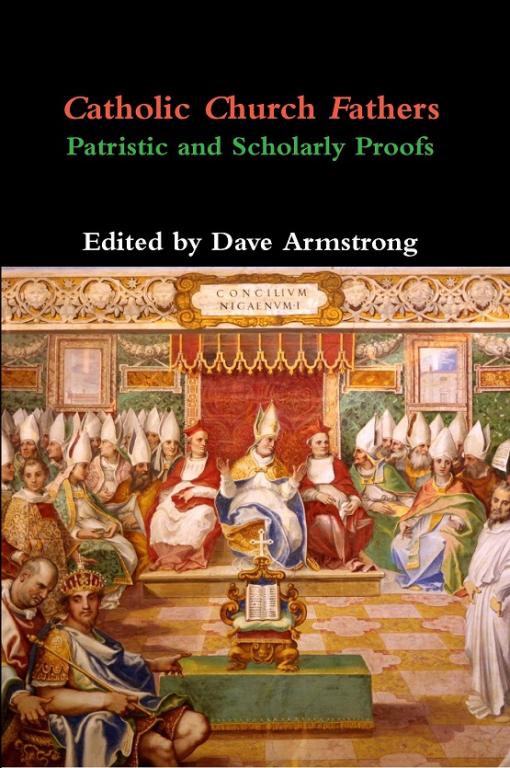
(revised on 28 August 2013)
***
Protestants and Catholics both claim that the early Church heritage of theology and broad consensus of the Church fathers leans more towards their own view. Protestants, from the beginning of their existence, claimed to be “reformers” of the Catholic Church; that is, they felt themselves to be hearkening back to the more pure doctrines of the early Church and the Church fathers, rather than overturning historic Catholic doctrine (what might be termed a “revolutionary” outlook, rather than a “reforming” one).
Whether the Protestant historic claims can withstand scrutiny and whether all that they stressed can be classified as a “conservative” return to what was held formerly, are separate and highly complex questions beyond our purview. Much of what will be presented in this book, however, will have relevance to that fundamental issue of what might be called “ecclesiological self-perception.”
*
The discussion of what the Church fathers believed, generally speaking (and in individual cases) must be undertaken by means of competing historical facts. The task of the patristic inquirer is to examine the relevant writings (for any given issue) of the fathers and make judgments of factuality and truth and falsity. It’s not a subjective enterprise but very much an objective one: it can be determined (fairly conclusively in most cases, I submit) what Church Father X believed about Christian doctrine or area of theology Y.
Church historians and other Christian scholars ought to be consulted often in the course of this pursuit, and non-scholars should be well aware of the complexity of this topic, and of their own inherent limitations of knowledge. A dose of intellectual humility is always a good thing. That said, laymen can also achieve a considerable degree of understanding on their own, especially with the easy availability of patristic resources on the Internet. No one can know everything on any given topic, but it doesn’t follow that an individual can’t know anything simply because he is not a trained academician.
Moreover, it should go without saying that inquirers ought not pick and choose and select certain passages and ignore or omit or deny the existence of others that may not fit into one particular theological schema or worldview or set of dogmas. Any seeker of “patristic truth” must take the greatest pains not to do this.
Church fathers can be wrong about things and contradict themselves or others, or the Church, just like anyone else. Catholics do not regard individual Church fathers as infallible. Nor do we think that broad patristic consensus is infallibility per se. But we do believe that this consensus is a strong indication of where the truth of historic Christian doctrine lies, and a key to the legitimate development of doctrine through the centuries.
I shall contend in this book, by means of massive documentation, that the “historical case” for Catholicism becomes stronger as the accumulation of patristic evidence piles up. Catholics need not fear patristic data any more than they need fear the Bible, as both (with all due respect to our esteemed non-Catholic Christian brothers and sisters) firmly support our theology and doctrine.
*
Lastly, I want to reiterate, especially to Catholic readers, that the more articulate and historically conscious among our Protestant brethren do not neglect or despise the Church fathers. They look to them as guides to true Christian doctrine, just as we do (with Scripture always being the overriding standard by which to judge any patristic opinion).
*
For example, the learned Lutheran systematic theologian Martin Chemnitz (1522-1586), who helped formulate the binding Lutheran confessions in the Book of Concord, wrote:
And we confess that we are greatly confirmed by the testimonies of the ancient church in the true and sound understanding of the Scripture. Nor do we approve of it if someone invents for himself a meaning which conflicts with all antiquity, and for which there are clearly no testimonies of the church. (Chemnitz, 208-209)
[W]e love and value greatly the true and sound interpretations which agree with the rules which we have quoted from the fathers. (Chemnitz, 211)
It is undeniably the truest of axioms that that alone is the true doctrine which the apostles transmitted and which the primitive church professed as received from the apostles. (Chemnitz, 225)
John Calvin (1509-1564) was described by a biographer as having a “precocious knowledge” of the fathers. He “read with close attention a great many works of the Fathers of the Church . . . until the end of his life he never ceased to deepen his thinking about the ancient Greek and Latin authors” (Wendel, 19, 123). Martin Luther (1483-1546), the founder of Protestantism, even went so far as to state:
This testimony of the universal holy Christian Church, even if we had nothing else, would be a sufficient warrant for holding this article [on the sacrament] and refusing to suffer or listen to a sectary, for it is dangerous and fearful to hear or believe anything against the unanimous testimony, belief, and teaching of the universal holy Christian churches, unanimously held in all the world from the beginning until now over fifteen hundred years. (in Bainton, 26; from the year 1532; primary German source: Werke [Weimar edition], XXX, 552)
With this background in mind, let us proceed to survey the beliefs of the Church fathers, particularly with regard to Catholic “distinctives.”
Chapters that include back-and-forth dialogues are based on real discussions with Protestants (mostly Lutherans, but sometimes Reformed / Calvinists) on the Internet. The words of my opponents will be paraphrased, but with the greatest care taken to preserve the nature and intent of their remarks, and to avoid any misrepresentation whatsoever.
*
[Note for revised 2013 edition: quotations from St. Augustine are no longer included, due to my separate book, The Quotable Augustine (Lulu, 2012); in order to avoid overlap and repetition for readers who purchase both volumes. I have also edited and published The Quotable Eastern Church Fathers (Lulu, 2013), to round out a “patristic trilogy.”]
SOURCES
Bainton, Roland H., Studies on the Reformation, Boston: Beacon Press, 1963.
Chemnitz, Martin, Examination of the Council of Trent, Part I, translated by Fred Kramer, St. Louis: Concordia Publishing House, 1971.
Wendel, Francois, Calvin: Origins and Development of His Religious Thought, translated by Philip Mairet, New York: Harper & Row, 1963.
****
Church fathers & Protestantism
Previous Post
May 20, 2007
"The One-Minute Apologist": Quotation Sources & Additional Contexts
Next Post
October 8, 2007 Six Anti-Catholics Challenged: "Is Catholicism Christian?" (All Declined)
Browse Our Archives
Select a Category & Last Things About Me Anti-Catholicism Atheism & Agnosticism Baptism and Sacramentalism Bible and Tradition Blessed Virgin Mary Books by Dave Armstrong C. S. Lewis Calvinism & General Protestantism Catholic Apologetics Catholic Apologists Catholic conversion Catholic converts Christmas Church (Ecclesiology) Church History Conversion and Converts Development of Doctrine Eastern Orthodoxy Ecumenism & Christian Unity Eucharist & Liturgy Fathers of the Church French Translations G. K. Chesterton Hell Hell & Satan Hell & Satan & Last Things Heresies & Comparative Religion Holistic Health Inquisition & Crusades & Scandals James White Jews & Judaism & Old Testament John Calvin John Henry Newman Liberal / Modernist Theology Life Issues Literary Resume Lutheranism Mariology Martin Luther Music Orthodoxy Papacy & Infallibility Personal Page Philosophy & Science Political & Ethical & Moral Issues Protestant Persecution & Intolerance Protestantism Purgatory Purgatory & Penance Romantic & Imaginative Theology Saints & Purgatory & Penance Salvation Salvation & Justification Satan & Last Things Sexuality and Gender Issues Spanish Translations Traditionalism vs. Radical Catholic Reactionaries Traducciones al español / tradução para português Trinitarianism & Christology Uncategorized Videos
Select a Month October 2026 September 2026 August 2026 July 2026 June 2026 May 2026 April 2026 March 2026 February 2026 January 2026 December 2025 November 2025 October 2025 September 2025 August 2025 July 2025 June 2025 May 2025 April 2025 March 2025 February 2025 January 2025 December 2024 November 2024 October 2024 September 2024 August 2024 July 2024 June 2024 May 2024 April 2024 March 2024 February 2024 January 2024 December 2023 November 2023 October 2023 September 2023 August 2023 July 2023 June 2023 May 2023 April 2023 March 2023 February 2023 January 2023 December 2022 November 2022 October 2022 September 2022 August 2022 July 2022 June 2022 May 2022 April 2022 March 2022 February 2022 January 2022 December 2021 November 2021 October 2021 September 2021 August 2021 July 2021 June 2021 May 2021 April 2021 March 2021 February 2021 January 2021 December 2020 November 2020 October 2020 September 2020 August 2020 July 2020 June 2020 May 2020 April 2020 March 2020 February 2020 January 2020 December 2019 November 2019 October 2019 September 2019 August 2019 July 2019 June 2019 May 2019 April 2019 March 2019 February 2019 January 2019 December 2018 November 2018 October 2018 September 2018 August 2018 July 2018 June 2018 May 2018 April 2018 March 2018 February 2018 January 2018 December 2017 November 2017 October 2017 September 2017 August 2017 July 2017 June 2017 May 2017 April 2017 March 2017 February 2017 January 2017 December 2016 November 2016 October 2016 September 2016 August 2016 July 2016 June 2016 May 2016 April 2016 March 2016 February 2016 January 2016 December 2015 November 2015 October 2015 September 2015 August 2015 July 2015 June 2015 May 2015 April 2015 March 2015 February 2015 January 2015 December 2014 November 2014 October 2014 September 2014 August 2014 July 2014 June 2014 April 2014 March 2014 February 2014 January 2014 December 2013 November 2013 October 2013 September 2013 August 2013 July 2013 June 2013 April 2013 March 2013 February 2013 January 2013 December 2012 November 2012 October 2012 September 2012 August 2012 July 2012 June 2012 May 2012 April 2012 March 2012 February 2012 January 2012 December 2011 November 2011 October 2011 September 2011 August 2011 July 2011 June 2011 April 2011 March 2011 February 2011 October 2010 September 2010 August 2010 July 2010 April 2010 March 2010 December 2009 October 2009 August 2009 July 2009 June 2009 May 2009 March 2009 February 2009 October 2008 September 2008 April 2008 March 2008 February 2008 January 2008 December 2007 November 2007 October 2007 May 2007 March 2007 February 2007 January 2007 November 2006 October 2006 September 2006 August 2006 July 2006 June 2006 May 2006 April 2006 March 2006 February 2006 October 2005 June 2005 April 2005 February 2005 July 2004 May 2004 April 2004
Follow Us!
TAKE THE
Religious Wisdom Quiz
How many disciples did Jesus have?
Select your answer to see how you score.
Thirty Seven One hundred Twelve
Books by This Author Books by Dave Armstrong
Related posts from Biblical Evidence for Catholicism

17 Church Fathers on Purgatory (Esp. 1 Cor...
Biblical Evidence for Catholicism

Deuterocanon & Javier Perdomo's Straw Men
Biblical Evidence for Catholicism

St. Athanasius & the Deuterocanon (vs. Javier Perdomo)
Biblical Evidence for Catholicism
Chrysostom vs. Faith Alone (vs. Lutheran Will Weedon)
Biblical Evidence for Catholicism
TRENDING AT PATHEOS Catholic

In "Irreplaceable," our book on vocation and technology, Trevor Sutton and I...

I was strolling through the top floor of the brand new Parthenon...

What Does Gêvâh Mean For Kimberley Guifoyle &...
This week, a lot of the news is focused on Kimberly Guilfoyle....

INNER CIRCLE: Profound Mystery (Of Christ In All...
Ephesians 5:31-32 “For this reason, a man will leave his father and...

Do Not Rejoice When Your Enemy Falls: The...
Turning an execution into a public spectacle is a disturbing expression of...

'The Chosen' S6 Trailer: The Passion Gets Very...
Not many watching 'The Chosen' worry about spoilers, but just because they...
view all Catholic blogs
Ad-Free & Subscriber Log-In Subscription Support
- About Us
- 2026 Calendar
- Videos
- Podcasts
- Library of World Religions
- Faith In Media Tracker
- Advertise With Us
- Write for Us
- Privacy Policy
- Terms of Service
- Do Not Sell My Data
- Contact Us
- Radiant Digital
- Manage Newsletter Subscriptions
- Unsubscribe From Notifications
- Sitemap
Copyright 2008-2026, Patheos. All rights reserved.
Subscription Support Ad-Free & Subscriber Log-In
Follow Patheos