
BuddhistCatholicContemplativeEvangelicalGeneral ChristianHinduJewishLatter-day SaintMuslimNew VisionsProgressive Christian
Beliefs
- Buddhist
- Catholic
- Contemplative
- Evangelical
- General Christian
- Hindu
- Jewish
- Latter-day Saint
- More Voices
- Muslim
- New Visions
- Pagan
- Progressive Christian
Topics
- Religion News
- Food and Religion
- Sports and Religion
- Religious Art
- Religious Music and Entertainment
- Religious Events
- History and Religion
- Style and Religion
- Politics and Religion
- Women in Religion
- Recreation Outdoors and Religion
- Business Finance and Religion
- Careers Workplace and Religion
- Education and Religion
- Family Parenting and Religion
- Health Fitness and Religion
- Home and Religion
- Relationships and Religion
- Technology and Religion
- Travel and Religion
Columnists
- Buddhist Columnists
- Business Finance and Religion Columnists
- Careers Workplace and Religion Columnists
- Catholic Columnists
- Contemplative Columnists
- Education and Religion Columnists
- Evangelists Columnists
- Family Parenting and Religion Columnists
- General Christian Columnists
- Health Fitness and Religion Columnists
- Hindu Columnists
- History and Religion Columnists
- Home and Religion Columnists
- Jewish Columnists
- More Voices Columnists
- Latter Day Columnists
- Muslim Columnists
- New Visions Columnists
- Nonreligious Columnists
- Pagan Columnists
- Politics and Religion Columnists
- Progressive Columnists
- Recreation Outdoors and Religion Columnists
- Relationships and Religion Columnists
- Religion News Columnists
- Religious Art Columnists
- Religious Events Columnists
- Religious Music and Entertainment Columnists
- Sports and Religion Columnists
- Style and Religion Columnists
- Technology and Religion Columnists
- Travel and Religion Columnists
- Women in Religion Columnists
Resource Library
- 2026 Calendar
- Library of World Religions
- The 100 Most Holy Places on Earth
- Patheos Answers
- Podcasts
- Videos
- Faith Leaders Database
- Anglican Episcopalian
- Bahai
- Baptist
- Buddhism
- Christianity
- Confucianism
- Eastern Orthodoxy
- Hinduism
- Holiness and Pentecostal
- ISKCON
- Islam
- Judaism
- Lutheran
- Methodist
- The Church of Jesus Christ of Latter-day Saints
- New Age
- Paganism
- Presbytarian and Reformed
- Protestantism
- Religion Behind the Scenes
- Roman Catholic
- Scientology
- Shia Islam
- Sikhism
- Sufism
- Sunni Islam
- Taoism
- Zen
- See all religions
Research Tools
 Ad-Free & Subscriber Log-In Subscription Support
Ad-Free & Subscriber Log-In Subscription Support
Follow Patheos 

- Trending:
- Forgiveness
- |
- Marriage
- |
- Consciousness
- |
- Death Penalty
- |
- Election
- |
- Halloween

-
About
-
Catholic Apologetics
-
Church History
-
Great Apologists
-
Christian Worldview
-
Protestantism & Misc.
- Home
- Catholic
- History and Religion
- “The One-Minute Apologist”: Quotation Sources & Additional Contexts
“The One-Minute Apologist”: Quotation Sources & Additional Contexts
Last updated on: June 6, 2026 at 12:26 am by Dave Armstrong
“The One-Minute Apologist”: Quotation Sources & Additional Contexts 2026-06-06T00:26:41-04:00 Dave Armstrong
Patheos Explore the world's faith through different perspectives on religion and spirituality! Patheos has the views of the prevalent religions and spiritualities of the world.
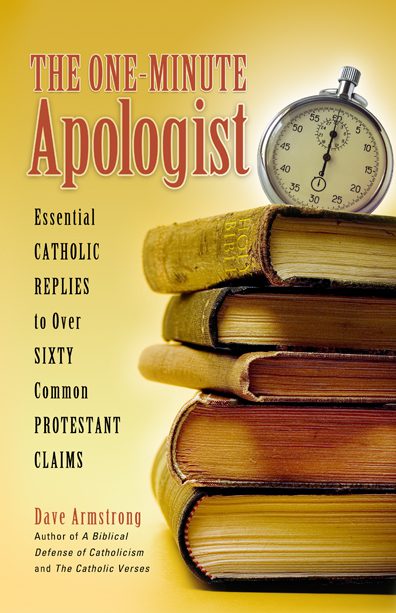
(5-20-07; updated on 19 February 2012)
*****
My publisher chose to not include the documentation for all the quotations I was asked to provide for each two-page section of my just-released book (see its book page and purchase information). This information was included in my manuscript, and so I shall provide that information here. Blue sections are continuations of quotations that were edited out of the published version, and green sections preceded existing book citations in my original manuscript:
* * * * *
Martin Luther [p. 5]
(in the year 1532; from Protestant Luther biographer Roland H. Bainton, Studies on the Reformation [Boston: Beacon Press, 1963], p. 26; primary source: WA [Werke, Weimar edition in German], XXX, 552; bracketed comment is Bainton’s own)
Robert McAfee Brown (Protestant scholar) [p. 7]
“Much of this may be due to faulty reading and faulty listening. But it cannot all be explained so simply. It can be explained only by recognizing honestly that Protestants do not rely on sola Scriptura in quite the pure way that Reformation Sunday sermons would suggest.”(
The Spirit of Protestantism, London: Oxford University Press, 1961, 215-216)
F.F. Bruce (Protestant Bible scholar) [pp. 9, 11]
(The Canon of Scripture, Downers Grove, IL: InterVarsity Press, 1988, 79-80; discussing St. Athanasius’ Festal Letter [No. 39], written in 367)
(The Canon of Scripture, Downers Grove, IL: InterVarsity Press, 1988, 41, 50, 280-282)
James Gairdner (Protestant Church historian) [p. 13]
(Lollardy and the Reformation in England, Vol. 1 of 4, 1908, 105, 117)
Philip Schaff (Protestant Church historian) [p. 17]
“. . . and the accounts of Irenaeus, Tertullian, Eusebius, and Jerome, that the same apostle nominated and ordained Polycarp (with whom Irenaeus was personally acquainted) bishop of Smyrna.”
(History of the Christian Church, Vol. II: Ante-Nicene Christianity: A.D. 100-325, Grand Rapids, MI: Eerdmans, 1970; from the 5th revised edition of 1910, 135-136)
John Calvin [p. 19]
” . . . [Matt. 22:30]. Our weakness does not allow us to be dismissed from her school until we have been pupils all our lives. Furthermore, away from her bosom one cannot hope for any forgiveness of sins or any salvation, as Isaiah [Isa. 37:32] and Joel [Joel 2:32] testify . . .”
(Institutes of the Christian Religion, edited by John T. McNeill; translated by Ford Lewis Battles, Philadelphia: The Westminster Press, 1960, IV, 1, 4; Vol. 2, p. 1016)
Philip Schaff (Protestant Church historian) [p. 21]
(History of the Christian Church, vol. 3: Nicene and Post-Nicene Christianity: A.D. 311-600, Grand Rapids, MI: Eerdmans, 1974; from the revised 5th edition of 1910, 396-397)
James D.G. Dunn (Protestant New Testament Scholar) [p. 23]
(Unity and Diversity in the New Testament, London: SCM Press, second edition, 1990, 192-193; glossalalia is the Greek word for tongues)
Bertrand Conway [p. 25]
“Neither excommunication nor anathemas imply the Church’s condemning anyone to hell. That is the prerogative of God alone. Excommunication is a Church law, excluding a notorious sinner from the communion of the faithful (Canons 2257-2267). Its purpose is to warn the sinner of the danger he runs of incurring eternal ruin, unless he repent of his sin. The “delivering of the sinner to Satan,” which we find in the Roman Pontifical, is based on the words of St. Paul, who delivered the incestuous sinner to Satan, “that his spirit might be saved in the Day of the Lord Jesus Christ” (1 Cor. 5:5; cf. 1 Tim. 1:20).”
(The Question Box, New York: The Paulist Press, 205)
Ronald Knox [p. 27]
(University and Anglican Sermons, London: Burns and Oates, 1963, 63)
H. Richard Niebuhr (Protestant Theologian) [p. 29]
(The Social Sources of Denominationalism, New York: The World Publishing Co. / Meridian Books, 1957; originally 1929, 25)
The Catholic Encyclopedia [p. 31]
(Vol. VI, 1909, “Galileo Galilei,” John Gerard)
James D.G. Dunn (Protestant Bible scholar) [p. 35]
(Unity and Diversity in the New Testament, London: SCM Press, 2nd edition, 1990, 385; cited in agreement by Bruce in the work above, pp. 42-43)
The New Bible Dictionary (Protestant reference work) [p. 37]
(general editor: J.D. Douglas; Grand Rapids, MI: Eerdmans Pub. Co., 1962, “Power,” section III: “The Power of the Keys,” by R.N. Caswell, pp. 1017-1018)
R.T. France (Anglican Bible commentator) [p. 39]
“Jesus now sums up Peter’s significance in a name, Peter . . . It describes not so much Peter’s character (he did not prove to be ‘rock-like’ in terms of stability or reliability), but his function, as the foundation-stone of Jesus’ church. The feminine word for ‘rock’, ‘petra’, is necessarily changed to the masculine ‘petros’ (stone) to give a man’s name, but the word-play is unmistakable (and in Aramaic would be even more so, as the same form ‘kepha’ would occur in both places). It is only Protestant overreaction to the Roman Catholic claim . . . that what is here said of Peter applies also to the later bishops of Rome, that has led some to claim that the ‘rock’ here is not Peter at all but the faith which he has just confessed. The word-play, and the whole structure of the passage, demands that this verse is every bit as much Jesus’ declaration about Peter as v.16 was Peter’s declaration about Jesus . . . It is to Peter, not to his confession, that the rock metaphor is applied . . . Peter is to be the foundation-stone of Jesus’ new community . . .”
(in Leon Morris, general editor, Tyndale New Testament Commentaries, Leicester, England: Inter-Varsity Press / Grand Rapids, MI: Eerdmans Pub. Co., 1985, vol. 1: Matthew, 254, 256)
The New Bible Dictionary (Protestant reference work) [p. 41]
(Organizing editor: J.D. Douglas, Grand Rapids, MI, Eerdmans Publishing Co., 1962; article “Peter,” written by A.F. Walls, 973)
John Henry Newman [p. 43]
(An Essay on the Development of Christian Doctrine, 1845, Part I, Ch. 2, Sec. 3)
Patrick Madrid (Catholic Apologist) [p. 45]
(Pope Fiction, San Diego: Basilica Press, 1999, 161-162)
St. Augustine [p. 49]
(The City of God, translated by Henry Bettenson, Baltimore: Penguin Books, 1972, XX, 10; p. 919)
Pope Pius XII (r. 1939-1958) [p. 51]
(Menti Nostrae, 23 September 1950)
C.S. Lewis [p. 53]
(“Priestesses in the Church?” From: God in the Dock: Essays on Theology and Ethics, edited by Walter Hooper, Grand Rapids, MI: Eerdmans, 1970, 235-236; originally published as “Notes on the Way,” in Time and Tide, vol. XXIX: 14 August 1948, pp. 830-831)
St. Thomas Aquinas (1225-1274) [p. 57]
(Summa Theologica, III, Q. 66, Art. 11)
Blaise Pascal [p. 59]
Pensees (no further documentation given)
St. Augustine [p. 61]
(The City of God, translated by Henry Bettenson, Baltimore: Penguin Books, 1972, XXII, 10; pp. 1048-1049)
F.F. Bruce (Protestant Bible Scholar) [p. 63]
(Israel and the Nations, Grand Rapids, MI: Eerdmans, 1963; reprinted 1981, 41)
St. Ignatius of Antioch (d.c. 110) [p. 65]
This one is a blatant typo in the book. My concluding words were mistakenly listed as a citation from St. Ignatius (!!!). I’m honored and humbled by the “compliment”, but here is my intended citation:
“Come together in common, one and all without exception in charity, in one faith and in one Jesus Christ, Who is of the race of David according to the flesh, the son of man and Son of God, so that with undivided mind you may obey the bishop and the priests, and break one Bread which is the medicine of immortality and the antidote against death, enabling us to live for ever in Jesus Christ.”
(Letter to the Ephesians, 20)
Martin Luther [pp. 67, 69]
(Large Catechism, 1529; Minneapolis: Augsburg Publishing House, 1935; section 230, p. 165)
(Large Catechism, 1529; Minneapolis: Augsburg Publishing House, 1935; section 234, p. 167)
Fr. John A. Hardon, S.J. [p. 71]
(Modern Catholic Dictionary, Garden City, New York, Doubleday & Company, 1980, “Limbo,” p. 320)
Blaise Pascal [p. 73]
Pensees (no further documentation given)
C.S. Lewis [p. 77]
(Mere Christianity, New York: Macmillan, 1952, 129-130)
John Wesley (Founder of Methodism) [p. 79]
(A Farther Appeal, 1745, Works, London: 1831, VIII, 68 ff. / Working Out Our Own Salvation, 1788, Works, VI, 511 ff.)
John Calvin [p. 81]
(Institutes of the Christian Religion, edited by John T. McNeill; translated by Ford Lewis Battles, Philadelphia: The Westminster Press, 1960, IV, 1, 3; Vol. 2, p. 1015; cf. IV, 1, 8; IV, 12, 9)
. . . [II Tim. 2:19]
(Ibid., IV, 1, 2; Vol. 2, p. 1013)
John Henry Newman [pp. 83, 85]
(Lectures on Justification; no further documentation)
(Parochial and Plain Sermons, Vol. 5, Sermon 14: “Transgressions and Infirmities” – from Newman’s Anglican period: 1840)
G.K. Chesterton [p. 87]
(All Things Considered, 1908; New York: Sheed & Ward, 1956, 140-141)
C.S. Lewis [p. 89]
“Though Our Lord often speaks of Hell as a sentence inflicted by a tribunal, He also says elsewhere that the judgement consists in the very fact that men prefer darkness to light, and that not He, but His ‘word,’ judges men. We are therefore at liberty – since the two conceptions, in the long run, mean the same thing – to think of this bad man’s perdition not as a sentence imposed on him but as the mere fact of being what he is. The characteristic of lost souls is ‘their rejection of everything that is not simply themselves.’”
(The Problem of Pain, New York: Macmillan, 1962, ch. 8, 122-123)
Fr. Ray Ryland [p. 91]
The Church speaks of “implicit desire” or “longing” that can exist in the hearts of those who seek God but are ignorant of the means of his grace. If a person longs for salvation but does not know the divinely established means of salvation, he is said to have an implicit desire for membership in the Church. Non-Catholic Christians know Christ, but they do not know his Church. In their desire to serve him, they implicitly desire to be members of his Church. Non-Christians can be saved, said John Paul, if they seek God with “a sincere heart.” In that seeking they are “related” to Christ and to his body the Church . . .
(“No Salvation Outside the Church,” This Rock, Vol. 16, No. 10, December 2005)
The Oxford Dictionary of the Christian Church [p. 93]
(De Civ. Dei [City of God], xxi. 13, and xxi. 24)
(F. L. Cross and E. A. Livingstone, editors, Oxford University Press, 2nd edition, 1983, 1144-1145)
John Henry Newman [p. 95]
(An Essay on the Grammar of Assent, 1870, 10)
C.S. Lewis [p. 99]
(“The Poison of Subjectivism,” 1943; later included in Christian Reflections: New York: Macmillan: 1967)
Romano Guardini (Catholic Theologian) [p. 101]
It is in him, the Third Person of the Trinity, that Father and Son are powerfully individual, yet one.
(The Lord, translated by Elinor Castendyk Briefs, Chicago: Henry Regnery Co., 1954, 433)
Sir Arnold Lunn (English Writer) [p. 103]
(Now I See, 1933)
Matthias Premm (Catholic Theologian) [p. 105]
The teaching of the Catholic Church is this: the unity in Christ did not result from the uniting of his two natures with each other, but in the union of each of them in the Person of the Son of God. The union is thus achieved in the Person (in theological terms this is called the hypostatic union), and not in the natures . . . both divine and human attributes can be predicated of him, although the two natures are separated by an infinite abyss. For example, I can say that Christ is omniscient (as God), but also that he does not know everything (as man); God is lying in the crib (that is, as a man); God is dying on the cross, etc.
(Dogmatic Theology for the Laity, Rockford, IL: TAN, 1967, 151-152)
St. Augustine [p. 109]
(On Nature and Grace [415], XXXVI, 42)
Martin Luther [pp. 111, 113]
(That Jesus Christ was Born a Jew, 1523; LW: Vol. 45, 199, 206)
She became the Mother of God, in which work so many and such great good things are bestowed on her as pass man’s understanding. For on this there follows all honor, all blessedness, and her unique place in the whole of mankind, among which she has no equal, namely, that she had a child by the Father in heaven, and such a Child . . . Hence men have crowded all her glory into a single word, calling her the Mother of God . . . None can say of her nor announce to her greater things, even though he had as many tongues as the earth possesses flowers and blades of grass: the sky, stars; and the sea, grains of sand. It needs to be pondered in the heart what it means to be the Mother of God.
(Commentary on the Magnificat, 1521; in Luther’s Works, Pelikan et al, volume 21, 326)
Heinrich Bullinger (Prominent Early Protestant Leader) [p. 115]
(in Max Thurian, Mary: Mother of all Christians, translated by Neville B. Cryer, New York: Herder & Herder, 1963, 197-198; from De origine erroris, 16, written in 1568)
John Henry Newman [p. 117]
The last clause in the published version was cut off, and a period put after “power,” leaving an incomplete sentence at the end. The “Though then” at the beginning, shows that the grammar necessitates an additional clause, because it is a compare-and-contrast sentence. Obviously, inadvertent human error on my (all in all, excellent) editor’s part . . .
Our Lord died for those heathens who did not know Him; and His Mother intercedes for those Christians who do not know her; and she intercedes according to His will, and, when He wills to save a particular soul, she at once prays for it. I say, He wills indeed according to her prayer, but then she prays according to His will. Though then it is natural and prudent for those to have recourse to her, who from the Church’s teaching know her power, yet it cannot be said that devotion to her is a sine-qua-non of salvation.
(Certain Difficulties Felt by Anglicans in Catholic Teaching, Vol. 2, § 5)
Martin Luther / Philip Schaff (Protestant Church Historian) [p. 119]
(Confession Concerning Christ’s Supper, 1528, in Luther’s Works, edited by Jaroslav Pelikan, vol. 37, 369)
(History of the Christian Church, Vol. II: Ante-Nicene Christianity: A.D. 100-325, Grand Rapids, MI: Eerdmans, 1970; 5th revised edition of 1910, 603-604)
C.S. Lewis [p. 121]
[D]evotions to saints . . . There is clearly a theological defence for it; if you can ask for the prayers of the living, why should you not ask for the prayers of the dead? . . . I am not thinking of adopting the practice myself; and who am I to judge the practices of others? . . . The consoling thing is that while Christendom is divided about the rationality and even the lawfulness, of praying to the saints, we are all agreed about praying with them. ‘With angels and archangels and all the company of heaven’ . . . You may say that the distinction between the communion of the saints as I find it in that act and full-fledged prayer to saints is not, after all, very great. All the better if so. I sometimes have a bright dream of reunion engulfing us unawares, like a great wave from behind our backs . . . Discussions usually separate us; actions sometimes unite us.
(Letters to Malcolm: Chiefly On Prayer, New York: Harcourt Brace Jovanovich, 1964, 15-16)
Ronald Knox [p. 123]
The book edit fails to include ellipses [ . . . ] between “the faith” and “Yes, this man . . .”, thus leaving the impression that Knox’s original statement didn’t include all the words in between them.
The attitude of our non-Catholic friends towards the Catholic saints; they always contrive to discredit, in one of two ways, their witness to the faith. Either they will say: “This was a very unpleasant, narrow-minded man, of ridiculous personal habits; and if that is what saints are like we would sooner hear no more of them”, or they will say: “Yes, this man was indeed a saint; but then he was not really a Roman Catholic. He was just a good Christian, as I and my wife are; he only happened to be in communion with the Pope because everybody was in those days.”
(Occasional Sermons, New York: Sheed & Ward, 1960, 115-116)
James Cardinal Gibbons [p. 127]
(The Faith of Our Fathers, New York: P. J. Kenedy & Sons, revised edition, 1917, 311)
Carryl Houselander (American Writer) [p. 129]
(Guilt, New York: Sheed & Ward, 1951)
Bertrand L. Conway [p. 131]
(The Question Box, New York: The Paulist Press, revised edition, 1929, 368)
Martin Luther [p. 133]
(Against the Heavenly Prophets, 1525, in Luther’s Works, edited by Jaroslav Pelikan, Vol. 40, p. 96)
St. Thomas Aquinas [p. 135]
[D]ivine power works invisibly through visible signs…. Hereby is excluded the error of certain heretics, who wish all visible sacramental signs swept away; and no wonder, for they take all visible things to be of their own nature evil, and the work of an evil author. These visible sacramental signs are the instruments of a God Incarnate and Crucified.
(Summa Contra Gentiles, IV, 56: “Of the Need of Sacraments”)
St. Augustine [p. 137]
(On Marriage and Concupiscence, 1,10[11]; A.D. 420, in NPNF1, V, 268 / Ibid., 1:17:19)
Bertrand L. Conway [p. 139]
(The Question Box, New York: The Paulist Press, revised edition, 1929, 331)
G.K. Chesterton [p. 141]
(The Well and the Shallows, New York: Sheed & Ward, 1935, 233)
Summary of Multiple Citations (62 Quotations in 61 sections)
Martin Luther: 7
C.S. Lewis: 5
John Henry Newman: 5
St. Augustine: 4
Philip Schaff: 3
F.F. Bruce: 3
Bertrand L. Conway: 3
G.K. Chesterton: 2
St. Thomas Aquinas: 2
Blaise Pascal: 2
John Calvin: 2
James D.G. Dunn: 2
Ronald Knox: 2
New Bible Dictionary: 2
*****
Meta Description: I provided a quotation at the end of each two-page section, but the paperback didn’t give source documentation: which I now provide.
Meta Keywords: The One-Minute Apologist, Catholic apologetics, books by Dave Armstrong
Previous Post
March 1, 2007
Fathers of the Church (Index Page)
Next Post
October 7, 2007 Introduction to Dave Armstrong's Book, "Catholic Church Fathers"
Browse Our Archives
Select a Category & Last Things About Me Anti-Catholicism Atheism & Agnosticism Baptism and Sacramentalism Bible and Tradition Blessed Virgin Mary Books by Dave Armstrong C. S. Lewis Calvinism & General Protestantism Catholic Apologetics Catholic Apologists Catholic conversion Catholic converts Christmas Church (Ecclesiology) Church History Conversion and Converts Development of Doctrine Eastern Orthodoxy Ecumenism & Christian Unity Eucharist & Liturgy Fathers of the Church French Translations G. K. Chesterton Hell Hell & Satan Hell & Satan & Last Things Heresies & Comparative Religion Holistic Health Inquisition & Crusades & Scandals James White Jews & Judaism & Old Testament John Calvin John Henry Newman Liberal / Modernist Theology Life Issues Literary Resume Lutheranism Mariology Martin Luther Music Orthodoxy Papacy & Infallibility Personal Page Philosophy & Science Political & Ethical & Moral Issues Protestant Persecution & Intolerance Protestantism Purgatory Purgatory & Penance Romantic & Imaginative Theology Saints & Purgatory & Penance Salvation Salvation & Justification Satan & Last Things Sexuality and Gender Issues Spanish Translations Traditionalism vs. Radical Catholic Reactionaries Traducciones al español / tradução para português Trinitarianism & Christology Uncategorized Videos
Select a Month October 2026 September 2026 August 2026 July 2026 June 2026 May 2026 April 2026 March 2026 February 2026 January 2026 December 2025 November 2025 October 2025 September 2025 August 2025 July 2025 June 2025 May 2025 April 2025 March 2025 February 2025 January 2025 December 2024 November 2024 October 2024 September 2024 August 2024 July 2024 June 2024 May 2024 April 2024 March 2024 February 2024 January 2024 December 2023 November 2023 October 2023 September 2023 August 2023 July 2023 June 2023 May 2023 April 2023 March 2023 February 2023 January 2023 December 2022 November 2022 October 2022 September 2022 August 2022 July 2022 June 2022 May 2022 April 2022 March 2022 February 2022 January 2022 December 2021 November 2021 October 2021 September 2021 August 2021 July 2021 June 2021 May 2021 April 2021 March 2021 February 2021 January 2021 December 2020 November 2020 October 2020 September 2020 August 2020 July 2020 June 2020 May 2020 April 2020 March 2020 February 2020 January 2020 December 2019 November 2019 October 2019 September 2019 August 2019 July 2019 June 2019 May 2019 April 2019 March 2019 February 2019 January 2019 December 2018 November 2018 October 2018 September 2018 August 2018 July 2018 June 2018 May 2018 April 2018 March 2018 February 2018 January 2018 December 2017 November 2017 October 2017 September 2017 August 2017 July 2017 June 2017 May 2017 April 2017 March 2017 February 2017 January 2017 December 2016 November 2016 October 2016 September 2016 August 2016 July 2016 June 2016 May 2016 April 2016 March 2016 February 2016 January 2016 December 2015 November 2015 October 2015 September 2015 August 2015 July 2015 June 2015 May 2015 April 2015 March 2015 February 2015 January 2015 December 2014 November 2014 October 2014 September 2014 August 2014 July 2014 June 2014 April 2014 March 2014 February 2014 January 2014 December 2013 November 2013 October 2013 September 2013 August 2013 July 2013 June 2013 April 2013 March 2013 February 2013 January 2013 December 2012 November 2012 October 2012 September 2012 August 2012 July 2012 June 2012 May 2012 April 2012 March 2012 February 2012 January 2012 December 2011 November 2011 October 2011 September 2011 August 2011 July 2011 June 2011 April 2011 March 2011 February 2011 October 2010 September 2010 August 2010 July 2010 April 2010 March 2010 December 2009 October 2009 August 2009 July 2009 June 2009 May 2009 March 2009 February 2009 October 2008 September 2008 April 2008 March 2008 February 2008 January 2008 December 2007 November 2007 October 2007 May 2007 March 2007 February 2007 January 2007 November 2006 October 2006 September 2006 August 2006 July 2006 June 2006 May 2006 April 2006 March 2006 February 2006 October 2005 June 2005 April 2005 February 2005 July 2004 May 2004 April 2004
Follow Us!
TAKE THE
Religious Wisdom Quiz
What does "Pentateuch" mean?
Select your answer to see how you score.
Five Scrolls God's Law Sacred Teachings Holy Writings
Books by This Author Books by Dave Armstrong
Related posts from Biblical Evidence for Catholicism

Book: Martin Luther: Dissenter and Defender
Biblical Evidence for Catholicism
"Martin Luther: Dissenter & Defender": Introduction
Biblical Evidence for Catholicism
Introducing "Faith Alone: The 'Theological Novum'”
Biblical Evidence for Catholicism
Faith Alone: The "Theological Novum" (Dave Armstrong Book)
Biblical Evidence for Catholicism
TRENDING AT PATHEOS Catholic

In "Irreplaceable," our book on vocation and technology, Trevor Sutton and I...

I was strolling through the top floor of the brand new Parthenon...

What Does Gêvâh Mean For Kimberley Guifoyle &...
This week, a lot of the news is focused on Kimberly Guilfoyle....

INNER CIRCLE: Profound Mystery (Of Christ In All...
Ephesians 5:31-32 “For this reason, a man will leave his father and...

Do Not Rejoice When Your Enemy Falls: The...
Turning an execution into a public spectacle is a disturbing expression of...

'The Chosen' S6 Trailer: The Passion Gets Very...
Not many watching 'The Chosen' worry about spoilers, but just because they...
view all Catholic blogs
Ad-Free & Subscriber Log-In Subscription Support
- About Us
- 2026 Calendar
- Videos
- Podcasts
- Library of World Religions
- Faith In Media Tracker
- Advertise With Us
- Write for Us
- Privacy Policy
- Terms of Service
- Do Not Sell My Data
- Contact Us
- Radiant Digital
- Manage Newsletter Subscriptions
- Unsubscribe From Notifications
- Sitemap
Copyright 2008-2026, Patheos. All rights reserved.
Subscription Support Ad-Free & Subscriber Log-In
Follow Patheos