
BuddhistCatholicContemplativeEvangelicalGeneral ChristianHinduJewishLatter-day SaintMuslimNew VisionsProgressive Christian
Beliefs
- Buddhist
- Catholic
- Contemplative
- Evangelical
- General Christian
- Hindu
- Jewish
- Latter-day Saint
- More Voices
- Muslim
- New Visions
- Pagan
- Progressive Christian
Topics
- Religion News
- Food and Religion
- Sports and Religion
- Religious Art
- Religious Music and Entertainment
- Religious Events
- History and Religion
- Style and Religion
- Politics and Religion
- Women in Religion
- Recreation Outdoors and Religion
- Business Finance and Religion
- Careers Workplace and Religion
- Education and Religion
- Family Parenting and Religion
- Health Fitness and Religion
- Home and Religion
- Relationships and Religion
- Technology and Religion
- Travel and Religion
Columnists
- Buddhist Columnists
- Business Finance and Religion Columnists
- Careers Workplace and Religion Columnists
- Catholic Columnists
- Contemplative Columnists
- Education and Religion Columnists
- Evangelists Columnists
- Family Parenting and Religion Columnists
- General Christian Columnists
- Health Fitness and Religion Columnists
- Hindu Columnists
- History and Religion Columnists
- Home and Religion Columnists
- Jewish Columnists
- More Voices Columnists
- Latter Day Columnists
- Muslim Columnists
- New Visions Columnists
- Nonreligious Columnists
- Pagan Columnists
- Politics and Religion Columnists
- Progressive Columnists
- Recreation Outdoors and Religion Columnists
- Relationships and Religion Columnists
- Religion News Columnists
- Religious Art Columnists
- Religious Events Columnists
- Religious Music and Entertainment Columnists
- Sports and Religion Columnists
- Style and Religion Columnists
- Technology and Religion Columnists
- Travel and Religion Columnists
- Women in Religion Columnists
Resource Library
- 2026 Calendar
- Library of World Religions
- The 100 Most Holy Places on Earth
- Patheos Answers
- Podcasts
- Videos
- Faith Leaders Database
- Anglican Episcopalian
- Bahai
- Baptist
- Buddhism
- Christianity
- Confucianism
- Eastern Orthodoxy
- Hinduism
- Holiness and Pentecostal
- ISKCON
- Islam
- Judaism
- Lutheran
- Methodist
- The Church of Jesus Christ of Latter-day Saints
- New Age
- Paganism
- Presbytarian and Reformed
- Protestantism
- Religion Behind the Scenes
- Roman Catholic
- Scientology
- Shia Islam
- Sikhism
- Sufism
- Sunni Islam
- Taoism
- Zen
- See all religions
Research Tools
 Ad-Free & Subscriber Log-In Subscription Support
Ad-Free & Subscriber Log-In Subscription Support
Follow Patheos 

- Trending:
- Forgiveness
- |
- Marriage
- |
- Consciousness
- |
- Death Penalty
- |
- Election
- |
- Halloween

-
About
-
Catholic Apologetics
-
Church History
-
Great Apologists
-
Christian Worldview
-
Protestantism & Misc.
- Home
- Catholic
- History and Religion
- Debate with an Agnostic on the “Last Days” (vs. Ed Babinski)
Debate with an Agnostic on the “Last Days” (vs. Ed Babinski)
Last updated on: June 3, 2017 at 11:38 am by Dave Armstrong
Debate with an Agnostic on the “Last Days” (vs. Ed Babinski) 2017-06-03T11:38:29-04:00 Dave Armstrong
Patheos Explore the world's faith through different perspectives on religion and spirituality! Patheos has the views of the prevalent religions and spiritualities of the world.
Was the Author of Hebrews a False Prophet?
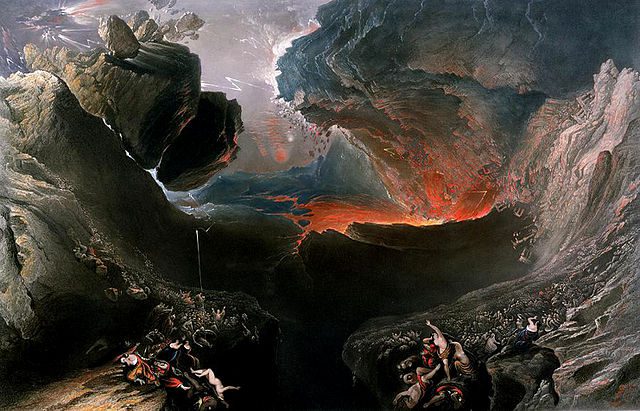
The Great Day of His Wrath (c. 1853), by John Martin (1789-1854) [public domain / Wikimedia Commons]

***
(9-13-06)
***
The following is a reply to agnostic Ed Babinski’s article, “Gimme That Old False Prediction, It’s Good Enough For Me.” I’ve cited most of it below, but not all of it, which can be read by following the link. His words will be in blue. Presbyterian NT scholar Dr. Robert Rayburn’s will be in purple.
* * * * *
Ed provides a classic textbook case of ignorance of biblical and Hebrew idiom and the prophetic outlook, leading to false conclusions that (gee, what a surprise!) the Bible is filled with false prophecy, due to same. Let’s take a few minutes to examine his claims.
The author of the letter to the Hebrews began his letter, “. . . in these last days,” and argued on such a basis that, “He (Jesus) would have needed to suffer often since the foundation of the world; but now once at the consummation He has been manifested to put away sin by the sacrifice of Himself.” With equal fervor he employed the phrase, “as you see the day drawing near . . . ” – and made the prediction, “. . . for yet a very little while, He who is coming will come, and will not delay.” (Heb. 1:2; 9:26; 10:25,37) Oops! There’s been a sleight [sic] delay.
Like the good fundamentalist that Ed used to be, he cites biblical passages piecemeal. This practice of prooftexting without proper consideration of either context or cross-referencing is notorious for producing false conclusions. Thus Ed falls prey to the very errors in methodology that he would seem to often fault Christians for committing. In zealously fighting ignorance, he exhibits a great deal himself.
Fundamentalists are also known for their hyper-literalism and wooden sort of biblical interpretation. But as every good Bible student knows (whether Catholic, Protestant, or Orthodox) one has to interpret the Bible just as any other literature is interpreted. Clearly, not everything is meant to be taken literally.
Hence, Ed sees “last days” and salivates at the imminent commission of a false prophecy. He takes it literally; something like “the 31st is the last day of the month.”
But is it necessarily so? Not at all. Dr. Robert Rayburn holds a Master of Divinity degree from Covenant Theological Seminary and a doctorate in New Testament from the University of Aberdeen, Scotland. In his article (and sermon?), “The Last Days” (And “Imminence”), he noted:
We are noting week after week the effect of the characteristic idiom in which biblical predictions of the future are cast, especially what scholars call the prophetic perspective according to which the future is set before us in its wholeness, as if it were a single event, a single moment. In this way – a way of speaking about the past and future that we often employ ourselves – the emphasis falls on the meaning of that future, on the divine purpose, on the certainty of an outcome and not instead on a detailed sequence of the events that make up that future. The main thing is placed before us, not the details.
Now, however, there is a motif that we might well think would be unusual in just that way, in the way in which it focuses our attention on chronological order. I am speaking of the phrase often used in the Bible to predict the future, viz. “the last days.” However, we are going to see that this nomenclature, this way of speaking has precisely the same characteristics as do the other motifs we have so far considered.
Dr. Rayburn gives an OT example:
The NASB renders Daniel 10:14:
Now I have come to give you an understanding of what will happen to your people in the latter days, for the vision pertains to the days yet future.
Now what is interesting is that the prophecy that follows concerns the kings of Persia, Alexander the Great and his successors, and continues up to what seems to be without question the day of resurrection and the last judgment in chapter 12. Therefore, “the last days” in Daniel 10 encompasses a period that stretches from Daniel’s own day to the end of the world. In chapter 2, the same phrase is used similarly to mean the future days, the days to follow. For example, in 2:28 Daniel tells Nebuchadnezzar that in the dreams the Lord had given him, “He has shown King Nebuchadnezzar what will happen in days to come . . .” That “in days to come” is our “end of days” or “last days.” And the dream, if you remember, concerned the empires that would follow Babylon up to the empire of Rome and, during that time, the arrival of the King of Kings whose kingdom would be established, which would crush all those other kingdoms, and would itself endure forever. There “last days” again stretches from Daniel’s time to the end of history and includes within itself the long unfolding of history.
He notes that other passages indeed refer to a more compressed final period of history: “‘The last days’ can refer to the indeterminate future, or it can refer as a kind of technical term to ‘the final period of history . . . the ideal or Messianic future.'” In other words, this phrase – as so often in Scripture – can mean several different things. Therefore, context must determine which meaning is meant. And one cannot simplistically, woodenly conclude – as Ed wishfully has – that one meaning is meant.
Rayburn cites 2 Tim 3:1, Jude 18, and 1 Jn 2:18 as evidence that the “last days” or “last times” or “last hour” would last long enough to cause people to doubt that Jesus was coming again (2 Peter 3:3). Thus, it again doesn’t necessarily refer to a swift end, or literally the final hour of the day (like 11 PM till midnight). It is more analogous to something like 4 or 6 PM till midnight (in eschatological terms). Rayburn concludes:
Now, if you take all of this data together, it appears that “the last days,” especially in its most technical, eschatological use, means the epoch of fulfillment which began with the life, death, and resurrection of the Lord Jesus Christ and the descent of the Holy Spirit at Pentecost. Once again, the OT prophecies of this time, the age is compressed in the vision of the future and we are given to see only the triumph of the Messiah, . . . In the prophetic perspective we are not given to see ahead of time either the number of years that “the last days” would encompass or the complicated history of the development of the Messiah’s kingdom as it made its way out into the Gentile world. We have seen part of “the last days,” but not yet all of it, we have witnessed the beginnings of that fulfillment but not, by any means, the consummation of the vision of Isaiah or Micah. In all of this, of course, “the last days” ends up being very like the other motifs employed in biblical prophecy to forecast the future of the kingdom of God.
Does this sort of interpretation make reasonable sense of the passages that Ed has employed in his zeal to prove that the NT writers were “false prophets?” Let’s look at them. Hebrews 1:2: “in these last days”: this can easily fit into the scheme I have just presented, since it gives no immediate indication of the imminence of Christ’s return.
Perhaps Ed suspected this (if he knew very much about biblical prophecy and eschatological terminology), since he has to jump around to different texts in Hebrews. So he takes us to 9:26: “but now once at the consummation He has been manifested to put away sin . . .” (RSV: “end of the age”).
Ed uses Matthew 13:40-41 to suggest that the “end of the age” is literally (and only) the very end of time, when God judges the world and individuals. Indeed, it can mean that, as already freely conceded, but it can also have a broader meaning, encompassing more time.
Thus, when Jesus gave a lengthy discourse on “the close of the age” (Matt 24:3), the length of time involved is quite vague. Many indications suggest a long span: “you will hear of wars and rumors of wars . . . the end is not yet” (24:6), “this gospel of the kingdom will be preached throughout the whole world” (24:14), etc.
Now, obviously, if the gospel were to reach the whole world, it would take quite a bit of time. We Christians haven’t even accomplished that yet! Peter takes up a similar theme in Acts 2, in his sermon on the Day of Pentecost, referring to the “last days” (2:17), yet being very vague about how long that would last. Great time, in terms of needing to reach the whole world, and distant descendants seems to be implied in his words, “the promise [of baptism and reception of the Holy Spirit] is to you and to your children and to all that are far off . . .” (2:39).
The same Peter writes about “scoffers” in the “last days” being cynical about the return of Christ (2 Peter 3:3-4). Does he then go on to reiterate that it is only a wee bit longer; just a few years? No; quite the contrary:
But do not forget this one thing, dear friends: With the Lord a day is like a thousand years, and a thousand years are like a day. The Lord is not slow in keeping his promise, as some understand slowness. He is patient with you, not wanting anyone to perish, but everyone to come to repentance. But the day of the Lord will come like a thief. The heavens will disappear with a roar; the elements will be destroyed by fire, and the earth and everything in it will be laid bare.
(2 Peter 3:8-10; NIV)
So the evidence from both Jesus and Peter is quite consistent with the notion of an indeterminate future or vague concept of an “age”. It doesn’t require a view that it is imminent, in just a few years, as Ed makes out. But what about Ed’s texts?:
“as you see the day drawing near . . .” . . . “. . . for yet a very little while, He who is coming will come, and will not delay.” (Heb 10:25,37)
Once again, we must consult context, for we have already seen that this eschatological language can mean several different things. Can we find indications of a specific time-frame in Hebrews 10? No. Rather, we see this:
But when Christ had offered for all time a single sacrifice for sins, he sat down at the right hand of God, then to wait until his enemies should be made a stool for his feet.
(Hebrews 10:12-13; RSV)
Ed would have it that the NT requires that Jesus was going to return in His Second Coming literally very quickly, but in fact, it says here that He “wait”[ed] until certain things came to pass. No specific length of time is given, and, based on how prophecy works throughout the Old Testament, we know that this can indeed be a very long time.
The author also cites (10:16-17) the very famous passage from Jeremiah, announcing the New Covenant (Jer 31:33-34). If one peruses the older passage, one finds no indication in context that this was to be a quick consummation of the world. Nope; it was simply a time of renewal for Israel. Christians simply apply this to the Church age, post-crucifixion and post-Pentecost. Jeremiah refers to the indwelling of the Holy Spirit, which began occurring after Pentecost, when the Spirit descended upon the believers.
He writes, “Let us hold fast the confession of our hope without wavering” (10:23), perhaps suggesting a long span of time, rather than a short one. “You have need of endurance” (10:36). Then he spends an entire chapter recounting the extraordinary perseverance of OT saints (the implication being that Christians would have a long haul).
For example: “These all died in faith, not having received what was promised” (11:13); “. . . all these, though well-attested by their faith, did not receive what was promised” (11:39). He even keeps on in the chapter after that: “It is for discipline that you have to endure” (12:7). None of this data suggests a swift end. And none of it is inconsistent with what actually happened: nearly 2000 years of additional time and running. Since “last days” has a latitude of meaning in biblical usage, there is no need or necessity to posit a “false prophecy” here. Every indication is that no such “prophecy” was intended in the first place.
Ed cites Hebrews 10:37, which in turn cites Habakkuk 2:3-4. Now, does the old passage teach a swift end of time? Again, no (do we see a pattern by now??):
For still the vision awaits its time; it hastens to the end – it will not lie. If it seem slow, wait for it; it will surely come, it will not delay. Behold, he whose soul is not upright in him shall fail, but the righteous shall live by his faith. (RSV)
Once again we see the simultaneously ambiguous and compressed time-frame which is altogether characteristic of Hebrew prophecy. The event will “seem slow” (human limited, fallible perspective) but will “surely come” (God’s omniscient providence, out of time). The biblical text constantly moves back and forth from God’s perspective to man’s in this fashion.
This adequately explains all of Ed’s passages from Hebrews in a way that doesn’t require his interpretation at all. All of it is entirely consistent with a “last days” that can encompass all of history since Christ died, and more.
Ed writes:
. . . the author [of Matthew] based his description of “the end of the age” on Daniel 12, which was a description of the final judgment of mankind . . .
Yes, but as Dr. Rayburn showed above, that original prophecy (Daniel 10-12) also encompassed many epochs of time all the way up to the literal end of time. So that is no proof for his position, but of mine. Thanks, Ed! You make apologetics so easy.
Yet Ed rushes to the fool’s conclusion:
So that is exactly what the author of Matthew and the author of Hebrews predicted would happen in their day, i.e., the final judgment of mankind.
Precisely the opposite, as all relevant cross-referencing indications suggest.
Ed argues:
Also note the logic behind the argument in Hebrews 9:26. The author argued that continuous sinning “since the foundation of the world” required blood sacrifices “often.” But God saw to it that Jesus’s sacrifice occurred at a time when no further sacrifices would be required. That time could only be “at the consummation” or “at the end of the age” when the time of final judgment for all sinners had arrived.
This is simply a logical fallacy, and as such , can be disposed of quickly. The cessation of the OT sacrificial system does not mean, automatically, that the absolute end of time must come. Jesus’ sacrifice was the fulfillment of the OT law (Matt. 5:17-18) and the reality of which the OT sacrifices were types and shadows. The implication of a swift end is not required, as I have been showing in many different ways.
It should appear even to the most dense that the prediction as stated in the Book of Hebrews has failed.
Hardly. The only “dense” person here is Ed, who shows himself woefully, pathetically ignorant of reasonable Bible interpretation, while at the same time posing as superior to those of us who have made a love and study of the Bible our life’s work.
So, the author of Hebrews was a false prophet.
Not at all, as shown. Unless Ed can overcome the mountain of contrary exegetical evidence, he simply has no basis for making such a claim.
For more examples from the New Testament of false prophecies see, “The Lowdown on God’s Showdown.” [link]
Having seen how Ed is capable of butchering biblical texts and making the most absurd mistakes of logic and application of sound hermeneutical principles (here and in an earlier exchange on the Psalms), I will not rush to this other paper with baited breath. But then again, it might provide a useful exercise in refutation, to once again illustrate the myth of the “profundity” and “unanswerability” of atheist/agnostic biblical interpretation.
When will you guys ever learn to stop doing this and to simply admit that you don’t have a clue as to how to interpret the Bible properly? I highly suggest that you just go on with your lives and leave this work to those who know how to do it.
Yours, in It,
Dave Armstrong
Previous Post

August 18, 2006
Sins and Sinners in the Catholic Church: a Disproof?
Next Post

October 29, 2006 Case Study in Liberal Catholic Dissent: Fr. Joseph S. O'Leary
Browse Our Archives
Select a Category & Last Things About Me Anti-Catholicism Atheism & Agnosticism Baptism and Sacramentalism Bible and Tradition Blessed Virgin Mary Books by Dave Armstrong C. S. Lewis Calvinism & General Protestantism Catholic Apologetics Catholic Apologists Catholic conversion Catholic converts Christmas Church (Ecclesiology) Church History Conversion and Converts Development of Doctrine Eastern Orthodoxy Ecumenism & Christian Unity Eucharist & Liturgy Fathers of the Church French Translations G. K. Chesterton Hell Hell & Satan Hell & Satan & Last Things Heresies & Comparative Religion Holistic Health Inquisition & Crusades & Scandals James White Jews & Judaism & Old Testament John Calvin John Henry Newman Liberal / Modernist Theology Life Issues Literary Resume Lutheranism Mariology Martin Luther Music Orthodoxy Papacy & Infallibility Personal Page Philosophy & Science Political & Ethical & Moral Issues Protestant Persecution & Intolerance Protestantism Purgatory Purgatory & Penance Romantic & Imaginative Theology Saints & Purgatory & Penance Salvation Salvation & Justification Satan & Last Things Sexuality and Gender Issues Spanish Translations Traditionalism vs. Radical Catholic Reactionaries Traducciones al español / tradução para português Trinitarianism & Christology Uncategorized Videos
Select a Month October 2026 September 2026 August 2026 July 2026 June 2026 May 2026 April 2026 March 2026 February 2026 January 2026 December 2025 November 2025 October 2025 September 2025 August 2025 July 2025 June 2025 May 2025 April 2025 March 2025 February 2025 January 2025 December 2024 November 2024 October 2024 September 2024 August 2024 July 2024 June 2024 May 2024 April 2024 March 2024 February 2024 January 2024 December 2023 November 2023 October 2023 September 2023 August 2023 July 2023 June 2023 May 2023 April 2023 March 2023 February 2023 January 2023 December 2022 November 2022 October 2022 September 2022 August 2022 July 2022 June 2022 May 2022 April 2022 March 2022 February 2022 January 2022 December 2021 November 2021 October 2021 September 2021 August 2021 July 2021 June 2021 May 2021 April 2021 March 2021 February 2021 January 2021 December 2020 November 2020 October 2020 September 2020 August 2020 July 2020 June 2020 May 2020 April 2020 March 2020 February 2020 January 2020 December 2019 November 2019 October 2019 September 2019 August 2019 July 2019 June 2019 May 2019 April 2019 March 2019 February 2019 January 2019 December 2018 November 2018 October 2018 September 2018 August 2018 July 2018 June 2018 May 2018 April 2018 March 2018 February 2018 January 2018 December 2017 November 2017 October 2017 September 2017 August 2017 July 2017 June 2017 May 2017 April 2017 March 2017 February 2017 January 2017 December 2016 November 2016 October 2016 September 2016 August 2016 July 2016 June 2016 May 2016 April 2016 March 2016 February 2016 January 2016 December 2015 November 2015 October 2015 September 2015 August 2015 July 2015 June 2015 May 2015 April 2015 March 2015 February 2015 January 2015 December 2014 November 2014 October 2014 September 2014 August 2014 July 2014 June 2014 April 2014 March 2014 February 2014 January 2014 December 2013 November 2013 October 2013 September 2013 August 2013 July 2013 June 2013 April 2013 March 2013 February 2013 January 2013 December 2012 November 2012 October 2012 September 2012 August 2012 July 2012 June 2012 May 2012 April 2012 March 2012 February 2012 January 2012 December 2011 November 2011 October 2011 September 2011 August 2011 July 2011 June 2011 April 2011 March 2011 February 2011 October 2010 September 2010 August 2010 July 2010 April 2010 March 2010 December 2009 October 2009 August 2009 July 2009 June 2009 May 2009 March 2009 February 2009 October 2008 September 2008 April 2008 March 2008 February 2008 January 2008 December 2007 November 2007 October 2007 May 2007 March 2007 February 2007 January 2007 November 2006 October 2006 September 2006 August 2006 July 2006 June 2006 May 2006 April 2006 March 2006 February 2006 October 2005 June 2005 April 2005 February 2005 July 2004 May 2004 April 2004
Follow Us!
TAKE THE
Religious Wisdom Quiz
Who prayed for rain after a long drought and sent his servant to look seven times?
Select your answer to see how you score.
Elijah Isaiah Samuel Hosea
Books by This Author Books by Dave Armstrong
Related posts from Biblical Evidence for Catholicism

No Hell? Dialogue on Conditional Immortality, Pt. 3
Biblical Evidence for Catholicism
No Hell? Dialogue on Conditional Immortality, Pt. 2
Biblical Evidence for Catholicism
No Hell? Dialogue on Conditional Immortality
Biblical Evidence for Catholicism
Eternal Hell: Biblical? 25 Verses Say So
Biblical Evidence for Catholicism
TRENDING AT PATHEOS Catholic

I was strolling through the top floor of the brand new Parthenon...

What Does Gêvâh Mean For Kimberley Guifoyle &...
This week, a lot of the news is focused on Kimberly Guilfoyle....

INNER CIRCLE: Profound Mystery (Of Christ In All...
Ephesians 5:31-32 “For this reason, a man will leave his father and...

Do Not Rejoice When Your Enemy Falls: The...
Turning an execution into a public spectacle is a disturbing expression of...

'The Chosen' S6 Trailer: The Passion Gets Very...
Not many watching 'The Chosen' worry about spoilers, but just because they...

The purpose-driven labor priest
A labor activist reads Rick Warren and it gets me wondering about...
view all Catholic blogs
Ad-Free & Subscriber Log-In Subscription Support
- About Us
- 2026 Calendar
- Videos
- Podcasts
- Library of World Religions
- Faith In Media Tracker
- Advertise With Us
- Write for Us
- Privacy Policy
- Terms of Service
- Do Not Sell My Data
- Contact Us
- Radiant Digital
- Manage Newsletter Subscriptions
- Unsubscribe From Notifications
- Sitemap
Copyright 2008-2026, Patheos. All rights reserved.
Subscription Support Ad-Free & Subscriber Log-In
Follow Patheos