
BuddhistCatholicContemplativeEvangelicalGeneral ChristianHinduJewishLatter-day SaintMuslimNew VisionsProgressive Christian
Beliefs
- Buddhist
- Catholic
- Contemplative
- Evangelical
- General Christian
- Hindu
- Jewish
- Latter-day Saint
- More Voices
- Muslim
- New Visions
- Pagan
- Progressive Christian
Topics
- Religion News
- Food and Religion
- Sports and Religion
- Religious Art
- Religious Music and Entertainment
- Religious Events
- History and Religion
- Style and Religion
- Politics and Religion
- Women in Religion
- Recreation Outdoors and Religion
- Business Finance and Religion
- Careers Workplace and Religion
- Education and Religion
- Family Parenting and Religion
- Health Fitness and Religion
- Home and Religion
- Relationships and Religion
- Technology and Religion
- Travel and Religion
Columnists
- Buddhist Columnists
- Business Finance and Religion Columnists
- Careers Workplace and Religion Columnists
- Catholic Columnists
- Contemplative Columnists
- Education and Religion Columnists
- Evangelists Columnists
- Family Parenting and Religion Columnists
- General Christian Columnists
- Health Fitness and Religion Columnists
- Hindu Columnists
- History and Religion Columnists
- Home and Religion Columnists
- Jewish Columnists
- More Voices Columnists
- Latter Day Columnists
- Muslim Columnists
- New Visions Columnists
- Nonreligious Columnists
- Pagan Columnists
- Politics and Religion Columnists
- Progressive Columnists
- Recreation Outdoors and Religion Columnists
- Relationships and Religion Columnists
- Religion News Columnists
- Religious Art Columnists
- Religious Events Columnists
- Religious Music and Entertainment Columnists
- Sports and Religion Columnists
- Style and Religion Columnists
- Technology and Religion Columnists
- Travel and Religion Columnists
- Women in Religion Columnists
Resource Library
- 2026 Calendar
- Library of World Religions
- The 100 Most Holy Places on Earth
- Patheos Answers
- Podcasts
- Videos
- Faith Leaders Database
- Anglican Episcopalian
- Bahai
- Baptist
- Buddhism
- Christianity
- Confucianism
- Eastern Orthodoxy
- Hinduism
- Holiness and Pentecostal
- ISKCON
- Islam
- Judaism
- Lutheran
- Methodist
- The Church of Jesus Christ of Latter-day Saints
- New Age
- Paganism
- Presbytarian and Reformed
- Protestantism
- Religion Behind the Scenes
- Roman Catholic
- Scientology
- Shia Islam
- Sikhism
- Sufism
- Sunni Islam
- Taoism
- Zen
- See all religions
Research Tools
 Ad-Free & Subscriber Log-In Subscription Support
Ad-Free & Subscriber Log-In Subscription Support
Follow Patheos 

- Trending:
- Forgiveness
- |
- Marriage
- |
- Consciousness
- |
- Death Penalty
- |
- Election
- |
- Halloween

-
About
-
Catholic Apologetics
-
Church History
-
Great Apologists
-
Christian Worldview
-
Protestantism & Misc.
- Home
- Catholic
- History and Religion
- Books by Dave Armstrong: “Protestantism”
Books by Dave Armstrong: “Protestantism”
Last updated on: July 11, 2026 at 11:49 am by Dave Armstrong
Books by Dave Armstrong: “Protestantism” 2026-07-11T11:49:20-04:00 Dave Armstrong
Patheos Explore the world's faith through different perspectives on religion and spirituality! Patheos has the views of the prevalent religions and spiritualities of the world.
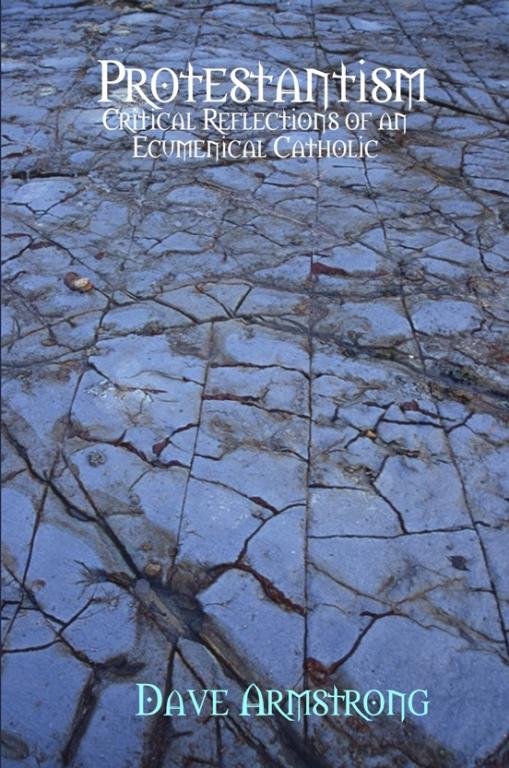
(completed in May 2003; published by Lulu in September 2007; 188 pages)
***
Purchase Options
***
[PAPERBACK: Lulu] [PDF + ePUB: $9.99]
***
Table of Contents
Dedication
Introduction
I Sola Scriptura: The Bible as Ultimate Authority
II Doctrinal Diversity and the Invisible Church
III The “Pure” Church, Devoid of Sinners
IV Private Judgment
V Church History
VI The Perspicuity (Clearness) of Scripture
VII Predestination, Calvinism, and Arminianism
VIII “Dead” Catholics and Rituals, Etc.
IX Martin Luther and Protestant Origins
X Faith and Works
Appendix 1 John Calvin on Protestant Divisions
Appendix 2 The Agony of Luther, Melanchthon, and
Bucer Over the State of Early Protestantism
Appendix 3 Luther’s Assertions of His Own Authority
Appendix 4 Erasmus on Luther and Protestantism, and
Luther on Erasmus
Appendix 5 John Henry Newman on ProtestantismApostolical Tradition, 1836
On the Abuse of Private Judgment, 1837
Private Judgment, 1841
St. Athanasius’ Rule of Faith, 1844
Faith and Private Judgment, 1849
Introduction
The numbered structural format of this book is modeled after the classic work by the French mathematician, physicist, and Catholic apologist Blaise Pascal, Pensees (“thoughts” – 1662). My intention is to critique various aspects of Protestantism, in the manner of “sayings” (272 total) – a literary technique used to great effect by our Lord Jesus Christ, St. Francis of Assisi, Confucius, Martin Luther, and Socrates, among many others. The generalizations used in this method are not meant to imply that there are no”exceptions to the rule.” They are simply broad observations of Protestant ideas and tendencies.
My intention is not to insult or to excite needless quarreling. This material is not meant to be an attack on the merit and personal character of present-day Protestants, but rather a very straightforward and critical examination of various aspects of Protestant theology and the formal principles of Protestantism, as well as some of its negative tendencies in practice.
I wish to emphasize that I have much respect for many, many Protestants, and the great deal of truth and noble, praiseworthy goals and aspects of their beliefs. This is a loving (if vigorous) “in-house” critique from a brother in the Lord, not a “hit piece” by an “enemy.” I was, after all, a Protestant for the first thirty-two years of my life, and I fondly remember that time.
Deep feelings of partisanship and allegiance are, of course, present in all seriously committed Christians. I only ask the Protestant reader to accept my good faith and to believe that I bear no ill will towards non-Catholics in general. I simply – as a Catholic – disagree with some things. I hope that I can be received as an honestly critical “friend” and fellow Christian, albeit across a rather large and unfortunate chasm.
True ecumenism, to which I am passionately committed, does not “paper over” profound disagreements in a delirious, “warm fuzzy” atmosphere of self-deluded bliss. Rather, the profundity of authentic ecumenism is fellowship despite major differences, in a special and delightful environment of mutual respect. I maintain a deep love and respect for my “separated” Christian brethren. And I offer these reflections in that spirit.
Excerpts
- The Bible doesn’t teach that it is the final authority in Christianity, in terms of it being in opposition to apostolic Tradition and the Church. All the teachings of the Bible are true, and Catholics (and Orthodox) affirm them. It is the unnecessary, unscriptural, and illogical step from these affirmations to the proposition of sola Scriptura with which we disagree, since the Bible itself speaks explicitly of both a true divine, “received” Tradition and of the binding authority of the universal, institutional Church, and the very canon (the “stuff”) of the Bible was authoritatively determined by the Church. Therefore, the three interrelated concepts cannot be separated, any more than can the three dimensions of a cube, even in a hypothetical scenario in which all we had for “data” was the Bible.
- I think God cares enough about doctrinal truth to guarantee its continued existence in some incarnated Body of Christ, through history. I don’t think God is a doctrinal relativist, enthralled with doctrinal “diversity.” That is pure liberalism. It’s one thing to have honest differences that we work through as Christians; quite another to start saying that such differences are normative, to be expected, and actually condoned by both Scripture and the early Church.
- To entirely blot out sin, God would have had to prevent the fall itself, and start the human race all over. Once sin is allowed into human existence, then there will be corrupt popes, just as there were corrupt Bible-writers (Peter, Paul, David, Moses: a betrayer, three murderers and an adulterer).
- It is said that those who convert to Catholicism based on historical considerations interpret Church history for themselves as they go through the process of conversion. To an extent this is true, but no more (in essence) than the Fathers when they said “the Church has always taught thus-and-so, and if you deny that you are a heretic.” It is an acceptance of a certain set of teachings that has been passed down through history (and can be verified), as opposed to determining what one will believe about doctrines x,y,z, as if that were permissible, given the history of doctrine. The convert is accepting what has been passed to the Church and them, not making up their own mind at every turn. We don’t reinvent the wheel every generation in the Church.
- One can readily accept the distinctions among early Protestants (Anabaptist vs. Reformed/Lutheran), and acknowledge that the former were much more anarchical from the start, whereas the latter maintained some semblance of Tradition and apostolic continuity (albeit “skeletal” from our vantage-point). On the other hand, we can also maintain (as I strongly do) that the principles which made rampant sectarianism historically inevitable (perspicuity, private judgment, absolute supremacy of the conscience, sola Scriptura, a certain anti-sacerdotal and anti-episcopal bent, iconoclasm, philosophical nominalism, etc.), were indeed consciously present from the beginning and can be regarded as initial causes for the later history.
- By and large, Catholics think the Scriptures are clear, yet need a binding interpreter in the end, and that the Fathers are largely clear, but need a Church and councils to determine where they are wrong in particulars. Many Protestants, on the other hand, seem to think that the Fathers are very unclear, and the Scriptures very clear, without a need for a binding Church authority. Yet they can’t come to an agreement.
- Calvinists say it is the human’s fault that he is damned by God from all eternity, and it is grace and mercy for God to save any from such a horrible fate, since they are all in the same boat. So which is worse (or more plausible): a human’s fault that he is damned, while his friend can go to heaven, neither having any choice in the matter at all, or a human’s fault that he doesn’t choose (by God’s grace) to accept the grace God freely offers to all? God cannot cause evil, and fallen man cannot save himself.
Purchase Options
***
[PAPERBACK: Lulu] [PDF + ePUB: $9.99]
***
***
*Practical Matters: This is the most comprehensive and multi-faceted Catholic apologetics blog: rated #1 for Christian sites by leading AI tool, ChatGPT. I offer more than 5,000 free online articles, fifty-eight books, and many scores of videos at the Catholic Bible Highlights YouTube channel (please subscribe!). If you believe my full-time apostolate is worth supporting, please seriously consider financially supporting it. PayPal donations are the easiest: just send to my email address: [email protected]. You’ll see the term “Dave Armstrong Bookstore”. To learn about the different methods of contributing (including Zelle and 100% tax-deductible donations if desired), see my page: About Catholic Apologist Dave Armstrong / Donation Information. Thanks a million!
***
Last updated on 11 July 2026
Calvinism & General Protestantism
Previous Post
July 31, 2006
Armstrong: "Family Matters: Catholic Theology of the Family"
Next Post
July 31, 2006 Books by Dave Armstrong: "Twin Scourges"
Browse Our Archives
Select a Category & Last Things About Me Anti-Catholicism Atheism & Agnosticism Baptism and Sacramentalism Bible and Tradition Blessed Virgin Mary Books by Dave Armstrong C. S. Lewis Calvinism & General Protestantism Catholic Apologetics Catholic Apologists Catholic conversion Catholic converts Christmas Church (Ecclesiology) Church History Conversion and Converts Development of Doctrine Eastern Orthodoxy Ecumenism & Christian Unity Eucharist & Liturgy Fathers of the Church French Translations G. K. Chesterton Hell Hell & Satan Hell & Satan & Last Things Heresies & Comparative Religion Holistic Health Inquisition & Crusades & Scandals James White Jews & Judaism & Old Testament John Calvin John Henry Newman Liberal / Modernist Theology Life Issues Literary Resume Lutheranism Mariology Martin Luther Music Orthodoxy Papacy & Infallibility Personal Page Philosophy & Science Political & Ethical & Moral Issues Protestant Persecution & Intolerance Protestantism Purgatory Purgatory & Penance Romantic & Imaginative Theology Saints & Purgatory & Penance Salvation Salvation & Justification Satan & Last Things Sexuality and Gender Issues Spanish Translations Traditionalism vs. Radical Catholic Reactionaries Traducciones al español / tradução para português Trinitarianism & Christology Uncategorized Videos
Select a Month October 2026 September 2026 August 2026 July 2026 June 2026 May 2026 April 2026 March 2026 February 2026 January 2026 December 2025 November 2025 October 2025 September 2025 August 2025 July 2025 June 2025 May 2025 April 2025 March 2025 February 2025 January 2025 December 2024 November 2024 October 2024 September 2024 August 2024 July 2024 June 2024 May 2024 April 2024 March 2024 February 2024 January 2024 December 2023 November 2023 October 2023 September 2023 August 2023 July 2023 June 2023 May 2023 April 2023 March 2023 February 2023 January 2023 December 2022 November 2022 October 2022 September 2022 August 2022 July 2022 June 2022 May 2022 April 2022 March 2022 February 2022 January 2022 December 2021 November 2021 October 2021 September 2021 August 2021 July 2021 June 2021 May 2021 April 2021 March 2021 February 2021 January 2021 December 2020 November 2020 October 2020 September 2020 August 2020 July 2020 June 2020 May 2020 April 2020 March 2020 February 2020 January 2020 December 2019 November 2019 October 2019 September 2019 August 2019 July 2019 June 2019 May 2019 April 2019 March 2019 February 2019 January 2019 December 2018 November 2018 October 2018 September 2018 August 2018 July 2018 June 2018 May 2018 April 2018 March 2018 February 2018 January 2018 December 2017 November 2017 October 2017 September 2017 August 2017 July 2017 June 2017 May 2017 April 2017 March 2017 February 2017 January 2017 December 2016 November 2016 October 2016 September 2016 August 2016 July 2016 June 2016 May 2016 April 2016 March 2016 February 2016 January 2016 December 2015 November 2015 October 2015 September 2015 August 2015 July 2015 June 2015 May 2015 April 2015 March 2015 February 2015 January 2015 December 2014 November 2014 October 2014 September 2014 August 2014 July 2014 June 2014 April 2014 March 2014 February 2014 January 2014 December 2013 November 2013 October 2013 September 2013 August 2013 July 2013 June 2013 April 2013 March 2013 February 2013 January 2013 December 2012 November 2012 October 2012 September 2012 August 2012 July 2012 June 2012 May 2012 April 2012 March 2012 February 2012 January 2012 December 2011 November 2011 October 2011 September 2011 August 2011 July 2011 June 2011 April 2011 March 2011 February 2011 October 2010 September 2010 August 2010 July 2010 April 2010 March 2010 December 2009 October 2009 August 2009 July 2009 June 2009 May 2009 March 2009 February 2009 October 2008 September 2008 April 2008 March 2008 February 2008 January 2008 December 2007 November 2007 October 2007 May 2007 March 2007 February 2007 January 2007 November 2006 October 2006 September 2006 August 2006 July 2006 June 2006 May 2006 April 2006 March 2006 February 2006 October 2005 June 2005 April 2005 February 2005 July 2004 May 2004 April 2004
Follow Us!
TAKE THE
Religious Wisdom Quiz
What Jewish festival was being celebrated when the Holy Spirit descended at Pentecost?
Select your answer to see how you score.
Shavuot Passover Purim Hanukkah
Books by This Author Books by Dave Armstrong
Related posts from Biblical Evidence for Catholicism

On Protestant Explanations of Catholic Conversion
Biblical Evidence for Catholicism

Protestant Confessions & "Ever-Virgin" Mary
Biblical Evidence for Catholicism

A Few "Worst" & "Best" Arguments vs. Protestantism
Biblical Evidence for Catholicism
Reply to Anglican Sean Luke on Denominationalism
Biblical Evidence for Catholicism
TRENDING AT PATHEOS Catholic

How to Make a Decision When You Can't...
Main point: It’s much more valuable to stay close to God so...

Archdiocese Hosts Military Marriage Retreat in Germany
RASTATT, Germany — The transient military lifestyle, with its frequent deployments and...

Nearly every morning, I make the drive to Detroit with my high-school-age...

The Real AI Story Is Adoption Without Trust
Artificial intelligence has crossed a political threshold. It is no longer a...

A new article, written by Jeff Lindsay and Gale L. Pooley,...

Swimfan: Forgotten Aughts Pleasures
This is a recovery effort. In 2002, My Big Fat Greek Wedding...
view all Catholic blogs
Ad-Free & Subscriber Log-In Subscription Support
- About Us
- 2026 Calendar
- Videos
- Podcasts
- Library of World Religions
- Faith In Media Tracker
- Advertise With Us
- Write for Us
- Privacy Policy
- Terms of Service
- Do Not Sell My Data
- Contact Us
- Radiant Digital
- Manage Newsletter Subscriptions
- Unsubscribe From Notifications
- Sitemap
Copyright 2008-2026, Patheos. All rights reserved.
Subscription Support Ad-Free & Subscriber Log-In
Follow Patheos