
BuddhistCatholicContemplativeEvangelicalGeneral ChristianHinduJewishLatter-day SaintMuslimNew VisionsProgressive Christian
Beliefs
- Buddhist
- Catholic
- Contemplative
- Evangelical
- General Christian
- Hindu
- Jewish
- Latter-day Saint
- More Voices
- Muslim
- New Visions
- Pagan
- Progressive Christian
Topics
- Religion News
- Food and Religion
- Sports and Religion
- Religious Art
- Religious Music and Entertainment
- Religious Events
- History and Religion
- Style and Religion
- Politics and Religion
- Women in Religion
- Recreation Outdoors and Religion
- Business Finance and Religion
- Careers Workplace and Religion
- Education and Religion
- Family Parenting and Religion
- Health Fitness and Religion
- Home and Religion
- Relationships and Religion
- Technology and Religion
- Travel and Religion
Columnists
- Buddhist Columnists
- Business Finance and Religion Columnists
- Careers Workplace and Religion Columnists
- Catholic Columnists
- Contemplative Columnists
- Education and Religion Columnists
- Evangelists Columnists
- Family Parenting and Religion Columnists
- General Christian Columnists
- Health Fitness and Religion Columnists
- Hindu Columnists
- History and Religion Columnists
- Home and Religion Columnists
- Jewish Columnists
- More Voices Columnists
- Latter Day Columnists
- Muslim Columnists
- New Visions Columnists
- Nonreligious Columnists
- Pagan Columnists
- Politics and Religion Columnists
- Progressive Columnists
- Recreation Outdoors and Religion Columnists
- Relationships and Religion Columnists
- Religion News Columnists
- Religious Art Columnists
- Religious Events Columnists
- Religious Music and Entertainment Columnists
- Sports and Religion Columnists
- Style and Religion Columnists
- Technology and Religion Columnists
- Travel and Religion Columnists
- Women in Religion Columnists
Resource Library
- 2026 Calendar
- Library of World Religions
- The 100 Most Holy Places on Earth
- Patheos Answers
- Podcasts
- Videos
- Faith Leaders Database
- Anglican Episcopalian
- Bahai
- Baptist
- Buddhism
- Christianity
- Confucianism
- Eastern Orthodoxy
- Hinduism
- Holiness and Pentecostal
- ISKCON
- Islam
- Judaism
- Lutheran
- Methodist
- The Church of Jesus Christ of Latter-day Saints
- New Age
- Paganism
- Presbytarian and Reformed
- Protestantism
- Religion Behind the Scenes
- Roman Catholic
- Scientology
- Shia Islam
- Sikhism
- Sufism
- Sunni Islam
- Taoism
- Zen
- See all religions
Research Tools
 Ad-Free & Subscriber Log-In Subscription Support
Ad-Free & Subscriber Log-In Subscription Support
Follow Patheos 

- Trending:
- Forgiveness
- |
- Marriage
- |
- Consciousness
- |
- Death Penalty
- |
- Election
- |
- Halloween

-
About
-
Catholic Apologetics
-
Church History
-
Great Apologists
-
Christian Worldview
-
Protestantism & Misc.
- Home
- Catholic
- History and Religion
- Armstrong: “Reflections on Radical Catholic Reactionaries”
Armstrong: “Reflections on Radical Catholic Reactionaries”
Last updated on: July 11, 2026 at 11:46 am by Dave Armstrong
Armstrong: “Reflections on Radical Catholic Reactionaries” 2026-07-11T11:46:10-04:00 Dave Armstrong
Patheos Explore the world's faith through different perspectives on religion and spirituality! Patheos has the views of the prevalent religions and spiritualities of the world.
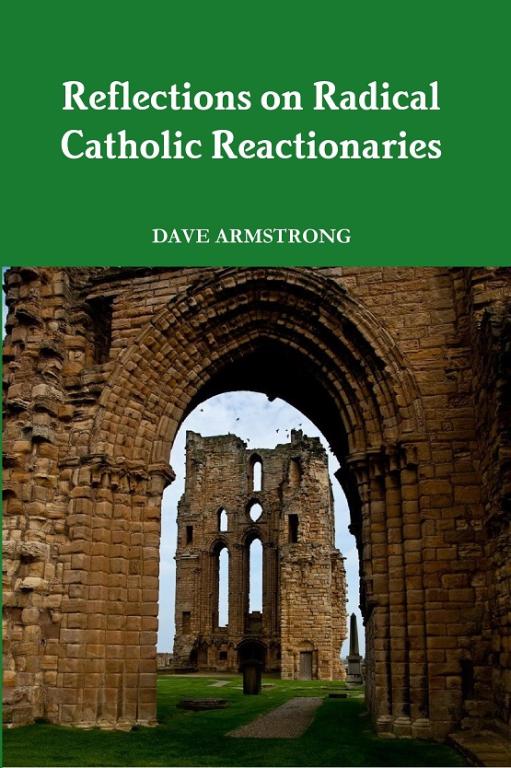
(145 pages; first edition completed in December 2002; published by Lulu in April 2007; revised second edition with a new title and new front and back covers completed on 17 August 2013, and published at Lulu on the same day)
***
[slightly revised again in November 2023 (mostly terminology)]
***
[former title: Pensées on Catholic Traditionalism]
***
Front cover photograph: Newcastle Upon Tyne: ruins of Tynemouth Priory (chancel: 13th century) at the mouth of the River Tyne, in Northumberland (northeast England). From the website, Losing It: Les Bessant’s Ramblings: 30 September 2010.
***
Purchase Options
***
[PAPERBACK: Amazon / Lulu] [PDF + ePUB: $9.99]
***
Table of Contents
Dedication [read below]
Introduction [read below]
I Radical Catholic Reactionaries: Essential Characteristics (1-30)
II Faith and Optimism vs. Pessimism (31-67)
III The Indefectibility of the Church (68-81)
IV So-Called “Neo-Catholics” (82-97)
V Development of Doctrine vs. Evolution of Dogma (98-111)
VI Private Judgment & “Cafeteria Catholics” (112-129)
VII Fundamentalists & Insufficiently Converted Catholics (130-135)
VIII “Pre-Conciliar” Church: the “Good Old Days” (136-141)
IX Ecumenism & Religious Liberty (142-193)
X The Theory of Evolution & Catholicism (194-197)
XI Is Vatican II a “Modernist” Council? (198-226)
XII Are the Vatican II Documents “Ambiguous”? (227-251)
XIII Post-Vatican II “Liberal” Popes (252-276)
XIV The Pauline (“New”) Mass (277-292)
XV Was Pope St. John Paul II a “Modernist”? (293-327)
XVI The Quasi-Schismatic Mentality (328-339)
Dedication
To G. K. Chesterton, whose writing continually exhibited the
“romance,” intellectual solidity, and spiritual excitement of
Catholic orthodoxy, and demonstrated how it was neither dead,
antiquated, and reactionary, as is often claimed by its critics on
the heterodox left of the theological spectrum, nor “modernism,”
“compromise,” and “neo-Catholicism”: as the caricatures from
the radical right would have it
Introduction
[revised on 15 August 2013 and very slightly on 15 November 2023]
A brief explanation of this book and my goals and outlook concerning it, is in order. I had in mind the method and structure of the French mathematician, physicist, and Catholic apologist Blaise Pascal’s classic, Pensées (“thoughts” — unfinished and in unorganized sketch form at his death in 1662). The “Reflections” in my title is roughly synonymous with pensées.
The late, great journalist, social critic, and convert to Catholicism, Malcolm Muggeridge, was an avid admirer of Pascal and the Pensées; particularly with regard to its unsystematic format. He thought that Pascal’s death before his material could be organized into a proper book was a “beneficent, if not miraculous circumstance.”
Catholic apologist and philosopher Peter Kreeft, in his delightful commentary on the Pensées, Christianity for Modern Pagans (San Francisco: Ignatius Press, 1993, 10-11), wrote insightfully about the organization and unfinished nature of Pascal’s Pensées, which he described as “raw pearls” and “scattered notes, like a scholar’s storm-struck study”:
The pensées . . . are more like “sayings” than a book . . . their very artlessness is the highest art. There is a higher and a lower mode of teaching. Books are the lower; living is the higher. “Sayings” are halfway between. They reflect and approximate the higher, the mode of Christ and Socrates and Buddha. That’s why Socrates is the greatest philosopher, according to St. Thomas (S.T. III, 42, 4): because he taught like Christ, in the higher mode. That’s why he wrote no books . . . Pascal has the passionate impatience of a lover. He writes lyrics, not maps – like St. Francis.
*
924 of Pascal’s pensées were compiled in the Harvard Classics edition of 1910, translated by W. F. Trotter, and 993 appeared in the Penguin Classics edition of 1966, translated by A. J. Krailsheimer. I doubt that I could come up with nearly that many separate observations on any topic, but I have managed to compile 339 separate “sayings” or what might be called “observations” in this book.
There the meager comparison ends, and I hasten to emphasize that I am not intending to compare myself or my own “thoughts” or their cogency or import in any way, shape, or form, to those of Pascal, let alone to Socrates or St. Francis or to our Lord Jesus.
I merely thought it might be worthwhile and helpful, for my purposes, to organize my writing on the topic of radical Catholic reactionaries (habitually abbreviated as “reactionaries”) in the same manner, in order to utilize some of the benefits of the unconventional structure of the Pensées. These advantages harmonize well, I believe, with the “philosophy” or “approach” that I myself have taken with regard to the present subject.
Rather than attempt a systematic “legal” critique primarily from canon law and all the various proclamations of the Church regarding schism and authority, and so forth (more akin to the method of St. Thomas Aquinas), I have sought to analyze (minus proper names, a la Trent) the premises, presuppositions, logical and ecclesiological “bottom lines” and (in a word), the spirit of a false and divisive radical Catholic reactionary strain of thought held by a distinctive sociological sub-group of Catholics.
One might regard such an enterprise as logically and conceptually prior to a formal critique (whether theological or philosophical) of the modes of thought involved. As Pascal sought to examine and “expose” the underlying assumptions of the unbeliever and the skeptic of his time (similar to Socrates’ own modus operandi), so I am trying to arrive at the foundational assumptions or “mindset” of the radical Catholic reactionary (as opposed to the mainstream Catholic “traditionalist”: with whom I have a great deal in common).
When legitimate “tradition” is abused or “co-opted”, it is a synonym for “traditions of men falsely made out to be the only proper traditions of the Church.” It’s a faulty and erroneous use of both dogma and private judgment (and often, selective judgment) contrary to orthodox Catholic theology and ecclesiology, and also Christian unity and charity.
I should make it abundantly clear (for obvious reasons) that I have no problem whatsoever with a devotion to the Tridentine Mass, or traditional liturgical practice and devotion (not to mention traditional morality and catechesis). Quite the contrary: I myself have been a member, for twenty-two years, of a quite traditional parish, which celebrates the Mass in Latin (Novus Ordo) every Sunday. Our larger parish (incorporating three church buildings) celebrates the Tridentine Mass every Sunday.
I utterly despise liturgical and aesthetic, architectural mediocrity, and modernism. I was received into the Church (after informal instruction) by the late Fr. John A. Hardon, S.J. — a theologian renowned for his impeccable orthodoxy, who was a catechist for Mother Teresa’s Missionaries of Charity. He has formally recommended my writing. I strongly believe in Fatima, Lourdes, and the Rosary, and even fully accept the controversial proposed Marian definitions, and have written much about them.
I am particularly fond of St. John Henry Cardinal Newman; having edited The Quotable Newman (Sophia Institute Press, 2012), and I love Chesterton, Belloc, and the Fathers and Doctors of the Church. A rejection of contraception and an aversion to the events and worldview of the Protestant Revolution were two of the major reasons why I was received into the Catholic Church in 1991.
Therefore, despite my strong, heartfelt disagreements with radical Catholic reactionaries and occasionally with mainstream “traditionalists,” indeed we have much in common, and I never claim that radical Catholic reactionaries are not Catholics (in the canonical sense of being baptized and adhering to the Creed, etc.). I prefer the descriptions of “schismatic spirit” or “quasi-schismatic”: as opposed to outright “schismatic” (excepting sedevacantism). I refer to “un-Catholic” beliefs or principles, but not to “non-Catholic” persons — a crucial distinction to bear in mind.
I possess no knee-jerk or merely temperamental or so-called “neo-Catholic” objection to legitimate traditionalism per se. I am contending against a distinctly separate group that I call “radical Catholic reactionaries” or “reactionaries” in short (my own self-coined term, originating in August 2013). I have no agenda other than the pursuit of truth and the “mind of the Church” on the matters of authority and true apostolic tradition.
The debate on the issues covered in this book has changed considerably in the eleven years since the first edition: so much that a change of terminology and system of classification was, in my opinion, called for. The revision will reflect these “re-thought” categories and use my new term, while at the same time, maintaining, as much as possible, the original content and tenor of the original 2002 edition. The errors critiqued remain the same, even though the terms have changed (most importantly, to make it much more clear that there is such a thing as legitimate “traditionalism” that is not being opposed in this book).
One problem remains the same as always: the co-opting of the term “traditionalism” by groups and schools of thought that vary quite widely. It’s similar to the love and adoption of the word “Christian” by many sects that are not Christian at all (since they deny the Holy Trinity or the divinity of Jesus Christ). Apologists like myself and other observers need to differentiate groups that are using the same name, for purposes of identification and critique, and to prevent misunderstandings as to exactly what we are contending against as error.
Many people (quite fashionably these days) profess a strong objection to labels, but as long as human beings talk and identify themselves (or sets of ideas) at all, and as long as distinguishable errors and falsehoods remain afoot, I’m afraid that titles, labels, and names cannot be avoided. Moreover, “negative” labels will continue to offend those who are classified under them. This can’t be avoided, either, since human beings will always object to any notion that they may be in bondage to an error or spiritually dangerous belief system.
Purchase Options
***
[PAPERBACK: Amazon / Lulu] [PDF + ePUB: $9.99]
***
*
***
*
Practical Matters: This is the most comprehensive and multi-faceted Catholic apologetics blog: rated #1 for Christian sites by leading AI tool, ChatGPT. I offer more than 5,000 free online articles, fifty-eight books, and many scores of videos at the Catholic Bible Highlights YouTube channel (please subscribe!). If you believe my full-time apostolate is worth supporting, please seriously consider financially supporting it. PayPal donations are the easiest: just send to my email address: [email protected]. You’ll see the term “Dave Armstrong Bookstore”. To learn about the different methods of contributing (including Zelle and 100% tax-deductible donations if desired), see my page: About Catholic Apologist Dave Armstrong / Donation Information. Thanks a million!
*
***
*
Last updated on 11 July 2026.
***
Traditionalism vs. Radical Catholic Reactionaries
Radical Catholic Reactionaries
Previous Post
July 13, 2006
Dave Armstrong: "Orthodoxy and Catholicism: A Comparison"
Next Post
July 31, 2006 Books by Dave Armstrong: "A Biblical Defense of Catholicism"
Browse Our Archives
Select a Category & Last Things About Me Anti-Catholicism Atheism & Agnosticism Baptism and Sacramentalism Bible and Tradition Blessed Virgin Mary Books by Dave Armstrong C. S. Lewis Calvinism & General Protestantism Catholic Apologetics Catholic Apologists Catholic conversion Catholic converts Christmas Church (Ecclesiology) Church History Conversion and Converts Development of Doctrine Eastern Orthodoxy Ecumenism & Christian Unity Eucharist & Liturgy Fathers of the Church French Translations G. K. Chesterton Hell Hell & Satan Hell & Satan & Last Things Heresies & Comparative Religion Holistic Health Inquisition & Crusades & Scandals James White Jews & Judaism & Old Testament John Calvin John Henry Newman Liberal / Modernist Theology Life Issues Literary Resume Lutheranism Mariology Martin Luther Music Orthodoxy Papacy & Infallibility Personal Page Philosophy & Science Political & Ethical & Moral Issues Protestant Persecution & Intolerance Protestantism Purgatory Purgatory & Penance Romantic & Imaginative Theology Saints & Purgatory & Penance Salvation Salvation & Justification Satan & Last Things Sexuality and Gender Issues Spanish Translations Traditionalism vs. Radical Catholic Reactionaries Traducciones al español / tradução para português Trinitarianism & Christology Uncategorized Videos
Select a Month October 2026 September 2026 August 2026 July 2026 June 2026 May 2026 April 2026 March 2026 February 2026 January 2026 December 2025 November 2025 October 2025 September 2025 August 2025 July 2025 June 2025 May 2025 April 2025 March 2025 February 2025 January 2025 December 2024 November 2024 October 2024 September 2024 August 2024 July 2024 June 2024 May 2024 April 2024 March 2024 February 2024 January 2024 December 2023 November 2023 October 2023 September 2023 August 2023 July 2023 June 2023 May 2023 April 2023 March 2023 February 2023 January 2023 December 2022 November 2022 October 2022 September 2022 August 2022 July 2022 June 2022 May 2022 April 2022 March 2022 February 2022 January 2022 December 2021 November 2021 October 2021 September 2021 August 2021 July 2021 June 2021 May 2021 April 2021 March 2021 February 2021 January 2021 December 2020 November 2020 October 2020 September 2020 August 2020 July 2020 June 2020 May 2020 April 2020 March 2020 February 2020 January 2020 December 2019 November 2019 October 2019 September 2019 August 2019 July 2019 June 2019 May 2019 April 2019 March 2019 February 2019 January 2019 December 2018 November 2018 October 2018 September 2018 August 2018 July 2018 June 2018 May 2018 April 2018 March 2018 February 2018 January 2018 December 2017 November 2017 October 2017 September 2017 August 2017 July 2017 June 2017 May 2017 April 2017 March 2017 February 2017 January 2017 December 2016 November 2016 October 2016 September 2016 August 2016 July 2016 June 2016 May 2016 April 2016 March 2016 February 2016 January 2016 December 2015 November 2015 October 2015 September 2015 August 2015 July 2015 June 2015 May 2015 April 2015 March 2015 February 2015 January 2015 December 2014 November 2014 October 2014 September 2014 August 2014 July 2014 June 2014 April 2014 March 2014 February 2014 January 2014 December 2013 November 2013 October 2013 September 2013 August 2013 July 2013 June 2013 April 2013 March 2013 February 2013 January 2013 December 2012 November 2012 October 2012 September 2012 August 2012 July 2012 June 2012 May 2012 April 2012 March 2012 February 2012 January 2012 December 2011 November 2011 October 2011 September 2011 August 2011 July 2011 June 2011 April 2011 March 2011 February 2011 October 2010 September 2010 August 2010 July 2010 April 2010 March 2010 December 2009 October 2009 August 2009 July 2009 June 2009 May 2009 March 2009 February 2009 October 2008 September 2008 April 2008 March 2008 February 2008 January 2008 December 2007 November 2007 October 2007 May 2007 March 2007 February 2007 January 2007 November 2006 October 2006 September 2006 August 2006 July 2006 June 2006 May 2006 April 2006 March 2006 February 2006 October 2005 June 2005 April 2005 February 2005 July 2004 May 2004 April 2004
Follow Us!
TAKE THE
Religious Wisdom Quiz
Which is the only book that does not mention "God"?
Select your answer to see how you score.
Song of Solomon Ezra Lamentations Esther
Books by This Author Books by Dave Armstrong
Related posts from Biblical Evidence for Catholicism

Book: Martin Luther: Dissenter and Defender
Biblical Evidence for Catholicism
"Martin Luther: Dissenter & Defender": Introduction
Biblical Evidence for Catholicism
Introducing "Faith Alone: The 'Theological Novum'”
Biblical Evidence for Catholicism
Faith Alone: The "Theological Novum" (Dave Armstrong Book)
Biblical Evidence for Catholicism
TRENDING AT PATHEOS Catholic

Pope Leo Celebrates Mass for Nurses & Docs...
I don't have any idea how he did it, but Pope Leo...

The Sermon on the Mount, Part I: Matthew...
The Sermon on the Mount, Part I (Matthew 4:12-5:12) St. Matthew moves...

What's up from Crossway: Reviewing some of their latest A few weeks...

Janie Learns the Way of the Cross: A...
Teaching children about Jesus' Passion can be challenging. Many parents and educators...

Looking For Good Catholic Writing - October 2026
He alone extends the heavens, and he walks upon the waves of...

In "Irreplaceable," our book on vocation and technology, Trevor Sutton and I...
view all Catholic blogs
Ad-Free & Subscriber Log-In Subscription Support
- About Us
- 2026 Calendar
- Videos
- Podcasts
- Library of World Religions
- Faith In Media Tracker
- Advertise With Us
- Write for Us
- Privacy Policy
- Terms of Service
- Do Not Sell My Data
- Contact Us
- Radiant Digital
- Manage Newsletter Subscriptions
- Unsubscribe From Notifications
- Sitemap
Copyright 2008-2026, Patheos. All rights reserved.
Subscription Support Ad-Free & Subscriber Log-In
Follow Patheos