
BuddhistCatholicContemplativeEvangelicalGeneral ChristianHinduJewishLatter-day SaintMuslimNew VisionsProgressive Christian
Beliefs
- Buddhist
- Catholic
- Contemplative
- Evangelical
- General Christian
- Hindu
- Jewish
- Latter-day Saint
- More Voices
- Muslim
- New Visions
- Pagan
- Progressive Christian
Topics
- Religion News
- Food and Religion
- Sports and Religion
- Religious Art
- Religious Music and Entertainment
- Religious Events
- History and Religion
- Style and Religion
- Politics and Religion
- Women in Religion
- Recreation Outdoors and Religion
- Business Finance and Religion
- Careers Workplace and Religion
- Education and Religion
- Family Parenting and Religion
- Health Fitness and Religion
- Home and Religion
- Relationships and Religion
- Technology and Religion
- Travel and Religion
Columnists
- Buddhist Columnists
- Business Finance and Religion Columnists
- Careers Workplace and Religion Columnists
- Catholic Columnists
- Contemplative Columnists
- Education and Religion Columnists
- Evangelists Columnists
- Family Parenting and Religion Columnists
- General Christian Columnists
- Health Fitness and Religion Columnists
- Hindu Columnists
- History and Religion Columnists
- Home and Religion Columnists
- Jewish Columnists
- More Voices Columnists
- Latter Day Columnists
- Muslim Columnists
- New Visions Columnists
- Nonreligious Columnists
- Pagan Columnists
- Politics and Religion Columnists
- Progressive Columnists
- Recreation Outdoors and Religion Columnists
- Relationships and Religion Columnists
- Religion News Columnists
- Religious Art Columnists
- Religious Events Columnists
- Religious Music and Entertainment Columnists
- Sports and Religion Columnists
- Style and Religion Columnists
- Technology and Religion Columnists
- Travel and Religion Columnists
- Women in Religion Columnists
Resource Library
- 2026 Calendar
- Library of World Religions
- The 100 Most Holy Places on Earth
- Patheos Answers
- Podcasts
- Videos
- Faith Leaders Database
- Anglican Episcopalian
- Bahai
- Baptist
- Buddhism
- Christianity
- Confucianism
- Eastern Orthodoxy
- Hinduism
- Holiness and Pentecostal
- ISKCON
- Islam
- Judaism
- Lutheran
- Methodist
- The Church of Jesus Christ of Latter-day Saints
- New Age
- Paganism
- Presbytarian and Reformed
- Protestantism
- Religion Behind the Scenes
- Roman Catholic
- Scientology
- Shia Islam
- Sikhism
- Sufism
- Sunni Islam
- Taoism
- Zen
- See all religions
Research Tools
 Ad-Free & Subscriber Log-In Subscription Support
Ad-Free & Subscriber Log-In Subscription Support
Follow Patheos 

- Trending:
- Forgiveness
- |
- Marriage
- |
- Consciousness
- |
- Death Penalty
- |
- Election
- |
- Halloween

-
About
-
Catholic Apologetics
-
Church History
-
Great Apologists
-
Christian Worldview
-
Protestantism & Misc.
- Home
- Catholic
- History and Religion
- Books by Dave Armstrong: “Bible Conversations”
Books by Dave Armstrong: “Bible Conversations”
Last updated on: July 11, 2026 at 11:20 am by Dave Armstrong
Books by Dave Armstrong: “Bible Conversations” 2026-07-11T11:20:13-04:00 Dave Armstrong
Patheos Explore the world's faith through different perspectives on religion and spirituality! Patheos has the views of the prevalent religions and spiritualities of the world.
“. . . Catholic-Protestant Dialogues on the Bible, Tradition, and Salvation“
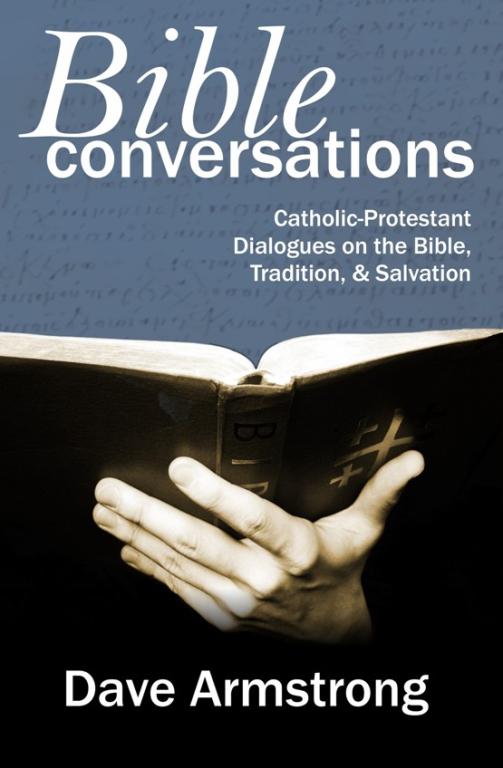
(completed in June 2002; published by Lulu in May 2007)
[Cover design by Chad Toney]
***
Purchase Options
***
[PAPERBACK: Amazon / Lulu] [PDF + ePUB: $9.99]
***
Table of Contents
Dedication
Introduction [read below]
The Bible
Chapter 1: The Premises of Sola Scriptura
Chapter 2: Is the Bible the Ultimate Rule of Faith?
Chapter 3: Does the Bible Clearly Teach That it is Clear?
Chapter 4: The Perspicuity (Clarity) of the Bible: Plowboys, Preachers, and Popes
Chapter 5: The Formal Sufficiency of Holy Scripture
Apostolic Tradition
Chapter 6: Tradition in the New Testament
Chapter 7: The Nature of “the Church” and Catholicism
Chapter 8: On Church Authority and Epistemological “Certainty”
Chapter 9: Are Dissident “Catholics” a Disproof of the Catholic Church’s Claims of Ecclesiological and Doctrinal Unity?
Chapter 10: “Dialogue” With the Reformed Belgic and Second Helvetic Confessions: On the True Church and Private Judgment
Salvation and Justification
Chapter 11: The Catholic Understanding of “Grace Alone” and Justification by Faith
Chapter 12: Repentance and Salvation
Chapter 13: Justification, the Law, and Grace
Chapter 14: The “Reformed” Definitions of Protestant and Pelagian
Chapter 15: The Biblical Evidence for Infant Baptism and Baptismal Regeneration
Appendix One:Martin Luther and the New Testament Canon
Appendix Two: The Origins of Sola Scriptura and Perspicuity (Hartmann Grisar)
Appendix Three: Catholic Biblical Exegesis and Hermeneutics (Catholic Encyclopedia)
Appendix Four: The Antiochene School of Literal Grammatico-Historical Hermeneutics (John Henry Newman)
Appendix Five: The Council of Trent: Canons on Justification [read online]
Appendix Six: The Catholic View of Non-Catholics (Karl Adam)
Introduction
The word dialogue appears in the Bible. The Greek dialegomai occurs 13 times in the New Testament, and refers to reason, rational argument, discussion, discourse, debate, dispute and so forth. Particularly, we often see it applied to the Apostle Paul as he reasoned and argued with Jews in the synagogues (Acts 17:2,17, 18:4,19, 19:8) and Greeks and other Gentiles in the marketplaces and academies of the time, where the exchange of ideas took place (Acts 17:17, 18:4, 19:9-10).
St. Paul’s evangelistic preaching wasn’t simply thrilling oratory and edifying, “homiletic” exposition; it involved in-depth reasoning; even – at times, such as on Mars Hill (Acts 17:22-34) -, literally philosophical discourse.
Our Lord Jesus, too, often engaged in vigorous, rational, scriptural argument, especially with the Pharisees, much in the spirit of the ancient rabbis. One example of this among many occurs in Mark 12:18-27, where He is said to be “disputing” (Greek, suzeteo) with the Sadducees (cf. Acts 9:29, where the same word is used).
Rational argument, thinking, or open-minded discourse and dialogue is altogether permissible; indeed, required of all Christians who wish to have a robust, confident, reasonable faith amidst the competing ideas and faiths of the world and academia. Our Lord instructs us to love God with our minds as well as with all our hearts, souls, and strength (Luke 10:27).
The word apologetics; that is, the defense of Christianity (or Catholicism in particular, in the present instance) is derived etymologically from the Greek apologia, which term was used by Plato as a title of one of his many classic dialogues, in description of the philosopher Socrates’ lengthy and elaborate defense or justification of himself against trumped-up, politically-motivated charges in Athens, in 399 B.C.
Apologia is also a biblical word, and appears much in the same sense as with Socrates, with regard to St. Paul’s defense of himself during his lengthy trial (Acts 22:1, 25:16). It is also used with reference to Paul’s defense and confirmation of the gospel (Philippians 1:7,16 – rendered defense in the RSV in all four instances).
The use of apologia in the imperative verse 1 Peter 3:15, with regard to the explanation of the hope of the gospel which resides in the heart of every Christian believer, makes apologetics a duty of every Christian, to some extent. But of course, people have different God-granted gifts and abilities, and the Christian or Catholic apologist is specifically called to that task as a matter of vocation and life’s work.
The dialogue or debate (as a teaching tool) seems to have been sort of a lost art for some time now, in wider Christian circles (though apologists such as C.S. Lewis and G.K. Chesterton had always loved and utilized it). Thankfully, it is making a comeback, notably in Thomist philosopher and Catholic Christian apologist Peter Kreeft’s books of fictional dialogues, some containing contributions from “Socrates” himself.
During the Middle Ages, there were many public disputations and debates, accompanied by much pomp and fanfare. Rhetoric was taught in the schools, as a key element of a broad, liberal arts education, based on the ancient arts, perfected by Pericles and others.
St. Thomas Aquinas, regarded by many as both the greatest Catholic theologian and philosopher, in his famous masterpiece Summa Theologica, used syllogistic reasoning and logic to great effect, anticipating many possible counter-responses of his opponents, in a sort of back-and-forth method, or self-dialogue.
He was, of course, incorporating the philosophical wisdom of Aristotle into Christian thought. Aristotle was a student of Plato, who in turn was taught by Socrates, in the Golden Era of Greek philosophy.
When the Protestant movement came about in the 16th century, many dialogues or disputations also took place, between Martin Luther, John Calvin and various Catholics such as Erasmus and Eck and Cardinal Sadoleto, as well as inter-Protestant squabbles. So this method is a time-honored one within Christianity as a whole; one which we should not be afraid of as a means to ascertain truth and to test competing theological or exegetical ideas.
Socratic method, or a certain method of discussion, has been ably described by the prominent philosopher and authority on Plato and Socrates, Alfred E. Taylor, in his 1933 book Socrates: The Man and His Thought:
Truth has to be reached by dint of dialogue or debate, which may be carried on between two inquirers, or also within the heart of a single inquirer, as his “soul” questions itself and answers its own questions. The truth, which is not to be discovered by any direct inspection of “facts,” may be beaten out in the critical confrontation of rival interpretations of them. It comes, when it comes, as the conclusion to a debate . . . .
Socrates starts from some proposition which, on any grounds, commends itself to him as presumably true. This he calls his initial hypothesis, and he proceeds to ask himself “what must follow if this is admitted,” that is, to deduce its consequences . . . whatever follows from it is also set down as true, and whatever conflicts with it as false. Thus the assumption of the method is simply that truth is a coherent system, and that nothing which conflicts with a true principle can be true.
Frederick Copleston, the great Jesuit historian of philosophy, in his History of Philosophy (volume 1: Greece and Rome, 1946), elaborates:
This dialectic might, of course, prove somewhat irritating or even disconcerting or humiliating to those whose ignorance was exposed and whose cocksureness was broken down . . . but the aim of Socrates was not to humiliate or to disconcert. His aim was to discover the truth, not as a matter of pure speculation, but with a view to the good life: in order to act well, one must know what the good life is. His “irony,” then, his profession of ignorance, was sincere; he did not know, but he wanted to find out, and he wanted to induce others to reflect for themselves and to give real thought to the supremely important work of caring for their souls . . . Socrates called his method “midwifery,” . . . to express his intention of getting others to produce true ideas in their minds, with a view to right action.
This general outlook, informs the following series of dialogues. I have sought to adopt this Socratic method to some extent in my own apologetics. The most obvious mark of this influence has been my participation in many, many dialogues, throughout my now-20 years of apologetics and innumerable “serious discussions” with people of almost every imaginable worldview.
I have changed my mind on many things as a result of such dialogues: notably with regard to my conversion to Catholicism, which came about very much as a result of ecumenical dialogue carried out in my own living room. I continue to love and enjoy dialogue, and have posted dozens of these discussions on my website (and now, in books), in order to foster critical thinking among readers and seekers after truth, as I myself try to be at all times.
The following fifteen dialogues are loosely-based on real encounters with Protestants, over the course of nearly five years of Internet discussions on lists, bulletin boards, and private correspondence. My words are essentially the same as they were at the time, with some editing of extraneous or unnecessary material for the purpose of this book.
I have paraphrased and re-written the essential arguments of my Protestant opponents, in order to make this my own work, in my own words, but I have taken great pains to retain the essence of their arguments, so as not to distort or misrepresent their own particular Protestant strain of thought or ways of thinking about Scripture, Tradition, and salvation.
The Catholic apologist often hears the objection that a particular belief critiqued or scrutinized is only held by some Protestants (perhaps a minority) and not all, but that goes with the territory. In any treatment of a religious and intellectual movement as splintered as Protestantism, it is simply impossible to present a unified portrayal. That being the case, I have tried to faithfully and accurately present the thought of each person, so as not to be guilty of creating any “straw men” (which I have absolutely no desire to do).
My opponents were most sharp and worthy ones, with a far above-average theological education and ability to express their beliefs eloquently and intelligently. Among the eleven people with whom I engaged in these dialogues, three had advanced theological degrees, some had attended Bible colleges, and others were very well-educated informally in such matters.
All of them would call themselves evangelicals; some generically so; others under the denominational categories of Presbyterian/Reformed, Baptist, Reformed Baptist, and Lutheran. Essentially, then, this is a series of discussions based on real dialogues, yet re-written and “tightened up” for public consumption, between a Catholic and former evangelical Protestant (myself) and able representatives of mainstream evangelical Protestantism in several of its major branches.
It is my devout wish that the reader will enjoy these exchanges as much as I did participating in them, and that they will be challenged to exercise their critical faculties, in order to make up their own minds on the issues, with knowledge and an accurate acquaintance with the thought of both parties.
Purchase Options
***
[PAPERBACK: Amazon / Lulu] [PDF + ePUB: $9.99]
***
***
*Practical Matters: This is the most comprehensive and multi-faceted Catholic apologetics blog: rated #1 for Christian sites by leading AI tool, ChatGPT. I offer more than 5,000 free online articles, fifty-eight books, and many scores of videos at the Catholic Bible Highlights YouTube channel (please subscribe!). If you believe my full-time apostolate is worth supporting, please seriously consider financially supporting it. PayPal donations are the easiest: just send to my email address: [email protected]. You’ll see the term “Dave Armstrong Bookstore”. To learn about the different methods of contributing (including Zelle and 100% tax-deductible donations if desired), see my page: About Catholic Apologist Dave Armstrong / Donation Information. Thanks a million!
***
Last updated on 11 July 2026
Previous Post
July 31, 2006
Dave Armstrong: "More Biblical Evidence for Catholicism"
Next Post
July 31, 2006 Books by Dave Armstrong: "Development of Catholic Doctrine"
Browse Our Archives
Select a Category & Last Things About Me Anti-Catholicism Atheism & Agnosticism Baptism and Sacramentalism Bible and Tradition Blessed Virgin Mary Books by Dave Armstrong C. S. Lewis Calvinism & General Protestantism Catholic Apologetics Catholic Apologists Catholic conversion Catholic converts Christmas Church (Ecclesiology) Church History Conversion and Converts Development of Doctrine Eastern Orthodoxy Ecumenism & Christian Unity Eucharist & Liturgy Fathers of the Church French Translations G. K. Chesterton Hell Hell & Satan Hell & Satan & Last Things Heresies & Comparative Religion Holistic Health Inquisition & Crusades & Scandals James White Jews & Judaism & Old Testament John Calvin John Henry Newman Liberal / Modernist Theology Life Issues Literary Resume Lutheranism Mariology Martin Luther Music Orthodoxy Papacy & Infallibility Personal Page Philosophy & Science Political & Ethical & Moral Issues Protestant Persecution & Intolerance Protestantism Purgatory Purgatory & Penance Romantic & Imaginative Theology Saints & Purgatory & Penance Salvation Salvation & Justification Satan & Last Things Sexuality and Gender Issues Spanish Translations Traditionalism vs. Radical Catholic Reactionaries Traducciones al español / tradução para português Trinitarianism & Christology Uncategorized Videos
Select a Month October 2026 September 2026 August 2026 July 2026 June 2026 May 2026 April 2026 March 2026 February 2026 January 2026 December 2025 November 2025 October 2025 September 2025 August 2025 July 2025 June 2025 May 2025 April 2025 March 2025 February 2025 January 2025 December 2024 November 2024 October 2024 September 2024 August 2024 July 2024 June 2024 May 2024 April 2024 March 2024 February 2024 January 2024 December 2023 November 2023 October 2023 September 2023 August 2023 July 2023 June 2023 May 2023 April 2023 March 2023 February 2023 January 2023 December 2022 November 2022 October 2022 September 2022 August 2022 July 2022 June 2022 May 2022 April 2022 March 2022 February 2022 January 2022 December 2021 November 2021 October 2021 September 2021 August 2021 July 2021 June 2021 May 2021 April 2021 March 2021 February 2021 January 2021 December 2020 November 2020 October 2020 September 2020 August 2020 July 2020 June 2020 May 2020 April 2020 March 2020 February 2020 January 2020 December 2019 November 2019 October 2019 September 2019 August 2019 July 2019 June 2019 May 2019 April 2019 March 2019 February 2019 January 2019 December 2018 November 2018 October 2018 September 2018 August 2018 July 2018 June 2018 May 2018 April 2018 March 2018 February 2018 January 2018 December 2017 November 2017 October 2017 September 2017 August 2017 July 2017 June 2017 May 2017 April 2017 March 2017 February 2017 January 2017 December 2016 November 2016 October 2016 September 2016 August 2016 July 2016 June 2016 May 2016 April 2016 March 2016 February 2016 January 2016 December 2015 November 2015 October 2015 September 2015 August 2015 July 2015 June 2015 May 2015 April 2015 March 2015 February 2015 January 2015 December 2014 November 2014 October 2014 September 2014 August 2014 July 2014 June 2014 April 2014 March 2014 February 2014 January 2014 December 2013 November 2013 October 2013 September 2013 August 2013 July 2013 June 2013 April 2013 March 2013 February 2013 January 2013 December 2012 November 2012 October 2012 September 2012 August 2012 July 2012 June 2012 May 2012 April 2012 March 2012 February 2012 January 2012 December 2011 November 2011 October 2011 September 2011 August 2011 July 2011 June 2011 April 2011 March 2011 February 2011 October 2010 September 2010 August 2010 July 2010 April 2010 March 2010 December 2009 October 2009 August 2009 July 2009 June 2009 May 2009 March 2009 February 2009 October 2008 September 2008 April 2008 March 2008 February 2008 January 2008 December 2007 November 2007 October 2007 May 2007 March 2007 February 2007 January 2007 November 2006 October 2006 September 2006 August 2006 July 2006 June 2006 May 2006 April 2006 March 2006 February 2006 October 2005 June 2005 April 2005 February 2005 July 2004 May 2004 April 2004
Follow Us!
TAKE THE
Religious Wisdom Quiz
What book of the Bible comes after Genesis?
Select your answer to see how you score.
Deuteronomy Exodus Leviticus Numbers
Books by This Author Books by Dave Armstrong
Related posts from Biblical Evidence for Catholicism

Bible & Catholicism on Mortal Sin (vs. John...
Biblical Evidence for Catholicism

Dialogue on Eternal Security / Absolute Assurance
Biblical Evidence for Catholicism

"Faith Alone" Dialogue with a Calvinist
Biblical Evidence for Catholicism

Exegesis of 75 NT Faith [Alone?] & Works...
Biblical Evidence for Catholicism
TRENDING AT PATHEOS Catholic

In "Irreplaceable," our book on vocation and technology, Trevor Sutton and I...

I was strolling through the top floor of the brand new Parthenon...

What Does Gêvâh Mean For Kimberley Guifoyle &...
This week, a lot of the news is focused on Kimberly Guilfoyle....

INNER CIRCLE: Profound Mystery (Of Christ In All...
Ephesians 5:31-32 “For this reason, a man will leave his father and...

Do Not Rejoice When Your Enemy Falls: The...
Turning an execution into a public spectacle is a disturbing expression of...

'The Chosen' S6 Trailer: The Passion Gets Very...
Not many watching 'The Chosen' worry about spoilers, but just because they...
view all Catholic blogs
Ad-Free & Subscriber Log-In Subscription Support
- About Us
- 2026 Calendar
- Videos
- Podcasts
- Library of World Religions
- Faith In Media Tracker
- Advertise With Us
- Write for Us
- Privacy Policy
- Terms of Service
- Do Not Sell My Data
- Contact Us
- Radiant Digital
- Manage Newsletter Subscriptions
- Unsubscribe From Notifications
- Sitemap
Copyright 2008-2026, Patheos. All rights reserved.
Subscription Support Ad-Free & Subscriber Log-In
Follow Patheos