
BuddhistCatholicContemplativeEvangelicalGeneral ChristianHinduJewishLatter-day SaintMuslimNew VisionsProgressive Christian
Beliefs
- Buddhist
- Catholic
- Contemplative
- Evangelical
- General Christian
- Hindu
- Jewish
- Latter-day Saint
- More Voices
- Muslim
- New Visions
- Pagan
- Progressive Christian
Topics
- Religion News
- Food and Religion
- Sports and Religion
- Religious Art
- Religious Music and Entertainment
- Religious Events
- History and Religion
- Style and Religion
- Politics and Religion
- Women in Religion
- Recreation Outdoors and Religion
- Business Finance and Religion
- Careers Workplace and Religion
- Education and Religion
- Family Parenting and Religion
- Health Fitness and Religion
- Home and Religion
- Relationships and Religion
- Technology and Religion
- Travel and Religion
Columnists
- Buddhist Columnists
- Business Finance and Religion Columnists
- Careers Workplace and Religion Columnists
- Catholic Columnists
- Contemplative Columnists
- Education and Religion Columnists
- Evangelists Columnists
- Family Parenting and Religion Columnists
- General Christian Columnists
- Health Fitness and Religion Columnists
- Hindu Columnists
- History and Religion Columnists
- Home and Religion Columnists
- Jewish Columnists
- More Voices Columnists
- Latter Day Columnists
- Muslim Columnists
- New Visions Columnists
- Nonreligious Columnists
- Pagan Columnists
- Politics and Religion Columnists
- Progressive Columnists
- Recreation Outdoors and Religion Columnists
- Relationships and Religion Columnists
- Religion News Columnists
- Religious Art Columnists
- Religious Events Columnists
- Religious Music and Entertainment Columnists
- Sports and Religion Columnists
- Style and Religion Columnists
- Technology and Religion Columnists
- Travel and Religion Columnists
- Women in Religion Columnists
Resource Library
- 2026 Calendar
- Library of World Religions
- The 100 Most Holy Places on Earth
- Patheos Answers
- Podcasts
- Videos
- Faith Leaders Database
- Anglican Episcopalian
- Bahai
- Baptist
- Buddhism
- Christianity
- Confucianism
- Eastern Orthodoxy
- Hinduism
- Holiness and Pentecostal
- ISKCON
- Islam
- Judaism
- Lutheran
- Methodist
- The Church of Jesus Christ of Latter-day Saints
- New Age
- Paganism
- Presbytarian and Reformed
- Protestantism
- Religion Behind the Scenes
- Roman Catholic
- Scientology
- Shia Islam
- Sikhism
- Sufism
- Sunni Islam
- Taoism
- Zen
- See all religions
Research Tools
 Ad-Free & Subscriber Log-In Subscription Support
Ad-Free & Subscriber Log-In Subscription Support
Follow Patheos 

- Trending:
- Forgiveness
- |
- Marriage
- |
- Consciousness
- |
- Death Penalty
- |
- Election
- |
- Halloween

-
About
-
Catholic Apologetics
-
Church History
-
Great Apologists
-
Christian Worldview
-
Protestantism & Misc.
- Home
- Catholic
- History and Religion
- Development of Doctrine: A Corruption of Biblical Teaching?
Development of Doctrine: A Corruption of Biblical Teaching?
Last updated on: June 6, 2026 at 12:27 am by Dave Armstrong
Development of Doctrine: A Corruption of Biblical Teaching? 2026-06-06T00:27:17-04:00 Dave Armstrong
Patheos Explore the world's faith through different perspectives on religion and spirituality! Patheos has the views of the prevalent religions and spiritualities of the world.
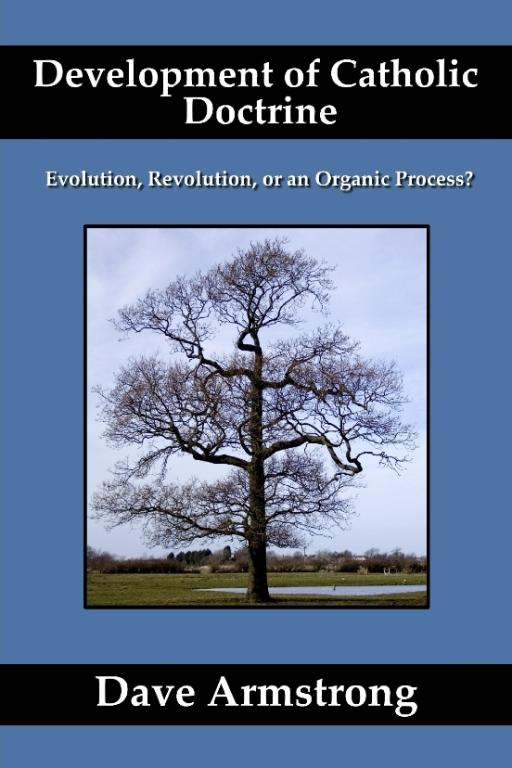
[link for complete information about this book]
***
[Written in 1995. This article was published in The Catholic Answer, September / October 1995 and uploaded on 5 July 2001]
*****
C. S. Lewis, the famous Anglican writer, once wrote:
The very possibility of progress demands that there should be an unchanging element . . . the positive historical statements made by Christianity have the power . . . of receiving, without intrinsic change, the increasing complexity of meaning which increasing knowledge puts into them.
(God in the Dock, Eerdmans, Grand Rapids, Michigan, 1970, 44-47)
The Catholic Church, in agreement with Lewis, defines doctrinal development as a growth of depth and clarity in the understanding of the truths of divine revelation. It is important to understand that the substantial or essential truths at the core of each doctrine remain unchanged. Only the subjective grasp of men increases. This increase is the result of the prayerful reflection of the Church, theological study and research (often occasioned by heretical challenges), practical experience, and the collective wisdom of the Church’s bishops and popes, especially when joined in Ecumenical Councils.
Like many Christian doctrines, the idea of doctrinal development is based on much implicit or indirect scriptural evidence. The best indications are perhaps Mt. 5:17, 13:31-2, Jn. 14:26, 16:13, 1 Cor. 2:9-16, Gal. 4:4, Eph. 1:10, 4:12-15. Furthermore, doctrine clearly develops within Scripture (“progressive revelation”). Examples: doctrines of the afterlife, the Trinity, the Messiah (eventually revealed as God the Son), the Holy Spirit (Divine Person in the New Testament), the equality of Jews and Gentiles, bodily resurrection, sacrifice of lambs evolving into the sacrifice of Christ, etc. Not a single doctrine emerges in the Bible complete with no further need of development.
In general, whenever Scripture refers to the increasing knowledge and maturity of Christians and the Church, an idea very similar to doctrinal development is present. Holy Scripture, then, is in no way hostile to development. It is only Protestant presuppositions – not always so “biblical” – which preclude development for fear of “excess.”
The Canon of Scripture itself is an example of developing doctrine. The New Testament never informs us which books comprise itself, and its Canon (final list of books) took about 360 years to reach its final form (at the Council of Carthage in 397). For instance, the books of Hebrews, James, 2 Peter, 2 and 3 John, Jude, and Revelation were not widely accepted by the Church until 350 A.D.!
And books such as Barnabas and 1 and 2 Clement were considered Scripture by many at the same time (for example, the manuscripts Codex Sinaiticus and Codex Alexandrinus). Of the 27 New Testament books, 14 were not mentioned at all until around 200 A.D., including Acts, 2 Corinthians, Galatians and Colossians.
On what grounds, then, can we receive the Canon today except on the authority of the Church in the 5th century? These facts cause insuperable problems for Protestantism and its guiding principle of “Scripture Alone,” but are not a difficulty in the least for Catholics, who believe in Tradition, Church Authority, and development – all crucial elements in the very human process of selection of the biblical Canon.
It is plain silly (not to mention insufferably arrogant) to assert, as did Luther and especially Calvin, that the knowledge of what books constitute Scripture is attained simply by an intuitive and subjective inkling within each Spirit-filled person. If the early Church had such a difficult time determining what was and was not Scripture, how could Calvin 15 centuries later claim that it was altogether simple for him and every other sincere Christian?!
The Church is called the “Body” of Christ often (e.g., Eph. 1:22-3), and is compared to a seed which grows into a tree (Mt. 13:31-2). Seeds and bodies grow and expand. Yet Protestants tend to see Church and Doctrine as more like a statue, subject to pigeon droppings (i.e., so-called Catholic “corruptions”!). This robs the metaphors of Christ of their essential meaning. It is impossible to claim that no development occurred in Church history, or that it ceased after the 1st, 2nd, 3rd, or 5th century, etc. (all arbitrary human traditions). The Bible is not absolutely clear in every part, and requires the developing wisdom of the Church.
Doctrines agreed upon by all develop, too. The Divinity or Godhood of Christ was only finalized in 325, and the full doctrine of the Trinity in 381.The dogma of the Two Natures of Christ (God and Man) was proclaimed in 451. These decisions of General Councils of the Church were in response to challenging heresies. Why should Protestants accept these authoritative verdicts, but reject similar proclamations on Church government, the Eucharist, Mary, Purgatory, etc.?
Although understanding increases, the essential elements of doctrines exist from the beginning. Today’s Church shouldn’t be expected to look like the primitive Church if it is a living, vibrant, spiritual organism. But even the early Church looks like a small “Catholic tree.” It doesn’t look like a Protestant “statue,” doomed to be increasingly corrupted by an encroaching, “diabolical” Catholicism, as is imagined by millions of Protestants unacquainted with the early Church and the oldest source materials after the New Testament, such as the writings of St. Ignatius of Antioch (d.c. 110) and St. Clement of Rome (d.c.101).
John Henry Cardinal Newman (1801-1890), the great English convert to Catholicism, who is widely regarded as one of the most profound religious thinkers of his time, wrote in his Essay on the Development of Christian Doctrine (1845), the one indispensable work on this subject:
One thing at least is certain; whatever history teaches . . . at least the Christianity of history is not Protestantism. If ever there were a safe truth, it is this. And Protestantism . . . as a whole, feels it, and has felt it. This is shown in the determination . . . of dispensing with historical Christianity altogether, and of forming a Christianity from the Bible alone . . . To be deep in history is to cease to be a Protestant.
(Introduction 5, 6)
The bulk of Newman’s extraordinary work is devoted to the exposition of a series of analogies, showing conclusively that the Protestant static conception of the Church (both historically and theologically) is incoherent and false. He argues, for example, that notions of suffering, or “vague forms of the doctrine of Purgatory,” were universally accepted, by and large, in the first four centuries of the Church, whereas, the same cannot be said for the doctrine of Original Sin, which is agreed upon by Protestants and Catholics.
Protestants falsely argue that Purgatory is a later corruption, but it was present early on and merely developed. Original Sin, however, was equally if not more so, subject to development. One cannot have it both ways. If Purgatory is unacceptable on grounds of its having undergone development, then Original Sin must be rejected with it. Contrariwise, if Original Sin is accepted notwithstanding its own development, then so must Purgatory be accepted.
Thus Protestantism is inconsistent in its selective espousal of Christian beliefs. The so-called “Catholic distinctives” were merely cast off at the time of the Protestant Revolt in the 16th century – basically due to prejudice and ignorance. Protestantism ever since has had to either distort, ignore, or be embarrassed by the facts of early Christian history which, again and again, are found to be much more in conjunction with Catholicism. Protestant anti-Catholic apologists are notorious for searching for quotes by Church Fathers which appear to support their presuppositions, while bypassing those (often by the same Father) which clearly suggest the Catholic outlook. I did this myself in the year before I was convinced of the truth of Catholicism.
Newman states, in summary:
If it be true that the principles of the later Church are the same as those of the earlier, then, whatever are the variations of belief between the two periods, the later in reality agrees more than it differs with the earlier, for principles are responsible for doctrines. Hence they who assert that the modern Roman system is the corruption of primitive theology are forced to discover some difference of principle between the one and the other; for instance, that the right of private judgment was secured to the early Church and has been lost to the later, or again, that the later Church rationalizes and the earlier went by faith.
(Ibid., ch. 7, section 6: conclusion)
This is true whether the theological considerations are those agreed upon by all, such as the Divinity of Christ, the Two Natures of Christ, the Trinity, the Holy Spirit, Original Sin, and the Canon of Scripture, or those denied by Protestants, such as the Marian dogmas, Purgatory, the papacy, the Real Presence of Christ in the Eucharist, the Communion of Saints, priestly absolution, baptismal regeneration, the Sacrifice of the Mass, etc.
If anything must be described, then, as a corruption of primitive, pure Christianity, it is Protestantism, not Catholicism, since it introduced a radically new mode of Christian authority which was a 180-degree departure from the established Christian Tradition: that of subjective, private judgment, tied in with the unbiblical, unhistorical, and unreasonable notion of “Scripture Alone.” Protestantism is much more of a corruption, if that word is defined as an essential change of direction or philosophy of an institution or a set of beliefs (in this case theological and spiritual).
One might say that an automobile was “corrupt” if the owner decided that it ran better with no muffler, no shocks, no air or fuel filters, half of its spark plugs, watered-down gas, no rear brakes, one headlight, no heat, three quarts low on oil, with half of its radiator coolant, etc. Corruption can consist of “subtraction” as well as “addition.” Protestantism’s charges against Catholicism, closely scrutinized, only come back to incriminate itself.
By and large, Protestantism merely asserts “sola Scriptura” without much consideration of the seriously-flawed implications of the same, and judges all doctrines accordingly. Therefore, those which are deemed to be either outright unbiblical or insufficiently grounded in Scripture to be authoritative, are jettisoned: the Marian doctrines, Purgatory, Penance, the papacy, etc. Apart from the question of Tradition as a legitimate carrier (alongside and in harmony with Scripture) of Christian belief, much more biblical support can be found in Scripture for these “Catholic” doctrines than Protestants suppose.
One simply needs to become familiar with Catholic biblical apologetic arguments. The idea of doctrinal development is a key, in any case, for understanding why the Catholic Church often appears on the surface as fundamentally different than the early Church. Thoughtful Protestants owe it to themselves and intellectual honesty to ponder this indispensable notion before lashing out at the allegedly “unbiblical excesses” of Catholicism.
*****
Meta Description: Introductory article concerning precisely what development of Christian doctrine means.
Meta Keywords: development of doctrine, doctrinal development, history of Christian doctrine, John Henry Newman
Previous Post
February 21, 2006
The Inquisition: Its Purpose & Rationale in the Medieval Worldview
Next Post

April 18, 2006 C. S. Lewis: 20th-Century Christian Knight (Links Page)
Browse Our Archives
Select a Category & Last Things About Me Anti-Catholicism Atheism & Agnosticism Baptism and Sacramentalism Bible and Tradition Blessed Virgin Mary Books by Dave Armstrong C. S. Lewis Calvinism & General Protestantism Catholic Apologetics Catholic Apologists Catholic conversion Catholic converts Christmas Church (Ecclesiology) Church History Conversion and Converts Development of Doctrine Eastern Orthodoxy Ecumenism & Christian Unity Eucharist & Liturgy Fathers of the Church French Translations G. K. Chesterton Hell Hell & Satan Hell & Satan & Last Things Heresies & Comparative Religion Holistic Health Inquisition & Crusades & Scandals James White Jews & Judaism & Old Testament John Calvin John Henry Newman Liberal / Modernist Theology Life Issues Literary Resume Lutheranism Mariology Martin Luther Music Orthodoxy Papacy & Infallibility Personal Page Philosophy & Science Political & Ethical & Moral Issues Protestant Persecution & Intolerance Protestantism Purgatory Purgatory & Penance Romantic & Imaginative Theology Saints & Purgatory & Penance Salvation Salvation & Justification Satan & Last Things Sexuality and Gender Issues Spanish Translations Traditionalism vs. Radical Catholic Reactionaries Traducciones al español / tradução para português Trinitarianism & Christology Uncategorized Videos
Select a Month October 2026 September 2026 August 2026 July 2026 June 2026 May 2026 April 2026 March 2026 February 2026 January 2026 December 2025 November 2025 October 2025 September 2025 August 2025 July 2025 June 2025 May 2025 April 2025 March 2025 February 2025 January 2025 December 2024 November 2024 October 2024 September 2024 August 2024 July 2024 June 2024 May 2024 April 2024 March 2024 February 2024 January 2024 December 2023 November 2023 October 2023 September 2023 August 2023 July 2023 June 2023 May 2023 April 2023 March 2023 February 2023 January 2023 December 2022 November 2022 October 2022 September 2022 August 2022 July 2022 June 2022 May 2022 April 2022 March 2022 February 2022 January 2022 December 2021 November 2021 October 2021 September 2021 August 2021 July 2021 June 2021 May 2021 April 2021 March 2021 February 2021 January 2021 December 2020 November 2020 October 2020 September 2020 August 2020 July 2020 June 2020 May 2020 April 2020 March 2020 February 2020 January 2020 December 2019 November 2019 October 2019 September 2019 August 2019 July 2019 June 2019 May 2019 April 2019 March 2019 February 2019 January 2019 December 2018 November 2018 October 2018 September 2018 August 2018 July 2018 June 2018 May 2018 April 2018 March 2018 February 2018 January 2018 December 2017 November 2017 October 2017 September 2017 August 2017 July 2017 June 2017 May 2017 April 2017 March 2017 February 2017 January 2017 December 2016 November 2016 October 2016 September 2016 August 2016 July 2016 June 2016 May 2016 April 2016 March 2016 February 2016 January 2016 December 2015 November 2015 October 2015 September 2015 August 2015 July 2015 June 2015 May 2015 April 2015 March 2015 February 2015 January 2015 December 2014 November 2014 October 2014 September 2014 August 2014 July 2014 June 2014 April 2014 March 2014 February 2014 January 2014 December 2013 November 2013 October 2013 September 2013 August 2013 July 2013 June 2013 April 2013 March 2013 February 2013 January 2013 December 2012 November 2012 October 2012 September 2012 August 2012 July 2012 June 2012 May 2012 April 2012 March 2012 February 2012 January 2012 December 2011 November 2011 October 2011 September 2011 August 2011 July 2011 June 2011 April 2011 March 2011 February 2011 October 2010 September 2010 August 2010 July 2010 April 2010 March 2010 December 2009 October 2009 August 2009 July 2009 June 2009 May 2009 March 2009 February 2009 October 2008 September 2008 April 2008 March 2008 February 2008 January 2008 December 2007 November 2007 October 2007 May 2007 March 2007 February 2007 January 2007 November 2006 October 2006 September 2006 August 2006 July 2006 June 2006 May 2006 April 2006 March 2006 February 2006 October 2005 June 2005 April 2005 February 2005 July 2004 May 2004 April 2004
Follow Us!
TAKE THE
Religious Wisdom Quiz
Which book of the Bible contains the most direct prophecies about the Messiah?
Select your answer to see how you score.
Micah Isaiah Zechariah Psalms
Books by This Author Books by Dave Armstrong
Related posts from Biblical Evidence for Catholicism

The Mass & Development of Doctrine (vs. Wes...
Biblical Evidence for Catholicism
Newman, Sinless Mary, & Development (vs. Javier Perdomo)
Biblical Evidence for Catholicism
Patristic Development of a Sinless Mary (Cdl. Newman)
Biblical Evidence for Catholicism

Mary's Sinlessness & the Fathers (vs. Javier Perdomo)
Biblical Evidence for Catholicism
TRENDING AT PATHEOS Catholic

The Sermon on the Mount, Part I: Matthew...
The Sermon on the Mount, Part I (Matthew 4:12-5:12) St. Matthew moves...

What's up from Crossway: Reviewing some of their latest A few weeks...

Janie Learns the Way of the Cross: A...
Teaching children about Jesus' Passion can be challenging. Many parents and educators...

Looking For Good Catholic Writing - October 2026
He alone extends the heavens, and he walks upon the waves of...

In "Irreplaceable," our book on vocation and technology, Trevor Sutton and I...

I was strolling through the top floor of the brand new Parthenon...
view all Catholic blogs
Ad-Free & Subscriber Log-In Subscription Support
- About Us
- 2026 Calendar
- Videos
- Podcasts
- Library of World Religions
- Faith In Media Tracker
- Advertise With Us
- Write for Us
- Privacy Policy
- Terms of Service
- Do Not Sell My Data
- Contact Us
- Radiant Digital
- Manage Newsletter Subscriptions
- Unsubscribe From Notifications
- Sitemap
Copyright 2008-2026, Patheos. All rights reserved.
Subscription Support Ad-Free & Subscriber Log-In
Follow Patheos