
BuddhistCatholicContemplativeEvangelicalGeneral ChristianHinduJewishLatter-day SaintMuslimNew VisionsProgressive Christian
Beliefs
- Buddhist
- Catholic
- Contemplative
- Evangelical
- General Christian
- Hindu
- Jewish
- Latter-day Saint
- More Voices
- Muslim
- New Visions
- Pagan
- Progressive Christian
Topics
- Religion News
- Food and Religion
- Sports and Religion
- Religious Art
- Religious Music and Entertainment
- Religious Events
- History and Religion
- Style and Religion
- Politics and Religion
- Women in Religion
- Recreation Outdoors and Religion
- Business Finance and Religion
- Careers Workplace and Religion
- Education and Religion
- Family Parenting and Religion
- Health Fitness and Religion
- Home and Religion
- Relationships and Religion
- Technology and Religion
- Travel and Religion
Columnists
- Buddhist Columnists
- Business Finance and Religion Columnists
- Careers Workplace and Religion Columnists
- Catholic Columnists
- Contemplative Columnists
- Education and Religion Columnists
- Evangelists Columnists
- Family Parenting and Religion Columnists
- General Christian Columnists
- Health Fitness and Religion Columnists
- Hindu Columnists
- History and Religion Columnists
- Home and Religion Columnists
- Jewish Columnists
- More Voices Columnists
- Latter Day Columnists
- Muslim Columnists
- New Visions Columnists
- Nonreligious Columnists
- Pagan Columnists
- Politics and Religion Columnists
- Progressive Columnists
- Recreation Outdoors and Religion Columnists
- Relationships and Religion Columnists
- Religion News Columnists
- Religious Art Columnists
- Religious Events Columnists
- Religious Music and Entertainment Columnists
- Sports and Religion Columnists
- Style and Religion Columnists
- Technology and Religion Columnists
- Travel and Religion Columnists
- Women in Religion Columnists
Resource Library
- 2026 Calendar
- Library of World Religions
- The 100 Most Holy Places on Earth
- Patheos Answers
- Podcasts
- Videos
- Faith Leaders Database
- Anglican Episcopalian
- Bahai
- Baptist
- Buddhism
- Christianity
- Confucianism
- Eastern Orthodoxy
- Hinduism
- Holiness and Pentecostal
- ISKCON
- Islam
- Judaism
- Lutheran
- Methodist
- The Church of Jesus Christ of Latter-day Saints
- New Age
- Paganism
- Presbytarian and Reformed
- Protestantism
- Religion Behind the Scenes
- Roman Catholic
- Scientology
- Shia Islam
- Sikhism
- Sufism
- Sunni Islam
- Taoism
- Zen
- See all religions
Research Tools
 Ad-Free & Subscriber Log-In Subscription Support
Ad-Free & Subscriber Log-In Subscription Support
Follow Patheos 

- Trending:
- Forgiveness
- |
- Marriage
- |
- Consciousness
- |
- Death Penalty
- |
- Election
- |
- Halloween

-
About
-
Catholic Apologetics
-
Church History
-
Great Apologists
-
Christian Worldview
-
Protestantism & Misc.
- Home
- Catholic
- History and Religion
- The Orthodox Traditionalist vs. the Heterodox Luther
The Orthodox Traditionalist vs. the Heterodox Luther
Last updated on: July 23, 2019 at 5:41 pm by Dave Armstrong
The Orthodox Traditionalist vs. the Heterodox Luther 2019-07-23T17:41:51-04:00 Dave Armstrong
Patheos Explore the world's faith through different perspectives on religion and spirituality! Patheos has the views of the prevalent religions and spiritualities of the world.
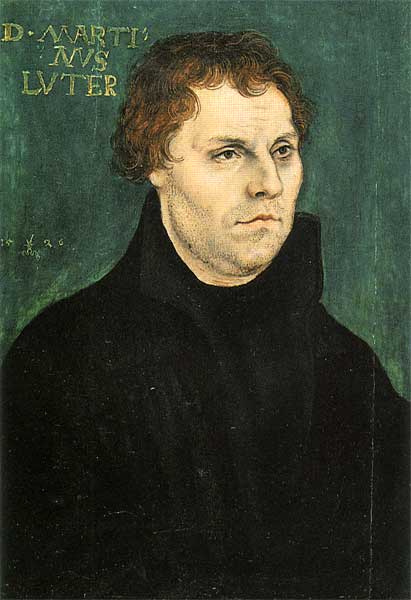
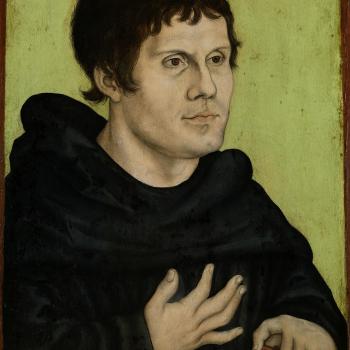
Martin Luther, 31 December 1525 (age 42), by Lucas Cranach the Elder [public domain / Wikimedia Commons]

***
[Note: this was written in 1992. I’ve learned tons of things about Martin Luther since that time; even in just the last few years, as I continue to do further research and reading. In several cases, I have changed my opinion on particular elements of his beliefs and behavior. Thus, I wouldn’t express several things in this article the way I did then, and I’ve discovered one definite inaccuracy; see the next note below. I have kept this article online, listed on my “Resume” because it was my first published article. But I don’t list it on my Luther web page, due to its outdated nature and relative lack of documentation. At the time I wrote it (before I was even online), I didn’t have nearly the resources available to me that I now have]
Martin Luther has, of course, been traditionally regarded as either a “Reformer of the True Church,” or the “Ultimate Heresiarch,” depending on one’s religious affiliation. Ironically, the first description of Luther seems to have taken hold among Catholics as well as Protestants in the current climate of ecumenism.
Arguably, however, the real Luther is far more fascinating and complex than his detractors or hagiographers have generally realized. There exists in “the Father of the Reformation” a curious mix of orthodoxy and heterodoxy which are part and parcel of his tempestuous and radically subjective temperament (a psychological trait acknowledged by serious biographers on all sides). It is worthwhile exploring this habit of both simultaneous contradiction and vacillation — a tendency easily documented from his own words — in attempting to understand this most controversial figure.
A striking example of Luther’s “doublespeak” occurs in a sequence of four letters – – all, incidentally, written after the posting of the Ninety-Five Theses (October 31, 1517):
Most Holy Father, prostrate at the feet of your Holiness, I offer myself with all that I am and have . . . I will acknowledge thy voice as the voice of Christ. (Letter to Pope Leo X, May 30, 1518)
The true Antichrist, according to Paul, reigns in the Roman Court: I think I am able to prove that he [the Pope] is now worse than the Turks. (Letter to Wenceslaus Link, December 11, 1518)
I never approved of a schism, nor will I approve of it for all eternity . . . That the Roman Church is more honored by God than all others is not to be doubted . . . It is not by separating from the Church that we can make her better. (Letter to Pope Leo X, January 6, 1519)
[This was mistaken documentation on my part. Luther indeed did write (or say) all these words, but they actually derive from two sources, and neither is a letter to Pope Leo X from this date. The first clause came from the Leipzig Disputation with Johann Eck in July 1519; the rest is from a tract called An Instruction on Certain Articles, which dates from late February 1519. For much more on these four Luther utterances and related issues, see my paper about Luther’s views on the papacy from 1518 to 1520]
I do not know whether the Pope is Antichrist himself, or his Apostle: so miserably is Christ (that is, truth) corrupted and crucified by him in the decrees. (Letter to Georg Spalatin, March 13, 1519)
The most charitable and unassuming description of such clear equivocation might be “frequent profound mood changes!”
Some of Luther’s most shocking opinions are regarding celibacy, chastity, and marriage. One might expect from Luther a certain disdain of Tradition, but not such a wanton disrespect of the moral teachings of the Bible. The most famous sexual scandal of the Protestant Revolt was the bigamy of the Prince (“Landgrave”) Philip of Hesse. Philip was married, but continually engaged in adultery, and petitioned Luther for permission to take another wife. Although bigamy was punishable by death in German law, Philip Melanchthon, Luther’s right-hand man and successor, wrote a document sanctioning bigamy, signed by Luther and six other “reformers,” including Martin Bucer. It reads in part:
We declare under an oath that it ought to be done secretly . . . It is nothing unusual for princes to have concubines . . . and this modest way of living would please more than adultery. (Document dated December 10, 1539 / Luther’s Letters, De Wette — Seidemann, Berlin, 1828, vol. 6, 255-265)
The secret soon became public, whereupon Melanchthon “sickened almost to death with remorse.” Luther, unabashed, acted as if he was totally unaware of the illegal and immoral transaction, and confided to friends:
A secret yes must remain a public no and vice versa. (De Wette, vol. 6, 263)
and:
What would it matter if, for the sake of greater good and of the Christian Church, one were to tell a good, downright lie? (Lenz, Luther’s Letters, Leipzig, 1891, vol. 1, 382)
Luther believed that polygamy was sanctioned in Scripture:
I cannot forbid a person to marry several wives, for it does not contradict the Scripture. (De Wette, vol. 2, 459)
On the contrary, Jesus Christ (Matt 19:6-9) and St. Paul (Rom 7:3; I Cor 7:2; Eph 5:32-33) presupposed monogamy as normative for the Christian.
Celibacy was also supposedly impossible, an idea fraught with many dangers and implications:
Chastity is not in our power. All are created for marriage. God does not permit that one be alone. (De Wette, vol. 2, 637 ff.)
This is expressly denied by Our Lord (Matt 19:12). According to Luther, both men and women are utterly unable to abstain from sex, and indeed,
Libidinousness cannot be cured by anything, not even by marriage; for the greater part of the married live in adultery. (Luther’s Works, Erlangen, 1868, “Opp. Exeg. Lat.,” I, 212)
Despite all this (many similarly shocking utterances could be brought forth on a variety of topics), Luther’s softer and more reflective side can be surprisingly orthodox and even tender, especially when he teaches on the Blessed Virgin Mary. He believed in the Immaculate Conception, Mary’s perpetual virginity,and in the usage of the title Mother of God (in the latter two beliefs he is joined by Calvin, Zwingli, and other Protestants). Luther’s own words:
Christ . . . was the only Son of Mary, and the Virgin Mary bore no children besides Him . . . ‘brothers’ really means ‘cousins’ here, for Holy Writ and the Jews always call cousins brothers.(Sermons on John, chapters 1-4, 1537-39)
God says . . . :’Mary’s Son is My only Son.’ Thus Mary is the Mother of God. (Ibid.)
The infusion of Mary’s soul was effected without original sin . . . From the first moment she began to live she was free from all sin. (Sermon: “On the Day of the Conception of the Mother of God,” 1527)
The eminent Lutheran theologian Arthur Carl Piepkorn (1907-73), of Concordia Seminary, St. Louis, after years of study, confirmed Luther’s unswerving acceptance of the Immaculate Conception until his death.
Luther uttered many praises of Our Lady in several contexts:
Mary is the Mother of Jesus and the Mother of all of us . . . There where He is, we ought also to be and all that He has ought to be ours, and His Mother is also our Mother. (Sermon, Christmas, 1529)
The veneration of Mary is inscribed in the very depths of the human heart. (Sermon, September 1, 1522)
We can never honor her enough. Still honor and praise must be given to her in such a way as to injure neither Christ nor the Scriptures. (Sermon, Christmas, 1531)
Whoever possesses a good faith, says the Hail Mary without danger. (Sermon, March 11, 1523)
Luther’s view of the Eucharist was also, in many ways, orthodox (he believed the bread and wine remained after the consecration [consubstantiation] and denied the Sacrifice of the Mass). Here there is irony and inconsistency in Luther’s reasoning as well. He based his conclusion not only on Christ’s clear words at the Last Supper, but also on Church Tradition (!), writing to Melanchthon: “It was very dangerous to assume that the Church which had existed for so many centuries . . . should not have taught the true doctrine of the Sacraments.” Luther deemed more radical Protestants such as Zwingli and Oecolampadius as “damned . . . out of the Church . . . offspring of hell . . . heretics,” largely based on their symbolic views of the Eucharist.
Furthermore, we know Luther allowed those who still believed in Transubstantiation to join his party in 1543, only three years before he died (Letter to the Evangelicals at Venice, June 13, 1543). Writing about the Elevation of the Host in 1544, Luther stated:
If Christ is truly present in the Bread, why should He not be treated with the utmost respect and even be adored?” Joachim, a friend, added: “We saw how Luther bowed low at the Elevation with great devotion and reverently worshiped Christ. (Mathesius, Table Talk, Leipzig, 1903, 341)
In 1545 he described the Eucharist as the “adorable Sacrament,” which caused Calvin to accuse him of “raising up an idol in God’s temple,” and of being “half-papist.” Luther, in later years, lamented often about the actual course of his “Reformation” in Germany, thus perhaps revealing a sense of failure and guilt:
Who would have wanted to begin preaching, had we known beforehand that so much disaster, riotousness, scandal, sacrilege, ingratitude [i.e., towards himself], and wickedness were to follow. But now . . . we have to pay for it. (Works, Erlangen, 50,74; in 1538)
I have well nigh given up all hope for Germany, for . . . wickedness and roguery are reigning everywhere . . . and added to all else contempt of the Word. (Letter to Anton Lauterbach, November 1541)
Even so, despite frequent bouts of self-condemnation, he did not renounce his supposed absolute certainty concerning the “Gospel” which he felt he had restored from the ashes.
Perhaps the ultimate tragic contradiction in Luther is his simultaneous assertion of private judgment over against Church Tradition, and denial of the same right to his fellow Protestant sectarians, consigning all of them to damnation for not accepting his “clear” dogmatic statements of the truths of Christianity. In so doing, he had absurdly evolved full circle from “Here I stand – – I can do no other” to “This I declare – – you can believe no other,” and made himself an intolerant autocrat unequaled by any other major and important figure in Church history (with the possible exception of Calvin). He sanctioned censorship of non-Lutheran works, forcible suppression of the Mass, and capital punishment for wide-ranging theological errors determined by his magisterium of one (e.g., the Anabaptists).
Whatever one thinks of Martin Luther, however, he possessed beyond doubt one of the most interesting personalities in history, providing a lifetime of challenge for any theologically-minded amateur psychologist.
* * * * *
Two explanatory notes (in blue and brackets) added on 14 June 2008.
* * *
Meta Description: Introduction to Martin Luther, founder of Protestantism, from a Catholic perspective.
Meta Keywords: Martin Luther, Luther, Protestant Reformation, founder of Protestantism
Previous Post
April 15, 2004
Salvation and Judgment: Reflections on Sufficient Knowledge
Next Post
July 9, 2004 Early Protestant Hostility Towards (+ Ignorance of) Science
Browse Our Archives
Select a Category & Last Things About Me Anti-Catholicism Atheism & Agnosticism Baptism and Sacramentalism Bible and Tradition Blessed Virgin Mary Books by Dave Armstrong C. S. Lewis Calvinism & General Protestantism Catholic Apologetics Catholic Apologists Catholic conversion Catholic converts Christmas Church (Ecclesiology) Church History Conversion and Converts Development of Doctrine Eastern Orthodoxy Ecumenism & Christian Unity Eucharist & Liturgy Fathers of the Church French Translations G. K. Chesterton Hell Hell & Satan Hell & Satan & Last Things Heresies & Comparative Religion Holistic Health Inquisition & Crusades & Scandals James White Jews & Judaism & Old Testament John Calvin John Henry Newman Liberal / Modernist Theology Life Issues Literary Resume Lutheranism Mariology Martin Luther Music Orthodoxy Papacy & Infallibility Personal Page Philosophy & Science Political & Ethical & Moral Issues Protestant Persecution & Intolerance Protestantism Purgatory Purgatory & Penance Romantic & Imaginative Theology Saints & Purgatory & Penance Salvation Salvation & Justification Satan & Last Things Sexuality and Gender Issues Spanish Translations Traditionalism vs. Radical Catholic Reactionaries Traducciones al español / tradução para português Trinitarianism & Christology Uncategorized Videos
Select a Month October 2026 September 2026 August 2026 July 2026 June 2026 May 2026 April 2026 March 2026 February 2026 January 2026 December 2025 November 2025 October 2025 September 2025 August 2025 July 2025 June 2025 May 2025 April 2025 March 2025 February 2025 January 2025 December 2024 November 2024 October 2024 September 2024 August 2024 July 2024 June 2024 May 2024 April 2024 March 2024 February 2024 January 2024 December 2023 November 2023 October 2023 September 2023 August 2023 July 2023 June 2023 May 2023 April 2023 March 2023 February 2023 January 2023 December 2022 November 2022 October 2022 September 2022 August 2022 July 2022 June 2022 May 2022 April 2022 March 2022 February 2022 January 2022 December 2021 November 2021 October 2021 September 2021 August 2021 July 2021 June 2021 May 2021 April 2021 March 2021 February 2021 January 2021 December 2020 November 2020 October 2020 September 2020 August 2020 July 2020 June 2020 May 2020 April 2020 March 2020 February 2020 January 2020 December 2019 November 2019 October 2019 September 2019 August 2019 July 2019 June 2019 May 2019 April 2019 March 2019 February 2019 January 2019 December 2018 November 2018 October 2018 September 2018 August 2018 July 2018 June 2018 May 2018 April 2018 March 2018 February 2018 January 2018 December 2017 November 2017 October 2017 September 2017 August 2017 July 2017 June 2017 May 2017 April 2017 March 2017 February 2017 January 2017 December 2016 November 2016 October 2016 September 2016 August 2016 July 2016 June 2016 May 2016 April 2016 March 2016 February 2016 January 2016 December 2015 November 2015 October 2015 September 2015 August 2015 July 2015 June 2015 May 2015 April 2015 March 2015 February 2015 January 2015 December 2014 November 2014 October 2014 September 2014 August 2014 July 2014 June 2014 April 2014 March 2014 February 2014 January 2014 December 2013 November 2013 October 2013 September 2013 August 2013 July 2013 June 2013 April 2013 March 2013 February 2013 January 2013 December 2012 November 2012 October 2012 September 2012 August 2012 July 2012 June 2012 May 2012 April 2012 March 2012 February 2012 January 2012 December 2011 November 2011 October 2011 September 2011 August 2011 July 2011 June 2011 April 2011 March 2011 February 2011 October 2010 September 2010 August 2010 July 2010 April 2010 March 2010 December 2009 October 2009 August 2009 July 2009 June 2009 May 2009 March 2009 February 2009 October 2008 September 2008 April 2008 March 2008 February 2008 January 2008 December 2007 November 2007 October 2007 May 2007 March 2007 February 2007 January 2007 November 2006 October 2006 September 2006 August 2006 July 2006 June 2006 May 2006 April 2006 March 2006 February 2006 October 2005 June 2005 April 2005 February 2005 July 2004 May 2004 April 2004
Follow Us!
TAKE THE
Religious Wisdom Quiz
What does "Bartholomew" mean in Aramaic?
Select your answer to see how you score.
Servant of God The Lord is my Shepherd Fisher of Men Son of Talmai
Books by This Author Books by Dave Armstrong
Related posts from Biblical Evidence for Catholicism

A Few "Worst" & "Best" Arguments vs. Protestantism
Biblical Evidence for Catholicism

Book: Martin Luther: Dissenter and Defender
Biblical Evidence for Catholicism
Luther’s Anfechtung vs. Paul’s Spiritual Confidence
Biblical Evidence for Catholicism
"Martin Luther: Dissenter & Defender": Introduction
Biblical Evidence for Catholicism
TRENDING AT PATHEOS Catholic

Pope Leo Celebrates Mass for Nurses & Docs...
I don't have any idea how he did it, but Pope Leo...

The Sermon on the Mount, Part I: Matthew...
The Sermon on the Mount, Part I (Matthew 4:12-5:12) St. Matthew moves...

What's up from Crossway: Reviewing some of their latest A few weeks...

Janie Learns the Way of the Cross: A...
Teaching children about Jesus' Passion can be challenging. Many parents and educators...

Looking For Good Catholic Writing - October 2026
He alone extends the heavens, and he walks upon the waves of...

In "Irreplaceable," our book on vocation and technology, Trevor Sutton and I...
view all Catholic blogs
Ad-Free & Subscriber Log-In Subscription Support
- About Us
- 2026 Calendar
- Videos
- Podcasts
- Library of World Religions
- Faith In Media Tracker
- Advertise With Us
- Write for Us
- Privacy Policy
- Terms of Service
- Do Not Sell My Data
- Contact Us
- Radiant Digital
- Manage Newsletter Subscriptions
- Unsubscribe From Notifications
- Sitemap
Copyright 2008-2026, Patheos. All rights reserved.
Subscription Support Ad-Free & Subscriber Log-In
Follow Patheos