
BuddhistCatholicContemplativeEvangelicalGeneral ChristianHinduJewishLatter-day SaintMuslimNew VisionsProgressive Christian
Beliefs
- Buddhist
- Catholic
- Contemplative
- Evangelical
- General Christian
- Hindu
- Jewish
- Latter-day Saint
- More Voices
- Muslim
- New Visions
- Pagan
- Progressive Christian
Topics
- Religion News
- Food and Religion
- Sports and Religion
- Religious Art
- Religious Music and Entertainment
- Religious Events
- History and Religion
- Style and Religion
- Politics and Religion
- Women in Religion
- Recreation Outdoors and Religion
- Business Finance and Religion
- Careers Workplace and Religion
- Education and Religion
- Family Parenting and Religion
- Health Fitness and Religion
- Home and Religion
- Relationships and Religion
- Technology and Religion
- Travel and Religion
Columnists
- Buddhist Columnists
- Business Finance and Religion Columnists
- Careers Workplace and Religion Columnists
- Catholic Columnists
- Contemplative Columnists
- Education and Religion Columnists
- Evangelists Columnists
- Family Parenting and Religion Columnists
- General Christian Columnists
- Health Fitness and Religion Columnists
- Hindu Columnists
- History and Religion Columnists
- Home and Religion Columnists
- Jewish Columnists
- More Voices Columnists
- Latter Day Columnists
- Muslim Columnists
- New Visions Columnists
- Nonreligious Columnists
- Pagan Columnists
- Politics and Religion Columnists
- Progressive Columnists
- Recreation Outdoors and Religion Columnists
- Relationships and Religion Columnists
- Religion News Columnists
- Religious Art Columnists
- Religious Events Columnists
- Religious Music and Entertainment Columnists
- Sports and Religion Columnists
- Style and Religion Columnists
- Technology and Religion Columnists
- Travel and Religion Columnists
- Women in Religion Columnists
Resource Library
- 2026 Calendar
- Library of World Religions
- The 100 Most Holy Places on Earth
- Patheos Answers
- Podcasts
- Videos
- Faith Leaders Database
- Anglican Episcopalian
- Bahai
- Baptist
- Buddhism
- Christianity
- Confucianism
- Eastern Orthodoxy
- Hinduism
- Holiness and Pentecostal
- ISKCON
- Islam
- Judaism
- Lutheran
- Methodist
- The Church of Jesus Christ of Latter-day Saints
- New Age
- Paganism
- Presbytarian and Reformed
- Protestantism
- Religion Behind the Scenes
- Roman Catholic
- Scientology
- Shia Islam
- Sikhism
- Sufism
- Sunni Islam
- Taoism
- Zen
- See all religions
Research Tools
 Ad-Free & Subscriber Log-In Subscription Support
Ad-Free & Subscriber Log-In Subscription Support
Follow Patheos 

- Trending:
- Forgiveness
- |
- Marriage
- |
- Consciousness
- |
- Death Penalty
- |
- Election
- |
- Halloween
 Daughters of Eve
- Home
- Pagan
- Kwanzaa in a Pagan Home: My Spiritual, Pride Practice
Kwanzaa in a Pagan Home: My Spiritual, Pride Practice
Last updated on: November 11, 2022 at 3:07 pm by Crystal Blanton
Kwanzaa in a Pagan Home: My Spiritual, Pride Practice 2022-11-11T15:07:20-05:00 Crystal Blanton
Patheos Explore the world's faith through different perspectives on religion and spirituality! Patheos has the views of the prevalent religions and spiritualities of the world.
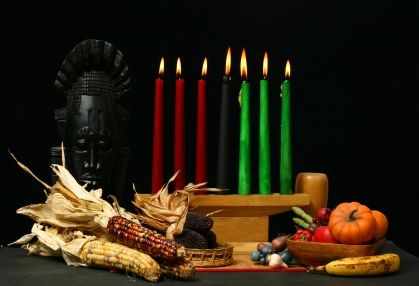
I am ending this year with pride and culture. I have been hesitant to start the practice of Kwanzaa in my home for some time, not because I did not believe in the value of its practice, but because of…. fear. It is the continuous fear of breaking away from overculture, even though I am Pagan, and a Black woman. I will never fit into the norm of overculture, and it is not something I am trying to do anyway. It is often an unconscious fear that pushes us away from something that is new and potentially beneficial…. yet different.
Kwanzaa is different, even though it should not be. I have dibbled and dabbled in studying up on it, but this year is different for me. 2013 has been one of intensive, intentional cultural reflection and learning. I have much more to learn, and yet am happy about what I am accomplishing on this journey. I have come to see that this year, my openness to embracing my ancestral culture and knowledge has made some people very uncomfortable. And yet, this same openness to embracing my ancestral culture and knowledge has led me to Kwanzaa.
So while I am not an expert on this celebratory holiday, I still feel compelled to share my journey as a doorway to personal reflection.
Part of living as a fully integrated spiritual being means that I don’t have to separate my roots from my worship. I can embrace my modern Paganism, often representative of Eurocentric gods and images, while still spiritually celebrating being a Black woman. There are many of us on this path that have to find that balance. After 11 years in the Craft, I am still perfecting mine.
Brief Explanation:
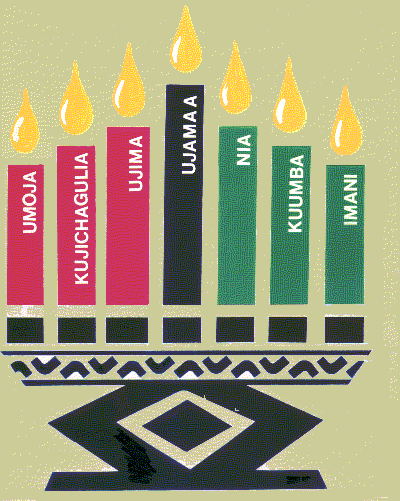 This African and Pan-African holiday was created by a professor of Black studies at California State University Long Beach, Dr. Maulana Ron Karenga, in 1966. Part of the motivation of this celebration was to help connect us back to a culture, and the roots of a culture, that is strong in a history we were separated from. The seven days of Kwanzaa represent the seven principles of the celebration. According to this website illustrating information on Kwanzaa, the 7 principles include: (1) Umoja or Unity; (2) Kujichagulia or Self-Determination; (3) Ujima or Collective Work and Responsibility; (4) Ujamaa or Cooperative Economics; (5) Nia or Purpose; (6) Kuumba or Creativity; and (7) Imani or Faith.
There is a customary meal on the 31st of December where families celebrate togetherness, and the 1st day of January is a day of reflection. It is said that on the day of meditation you are to reflect on three questions (Kawaida): “Who am I?”, “Am I really who I say I am”, “Am I all I ought to be?”. It is also said that this is a good time to honor the ancestors as well.
The Kinara, the candle holder for Kwanzaa, holds 7 candles that represents the colors of Africa. “Green is for the land, Gold is for our riches, Red is for the blood that was spilled, and black is for our people”, this is what I learned in as a child. Some of the informational websites talk about the correlations between Orisha and the colors as well.
The Making of a Kinara:
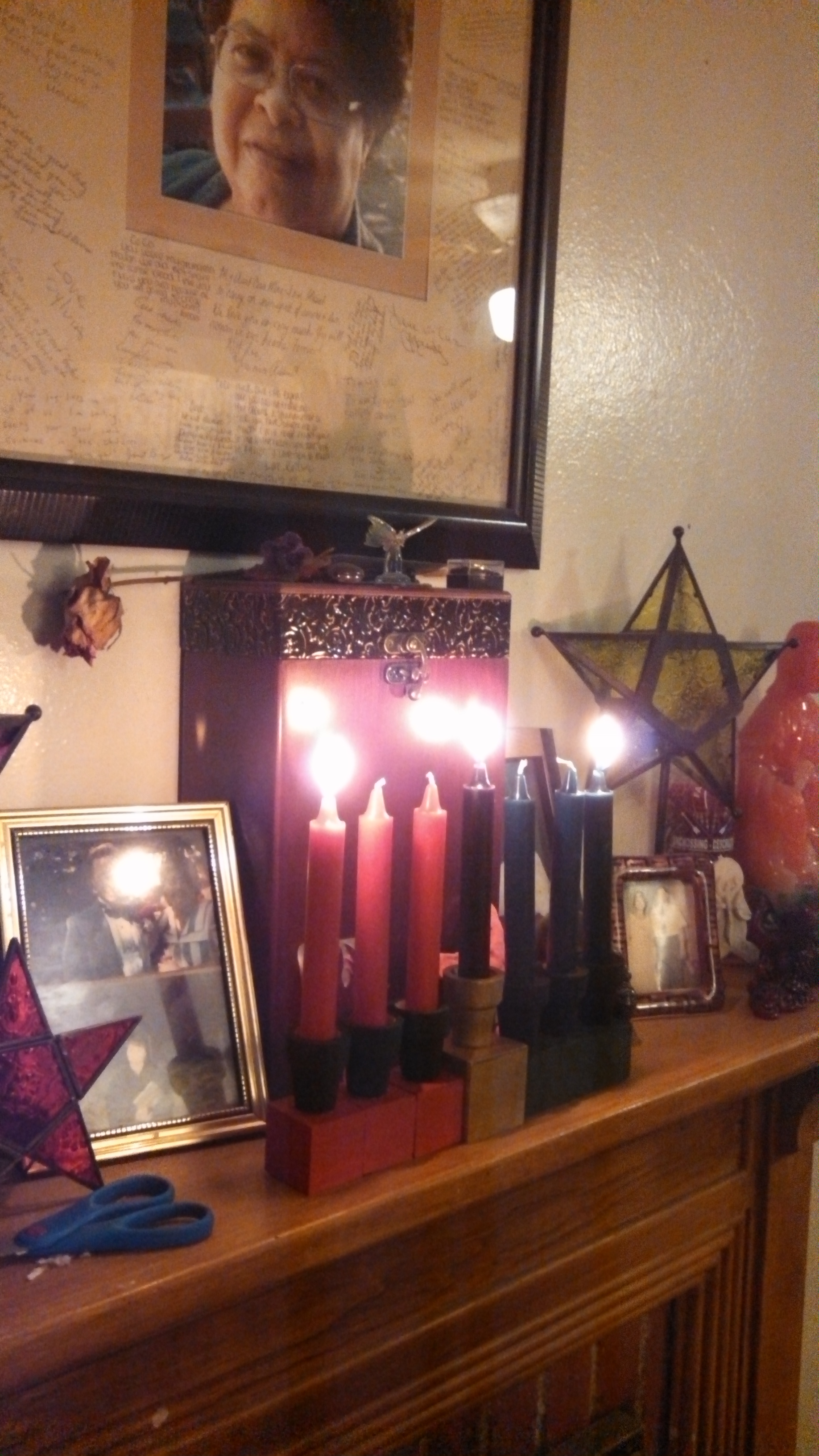 So I discovered that it is not easy finding a Kinara in all areas. I live in a relatively affluent community, and it was harder to find a Kinara than it is to find black hair care products. So after the frustration of looking, I decided to make one myself. I found a design on Michael’s craft store website that was pretty easy to make, and I went to the Michael’s down the street. Online I found Kinara’s priced from about $40.00 – 70.00, and the supplies to make this came to about $23.00. It would have been less if I had paint brushes and acrylic paint already, but I didn’t, so the cost includes those things.
I got seven blocks, painted them the colors of red, gold and green. I got 7 mini wooden pots, (they were out of the wooden candle holders), and painted those black. And then I got busy with the hot glue gun.
And BAM!!! I had a pretty cool little Kinara.
Oh, and then I had to find a black candle in December; small complication indeed.
Spiritual Inclusion:
I decided to put my Kinara on my ancestor mantle. I found that to be the most fitting in my home, a direct connection with my ancestors of blood and bone. Sitting right in front of my mother’s ashes, I lit the candles on the Kinara. Since I had to make one, I am a little behind on the candle lighting part.
In thinking about the seven principles that encompass this holiday, I have chosen to sit in meditation every night to really reflect on how the concepts empower who I am today, and who I want to be. My husband Jon and I talked about this today, how to do this with a family, and make it inclusive of their various developmental learning stages. We decided that we would do our meal on the 31st, and we would do the same on the first, and ask these types of questions (Kawaida) of ourselves to discuss. This way we can ask them in more developmentally appropriate ways, and share with one another how we are honoring the spirit of Kwanzaa. I hope this will embed the importance of these values in the children, so they will grow up to have a sense of importance about their culture and the roots of their ancestors.
Our most important form of magic comes from an ability to understand our personal power. Our strongest magic, our most authentic magic, is part ancestral, visionary, intentional, relational, and all things love…. all things you. So the more we take the time to know ourselves, the closer we are to manifesting things that are in line with our deepest wants and needs, and closer to our life plan.
It is for those reasons alone that my spiritual and culturally ethnic worlds have to share same space within my home. May your magic be as powerful as your holiday memories, your most loving embrace, your most vivid dreams, and the most mind-blowing touch.
I plan to ride that magic into 2014. Shall we?
Blessed Kwanzaa.
Lyrics from Sweet Honey on the Water’s Seven Principles song. Enjoy!
UMOJA-Unity that brings us together.
KUJICHAGULIA- We will determine who we are.
UJIMA- Working and building our union.
UJAMAA- We’ll spend our money wisely.
NIA- We know the purpose of our lives.
KUUMBA- All that we touch is more beautiful.
IMANI- We believe that we can, We know that we can, We will any way that we can.

Browse Our Archives
Select a Category Ancestors Culture goddess justice Magical work Natural hair Paganism parenting ritual service Spiritual Growth Uncategorized Wicca
Select a Month April 2016 February 2016 January 2016 December 2015 November 2015 September 2015 July 2015 June 2015 May 2015 March 2015 February 2015 January 2015 December 2014 November 2014 October 2014 September 2014 August 2014 July 2014 June 2014 May 2014 April 2014 March 2014 February 2014 January 2014 December 2013 November 2013 October 2013 September 2013 August 2013 July 2013 June 2013 May 2013 April 2013 March 2013 February 2013 January 2013 December 2012 November 2012 October 2012 September 2012 August 2012 July 2012 June 2012 May 2012 April 2012 March 2012 February 2012 January 2012 December 2011 November 2011 October 2011 September 2011 August 2011 July 2011 June 2011 May 2011 April 2011 March 2011
Follow Us!
TAKE THE
Religious Wisdom Quiz
True or False: Romans teaches that creation itself will be liberated from its bondage to decay.
Select your answer to see how you score.
FALSE TRUE
Related posts from Daughters of Eve

Conjuring a Path: Embracing African-American Folk Magic



Dropping the Crystal Ball with A Little Grace,...
TRENDING AT PATHEOS Pagan

I was recently chatting with someone on Instagram. She asked me what...

While there are many people who share their results, the end of...

On July 23, I saw Christopher Nolan's The Odyssey which is Homer’s...

As I write this two big events have just finished up. One...

Restoring the Watershed of Divine Love
Perhaps cooperation is not something we manufacture through legislation, ideology, or moral...

Many UUs don’t pray because of bad experiences in a previous religion,...
view all Pagan blogs
Ad-Free & Subscriber Log-In Subscription Support
- About Us
- 2026 Calendar
- Videos
- Podcasts
- Library of World Religions
- Faith In Media Tracker
- Advertise With Us
- Write for Us
- Privacy Policy
- Terms of Service
- Do Not Sell My Data
- Contact Us
- Radiant Digital
- Manage Newsletter Subscriptions
- Unsubscribe From Notifications
- Sitemap
Copyright 2008-2026, Patheos. All rights reserved.
Subscription Support Ad-Free & Subscriber Log-In
Follow Patheos