
BuddhistCatholicContemplativeEvangelicalGeneral ChristianHinduJewishLatter-day SaintMuslimNew VisionsProgressive Christian
Beliefs
- Buddhist
- Catholic
- Contemplative
- Evangelical
- General Christian
- Hindu
- Jewish
- Latter-day Saint
- More Voices
- Muslim
- New Visions
- Pagan
- Progressive Christian
Topics
- Religion News
- Food and Religion
- Sports and Religion
- Religious Art
- Religious Music and Entertainment
- Religious Events
- History and Religion
- Style and Religion
- Politics and Religion
- Women in Religion
- Recreation Outdoors and Religion
- Business Finance and Religion
- Careers Workplace and Religion
- Education and Religion
- Family Parenting and Religion
- Health Fitness and Religion
- Home and Religion
- Relationships and Religion
- Technology and Religion
- Travel and Religion
Columnists
- Buddhist Columnists
- Business Finance and Religion Columnists
- Careers Workplace and Religion Columnists
- Catholic Columnists
- Contemplative Columnists
- Education and Religion Columnists
- Evangelists Columnists
- Family Parenting and Religion Columnists
- General Christian Columnists
- Health Fitness and Religion Columnists
- Hindu Columnists
- History and Religion Columnists
- Home and Religion Columnists
- Jewish Columnists
- More Voices Columnists
- Latter Day Columnists
- Muslim Columnists
- New Visions Columnists
- Nonreligious Columnists
- Pagan Columnists
- Politics and Religion Columnists
- Progressive Columnists
- Recreation Outdoors and Religion Columnists
- Relationships and Religion Columnists
- Religion News Columnists
- Religious Art Columnists
- Religious Events Columnists
- Religious Music and Entertainment Columnists
- Sports and Religion Columnists
- Style and Religion Columnists
- Technology and Religion Columnists
- Travel and Religion Columnists
- Women in Religion Columnists
Resource Library
- 2026 Calendar
- Library of World Religions
- The 100 Most Holy Places on Earth
- Patheos Answers
- Podcasts
- Videos
- Faith Leaders Database
- Anglican Episcopalian
- Bahai
- Baptist
- Buddhism
- Christianity
- Confucianism
- Eastern Orthodoxy
- Hinduism
- Holiness and Pentecostal
- ISKCON
- Islam
- Judaism
- Lutheran
- Methodist
- The Church of Jesus Christ of Latter-day Saints
- New Age
- Paganism
- Presbytarian and Reformed
- Protestantism
- Religion Behind the Scenes
- Roman Catholic
- Scientology
- Shia Islam
- Sikhism
- Sufism
- Sunni Islam
- Taoism
- Zen
- See all religions
Research Tools
 Ad-Free & Subscriber Log-In Subscription Support
Ad-Free & Subscriber Log-In Subscription Support
Follow Patheos 

- Trending:
- Forgiveness
- |
- Marriage
- |
- Consciousness
- |
- Death Penalty
- |
- Election
- |
- Halloween
 Daughters of Eve
- Home
- Pagan
- Sensationalizing Pagan Leaders: The Damaging Social Structure Behind BNP Status
Sensationalizing Pagan Leaders: The Damaging Social Structure Behind BNP Status
Last updated on: March 21, 2013 at 11:12 am by Crystal Blanton
Sensationalizing Pagan Leaders: The Damaging Social Structure Behind BNP Status 2013-03-21T11:12:05-04:00 Crystal Blanton
Patheos Explore the world's faith through different perspectives on religion and spirituality! Patheos has the views of the prevalent religions and spiritualities of the world.
My good friend Peter Dybing started a conversation on his blog several days ago that is really important to me. I was on the Pagan Musings Podcast and was talking about this very topic because I was referred to as one of the “new BNP’s”. Not that the podcast did anything wrong, but the thought made me cringe. I have never publicly been called any type of BNP, only teased by my closest friends. And yet the conversation from the interview and Peter’s blog, presents a view point that I agree with. The use of of the label BNP is not helpful to the greater needs within the Pagan community. In my opinion, the need that serves the whole of the community is an ability to be one with each other in worship, celebration and in growth.

The term Big Named Pagan has become a part of modern Pagan culture. I think part of what I do not like is the separation from community that happens when someone is labeled as different from others. I see community as a group of people that have common interests or beliefs, and are working together to achieve or celebrate those commonalities. Part of the power of that is the knowing that we are all in this together; good, bad or indifferent. It is the process of co-existence that motivates us to work towards the betterment of our society. The labeling of certain people out of those community members means that there is a separation and they are then given this elitist type position within the community. How does this further empower or promote the community voice? How does this encourage everyone to embrace the responsibility of the outcome of the collective people? I do not believe it does, and that it is counterproductive at best.
When someone speaks against the BNP title, it is often confused with an unwillingness to accept leadership responsibilities. This is far from the truth in my opinion. Leadership does not bother me, work does not bother me. I am not afraid to get my hands dirty and “put my money where my mouth is”. The societal culture of separation is one that goes beyond Paganism. It is a culture that is deeply ingrained in American culture and our history together on this land. We have always needed a leader, a ruler, a decision maker or an enforcer. We are conditioned to look for those who are more worthy than the average person to hold the torch.
And just like with American politics, we elect those people and then we tear them down once they are in office. We forget that before given the title, they were mothers, fathers, sons, daughters, workers, voters, and community members. Low and behold, everyone that receives a label of such is still a real life person that benefits from their active participation in the process of community.
Why do we do this to our community leaders? Why do we build them up, thrust importance onto them, push them away from community and then blame them for not fulfilling our needs? Who is responsible for fulfilling our personal needs? Why do we twist certain types of leadership or expression into the dysfunctional, distorted culture mold of our American history; basing worth in spotlight value?
Social work theories point to many systems that make sense of this. Conflict theory being one of them. Conflict theory looks at social groups and structures that naturally create conflict over limited resources. Then the real question we should look at is one of limited resource. What is so limited?
I have seen a limited resource on personal worth within society, and also within the Pagan community. Our community is a microcosm of larger societal issues, meaning that we are a perfect representation of the larger whole; beauty and issues included. Our smaller version of the whole shows the same struggles with identity, and finding importance individually and collectively. People place value on titles, labels, categories, associations, teachers, traditions, physical appearances, or even practices instead of placing value on ourselves. We have the automatic response that something outside of ourselves will define who we are… or who we are not. The limited resource might just be a base lack of personal and cultural community worth.
Society structures of belief between the “haves” and the “have nots”, the worthy and the unworthy, is based on the history of value system within our society. We define the importance of people based on outdated moral information and judge them by standards that often no longer apply. Social work theory’s often refers to American values that include individualism, protestant work ethic, egalitarianism and social Darwinism. These values have been a part of our foundation and become a part of our cultural conditioning as Americans. And so it is my belief that we unconsciously view our small society through the glasses of a history rich in separation, and with a strong sense of identifying the values of one another to indicate importance.
I understand this and yet it saddens me to see us unconsciously, and sometimes consciously, use divisive tactics within our community that will divide more than serve. I am not anti-leadership or some form of structure. I am against blindly applying structures in our community that have proven to be historically harmful to the ability to celebrate our collective worth. Let us be conscious of the unconscious messages we are passing along in our speech and our actions. That is all I am asking.
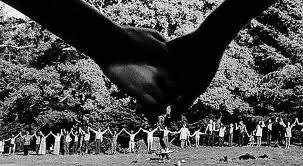
No one is a small named Pagan to me. I wish everyone could know the awesomeness I have learned from the “small names” as well as those who might be more commonly known. I learn from my coven sisters all the time, for years. My local community teaches me so much. My husband stretches me daily to be a better mother, wife and priestess.
No amount of skill, Pagan fame, publicity, good photos or even incredible writing would make someone effective in isolation. I am not effective with any mission I set out to do by myself, without the skills and support around me . And so I am choosing to recognize the contributions of all people in our Pagan village, including my own. Let’s celebrate and appreciate one another, and grow within ourselves, and within our community, to rebuild our personal and community worth.
And in that process, let us be conscious of our developing vocabulary, so we can be inclusive in our speech. We can choose phrases that do not include the opposite as somehow smaller or less. We can consciously select ways to refer to one another that continue the thread of community.
Previous Post

March 19, 2013
Two Years and Counting
Next Post

March 27, 2013 Stepping Out of the Broom Closet and Gliding Across Boundaries
Browse Our Archives
Select a Category Ancestors Culture goddess justice Magical work Natural hair Paganism parenting ritual service Spiritual Growth Uncategorized Wicca
Select a Month April 2016 February 2016 January 2016 December 2015 November 2015 September 2015 July 2015 June 2015 May 2015 March 2015 February 2015 January 2015 December 2014 November 2014 October 2014 September 2014 August 2014 July 2014 June 2014 May 2014 April 2014 March 2014 February 2014 January 2014 December 2013 November 2013 October 2013 September 2013 August 2013 July 2013 June 2013 May 2013 April 2013 March 2013 February 2013 January 2013 December 2012 November 2012 October 2012 September 2012 August 2012 July 2012 June 2012 May 2012 April 2012 March 2012 February 2012 January 2012 December 2011 November 2011 October 2011 September 2011 August 2011 July 2011 June 2011 May 2011 April 2011 March 2011
Follow Us!
TAKE THE
Religious Wisdom Quiz
I am a book of sermons and laws, Moses' final words before entering the Promised Land. What book am I?
Select your answer to see how you score.
The second law The law Moses' testimony Deuteronomy
Related posts from Daughters of Eve

Conjuring a Path: Embracing African-American Folk Magic



Dropping the Crystal Ball with A Little Grace,...
TRENDING AT PATHEOS Pagan

I was recently chatting with someone on Instagram. She asked me what...

While there are many people who share their results, the end of...

On July 23, I saw Christopher Nolan's The Odyssey which is Homer’s...

As I write this two big events have just finished up. One...

Restoring the Watershed of Divine Love
Perhaps cooperation is not something we manufacture through legislation, ideology, or moral...

Many UUs don’t pray because of bad experiences in a previous religion,...
view all Pagan blogs
Ad-Free & Subscriber Log-In Subscription Support
- About Us
- 2026 Calendar
- Videos
- Podcasts
- Library of World Religions
- Faith In Media Tracker
- Advertise With Us
- Write for Us
- Privacy Policy
- Terms of Service
- Do Not Sell My Data
- Contact Us
- Radiant Digital
- Manage Newsletter Subscriptions
- Unsubscribe From Notifications
- Sitemap
Copyright 2008-2026, Patheos. All rights reserved.
Subscription Support Ad-Free & Subscriber Log-In
Follow Patheos