
BuddhistCatholicContemplativeEvangelicalGeneral ChristianHinduJewishLatter-day SaintMuslimNew VisionsProgressive Christian
Beliefs
- Buddhist
- Catholic
- Contemplative
- Evangelical
- General Christian
- Hindu
- Jewish
- Latter-day Saint
- More Voices
- Muslim
- New Visions
- Pagan
- Progressive Christian
Topics
- Religion News
- Food and Religion
- Sports and Religion
- Religious Art
- Religious Music and Entertainment
- Religious Events
- History and Religion
- Style and Religion
- Politics and Religion
- Women in Religion
- Recreation Outdoors and Religion
- Business Finance and Religion
- Careers Workplace and Religion
- Education and Religion
- Family Parenting and Religion
- Health Fitness and Religion
- Home and Religion
- Relationships and Religion
- Technology and Religion
- Travel and Religion
Columnists
- Buddhist Columnists
- Business Finance and Religion Columnists
- Careers Workplace and Religion Columnists
- Catholic Columnists
- Contemplative Columnists
- Education and Religion Columnists
- Evangelists Columnists
- Family Parenting and Religion Columnists
- General Christian Columnists
- Health Fitness and Religion Columnists
- Hindu Columnists
- History and Religion Columnists
- Home and Religion Columnists
- Jewish Columnists
- More Voices Columnists
- Latter Day Columnists
- Muslim Columnists
- New Visions Columnists
- Nonreligious Columnists
- Pagan Columnists
- Politics and Religion Columnists
- Progressive Columnists
- Recreation Outdoors and Religion Columnists
- Relationships and Religion Columnists
- Religion News Columnists
- Religious Art Columnists
- Religious Events Columnists
- Religious Music and Entertainment Columnists
- Sports and Religion Columnists
- Style and Religion Columnists
- Technology and Religion Columnists
- Travel and Religion Columnists
- Women in Religion Columnists
Resource Library
- 2026 Calendar
- Library of World Religions
- The 100 Most Holy Places on Earth
- Patheos Answers
- Podcasts
- Videos
- Faith Leaders Database
- Anglican Episcopalian
- Bahai
- Baptist
- Buddhism
- Christianity
- Confucianism
- Eastern Orthodoxy
- Hinduism
- Holiness and Pentecostal
- ISKCON
- Islam
- Judaism
- Lutheran
- Methodist
- The Church of Jesus Christ of Latter-day Saints
- New Age
- Paganism
- Presbytarian and Reformed
- Protestantism
- Religion Behind the Scenes
- Roman Catholic
- Scientology
- Shia Islam
- Sikhism
- Sufism
- Sunni Islam
- Taoism
- Zen
- See all religions
Research Tools
 Ad-Free & Subscriber Log-In Subscription Support
Follow Patheos 

- Trending:
- Advent
- |
- Forgiveness
- |
- Thanksgiving
- |
- Election
- |
- Seasonal Holidays
- |
- Marriage

- Home
- Latter-day Saint
- Travel and Religion
- “The Soul’s Captain”
“The Soul’s Captain”
Last updated on: November 23, 2026 at 11:03 pm by Dan Peterson
“The Soul’s Captain” 2026-11-23T23:03:14-07:00 Dan Peterson
Patheos Explore the world's faith through different perspectives on religion and spirituality! Patheos has the views of the prevalent religions and spiritualities of the world.

A Tuscan landscape after the wheat harvest
(Wikimedia Commons public domain photograph by Martin Falbisoner)
I published this column for Thanksgiving 2012 in the Deseret News. I don’t believe that it’s entirely obsolete yet:
William Ernest Henley’s famous Victorian-era poem “Invictus” provided the title and the theme for Clint Eastwood’s inspiring 2009 film about Nelson Mandela. It also provided the memorable claim “I am the master of my fate: I am the captain of my soul.”
It’s a stirring assertion, and, in a very real sense, true. A great proportion of what we are and do rests upon our own decisions.
But not everything, and perhaps not the most important things. Henley’s claim is also false and misleading.
As I write, a friend and neighbor is recuperating from a catastrophic fall that lacerated his face, took out most of his teeth, broke major bones everywhere in his body, and very nearly killed him. As he plunged groundwards, he certainly wasn’t the master of his fate, and he’s scarcely more so as he lies in a hospital bed. Those who’ve surveyed the spot where he landed, closely bordered by objects that could instantly have ended his life, regard his survival as a miracle, and he himself, speaking with difficulty, testifies to it.
“I thank whatever gods may be,” says Henley, “for my unconquerable soul.”
Thirty years ago, my wife and I traveled with our infant son from southern California to her parents’ house in Denver, Colorado, where the whole extended family were gathering for a Christmas trip to Florida. We participated in a “Messiah” sing-along and then went home to prepare for our flight to Orlando the next morning.
But then came what’s been called “the Christmas Eve blizzard of 1982.” Stapleton International Airport closed at 9:30 AM on 24 December, remained closed for fully thirty-three hours, and then, for several days thereafter, was open only for severely limited operations. Ten-foot-high snowdrifts were left throughout greater Denver, highways into and out of the city were shut down, power outages darkened large portions of the metropolitan area, roofs collapsed, supermarkets closed because their employees couldn’t get to work, hospitals were reduced to minimal staff on emergency power, and snowmobiles dominated suburban streets.
It was astounding to me, and revealing, to realize how easily simple snowfall could shut down a major modern city quite accustomed to seeing it.
We’re plainly not entirely the masters of our fates, the captains of our souls. Rather, as Elder Orson F. Whitney (d. 1931) of the Quorum of the Twelve Apostles put it in “The Soul’s Captain,” his response to “Invictus,” “Men are as bubbles on the wave, as leaves upon the tree.”
We’re fragile creatures. A few days without food, even fewer without water, a few minutes without oxygen, and we’re gone. If our hearts miss just a few beats, none of our plans, ambitions, schemes, or careful investments will mean a thing. And, in the end, no matter how we fight it, we’ll die.
Our comfort and survival in the meantime depend upon cycles of evaporation and precipitation that few of us really understand, and we rely upon complex networks of exchange and transportation that very few of us could begin to explain.
The ground on which most of us live and where our food is grown was cleared of rocks, trees, and stumps by millions of hardworking people whose names we’ve forgotten. Our cities—big and small—feature large buildings erected by generations of construction workers to whom we’ve probably never given the slightest thought.
We owe a debt of gratitude that we can never repay. “For behold, are we not all beggars? Do we not all depend upon . . . God, for all the substance which we have, for both food and raiment, and for gold, and for silver, and for all the riches which we have of every kind?” (Mosiah 4:19). The Book of Mormon’s Amulek wisely counsels us that we should “humble ourselves even to the dust, and worship God, in whatsoever place we may be in, in spirit and in truth; and that we live in thanksgiving daily, for the many mercies and blessings which he doth bestow upon us” (paraphrased slightly from Alma 34:38).
In the United States of America, where many of us are gathering together as families and friends for the Thanksgiving holiday, this is an exceptionally appropriate day for us to remember the debt that we owe to those who’ve preceded us and to God, “in whom we live, and move, and have our being” (Acts 17:28).
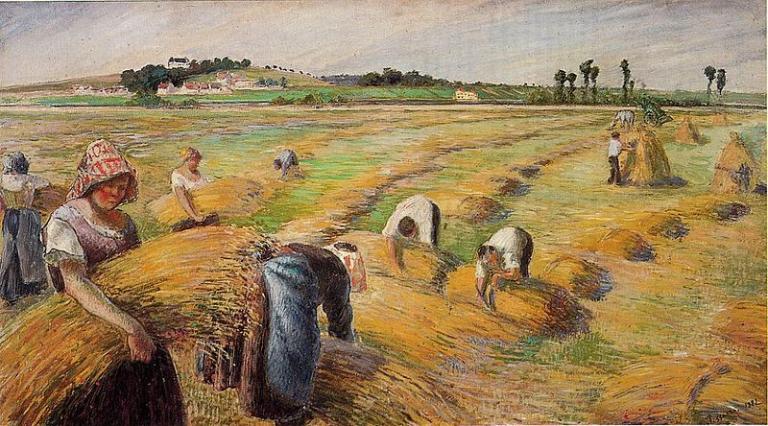
Camille Pissarro, “The Harvest” (1882) (Wikimedia Commons public domain image)
And here is my Deseret News Thanksgiving column for the next year, 2013:
American traditions of Thanksgiving are generally associated with Puritan harvest feasts in early colonial times, and particularly with the one in October 1621, when Chief Massasoit and about 90 other Native American men joined slightly more than 50 European immigrants at Plymouth Colony, in today’s Massachusetts, for a communal meal. Abraham Lincoln’s formal proclamation of a late-November “Day of Thanksgiving and Praise” came just 150 years ago, in 1863. However, religious festivals of thanksgiving associated with the agricultural cycle, thanking God for a bounteous harvest – essential to life through the winter — are much more ancient and universal, and can be found in most religious traditions of the world. In ancient agrarian societies, where survival ultimately depended on rain and on the fertility cycles of local plants and animals, a failed harvest could swiftly bring widespread disaster and death. Accordingly, a bountiful harvest was received with gratitude.
The sacrifices and festivals of ancient Israel were likewise fundamentally linked to the annual seasons of planting and reaping. One of their sacrifices was actually called the “thanksgiving” (Hebrew “todah”). As described in Leviticus 7:11-15, the thanksgiving offering was an entire meal, including fried cakes, bread and meat. Furthermore, it was commanded that “the flesh of the sacrifice of the peace offerings for thanksgiving shall be eaten the same day that it is offered.” That is, the ancient Israelite thanksgiving sacrifice was a sacred feast, a meal in which the food offerings were symbolically shared with God but were literally eaten by the sacrificer. In ancient Israel, such a “holiday feast”—as we now describe it—was actually a “holy-day feast.”
One of the fundamental psalms sung by the Levite choir each day at the temple was “O give thanks unto the Lord, for he is good, and his mercy endures forever” (Psalms 106, 107, 118, 136, 138; 1 Chronicles. 16:7, 34, 23:30; 2 Chronicles. 5:13, 7:6; Nehemiah 12:8). One could enter the Israelite temple only if one “entered the gates with thanksgiving” (Psalms 100:4 95:2). Psalm 50 describes the characteristics of the “thanksgiving sacrifice” (50:15): “he who offers thanksgiving (Hebrew “todah”) glorifies me” (50:23; cf. Psalm 116:17). When Jeremiah prophesied of the future restoration of Jerusalem and its temple, which was to come following the Babylonian captivity, he predicted that the returning Jews would “bring thank offerings to the house of the Lord” (Jeremiah 17:26), singing “songs of thanksgiving” (Jeremiah 30:19). Jeremiah likewise prophesied that in Jerusalem should again be heard “the voice of joy and the voice of gladness, the voice of the bridegroom and the voice of the bride . . . as they bring the thanksgiving sacrifice (Hebrew “todah”) into the House of the Lord” (Jeremiah 33:11).
In the New Testament, Christ is twice described as giving thanks in the context of a sacred meal. At the feeding of the 5000, he took the loaves and fish and, “having given thanks, he broke them and gave them to the disciples, and the disciples gave them to the crowds” (Matthew 15:36; Mark 8:6; John 6:11). In the old Israelite thanksgiving sacrifice, the people were to bring food to the temple and give it to the priests, who would then offer it to God. Now, in a paradoxical reversal of the old order, Christ, as God incarnate, brings the food, offers thanks, and gives it to his apostle-priests who then offer it to the people. The old order of the thanksgiving offering is thus reversed.
The same reversal of roles is found at the Last Supper, where, at the Passover dinner, Jesus gives thanks and shares a sacred meal with his apostles (Matthew 26:37; Mark 14:23; Luke 22:17, 19; 1 Corinthians 11:24). Christ’s atoning sacrifice has thus become a “thanksgiving offering.” Although in the Latter-day Saint tradition we tend to call our commemoration of the Last Supper the “sacrament,” in ancient Christianity it was referred to as the Eucharist— the “thanksgiving”. This is because Christ is described as having “given thanks” at the Last Supper—in Greek, “eucharistesas.” (Still today, the modern Greek equivalent of “thank you” is “efkharisto.”) Thus, for Latter-day Saint Christians, the sacrament is our commemoration of the archetypal thanksgiving sacrifice and meal of ancient Israel, of which our modern Thanksgiving holiday is only a pale shadow. Appropriately, too, for many Americans Thanksgiving kicks off the serious holiday season that culminates in Christmas, which recalls God’s greatest gift to us, his Son.
Travel and Religion
History and Religion
Previous Post

November 22, 2026
Gratitude for air and dirt
Recent Comments
"There is a ward of The Church of Jesus Christ of Latter-day Saints in Dearborn. ..."
Islam soon to be the world’s ..."
"Interesting question. I have closely read Stephen Smoots book, asked Kara Cooney her views. Kerry ..."
"There's more amazement still, too. Most of the metals that humanity has ever extracted from ..."
"Did you know someone stole Shakespeare's skull? It was thought to be a rumour but ..."
Browse Our Archives
Select a Category Uncategorized
Select a Month November 2026 October 2026 September 2026 August 2026 July 2026 June 2026 May 2026 April 2026 March 2026 February 2026 January 2026 December 2025 November 2025 October 2025 September 2025 August 2025 July 2025 June 2025 May 2025 April 2025 March 2025 February 2025 January 2025 December 2024 November 2024 October 2024 September 2024 August 2024 July 2024 June 2024 May 2024 April 2024 March 2024 February 2024 January 2024 December 2023 November 2023 October 2023 September 2023 August 2023 July 2023 June 2023 May 2023 April 2023 March 2023 February 2023 January 2023 December 2022 November 2022 October 2022 September 2022 August 2022 July 2022 June 2022 May 2022 April 2022 March 2022 February 2022 January 2022 December 2021 November 2021 October 2021 September 2021 August 2021 July 2021 June 2021 May 2021 April 2021 March 2021 February 2021 January 2021 December 2020 November 2020 October 2020 September 2020 August 2020 July 2020 June 2020 May 2020 April 2020 March 2020 February 2020 January 2020 December 2019 November 2019 October 2019 September 2019 August 2019 July 2019 June 2019 May 2019 April 2019 March 2019 February 2019 January 2019 December 2018 November 2018 October 2018 September 2018 August 2018 July 2018 June 2018 May 2018 April 2018 March 2018 February 2018 January 2018 December 2017 November 2017 October 2017 September 2017 August 2017 July 2017 June 2017 May 2017 April 2017 March 2017 February 2017 January 2017 December 2016 November 2016 October 2016 September 2016 August 2016 July 2016 June 2016 May 2016 April 2016 March 2016 February 2016 January 2016 December 2015 November 2015 October 2015 September 2015 August 2015 July 2015 June 2015 May 2015 April 2015 March 2015 February 2015 January 2015 December 2014 November 2014 March 2014 August 2013 February 2012
Follow Us!
TAKE THE
Religious Wisdom Quiz
True or False: Animals that chew the cud but do not have split hooves are considered clean to eat.
Select your answer to see how you score.
TRUE FALSE
Related posts from Sic et Non
Giving Thanks . . . To a Person


A really, really long post for the eve...
TRENDING AT PATHEOS Latter-day Saint

Smart people saying smart things (11.24.26)
Please take time to listen to Perry Bacon, Sarah Posner, Adam Serwer,...

The Contingency of Our Technology
Last week we were hit with a raft of massive technology outages....

In 1939, President Franklin D. Roosevelt moved Thanksgiving from November 30 to...

Reasons for Restraint: Ricardo Gonzalez, Florida and Dec...
The Morning of January 3 I begin with the dead. On the...

I published this column for Thanksgiving 2012 in the Deseret News....

For many years, Catholicism has been caught up in division over the...
view all Latter-day Saint blogs
What Are Your Thoughts?leave a comment
Ad-Free & Subscriber Log-In Subscription Support
- About Us
- 2026 Calendar
- Videos
- Podcasts
- Library of World Religions
- Faith In Media Tracker
- Advertise With Us
- Write for Us
- Privacy Policy
- Terms of Service
- Do Not Sell My Data
- Contact Us
- Radiant Digital
- Manage Newsletter Subscriptions
- Unsubscribe From Notifications
- Sitemap
Copyright 2008-2026, Patheos, part of the Radiant Digital network of media brands. All rights reserved.
Subscription Support Ad-Free & Subscriber Log-In
Follow Patheos