
BuddhistCatholicContemplativeEvangelicalGeneral ChristianHinduJewishLatter-day SaintMuslimNew VisionsProgressive Christian
Beliefs
- Buddhist
- Catholic
- Contemplative
- Evangelical
- General Christian
- Hindu
- Jewish
- Latter-day Saint
- More Voices
- Muslim
- New Visions
- Pagan
- Progressive Christian
Topics
- Religion News
- Food and Religion
- Sports and Religion
- Religious Art
- Religious Music and Entertainment
- Religious Events
- History and Religion
- Style and Religion
- Politics and Religion
- Women in Religion
- Recreation Outdoors and Religion
- Business Finance and Religion
- Careers Workplace and Religion
- Education and Religion
- Family Parenting and Religion
- Health Fitness and Religion
- Home and Religion
- Relationships and Religion
- Technology and Religion
- Travel and Religion
Columnists
- Buddhist Columnists
- Business Finance and Religion Columnists
- Careers Workplace and Religion Columnists
- Catholic Columnists
- Contemplative Columnists
- Education and Religion Columnists
- Evangelists Columnists
- Family Parenting and Religion Columnists
- General Christian Columnists
- Health Fitness and Religion Columnists
- Hindu Columnists
- History and Religion Columnists
- Home and Religion Columnists
- Jewish Columnists
- More Voices Columnists
- Latter Day Columnists
- Muslim Columnists
- New Visions Columnists
- Nonreligious Columnists
- Pagan Columnists
- Politics and Religion Columnists
- Progressive Columnists
- Recreation Outdoors and Religion Columnists
- Relationships and Religion Columnists
- Religion News Columnists
- Religious Art Columnists
- Religious Events Columnists
- Religious Music and Entertainment Columnists
- Sports and Religion Columnists
- Style and Religion Columnists
- Technology and Religion Columnists
- Travel and Religion Columnists
- Women in Religion Columnists
Resource Library
- 2026 Calendar
- Library of World Religions
- The 100 Most Holy Places on Earth
- Patheos Answers
- Podcasts
- Videos
- Faith Leaders Database
- Anglican Episcopalian
- Bahai
- Baptist
- Buddhism
- Christianity
- Confucianism
- Eastern Orthodoxy
- Hinduism
- Holiness and Pentecostal
- ISKCON
- Islam
- Judaism
- Lutheran
- Methodist
- The Church of Jesus Christ of Latter-day Saints
- New Age
- Paganism
- Presbytarian and Reformed
- Protestantism
- Religion Behind the Scenes
- Roman Catholic
- Scientology
- Shia Islam
- Sikhism
- Sufism
- Sunni Islam
- Taoism
- Zen
- See all religions
Research Tools
 Ad-Free & Subscriber Log-In Subscription Support
Follow Patheos 

- Trending:
- Advent
- |
- Forgiveness
- |
- Thanksgiving
- |
- Election
- |
- Seasonal Holidays
- |
- Marriage

- Home
- Latter-day Saint
- History and Religion
- Thinking about Thanksgiving
Thinking about Thanksgiving
Last updated on: November 25, 2026 at 8:34 pm by Dan Peterson
Thinking about Thanksgiving 2026-11-25T20:34:41-07:00 Dan Peterson
Patheos Explore the world's faith through different perspectives on religion and spirituality! Patheos has the views of the prevalent religions and spiritualities of the world.
Here are two Thanksgiving columns that I originally wrote for the Deseret News.
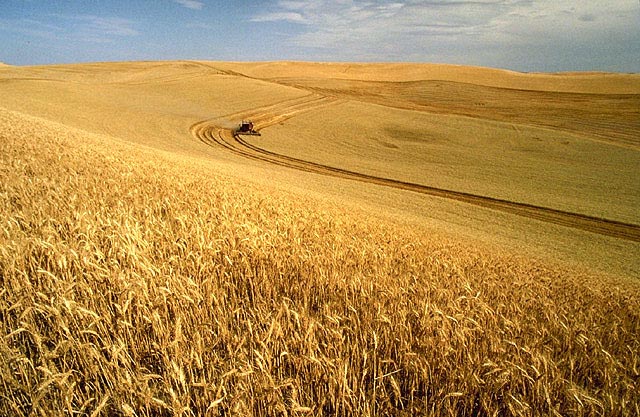
A rich harvest of wheat (Wikimedia Commons)
The first appeared in 2015:
Although American Thanksgiving Day began as a harvest festival, it’s not about eating. Most of us eat quite well—often too well—every day, so meals aren’t special. It’s not even really about family. As its name implies, it’s about giving thanks.
And we have much for which to be thankful.
Why is there a universe in the first place? Why is it so precisely fine-tuned as to produce us? The great twentieth-century atheistic astrophysicist Sir Fred Hoyle concluded, rather grumpily, that the whole thing is “a put-up job,” that “a superintellect has monkeyed with physics, as well as with chemistry and biology.” “As we look out into the universe,” wrote the Anglo-American mathematical physicist Freeman Dyson, of Princeton’s Institute for Advanced Study, “and identify the many accidents of physics and astronomy that have worked together to our benefit, it almost seems as if the universe must in some sense have known that we were coming.”
Ours, says the British physicist Paul Davies, is “a Goldilocks Universe.” It’s “just right.” And so is the globe on which we live, as demonstrated in recent books bearing such titles as Privileged Planet and Rare Earth.
Our bodies are phenomenally complicated; our brains, some scientists say, are the most physically complex objects in the known universe. Stars and galaxies are simple in comparison.
Most readers of this column enjoy the privilege of American citizenship, or of something rather like it. There are, today, a number of free countries that respect human rights. But many are unfree and oppressive. There are many prosperous nations, too—but also many that are very poor. We should be mindful of those less fortunate than ourselves, but also grateful for the blessings that we enjoy and not complacent about them.
Although most of us are isolated or insulated from the production of food and take it for granted, we have easy access to diets of a richness and variety that would have been unimaginable even to our relatively recent ancestors and to many in the world still today.
Gutenberg’s printing press and, now, ebooks and the Web and powerful search engines, grant us easy access to vast treasuries of knowledge. Cell phones and cheap and instant Internet communications keep us in contact, wherever we are. As we hurtle along in climate-controlled automobiles or jet aircraft, we listen, if the mood strikes us, to concerts by U2, or Taylor Swift, or the Berlin Philharmonic. And we lament journeys of several hours that, not so long ago, would have required uncomfortable days if not miserable and dangerous weeks. GPS systems guide us at every step, taking us from driveway to driveway, thousands of miles away.
Of course, no technical marvel changes life’s fundamentals. We still love family and friends. We still lose them. We become sick and, despite superb healthcare (including antibiotics and surgical procedures unknown to our grandparents), we die. We suffer from the human evils of oppression, crime, cruelty, and war. We endure mental and emotional illnesses, and virtually all of us know someone whose life has been damaged or even ruined by the scourge of drugs.
So, more than for anything else, we who’ve been privileged to learn of the Gospel of Christ should be thankful for his atonement and resurrection, which can mend all broken things and make all good things eternal. The power is not ours, but his. I close with powerful words from two hymns, the first from Rudyard Kipling and the second a Latin text derived from Psalm 115:1 and most recently set to memorable music by the great film composer Patrick Doyle:
God of our fathers, known of old, Lord of our far-flung battle-line, Beneath whose awful Hand we hold Dominion over palm and pine—Lord God of Hosts, be with us yet, Lest we forget—lest we forget!
The tumult and the shouting dies; The Captains and the Kings depart: Still stands Thine ancient sacrifice, An humble and a contrite heart. Lord God of Hosts, be with us yet, Lest we forget—lest we forget!
Far-called, our navies melt away; On dune and headland sinks the fire: Lo, all our pomp of yesterday Is one with Nineveh and Tyre! Judge of the Nations, spare us yet, Lest we forget—lest we forget!
Non nobis, Domine, non nobis, sed nomini tuo da gloriam. “Not unto us, O Lord, not unto us, but to thy name give the glory.”
Thanks be to God.

At Thanksgiving and throughout the Christmas season, many of us enjoy — even over-indulge in — the abundance of another year’s good harvest. But many, especially worldwide, don’t. Can we help? Yes. Easily. In ways both large and small. Even something small is better than nothing.
The second appeared in 2016:
It’s not insignficant that the verbs to think and to thank (compare German denken and danken) share the same linguistic root. The scriptures are replete with exhortations to “remember,” to reflect, to thank:
“O give thanks unto the Lord,” says the psalmist (105:1-5), “call upon his name: make known his deeds among the people. Sing unto him, sing psalms unto him: talk ye of all his wondrous works. Glory ye in his holy name: let the heart of them rejoice that seek the Lord. . . . Remember his marvellous works that he hath done; his wonders, and the judgments of his mouth.”
Even secular-minded people should pause occasionally to consider the blessings that we enjoy. We live in a universe, for example, that’s seemingly fine-tuned for our arrival, on a privileged planet where the conditions are primed for life.
But those conditions have existed throughout history. Today, though, most Americans live in unprecedented luxury of which even kings couldn’t have dreamed a few generations ago. Royal castles were drafty and cold then, and lacked plumbing. For us, by contrast, if the weather is too hot, we turn the air conditioning on. If it’s too cold, we have central heating.
We can, if we choose, enjoy an unimaginably rich cuisine—American one day, Chinese the next. Mexican, Thai, Indian, Japanese, French, Italian. We eat a variety of fruits and vegetables, without regard to season. The diet of a Renaissance prince was poor and monotonous compared to the offerings of a typical American supermarket.
For most of us, hunger and starvation aren’t the issue; our problem is actually having too much. (Of course, that’s not true of everybody, and now our challenge is to share with those most in need and, ideally, to bring them and others up to a better standard of living.) If anything, the traditional Thanksgiving feast has lost a bit of its “specialness” because many of us eat pretty well all the time. (One of my students tells me, though, that she’s looking eagerly forward to what she calls “non-ramen Thursday.”)
Our technology, our labor-saving devices, would astonish our ancestors. We travel at unimaginable speeds in unthinkable comfort; we’re upset if our flight is delayed for thirty minutes, and irritated when we’re handed pretzels rather than peanuts or obliged to sit in a middle seat.
We listen to the Berlin Philharmonic or to the latest rock or country tunes wherever and whenever we want. We communicate cheaply and instantaneously at great distances. The world’s knowledge is available to us with a few clicks. We watch movies on demand, whenever we choose. In our own homes. Whereas earlier generations were obliged to work from sunrise to sunset in order to survive, we worry about whether we’re getting enough exercise.
Many of the diseases that once carried us off can be cured with simple medicines; other ailments can be fixed with routine procedures. Death still takes us eventually but, on the whole, we live pretty well until it does. When our hearing falters, we have hearing aids. We keep our teeth, or else we replace them—along with our hips and our knees. Have you ever thought to be grateful for your glasses or contact lenses? Perhaps you should. What would your life be like without them?
Latter-day Saints, though, have specific reasons to be thankful, reasons that go far beyond material comforts and technological marvels.
The restoration of the gospel in the early nineteenth century provides modern corroboration of the biblical stories. It testifies of Christ’s atoning sacrifice and of his resurrection from the dead, gracious gifts from a loving Father and his selfless Son. Because Christ rose, we too will rise, and the ordinances of the gospel link generations together for all eternity. Life wins. Love wins. The restored gospel tells us of the plan of salvation, a plan of happiness that suffuses our lives with rich and deep meaning. It teaches us of a Heavenly Father who wants us to inherit everything that he has.
“O give thanks unto the Lord,” sings the Psalmist, “for he is good: for his mercy endureth for ever” (Psalm 107:1).
Moreover, the restored gospel teaches us that—like God, who seeks to share everything he has with his children—we should share our abundance with our brothers and sisters. At this season, as at all others. “Be ye therefore perfect, even as your Father which is in heaven is perfect” (Matthew 5:48).
Posted from Williamsburg, Virginia
History and Religion
Travel and Religion
Previous Post

November 24, 2026
Demmed if it do and demmed if it don't
Recent Comments
"TB: "I didn’t see you on top of the Herefordshire Beacon?"You were paying attention!My left ..."
Demmed if it do and demmed ..."
"TB: "Dan, can you find and restore my missing comment?"Sorry. I've been traveling since well ..."
Demmed if it do and demmed ..."
"Dan, can you find and restore my missing comment?"
Demmed if it do and demmed ..."
"TP: "As long as dispersed lead levels stay below 0.15 ug/m3, its not a problem."Not ..."
Demmed if it do and demmed ..."
Browse Our Archives
Select a Category Uncategorized
Select a Month November 2026 October 2026 September 2026 August 2026 July 2026 June 2026 May 2026 April 2026 March 2026 February 2026 January 2026 December 2025 November 2025 October 2025 September 2025 August 2025 July 2025 June 2025 May 2025 April 2025 March 2025 February 2025 January 2025 December 2024 November 2024 October 2024 September 2024 August 2024 July 2024 June 2024 May 2024 April 2024 March 2024 February 2024 January 2024 December 2023 November 2023 October 2023 September 2023 August 2023 July 2023 June 2023 May 2023 April 2023 March 2023 February 2023 January 2023 December 2022 November 2022 October 2022 September 2022 August 2022 July 2022 June 2022 May 2022 April 2022 March 2022 February 2022 January 2022 December 2021 November 2021 October 2021 September 2021 August 2021 July 2021 June 2021 May 2021 April 2021 March 2021 February 2021 January 2021 December 2020 November 2020 October 2020 September 2020 August 2020 July 2020 June 2020 May 2020 April 2020 March 2020 February 2020 January 2020 December 2019 November 2019 October 2019 September 2019 August 2019 July 2019 June 2019 May 2019 April 2019 March 2019 February 2019 January 2019 December 2018 November 2018 October 2018 September 2018 August 2018 July 2018 June 2018 May 2018 April 2018 March 2018 February 2018 January 2018 December 2017 November 2017 October 2017 September 2017 August 2017 July 2017 June 2017 May 2017 April 2017 March 2017 February 2017 January 2017 December 2016 November 2016 October 2016 September 2016 August 2016 July 2016 June 2016 May 2016 April 2016 March 2016 February 2016 January 2016 December 2015 November 2015 October 2015 September 2015 August 2015 July 2015 June 2015 May 2015 April 2015 March 2015 February 2015 January 2015 December 2014 November 2014 March 2014 August 2013 February 2012
Follow Us!
TAKE THE
Religious Wisdom Quiz
True or False: Song of Solomon is also called Song of Songs.
Select your answer to see how you score.
TRUE FALSE
Related posts from Sic et Non

We shouldn't act as if WE'RE in the...

This coming Sunday in Santa Barbara
TRENDING AT PATHEOS Latter-day Saint

Book III, Chapter 3: Christ "Classic" (Matt. 9:9-34)
Book III, Chapter 3: Christ "Classic" (Matt. 9:9-34) In honor of tomorrow's...

Jesus explicitly mentions the book of Jonah twice, but he retells the...

Peggy Sue Got Married: Coppola’s Always Been Like...
I enjoyed Megalopolis (2024). It’s a mess, but I enjoyed it. The...

My dissertation The Place of Mysticism in the Late Middle Ages concerns...

God and the Contingency of This World
The great Catholic philosopher Aquinas and the great Lutheran philosopher Leibniz developed...

Pope Francis and The Devil – A Pagan...
According to his private diaries, Pope Francis saw visions of the devil...
view all Latter-day Saint blogs
What Are Your Thoughts?leave a comment
Ad-Free & Subscriber Log-In Subscription Support
- About Us
- 2026 Calendar
- Videos
- Podcasts
- Library of World Religions
- Faith In Media Tracker
- Advertise With Us
- Write for Us
- Privacy Policy
- Terms of Service
- Do Not Sell My Data
- Contact Us
- Radiant Digital
- Manage Newsletter Subscriptions
- Unsubscribe From Notifications
- Sitemap
Copyright 2008-2026, Patheos, part of the Radiant Digital network of media brands. All rights reserved.
Subscription Support Ad-Free & Subscriber Log-In
Follow Patheos