
BuddhistCatholicContemplativeEvangelicalGeneral ChristianHinduJewishLatter-day SaintMuslimNew VisionsProgressive Christian
Beliefs
- Buddhist
- Catholic
- Contemplative
- Evangelical
- General Christian
- Hindu
- Jewish
- Latter-day Saint
- More Voices
- Muslim
- New Visions
- Pagan
- Progressive Christian
Topics
- Religion News
- Food and Religion
- Sports and Religion
- Religious Art
- Religious Music and Entertainment
- Religious Events
- History and Religion
- Style and Religion
- Politics and Religion
- Women in Religion
- Recreation Outdoors and Religion
- Business Finance and Religion
- Careers Workplace and Religion
- Education and Religion
- Family Parenting and Religion
- Health Fitness and Religion
- Home and Religion
- Relationships and Religion
- Technology and Religion
- Travel and Religion
Columnists
- Buddhist Columnists
- Business Finance and Religion Columnists
- Careers Workplace and Religion Columnists
- Catholic Columnists
- Contemplative Columnists
- Education and Religion Columnists
- Evangelists Columnists
- Family Parenting and Religion Columnists
- General Christian Columnists
- Health Fitness and Religion Columnists
- Hindu Columnists
- History and Religion Columnists
- Home and Religion Columnists
- Jewish Columnists
- More Voices Columnists
- Latter Day Columnists
- Muslim Columnists
- New Visions Columnists
- Nonreligious Columnists
- Pagan Columnists
- Politics and Religion Columnists
- Progressive Columnists
- Recreation Outdoors and Religion Columnists
- Relationships and Religion Columnists
- Religion News Columnists
- Religious Art Columnists
- Religious Events Columnists
- Religious Music and Entertainment Columnists
- Sports and Religion Columnists
- Style and Religion Columnists
- Technology and Religion Columnists
- Travel and Religion Columnists
- Women in Religion Columnists
Resource Library
- 2026 Calendar
- Library of World Religions
- The 100 Most Holy Places on Earth
- Patheos Answers
- Podcasts
- Videos
- Faith Leaders Database
- Anglican Episcopalian
- Bahai
- Baptist
- Buddhism
- Christianity
- Confucianism
- Eastern Orthodoxy
- Hinduism
- Holiness and Pentecostal
- ISKCON
- Islam
- Judaism
- Lutheran
- Methodist
- The Church of Jesus Christ of Latter-day Saints
- New Age
- Paganism
- Presbytarian and Reformed
- Protestantism
- Religion Behind the Scenes
- Roman Catholic
- Scientology
- Shia Islam
- Sikhism
- Sufism
- Sunni Islam
- Taoism
- Zen
- See all religions
Research Tools
 Ad-Free & Subscriber Log-In Subscription Support
Ad-Free & Subscriber Log-In Subscription Support
Follow Patheos 

- Trending:
- Forgiveness
- |
- Marriage
- |
- Consciousness
- |
- Death Penalty
- |
- Election
- |
- Halloween

- Home
- Latter-day Saint
- Travel and Religion
- Walking through History
Walking through History
Last updated on: October 16, 2026 at 2:44 pm by Dan Peterson
Walking through History 2026-10-16T14:44:08-06:00 Dan Peterson
Patheos Explore the world's faith through different perspectives on religion and spirituality! Patheos has the views of the prevalent religions and spiritualities of the world.
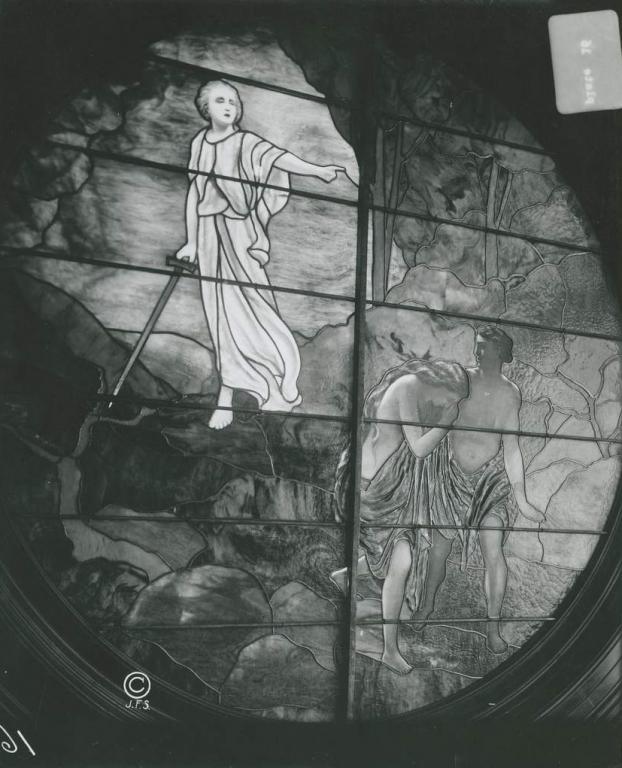
A Tiffany glass window in the Salt Lake Temple depicting the expulsion of Adam and Eve from the Garden of Eden. Unfortunately, I don’t have an image in color. It’s one of four Tiffany windows in the Salt Lake Temple.
(Wikimedia Commons public domain image)
A new article, written by Jeff Lindsay and Gale L. Pooley, went up today in Interpreter: A Journal of Latter-day Saint Faith and Scholarship 70 (2026): 91-128 under the title ““Enough and to Spare”: Economic Data Vindicate Once-implausible Prophetic Statements”:
Abstract: Despite frequently lacking material abundance in his life and living at a time when Malthusian concepts were becoming popular among intellectuals, Joseph Smith made a daring prophecy in 1834. He stated that God had designed the earth with abundant resources such that “the earth is full, and there is enough and to spare” (Doctrine and Covenants 104:17). While many in the world, and sometimes even in the Church, believe that the world is running out of many resources due to overpopulation, extensive economic data show that the opposite is true. Resources tend to become more abundant over time, as long as there is some degree of economic freedom. Here we examine those data, showing that our planet is not merely blessed with abundance, but with “superabundance.” The data suggest that Joseph’s daring prophecy has been vindicated. In fact, economic data further suggest that the most serious scarce resource the planet faces is arguably human beings who can create, innovate, and solve problems of scarcity, especially human beings who apply their agency for good. The teachings of the gospel can bring both spiritual and temporal abundance on this earth that is full, with enough and to spare.
I’m afraid that, being really busy over here and out of sync with American times and being still, rather incredibly, somewhat jet-lagged (perhaps because I’m also a bit under the weather), I’ve fallen behind on alerting readers of this blog to new materials from the Interpreter Foundation. So here’s another one: “Reprint: ‘This Thing is a Similitude’; A Typological Approach to Moses 5;4-15 and Ancient Apocryphal Literature,” written by David Calabro:
Part of our book chapter reprint series, this article originally appeared in Tracing Ancient Threads in the Book of Moses — Inspired Origins, Temple Contexts, and Literary Qualities Volumes I and II, edited by Jeffrey M. Bradshaw, David R. Seely, John W. Welch, and Scott Gordon. For more information, go to https://interpreterfoundation.org/books/ancient-threads-in-the-book-of-moses/.
“One of the most significant features of the Book of Moses is its account of the redemption of Adam and Eve following their expulsion from the Garden of Eden, an account that is completely absent from the parallel parts of the received text of Genesis. This account begins immediately following the notice of Adam and Eve working and having children, the portion of the text corresponding to Genesis 4:1a: ‘And Adam knew Eve his wife.’”

Golubac Fortress exactly as it appeared when we stepped from the boat (Wikimedia Commons public domain image)
Our visit this morning was to the extremely scenic and historically significant Golubac Fortress on the Serbian side of the Danube. I had no expectations, but I was delighted with it — not least because we docked very nearby and because our local guide was unusually fun and informative.
Stefan Lazarević (ca. 1377 – 1427) was one of those who possessed Golubac. My interest was caught by the fact that he was involved (as a vassal of the Ottoman Turks) in the catastrophic battle between the Ottomans, led by Sultan Bayezid I (aka Ottoman Turkish: یلدیرم بايزيد; modernTurkish: Yıldırım Bayezid or “Bayezid the Thunderbolt”; ca. 1360 – 1403). Despite his many brilliant military triumphs, Bayezid was defeated and captured by the Turco-Mongolian conqueror Timur-i Leng (Tamerlane) at the Battle of Ankara in 1402 and died in captivity in March 1403. Some reports indicate that Bayezid spent his last year or year and a half being transported around in a cage.
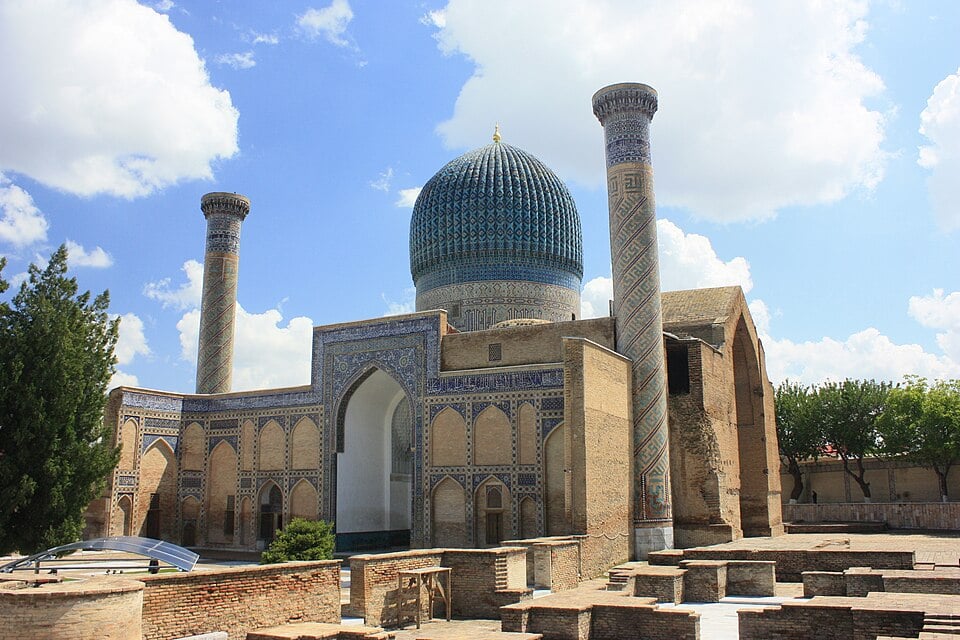
The Gūr-i Amīr in Samarkand (Wikimedia Commons public domain image)
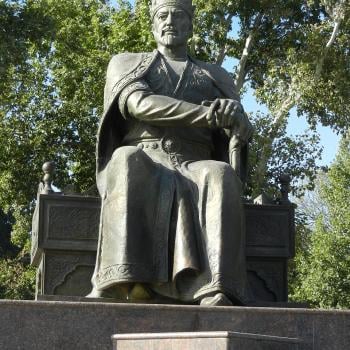
When I was in Uzbekistan in April of last year, we spent a fair amount of time on our first day at the Gūr-i Amīr, Timur’s mausoleum . The founder of the vast but relatively short-lived Timurid Empire, Timur is treated as a hero in Uzbekistan. (There is, for example, a larger than life-sized statue of an enthroned “Timur the Great” located in a park within easy walking distance of the hotel where we stayed.) In my opinion, though, Timur was probably a sociopath. While we were under the dome of the Gūr-i Amīr, listening to our local guide praise him, one of the Iranian scholars with whom we were to meet leaned over to me and whispered “He was a horrible person, you know.” I absolutely agreed, and that was the beginning of a beautiful friendship.
Timur took great and seemingly psychopathic pleasure in torturing and killing people. One of his trademark acts after capturing a city was to build large piles or towers of severed heads; one source that I recall reading in graduate school reported that, with the passage of time, the severed heads would decay and that, at night, they began to give off an eery greenish glow.
Once, when the Persian city of Isfahan — an important center of art and literature that I have visited — revolted against his oppressively high taxes, he ordered its citizens massacred; the death toll is estimated to have been between 100,000 and 200,000. An eye-witness counted more than 28 towers constructed of about 1,500 heads each, in Isfahan alone.
Here’s a charming story that I also recall reading while I was in grad school: A mid-sized city found itself in the path of Timur’s conquests and, hearing about the mass slaughters that had occurred in towns that had resisted him, decided to open its gates and surrender rather than to suffer the same fate. In fact, it went even further: When the conqueror approached, the residents of the city sent a large number of its young girls out to meet him, dressed in white and strewing flowers before him. Evidently, though, he wasn’t in a good mood. (Maybe he had a headache. Maybe his rheumatism was acting up, or he had a bad hangnail.) So he ordered his cavalry to trample the young girls to death.
One source suggests that, altogether, Timur was responsible for the deaths of approximately twenty million people. In the fourteenth century, a death toll of twenty million people would represent roughly five percent of the world’s total population. I lament Bayezid’s defeat.
Posted from Donji Milanovac, Serbia
Travel and Religion
History and Religion
Previous Post

October 15, 2026
Learning more about a region of which I've known little
Recent Comments
"I have cpnsidered in my mond if the 4 volume Saints could be made into ..."
From Serbia’s “White City,” Belgrade
"Another class of memories are of individuals who previously lived. Some of these remembered individuals ..."
"Sutherland's lecture sounds interesting. He seems to restate the Washington consensus that trade brings peace ..."
Learning more about a region of ..."
"In a meeting today, I learned another important reason why accurate (or at least as ..."
From Serbia’s “White City,” Belgrade
Browse Our Archives
Select a Category Uncategorized
Select a Month October 2026 September 2026 August 2026 July 2026 June 2026 May 2026 April 2026 March 2026 February 2026 January 2026 December 2025 November 2025 October 2025 September 2025 August 2025 July 2025 June 2025 May 2025 April 2025 March 2025 February 2025 January 2025 December 2024 November 2024 October 2024 September 2024 August 2024 July 2024 June 2024 May 2024 April 2024 March 2024 February 2024 January 2024 December 2023 November 2023 October 2023 September 2023 August 2023 July 2023 June 2023 May 2023 April 2023 March 2023 February 2023 January 2023 December 2022 November 2022 October 2022 September 2022 August 2022 July 2022 June 2022 May 2022 April 2022 March 2022 February 2022 January 2022 December 2021 November 2021 October 2021 September 2021 August 2021 July 2021 June 2021 May 2021 April 2021 March 2021 February 2021 January 2021 December 2020 November 2020 October 2020 September 2020 August 2020 July 2020 June 2020 May 2020 April 2020 March 2020 February 2020 January 2020 December 2019 November 2019 October 2019 September 2019 August 2019 July 2019 June 2019 May 2019 April 2019 March 2019 February 2019 January 2019 December 2018 November 2018 October 2018 September 2018 August 2018 July 2018 June 2018 May 2018 April 2018 March 2018 February 2018 January 2018 December 2017 November 2017 October 2017 September 2017 August 2017 July 2017 June 2017 May 2017 April 2017 March 2017 February 2017 January 2017 December 2016 November 2016 October 2016 September 2016 August 2016 July 2016 June 2016 May 2016 April 2016 March 2016 February 2016 January 2016 December 2015 November 2015 October 2015 September 2015 August 2015 July 2015 June 2015 May 2015 April 2015 March 2015 February 2015 January 2015 December 2014 November 2014 March 2014 August 2013 February 2012
Follow Us!
TAKE THE
Religious Wisdom Quiz
What did Lamentations describe happening to Jerusalem?
Select your answer to see how you score.
Its blessing and expansion Its destruction and mourning Its rebuilding Its prosperity
Related posts from Sic et Non

Learning more about a region of which I've...

From Serbia's "White City," Belgrade
TRENDING AT PATHEOS Latter-day Saint

57th Dove Awards Honor Dolly Parton, Crown New...
On gospel music’s biggest night, the 57th annual GMA Dove Awards honored...

The First Eucharistic Controversy: Christ’s Real Presence
For Catholics, the Eucharist is the source and summit of the Christian...

What a Stop Sign Can Teach Us About...
How to Make a Decision When You Can't Hear God Main point:...

Archdiocese Hosts Military Marriage Retreat in Germany
RASTATT, Germany — The transient military lifestyle, with its frequent deployments and...

Nearly every morning, I make the drive to Detroit with my high-school-age...

The Real AI Story Is Adoption Without Trust
Artificial intelligence has crossed a political threshold. It is no longer a...
view all Latter-day Saint blogs
What Are Your Thoughts?leave a comment
Ad-Free & Subscriber Log-In Subscription Support
- About Us
- 2026 Calendar
- Videos
- Podcasts
- Library of World Religions
- Faith In Media Tracker
- Advertise With Us
- Write for Us
- Privacy Policy
- Terms of Service
- Do Not Sell My Data
- Contact Us
- Radiant Digital
- Manage Newsletter Subscriptions
- Unsubscribe From Notifications
- Sitemap
Copyright 2008-2026, Patheos. All rights reserved.
Subscription Support Ad-Free & Subscriber Log-In
Follow Patheos