
BuddhistCatholicContemplativeEvangelicalGeneral ChristianHinduJewishLatter-day SaintMuslimNew VisionsProgressive Christian
Beliefs
- Buddhist
- Catholic
- Contemplative
- Evangelical
- General Christian
- Hindu
- Jewish
- Latter-day Saint
- More Voices
- Muslim
- New Visions
- Pagan
- Progressive Christian
Topics
- Religion News
- Food and Religion
- Sports and Religion
- Religious Art
- Religious Music and Entertainment
- Religious Events
- History and Religion
- Style and Religion
- Politics and Religion
- Women in Religion
- Recreation Outdoors and Religion
- Business Finance and Religion
- Careers Workplace and Religion
- Education and Religion
- Family Parenting and Religion
- Health Fitness and Religion
- Home and Religion
- Relationships and Religion
- Technology and Religion
- Travel and Religion
Columnists
- Buddhist Columnists
- Business Finance and Religion Columnists
- Careers Workplace and Religion Columnists
- Catholic Columnists
- Contemplative Columnists
- Education and Religion Columnists
- Evangelists Columnists
- Family Parenting and Religion Columnists
- General Christian Columnists
- Health Fitness and Religion Columnists
- Hindu Columnists
- History and Religion Columnists
- Home and Religion Columnists
- Jewish Columnists
- More Voices Columnists
- Latter Day Columnists
- Muslim Columnists
- New Visions Columnists
- Nonreligious Columnists
- Pagan Columnists
- Politics and Religion Columnists
- Progressive Columnists
- Recreation Outdoors and Religion Columnists
- Relationships and Religion Columnists
- Religion News Columnists
- Religious Art Columnists
- Religious Events Columnists
- Religious Music and Entertainment Columnists
- Sports and Religion Columnists
- Style and Religion Columnists
- Technology and Religion Columnists
- Travel and Religion Columnists
- Women in Religion Columnists
Resource Library
- 2026 Calendar
- Library of World Religions
- The 100 Most Holy Places on Earth
- Patheos Answers
- Podcasts
- Videos
- Faith Leaders Database
- Anglican Episcopalian
- Bahai
- Baptist
- Buddhism
- Christianity
- Confucianism
- Eastern Orthodoxy
- Hinduism
- Holiness and Pentecostal
- ISKCON
- Islam
- Judaism
- Lutheran
- Methodist
- The Church of Jesus Christ of Latter-day Saints
- New Age
- Paganism
- Presbytarian and Reformed
- Protestantism
- Religion Behind the Scenes
- Roman Catholic
- Scientology
- Shia Islam
- Sikhism
- Sufism
- Sunni Islam
- Taoism
- Zen
- See all religions
Research Tools
 Ad-Free & Subscriber Log-In Subscription Support
Ad-Free & Subscriber Log-In Subscription Support
Follow Patheos 

- Trending:
- Forgiveness
- |
- Marriage
- |
- Consciousness
- |
- Death Penalty
- |
- Election
- |
- Halloween

- Home
- Latter-day Saint
- Travel and Religion
- “Look on my Works, ye Mighty, and despair!”
“Look on my Works, ye Mighty, and despair!”
Last updated on: September 16, 2026 at 10:43 am by Dan Peterson
“Look on my Works, ye Mighty, and despair!” 2026-09-16T10:43:01-06:00 Dan Peterson
Patheos Explore the world's faith through different perspectives on religion and spirituality! Patheos has the views of the prevalent religions and spiritualities of the world.
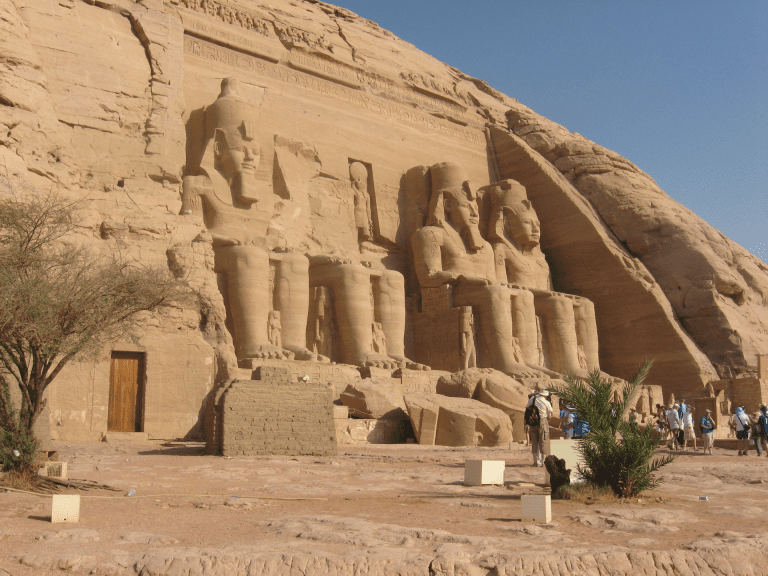
Part of the Temple of Ramses II (“the Great”) at Abu Simbel, far to Egypt’s south and its border with Sudan. (Wikimedia Commons public domain image) The companion temple that Ramses dedicated to his wife Nefertari — but which is likewise mostly about himself — is located roughly a hundred yards away to the left.
Pharaoh Ramses II (aka “Ramses the Great”; ca. BC 1303–1213) ruled over the Egyptian New Kingdom for roughly 67 years. One of the few pharaohs who were worshipped as deities during their lifetimes, he was responsible for massive building projects at Luxor, Karnak, Memphis, Abu Simbel, and other locations throughout Egypt. He also often had his artisans carve over or replace existing royal cartouches on statues and obelisks that had originally been made for earlier rulers such as Amenhotep III or Thutmose III. Sculptors sometimes even reshaped the facial features on statues of previous pharaohs in order to match Ramses II’s royal style. He has been dead for roughly 3239 years now, and, unsurprisingly, later pharaohs subsequently did the same thing to him.
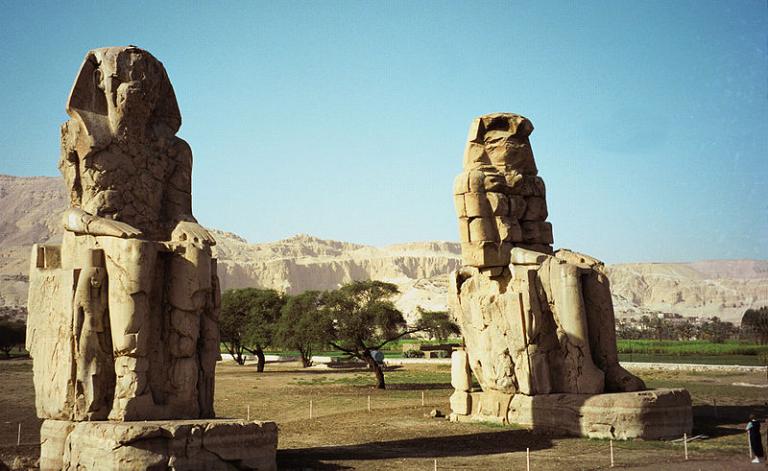
The Colossi of Memnon (Wikimedia Commons public domain image) These two statues of Amenhotep III (Eighteenth Dynasty; ca. 1388-1349 BC), located on the western bank of the Nile across from Luxor, are all that remains of his massive memorial temple. (Wikimedia Commons public domain photograph)
In ancient Greek sources, Ramses II is called Ozymandias, a name that is derived from the first part of his Egyptian-language regnal name: Usermaatre Setepenre. (“”The Maat of Ra is powerful—chosen of Ra”). Whenever I take a tour group to visit the so-called Colossi of Memnon on the western side of the River Nile across from Luxor, I make it a practice to read the poem Ozymandias, by Percy Bysshe Shelley, to my group.
The Colossi of Memnon were actually created as statues of the great New Kingdom pharaoh Amenhotep IV (reigned either BC 1386–1349 or BC 1388–1351/1350), marking the entrance to his enormous funerary temple or mortuary temple. Such royal temples were constructed as permanent ritual sites in which a deceased pharaoh would be worshipped and in which his ka — his life force or protective spirit — would be supplied with perpetual food, drink, and other goods. The two severely damaged statues are, now, essentially all that is left of Amenhotep III’s vast temple complex. By the early Christian era, they were thought by Greek and Roman visitors to represent the mythological King Memnon of Ethiopia, whose brief career and death are mentioned in Homer’s Iliad.
I don’t know much, if anything, about the actual character of Amenhotep III (aka “Amenhotep the Great” or “Amenhotep the Magnificent”; like Ramses II, he was worshipped as a god while still living), but the desolation surrounding his two forlorn statues, the last major remnant of what was once clearly the very large and impressive stone mortuary temple of the man who might have been the most powerful ruler of his time in the entire world — a man of whom very few people today have ever so much as heard the name — has always struck me as a powerful reminder of human transience and vanity, and of the ephemeral character of fame. Hence the relevance of Shelley’s Ozymandias:
I met a traveller from an antique land,
Who said—“Two vast and trunkless legs of stone
Stand in the desert. . . . Near them, on the sand,
Half sunk a shattered visage lies, whose frown,
And wrinkled lip, and sneer of cold command,
Tell that its sculptor well those passions read
Which yet survive, stamped on these lifeless things,
The hand that mocked them, and the heart that fed;
And on the pedestal, these words appear:
My name is Ozymandias, King of Kings;
Look on my Works, ye Mighty, and despair!
Nothing beside remains. Round the decay
Of that colossal Wreck, boundless and bare
The lone and level sands stretch far away.”

The colossal statue of Pharaoh Ramses II that lies just inside the gated entrance to the archaeological remains of ancient Memphis (Wikimedia Commons public domain image)
The empty tombs of the mighty pharaohs in the Valley of the Kings, and the great but empty pyramids of their royal predecessors, also summon up such thoughts, and put me in mind of the first chapter of the biblical book of Ecclesiastes:
2 Vanity of vanities, says the Preacher,
vanity of vanities! All is vanity.
3 What does man gain by all the toil
at which he toils under the sun?
4 A generation goes, and a generation comes,
but the earth remains forever.
5 The sun rises, and the sun goes down,
and hastens to the place where it rises.
6 The wind blows to the south
and goes around to the north;
around and around goes the wind,
and on its circuits the wind returns.
7 All streams run to the sea,
but the sea is not full;
to the place where the streams flow,
there they flow again.
8 All things are full of weariness;
a man cannot utter it;
the eye is not satisfied with seeing,
nor the ear filled with hearing.
9 What has been is what will be,
and what has been done is what will be done,
and there is nothing new under the sun.
10 Is there a thing of which it is said,
“See, this is new”?
It has been already
in the ages before us.
11 There is no remembrance of former things,
nor will there be any remembrance
of later things yet to be
among those who come after.

The John F. Kennedy Center for the Performing Arts in Washington DC
(Wikimedia Commons public domain photograph)
In other news: This morning, I asked former President Ronald Reagan — whom I enthusiastically supported in his campaigns for both the Governor’s Mansion in California and the White House — for his opinion on the current turmoil about renovating the Kennedy Center in Washington DC. In answer, he reminded me of a plaque that sat on his desk during his tenure as Governor of California and then as President of the United States. The inscription on it read as follows:
There is no limit to what a man can do or where he can go if he doesn’t mind who gets the credit.
Mr. Reagan also reminded me that official bronze/metal replicas of the plaque are available for purchase from the Ronald Reagan Presidential Foundation Store for $32.95.
Travel and Religion
History and Religion
Previous Post

September 15, 2026
Finally, a political blog entry like the ones I ALWAYS post!
Next Post

September 17, 2026 Islam in America or Islam versus America?
Recent Comments
"DP: “But Mr. Sutherland worries about the fact that our time, when we can communicate ..."
Learning more about a region of ..."
"Sutherland's lecture sounds interesting. He seems to restate the Washington consensus that trade brings peace ..."
Learning more about a region of ..."
"In a meeting today, I learned another important reason why accurate (or at least as ..."
From Serbia’s “White City,” Belgrade
"I've been watching a lot of video interviews of NDErs and researchers. I think in ..."
Browse Our Archives
Select a Category Uncategorized
Select a Month October 2026 September 2026 August 2026 July 2026 June 2026 May 2026 April 2026 March 2026 February 2026 January 2026 December 2025 November 2025 October 2025 September 2025 August 2025 July 2025 June 2025 May 2025 April 2025 March 2025 February 2025 January 2025 December 2024 November 2024 October 2024 September 2024 August 2024 July 2024 June 2024 May 2024 April 2024 March 2024 February 2024 January 2024 December 2023 November 2023 October 2023 September 2023 August 2023 July 2023 June 2023 May 2023 April 2023 March 2023 February 2023 January 2023 December 2022 November 2022 October 2022 September 2022 August 2022 July 2022 June 2022 May 2022 April 2022 March 2022 February 2022 January 2022 December 2021 November 2021 October 2021 September 2021 August 2021 July 2021 June 2021 May 2021 April 2021 March 2021 February 2021 January 2021 December 2020 November 2020 October 2020 September 2020 August 2020 July 2020 June 2020 May 2020 April 2020 March 2020 February 2020 January 2020 December 2019 November 2019 October 2019 September 2019 August 2019 July 2019 June 2019 May 2019 April 2019 March 2019 February 2019 January 2019 December 2018 November 2018 October 2018 September 2018 August 2018 July 2018 June 2018 May 2018 April 2018 March 2018 February 2018 January 2018 December 2017 November 2017 October 2017 September 2017 August 2017 July 2017 June 2017 May 2017 April 2017 March 2017 February 2017 January 2017 December 2016 November 2016 October 2016 September 2016 August 2016 July 2016 June 2016 May 2016 April 2016 March 2016 February 2016 January 2016 December 2015 November 2015 October 2015 September 2015 August 2015 July 2015 June 2015 May 2015 April 2015 March 2015 February 2015 January 2015 December 2014 November 2014 March 2014 August 2013 February 2012
Follow Us!
TAKE THE
Religious Wisdom Quiz
What Christian denomination is known for circuit riders and revival meetings in America?
Select your answer to see how you score.
Presbyterian Episcopalian Catholic Methodist
Related posts from Sic et Non

False Memories and Social Media

A sad day for Latter-day Saints
TRENDING AT PATHEOS Latter-day Saint

Swimfan: Forgotten Aughts Pleasures
This is a recovery effort. In 2002, My Big Fat Greek Wedding...

Top Three Anti-Catholic Lies About Catholicism
This is my initial transcript for the video, "THE 3 WORST...

Pope Leo Celebrates Mass for Nurses & Docs...
I don't have any idea how he did it, but Pope Leo...

The Sermon on the Mount, Part I: Matthew...
The Sermon on the Mount, Part I (Matthew 4:12-5:12) St. Matthew moves...

What's up from Crossway: Reviewing some of their latest A few weeks...

Janie Learns the Way of the Cross: A...
Teaching children about Jesus' Passion can be challenging. Many parents and educators...
view all Latter-day Saint blogs
What Are Your Thoughts?leave a comment
Ad-Free & Subscriber Log-In Subscription Support
- About Us
- 2026 Calendar
- Videos
- Podcasts
- Library of World Religions
- Faith In Media Tracker
- Advertise With Us
- Write for Us
- Privacy Policy
- Terms of Service
- Do Not Sell My Data
- Contact Us
- Radiant Digital
- Manage Newsletter Subscriptions
- Unsubscribe From Notifications
- Sitemap
Copyright 2008-2026, Patheos. All rights reserved.
Subscription Support Ad-Free & Subscriber Log-In
Follow Patheos