
BuddhistCatholicContemplativeEvangelicalGeneral ChristianHinduJewishLatter-day SaintMuslimNew VisionsProgressive Christian
Beliefs
- Buddhist
- Catholic
- Contemplative
- Evangelical
- General Christian
- Hindu
- Jewish
- Latter-day Saint
- More Voices
- Muslim
- New Visions
- Pagan
- Progressive Christian
Topics
- Religion News
- Food and Religion
- Sports and Religion
- Religious Art
- Religious Music and Entertainment
- Religious Events
- History and Religion
- Style and Religion
- Politics and Religion
- Women in Religion
- Recreation Outdoors and Religion
- Business Finance and Religion
- Careers Workplace and Religion
- Education and Religion
- Family Parenting and Religion
- Health Fitness and Religion
- Home and Religion
- Relationships and Religion
- Technology and Religion
- Travel and Religion
Columnists
- Buddhist Columnists
- Business Finance and Religion Columnists
- Careers Workplace and Religion Columnists
- Catholic Columnists
- Contemplative Columnists
- Education and Religion Columnists
- Evangelists Columnists
- Family Parenting and Religion Columnists
- General Christian Columnists
- Health Fitness and Religion Columnists
- Hindu Columnists
- History and Religion Columnists
- Home and Religion Columnists
- Jewish Columnists
- More Voices Columnists
- Latter Day Columnists
- Muslim Columnists
- New Visions Columnists
- Nonreligious Columnists
- Pagan Columnists
- Politics and Religion Columnists
- Progressive Columnists
- Recreation Outdoors and Religion Columnists
- Relationships and Religion Columnists
- Religion News Columnists
- Religious Art Columnists
- Religious Events Columnists
- Religious Music and Entertainment Columnists
- Sports and Religion Columnists
- Style and Religion Columnists
- Technology and Religion Columnists
- Travel and Religion Columnists
- Women in Religion Columnists
Resource Library
- 2026 Calendar
- Library of World Religions
- The 100 Most Holy Places on Earth
- Patheos Answers
- Podcasts
- Videos
- Faith Leaders Database
- Anglican Episcopalian
- Bahai
- Baptist
- Buddhism
- Christianity
- Confucianism
- Eastern Orthodoxy
- Hinduism
- Holiness and Pentecostal
- ISKCON
- Islam
- Judaism
- Lutheran
- Methodist
- The Church of Jesus Christ of Latter-day Saints
- New Age
- Paganism
- Presbytarian and Reformed
- Protestantism
- Religion Behind the Scenes
- Roman Catholic
- Scientology
- Shia Islam
- Sikhism
- Sufism
- Sunni Islam
- Taoism
- Zen
- See all religions
Research Tools
 Ad-Free & Subscriber Log-In Subscription Support
Ad-Free & Subscriber Log-In Subscription Support
Follow Patheos 

- Trending:
- Forgiveness
- |
- Marriage
- |
- Consciousness
- |
- Death Penalty
- |
- Election
- |
- Halloween

- Home
- Latter-day Saint
- History and Religion
- The Veto Power of Reason
The Veto Power of Reason
Last updated on: August 18, 2026 at 8:42 pm by Dan Peterson
The Veto Power of Reason 2026-08-18T20:42:39-06:00 Dan Peterson
Patheos Explore the world's faith through different perspectives on religion and spirituality! Patheos has the views of the prevalent religions and spiritualities of the world.

The Gordon B. Hinckley Alumni Center on the campus of Brigham Young University, in Provo, Utah. (Wikimedia Commons public domain image) I doubt that there will be much snow tomorrow on either the roof or the grounds. But we shall see!
The thirtieth installment of our ongoing series of short documentary videos came out yesterday, and I think that I neglected to mention it. (If true, this will be my first mistake in at least a decade.) So here it is: The latest iteration of the series is “Educate Women? What Did Brigham Young Believe?” — Becoming Brigham, Episode 30.
Were you aware, by the way, that you can actually subscribe to Becoming Brigham? Just go to the online home of the series, locate the button there that’s marked “Subscribe on YouTube,” click on it, and you’re virtually there. This way, you’ll be notified (or reminded) of new episodes. There is no charge and it’s quite painless.
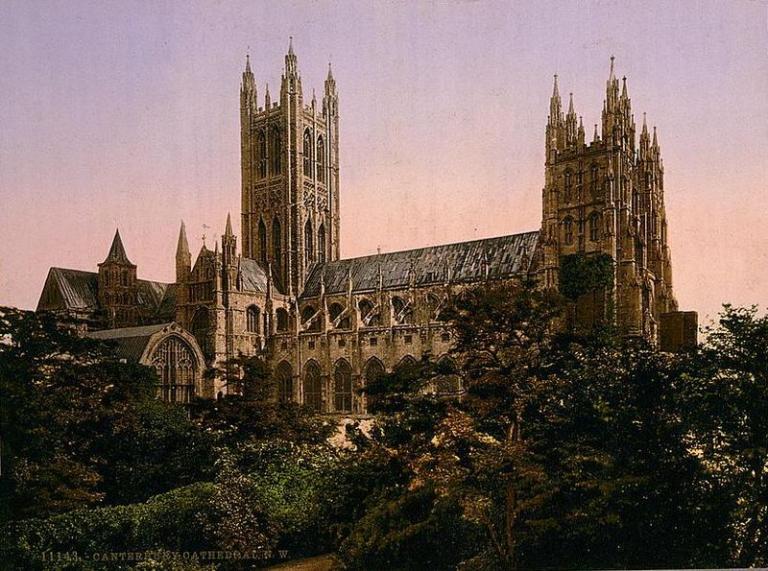
Canterbury Cathedral in the 1890s (Wikimedia Commons public domain image)
In other me-related news, I gave the first of my four 2026 BYU Education Week lectures today: The overall title for my lecture series is “After and Before the Apostles: Highlights from British Christian History Between Dispensations,” and today’s presentation was “Christianity Comes to the British Isles.” I spoke in the Assembly Hall of the Gordon B. Hinckley Alumni Center, which is billed as holding a lecture audience of five hundred people. It was full, practically speaking (that is, with a few empty chairs and a few people standing). We’ll see whether anybody comes tomorrow!
I had worried that I had too much material for one lecture but, as it happened, I finished a few minutes early. Bad planning. So I opened it up to questions. With such a large audience and high ceiling (and, possibly, with increasing deafness), it was sometimes a bit difficult to hear them. Still, if nobody else enjoyed himself or herself, I did. I’m an Anglophile, and I love English culture and English history. Tomorrow’s topic is “Figures from the History of British Monasticism.”

When I think of heaven, I confess that I think of Alpine mountain peaks and meadows. So I include here this image, from the region of Cusco, Peru: Among many other names, this peak is known as Verónica. At 19,334 feet (5,893 meters), it’s a genuinely serious peak.
(Wikimedia Commons public domain image)
And, once again, Jonn Claybaugh has generously contributed a set of notes for students and teachers of the Come, Follow Me curriculum of the Church of Jesus Christ of Latter-day Saints: Come, Follow Me — Old Testament Study and Teaching Helps August 24-30, 2026: Psalms 49-51; 61-66; 69-72; 77-78; 85-86 — “I will declare what he hath done for my soul”
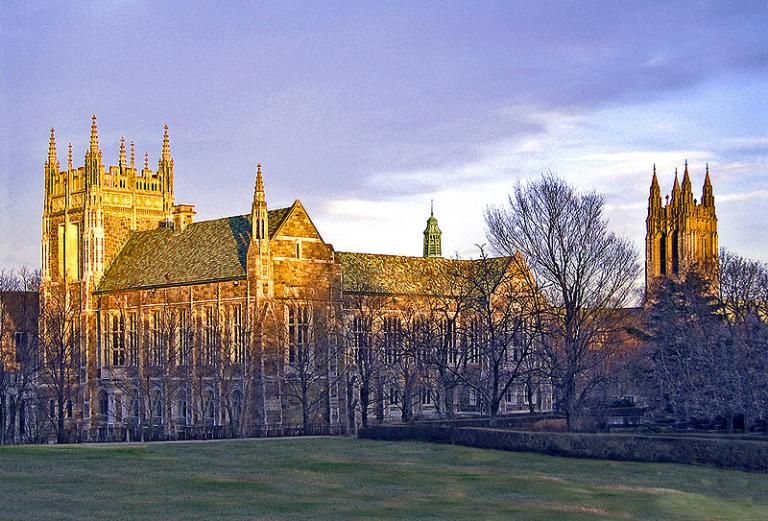
Sunset at Boston College, where Peter Kreeft and Father Ronald Tacelli were teaching in the Department of Philosophy when their Pocket Handbook of Christian Apologetics was first published (Wikimedia Commons public domain image)
I’ve begun actually reading through Peter Kreeft and Ronald K. Tacelli, Pocket Handbook of Christian Apologetics (Downers Grove, IL: IVP Academic, 2003), from its beginning. At the time that the Pocket Handbook was published (nearly a quarter of a century ago), Peter Kreeft was a professor of philosophy at Boston College, and Ronald Tacelli S.J. was an associate professor of philosophy at the same school.
I like a point that they make at the beginning of their little book, in which they’re defending the legitimacy of apologetics. It’s a point very much akin to that of a quotation from Austin Farrer that was, for a while, something of the unofficial motto of the old Neal A. Maxwell Institute for Religious Scholarship at Brigham Young University, back when the Maxwell Institute really was the successor to the Foundation for Ancient Research and Mormon Studies, or FARMS. Elder Maxwell, for whom the Maxwell Institute was eventually named, was fond of Austin Farrer’s praise of the great C. S. Lewis: “Though argument does not create conviction,” Farrer wrote,
lack of it destroys belief. What seems to be proved may not be embraced; but what no one shows the ability to defend is quickly abandoned. Rational argument does not create belief, but it maintains a climate in which belief may flourish. (See Austin Farrer, “Grete Clerk,” in Jocelyn Gibb, comp., Light on C. S. Lewis [New York: Harcourt and Brace, 1965], 26.)
In a similar vein, Kreeft and Tacelli write that, while it probably can’t create actual faith on its own,
reason at least has veto power. We can’t believe what we believe to be untrue, and we can’t love what we believe to be unreal. Arguments may not bring you to faith, but they can certainly keep you away from faith. Therefore we must join the battle of arguments.
Arguments can bring you closer to faith in the same sense that a car can bring you to the sea. The car can’t swim; you have to jump in to do that. But you can’t jump in from a hundred miles inland. You need a car first to bring you to the point where you can make a leap of faith into the sea. Faith is a leap, but a leap in the light, not in the dark. (9-10)
In this passage from Kreeft and Tacelli, I think that you can recognize the two complementary kinds of apologetics that I’ve often distinguished as positive apologetics and negative apologetics. It occurs to me now that another way of characterizing them might be as, respectively, constructive and defensive. Sometimes, we’ve spoken of the role of an apologist as commending and defending the faith.
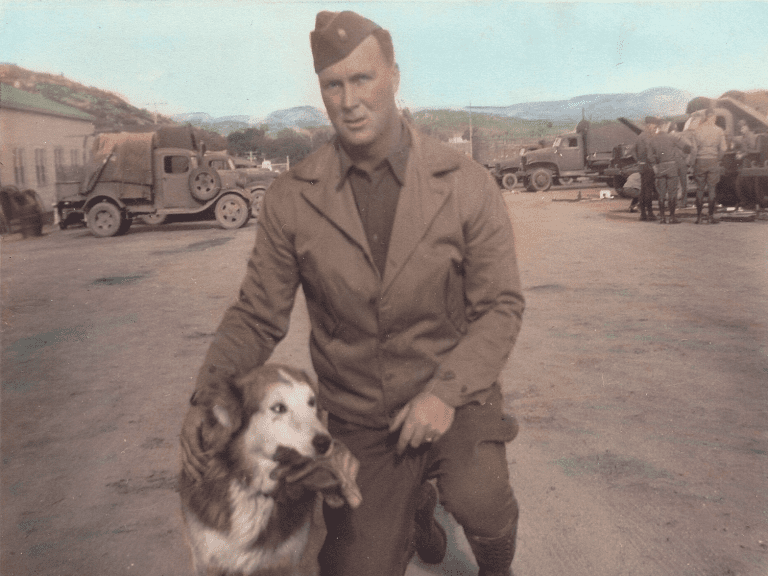
I was raised to love dogs. It came with my family. Here’s my father with a friend of his, somewhere (I think) on the continent of Europe sometime (I’m guessing) in mid-1945.
Another passage that resonated with me from the opening pages of the Pocket Handbook of Christian Apologetics is this one:
Without a living relationship to the living God, propositions are pointless, for their point is to point beyond themselves to God. (“A finger is good for pointing to the moon,” according to a wise Zen saying.) (13-14)
I myself have sometimes used a related metaphor or simile that is based on my observations of Prince, my very first pet dog when I was a young boy. I noticed that, when I tried to point his attention toward something with my finger, Prince would focus on my finger. I’ve thought of that often, when I’ve seen people, as I thought, confusing a symbol for the object or concept that the symbol was intended to represent. I suppose, though, that Prince’s concentration on my finger might just as well be used to illustrate the error that occurs when facts or propositions or arguments that are intended to move us toward God come, instead, to be the focus in and of themselves.
History and Religion
Travel and Religion
Previous Post

August 17, 2026
Racial Harmony After the Priesthood Ban
Next Post

August 19, 2026 In my best fourteenth-century English
Recent Comments
"Thanks John. You always have so many interesting facts. I could listen to you read ..."
"You dig out some really interesting information from the background details of the Church."
"The G-20 interreligious summit is happening in Salt Lake City for the first time. President ..."
"Provo High may have some nostalgic value for some folks here--but I have to say ..."
From Serbia’s “White City,” Belgrade
Browse Our Archives
Select a Category Uncategorized
Select a Month October 2026 September 2026 August 2026 July 2026 June 2026 May 2026 April 2026 March 2026 February 2026 January 2026 December 2025 November 2025 October 2025 September 2025 August 2025 July 2025 June 2025 May 2025 April 2025 March 2025 February 2025 January 2025 December 2024 November 2024 October 2024 September 2024 August 2024 July 2024 June 2024 May 2024 April 2024 March 2024 February 2024 January 2024 December 2023 November 2023 October 2023 September 2023 August 2023 July 2023 June 2023 May 2023 April 2023 March 2023 February 2023 January 2023 December 2022 November 2022 October 2022 September 2022 August 2022 July 2022 June 2022 May 2022 April 2022 March 2022 February 2022 January 2022 December 2021 November 2021 October 2021 September 2021 August 2021 July 2021 June 2021 May 2021 April 2021 March 2021 February 2021 January 2021 December 2020 November 2020 October 2020 September 2020 August 2020 July 2020 June 2020 May 2020 April 2020 March 2020 February 2020 January 2020 December 2019 November 2019 October 2019 September 2019 August 2019 July 2019 June 2019 May 2019 April 2019 March 2019 February 2019 January 2019 December 2018 November 2018 October 2018 September 2018 August 2018 July 2018 June 2018 May 2018 April 2018 March 2018 February 2018 January 2018 December 2017 November 2017 October 2017 September 2017 August 2017 July 2017 June 2017 May 2017 April 2017 March 2017 February 2017 January 2017 December 2016 November 2016 October 2016 September 2016 August 2016 July 2016 June 2016 May 2016 April 2016 March 2016 February 2016 January 2016 December 2015 November 2015 October 2015 September 2015 August 2015 July 2015 June 2015 May 2015 April 2015 March 2015 February 2015 January 2015 December 2014 November 2014 March 2014 August 2013 February 2012
Follow Us!
TAKE THE
Religious Wisdom Quiz
What was Cornelius' profession?
Select your answer to see how you score.
Fisherman Carpenter Shepherd Roman centurion
Related posts from Sic et Non


Notes on Women, Priesthood, and General Conference

"The Book of Moses as a Temple Text"

TRENDING AT PATHEOS Latter-day Saint

The Image: On the Horror of Capitalism and...
The Image Then went the Pharisees, and took counsel how they might...

We are approaching the date of our new American national holiday: October...

Letters on Living the Faith by C.S. Lewis
Most of us met C.S. Lewis as a public intellectual. Mere Christianity....

When Halloween Unmasks Married Hearts
Written by Dr. David K. Ewen from Eternal Truth Bible College Behind...

Aristotle. He’s been called the father of logic, the father of the...

Methodist Central Hall and Westminster Abbey
Situated on the same square is Methodist Central Hall and Westminster Abbey. ...
view all Latter-day Saint blogs
What Are Your Thoughts?leave a comment
Ad-Free & Subscriber Log-In Subscription Support
- About Us
- 2026 Calendar
- Videos
- Podcasts
- Library of World Religions
- Faith In Media Tracker
- Advertise With Us
- Write for Us
- Privacy Policy
- Terms of Service
- Do Not Sell My Data
- Contact Us
- Radiant Digital
- Manage Newsletter Subscriptions
- Unsubscribe From Notifications
- Sitemap
Copyright 2008-2026, Patheos. All rights reserved.
Subscription Support Ad-Free & Subscriber Log-In
Follow Patheos