
BuddhistCatholicContemplativeEvangelicalGeneral ChristianHinduJewishLatter-day SaintMuslimNew VisionsProgressive Christian
Beliefs
- Buddhist
- Catholic
- Contemplative
- Evangelical
- General Christian
- Hindu
- Jewish
- Latter-day Saint
- More Voices
- Muslim
- New Visions
- Pagan
- Progressive Christian
Topics
- Religion News
- Food and Religion
- Sports and Religion
- Religious Art
- Religious Music and Entertainment
- Religious Events
- History and Religion
- Style and Religion
- Politics and Religion
- Women in Religion
- Recreation Outdoors and Religion
- Business Finance and Religion
- Careers Workplace and Religion
- Education and Religion
- Family Parenting and Religion
- Health Fitness and Religion
- Home and Religion
- Relationships and Religion
- Technology and Religion
- Travel and Religion
Columnists
- Buddhist Columnists
- Business Finance and Religion Columnists
- Careers Workplace and Religion Columnists
- Catholic Columnists
- Contemplative Columnists
- Education and Religion Columnists
- Evangelists Columnists
- Family Parenting and Religion Columnists
- General Christian Columnists
- Health Fitness and Religion Columnists
- Hindu Columnists
- History and Religion Columnists
- Home and Religion Columnists
- Jewish Columnists
- More Voices Columnists
- Latter Day Columnists
- Muslim Columnists
- New Visions Columnists
- Nonreligious Columnists
- Pagan Columnists
- Politics and Religion Columnists
- Progressive Columnists
- Recreation Outdoors and Religion Columnists
- Relationships and Religion Columnists
- Religion News Columnists
- Religious Art Columnists
- Religious Events Columnists
- Religious Music and Entertainment Columnists
- Sports and Religion Columnists
- Style and Religion Columnists
- Technology and Religion Columnists
- Travel and Religion Columnists
- Women in Religion Columnists
Resource Library
- 2026 Calendar
- Library of World Religions
- The 100 Most Holy Places on Earth
- Patheos Answers
- Podcasts
- Videos
- Faith Leaders Database
- Anglican Episcopalian
- Bahai
- Baptist
- Buddhism
- Christianity
- Confucianism
- Eastern Orthodoxy
- Hinduism
- Holiness and Pentecostal
- ISKCON
- Islam
- Judaism
- Lutheran
- Methodist
- The Church of Jesus Christ of Latter-day Saints
- New Age
- Paganism
- Presbytarian and Reformed
- Protestantism
- Religion Behind the Scenes
- Roman Catholic
- Scientology
- Shia Islam
- Sikhism
- Sufism
- Sunni Islam
- Taoism
- Zen
- See all religions
Research Tools
 Ad-Free & Subscriber Log-In Subscription Support
Ad-Free & Subscriber Log-In Subscription Support
Follow Patheos 

- Trending:
- Forgiveness
- |
- Marriage
- |
- Consciousness
- |
- Death Penalty
- |
- Election
- |
- Halloween

- Home
- Latter-day Saint
- Lamanite Identity, Muslim Identity, and Identity Politics
Lamanite Identity, Muslim Identity, and Identity Politics
Last updated on: August 14, 2026 at 4:11 pm by Dan Peterson
Lamanite Identity, Muslim Identity, and Identity Politics 2026-08-14T16:11:32-06:00 Dan Peterson
Patheos Explore the world's faith through different perspectives on religion and spirituality! Patheos has the views of the prevalent religions and spiritualities of the world.
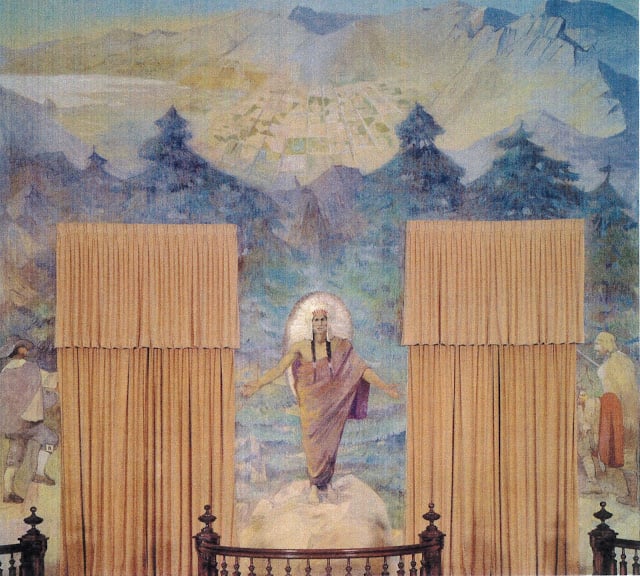
A detail from Minerva Teichert’s large and dramatic mural in the World Room of the Manti Utah Temple. While the temple was dedicated in 1888, Teichert’s mural — replacing previous work (probably by the Norwegian-American painter Danquart Weggeland) — was added in 1947. The photograph comes from http://ldspioneerarchitecture.blogspot.com. I tried to write to ask permission to use this image, as invited, but the email address didn’t work. If the proprietor of the site has a concern, I will happily remove the image.
Two new but somewhat related articles appeared today in Interpreter. The first of them is “Estranged No More: Covenant and a Reclaimed Identity of the Lamanites” (Interpreter A Journal of Latter-day Saint Faith and Scholarship 69 [2026]: 401-424), which was written by John E. Cochran II:
Abstract: This article reexamines Lamanite identity in the Book of Mormon, arguing that in addition to referencing a specific branch of Lehi’s posterity, even more importantly, the term Lamanite can also function as a covenantal designation describing those estranged from God yet remembered through divine mercy. Drawing on Jacob 1:13–14 and related passages that define Nephite and Lamanite identity by covenant allegiance, this study situates the term within a redemptive pattern of estrangement and return. Read in hindsight, this framework can be applied to reframe the 1830 mission to the Lamanites with an interpretive lens that reveals the limits of merely lineage-based expectations of covenant belonging. Integrating scripture with early Restoration history and theological reflection, the article shows how covenant identity transcends ancestry while preserving cultural particularity. The result is a vision of Lamanite identity that is both ancient and expansive, bearing witness to a God who gathers those who respond to covenantal grace.
Accompanying “Estranged No More” is “Interpreting Interpreter: ‘Lamanite’ as a Covenantal Identity,” written by Kyler Rasmussen:
This post is a summary of the article “Estranged No More: Covenant and a Reclaimed Identity of the Lamanites” by John E. Cochran II in Volume 69 of Interpreter: A Journal of Latter-day Saint Faith and Scholarship. All of the Interpreting Interpreter articles may be seen at https://interpreterfoundation.org/category/summaries/. An introduction to the Interpreting Interpreter series is available at https:/interpreterfoundation.org/interpreting-interpreter-on-abstracting-thought/.
A video introduction to this Interpreter article is now available on all of our social media channels, including on YouTube at https://youtube.com/shorts/Ky66PSHLQ5E.
The Takeaway: Cochran looks at how the term “Lamanite” is used in the Book of Mormon, highlighting it as a covenantal orientation rather than an ethnic label, one with the promise of repentance and turning toward God. He argues that the early Saints’ mission to the Lamanites in the 1830s is best understood in the covenantal light.

The 1830-1831 Mission to the Lamanites (Robert T. Barrett, LDS Media Library)
The second of them is “Dynastic Dynamics II: Lamanite Governance and Politics” (Interpreter A Journal of Latter-day Saint Faith and Scholarship 69 [2026]: 425-450), which was written by Noel Hudson:
Abstract: The Book of Mormon preserves only fragmentary evidence concerning Lamanite internal politics. Most references to the Lamanites come through Nephite narrators, whose focus usually centers on the many wars, missionary activity, and Nephite affairs, rather than on Lamanite institutions. Even so, the narratives in the books of Mosiah, Alma, Helaman, and 3 Nephi contain enough incidental detail to permit a cautious reconstruction of important developments in Lamanite political history. This study proposes that from the time of Zeniff to the rise of the Gadianton order, Lamanite society underwent substantial military, administrative, and dynastic change. More significantly, many major developments in Lamanite political and military life seem to have been shaped by successive waves of Nephite dissenters, including the Amulonites, Amalekites, and Zoramites. In that sense, many of the conflicts commonly described as Nephite–Lamanite wars may be more precisely understood as struggles in which Lamanite populations were repeatedly drawn into contests rooted in Nephite factionalism. Although some parts of this reconstruction remain speculative, the cumulative evidence suggests a more dynamic and internally differentiated picture of Lamanite history than is often assumed.
Accompanying “Dynastic Dynamics II” is “Interpreting Interpreter: Lamanite Political Development,” written by Kyler Rasmussen:
This post is a summary of the article “ Dynastic Dynamics II: Lamanite Governance and Politics” by Noel Hudson in Volume 69 of Interpreter: A Journal of Latter-day Saint Faith and Scholarship. A video introduction to this Interpreter article is now available on all of our social media channels, including on YouTube at https://youtube.com/shorts/y5PNzsBZA-Q.
The Takeaway: Hudson examines the Book of Mormon text for hints of Lamanite political dynamics and governance structures. He argues that Lamanite governance developed substantially over time, in part through the intervention of Nephite dissenters.
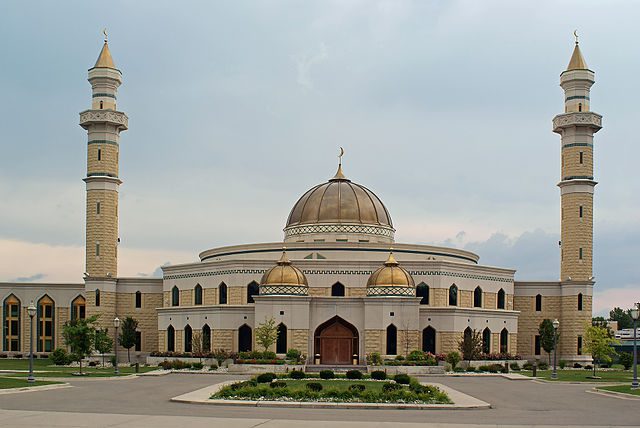
The Islamic Center of America — the largest mosque in the United States — is located in Dearborn, Michigan. I believe that Muslim citizens who reside in Michigan have the right to vote and to run for office, just as Jewish, agnostic, Catholic, Orthodox, Latter-day Saint, Evangelical, and other citizens do. (Wikimedia Commons public domain image)
Abdul El-Sayed, the Democratic nominee for the 2026 Michigan election to the United States Senate, has called out Republicans, including his GOP opponent Mike Rogers, after the National Republican Senatorial Committee issued press releases and ads attacking him that refer to him by his full name, Abdulrahman Mohamed El-Sayed. (See here.). He says that it’s a dogwhistle designed to emphasize his being a Muslim and, thus, to appeal to anti-Muslim prejudice among the electorate.
I have absolutely no doubt in my mind that his charge is right — and I say this as someone who opposes socialism in all its forms and who hopes that El-Sayed, a Democratic Socialist, loses in November. Sen. Tim Scott (R-SC), who is (I believe) the chairman of the National Republican Senatorial Committee, defends the references to El-Sayed’s full name by saying that people have often called him “Timothy Eugene Scott.” But I’ll bet that they don’t do it very often, and Senator Scott’s response seems pretty plainly disingenuous to me.
Appeals to rank anti-Muslim prejudice are likely to be successful with substantial portions of the voting population. (Remember references to “Barack Hussein Obama”? Against whom, for the record, I voted twice?) I’ve had to respond to a couple of anti-Muslim bigots on Facebook just today. (A hopeless waste of time, of course, but I simply can’t silently let some things pass without contradiction.) So this tactic will probably have its desired effect, to at least some degree.
But I do want to post my own little complaint about the name Abdul El-Sayed. It reflects common practice among people with Arabic or Arabic-style names who live in the West. But it makes no sense in Arabic. Permit me to explain:
The Arabic word ‘abd (عبد) means “slave” or “servant,” and, followed by the definite article el- or al-, it means “servant/slave of the” — which is obviously incomplete. It requires a noun (always a divine title) to complete the phrase. Common examples are ‘Abd al-Malik (“Servant of the King”), ‘Abd al-Jabbar (“Servant of the Omnipotent”), ‘Abd al-Karim (“Servant of the Noble/Generous [One]”), ‘Abd Allah or ‘Abdullah (“Servant of God”), and, among Christians, ‘Abd al-Massih (“Servant of the Messiah/Christ”). Abdulrahman or ‘Abd al-Rahman means “Servant of the Merciful”). My complaint is that you really can’t or should’t separate Abdul (“Servant of the”) from the rest of the name. But immigrants or children of immigrants from Muslim or Arab nations often do it, so I’m fighting a losing battle.
As to the name Mohamed (or, my preferred spelling, Muhammad), it’s probably the most common personal name on the planet — so common, in fact, that men bearing it often don’t actually use it. For example, two former presidents of Egypt were Muhammad Anwar el-Sadat and Muhammad Hosni Mubarak. The last shah of Iran was Mohammad Reza Pahlevi. And on and on.
Previous Post

August 13, 2026
Will I see you on Tuesday? Wednesday? Thursday? Friday?
Next Post

August 15, 2026 Michael Faraday, James Clerk Maxwell, and the Open Mind
Recent Comments
"In a meeting today, I learned another important reason why accurate (or at least as ..."
From Serbia’s “White City,” Belgrade
"I've been watching a lot of video interviews of NDErs and researchers. I think in ..."
"PL: "Let's hope he doesn't have your address..."I have to frankly confess that a few ..."
From Serbia’s “White City,” Belgrade
"Let's hope he doesn't have your address..."
From Serbia’s “White City,” Belgrade
Browse Our Archives
Select a Category Uncategorized
Select a Month October 2026 September 2026 August 2026 July 2026 June 2026 May 2026 April 2026 March 2026 February 2026 January 2026 December 2025 November 2025 October 2025 September 2025 August 2025 July 2025 June 2025 May 2025 April 2025 March 2025 February 2025 January 2025 December 2024 November 2024 October 2024 September 2024 August 2024 July 2024 June 2024 May 2024 April 2024 March 2024 February 2024 January 2024 December 2023 November 2023 October 2023 September 2023 August 2023 July 2023 June 2023 May 2023 April 2023 March 2023 February 2023 January 2023 December 2022 November 2022 October 2022 September 2022 August 2022 July 2022 June 2022 May 2022 April 2022 March 2022 February 2022 January 2022 December 2021 November 2021 October 2021 September 2021 August 2021 July 2021 June 2021 May 2021 April 2021 March 2021 February 2021 January 2021 December 2020 November 2020 October 2020 September 2020 August 2020 July 2020 June 2020 May 2020 April 2020 March 2020 February 2020 January 2020 December 2019 November 2019 October 2019 September 2019 August 2019 July 2019 June 2019 May 2019 April 2019 March 2019 February 2019 January 2019 December 2018 November 2018 October 2018 September 2018 August 2018 July 2018 June 2018 May 2018 April 2018 March 2018 February 2018 January 2018 December 2017 November 2017 October 2017 September 2017 August 2017 July 2017 June 2017 May 2017 April 2017 March 2017 February 2017 January 2017 December 2016 November 2016 October 2016 September 2016 August 2016 July 2016 June 2016 May 2016 April 2016 March 2016 February 2016 January 2016 December 2015 November 2015 October 2015 September 2015 August 2015 July 2015 June 2015 May 2015 April 2015 March 2015 February 2015 January 2015 December 2014 November 2014 March 2014 August 2013 February 2012
Follow Us!
TAKE THE
Religious Wisdom Quiz
What is the shortest book in the New Testament?
Select your answer to see how you score.
3 John Jude Philemon 2 John
Related posts from Sic et Non


Notes on Women, Priesthood, and General Conference

"The Book of Moses as a Temple Text"

TRENDING AT PATHEOS Latter-day Saint

Janie Learns the Way of the Cross: A...
Teaching children about Jesus' Passion can be challenging. Many parents and educators...

Looking For Good Catholic Writing - October 2026
He alone extends the heavens, and he walks upon the waves of...

In "Irreplaceable," our book on vocation and technology, Trevor Sutton and I...

I was strolling through the top floor of the brand new Parthenon...

What Does Gêvâh Mean For Kimberley Guifoyle &...
This week, a lot of the news is focused on Kimberly Guilfoyle....

INNER CIRCLE: Profound Mystery (Of Christ In All...
Ephesians 5:31-32 “For this reason, a man will leave his father and...
view all Latter-day Saint blogs
What Are Your Thoughts?leave a comment
Ad-Free & Subscriber Log-In Subscription Support
- About Us
- 2026 Calendar
- Videos
- Podcasts
- Library of World Religions
- Faith In Media Tracker
- Advertise With Us
- Write for Us
- Privacy Policy
- Terms of Service
- Do Not Sell My Data
- Contact Us
- Radiant Digital
- Manage Newsletter Subscriptions
- Unsubscribe From Notifications
- Sitemap
Copyright 2008-2026, Patheos. All rights reserved.
Subscription Support Ad-Free & Subscriber Log-In
Follow Patheos