
BuddhistCatholicContemplativeEvangelicalGeneral ChristianHinduJewishLatter-day SaintMuslimNew VisionsProgressive Christian
Beliefs
- Buddhist
- Catholic
- Contemplative
- Evangelical
- General Christian
- Hindu
- Jewish
- Latter-day Saint
- More Voices
- Muslim
- New Visions
- Pagan
- Progressive Christian
Topics
- Religion News
- Food and Religion
- Sports and Religion
- Religious Art
- Religious Music and Entertainment
- Religious Events
- History and Religion
- Style and Religion
- Politics and Religion
- Women in Religion
- Recreation Outdoors and Religion
- Business Finance and Religion
- Careers Workplace and Religion
- Education and Religion
- Family Parenting and Religion
- Health Fitness and Religion
- Home and Religion
- Relationships and Religion
- Technology and Religion
- Travel and Religion
Columnists
- Buddhist Columnists
- Business Finance and Religion Columnists
- Careers Workplace and Religion Columnists
- Catholic Columnists
- Contemplative Columnists
- Education and Religion Columnists
- Evangelists Columnists
- Family Parenting and Religion Columnists
- General Christian Columnists
- Health Fitness and Religion Columnists
- Hindu Columnists
- History and Religion Columnists
- Home and Religion Columnists
- Jewish Columnists
- More Voices Columnists
- Latter Day Columnists
- Muslim Columnists
- New Visions Columnists
- Nonreligious Columnists
- Pagan Columnists
- Politics and Religion Columnists
- Progressive Columnists
- Recreation Outdoors and Religion Columnists
- Relationships and Religion Columnists
- Religion News Columnists
- Religious Art Columnists
- Religious Events Columnists
- Religious Music and Entertainment Columnists
- Sports and Religion Columnists
- Style and Religion Columnists
- Technology and Religion Columnists
- Travel and Religion Columnists
- Women in Religion Columnists
Resource Library
- 2026 Calendar
- Library of World Religions
- The 100 Most Holy Places on Earth
- Patheos Answers
- Podcasts
- Videos
- Faith Leaders Database
- Anglican Episcopalian
- Bahai
- Baptist
- Buddhism
- Christianity
- Confucianism
- Eastern Orthodoxy
- Hinduism
- Holiness and Pentecostal
- ISKCON
- Islam
- Judaism
- Lutheran
- Methodist
- The Church of Jesus Christ of Latter-day Saints
- New Age
- Paganism
- Presbytarian and Reformed
- Protestantism
- Religion Behind the Scenes
- Roman Catholic
- Scientology
- Shia Islam
- Sikhism
- Sufism
- Sunni Islam
- Taoism
- Zen
- See all religions
Research Tools
 Ad-Free & Subscriber Log-In Subscription Support
Ad-Free & Subscriber Log-In Subscription Support
Follow Patheos 

- Trending:
- Forgiveness
- |
- Marriage
- |
- Consciousness
- |
- Death Penalty
- |
- Election
- |
- Halloween

- Home
- Latter-day Saint
- Travel and Religion
- How many divine beings appeared in Joseph’s First Vision?
How many divine beings appeared in Joseph’s First Vision?
Last updated on: August 24, 2026 at 9:49 pm by Dan Peterson
How many divine beings appeared in Joseph’s First Vision? 2026-08-24T21:49:25-06:00 Dan Peterson
Patheos Explore the world's faith through different perspectives on religion and spirituality! Patheos has the views of the prevalent religions and spiritualities of the world.

Brigham Young’s “Lion House” in Salt Lake City, Utah (Wikimedia Commons public domain photo). Brigham Young was sometimes called “The Lion of the Lord.”
The latest installment of the Interpreter Foundation’s Becoming Brigham series is now up: “Lives of Their Own? The Wives of Brigham Young — Becoming Brigham, Episode 31”
How did Brigham Young’s rejection of his father’s harsh discipline shape daily life and family rituals in the Lion House?
In what concrete ways did women such as Eliza R. Snow exercise leadership and autonomy under Brigham Young?
Why do the historians argue that judging Brigham Young solely by modern standards risks missing both the complexity of his character and the reasons so many people willingly followed him?
Drawing on his daughters’ recollections and the insights of historians Lisa Olson Tate and Brittany Chapman Nash, this episode explores Brigham Young as a father and the inner life of his large household. Clarissa and Susa Young remembered him as an affectionate, tender, and ideal parent whom they adored and never feared—in contrast to Brigham’s own childhood under a stern, disciplinarian father. Nightly family prayer in the Lion House created both closeness and a setting for meaningful discussion with gathered wives and children; some of those conversations, particularly with Eliza R. Snow, helped shape later organizations such as the Young Women. Brigham’s parenting philosophy favored kindness over the rod, teaching that loving actions bind children far more effectively than force, and he expected the same restraint from the mothers in his household. The episode also examines the practical balance between traditional gender expectations and real autonomy for women. Under Brigham Latter-day Saint women exercised significant leadership. The hosts and historians close by urging a more nuanced view of historical figures, noting that Brigham’s deepest aim was for people to flourish through the gospel and the building of Zion, and that Brigham is best understood through original sources that reveal his counsel and kindness.
And please don’t forget that you can actually subscribe to Becoming Brigham — painlessly and at no charge — by simply going to the project’s official website and clicking there on the button marked “Subscribe on YouTube.”
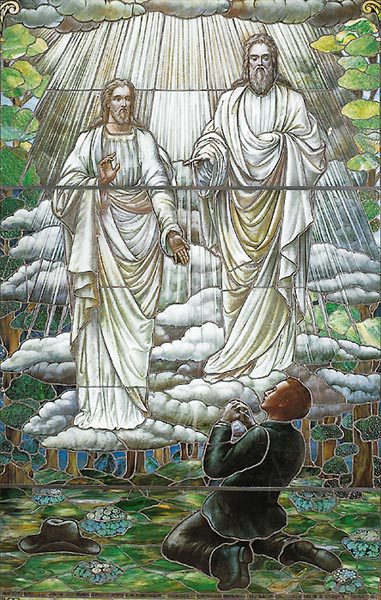
Joseph Smith’s First Vision (A stained glass window from roughly 1913) Wikimedia Commons public domain image
Joseph Smith left behind him four primary, firsthand accounts of his First Vision — which is to say that they were written or dictated by the Prophet himself. They are:
- The 1832 Account: The earliest known account, partially written in Joseph Smith’s own handwriting. It focuses heavily on his early personal concerns, his search for forgiveness of sins, and mentions the appearance of “the Lord.”
- The 1835 Account: Recounted to a visitor named Robert Matthews (or Joshua) and recorded in his journal by his scribe Warren Parrish. It emphasizes the heavy opposition or dark presence he felt while praying, the appearance of one divine personage followed by another, and the presence of angels.
- The 1838 Account: The official and most detailed version, dictated to scribes and later canonized in the Pearl of Great Price, it clearly describes two distinct personages (God the Father and Jesus Christ).
- The 1842 Account: Written in response to an inquiry from Chicago newspaper editor John Wentworth (part of the “Wentworth Letter”) and intended for a non-member audience, it describes “two glorious personages” whose appearance matched each other.
For many years, critics of the Restoration have seized upon the 1832 account, with its reference only to “the Lord,” as contradicting the three subsequent accounts. Some have said that, in the 1832 report, Joseph actually denies seeing the Father. But he doesn’t. And it would only contradict the later accounts with regard to the number of divine beings if he had denied seeing the Father or seeing a second divine being in the 1832 narrative. But he doesn’t.
One of my more diligent critics over at the Peterson Obsession Board recently dredged up this comment of mine from somewhere in which, clearly, I was trying to make the point that mentioning one divine being who appeared to Joseph in the grove doesn’t, as such, rule out the appearance of a second divine being:
“For example, if the 1832 account mentions Jesus only, that doesn’t mean — contrary to certain critics — that the Father didn’t appear. And if an account describes a “vision of angels,” that’s entirely compatible with a vision of the Father and the Son also. (In fact, the Lord himself is sometimes referred to, biblically, as an angel.) As a parallel, if I say that I met Frank at the party, I’m not thereby denying that I also met John. And, for that matter, Jane, Bob, Ellen and Stan, as well.”
I’m afraid that I need to resort to actual logic here. It’s logically valid to say that P & Q → P. To give a trio of illustrative examples:
- “Hawaii and Alaska are both beautiful American states” logically entails the proposition that “Alaska is a beautiful American state.”
- “Frankie and Johnny were at the party” logically implies that “Frankie was at the party.”
- “Squirrels and caribou are both mammals,” if true, requires that “Squirrels are mammals.”
There is, thus, nothing illogical or contradictory about saying in one place that the Father and the Son appeared to Joseph Smith in the grove and, in another place, that the Son appeared to Joseph in the grove.
However, it isn’t logically valid, in and of itself, to assert that P → ¬Q. Once again, a threesome of illustrative examples:
- “Hawaii is a beautiful American state” doesn’t imply or entail that “Alaska isn’t a beautiful American state.”
- “Frankie was at the party” doesn’t logically lead to the conclusion that “Johnny wasn’t at the party.”
- “Squirrels are mammals” doesn’t require the conclusion that “Caribou are not mammals.”
Thus, for one account of Joseph Smith’s First Vision to say that the Son appeared to him does not imply or entail the conclusion that the Father didn’t appear to him.
“Well folks,” comments “Everybody’s WC” in a stunningly novel variation on his usual refrain of “Folks, you simply can’t make this stuff up!,” “you simply cannot script this level of absurdity.” But it’s obviously not absurd. Rather, it’s a simple, small, and quite uncontroversial logical point. Nothing more. Nothing less. Logically speaking — that is, according to the universally recognized rules of logic — the 1832 account simply doesn’t “contradict” the 1835, 1838, and 1842 accounts.
One of the savants at the Peterson Obsession Board (hereafter, the POB) suggests that I’m saying that Joseph regarded the appearance of the Father as an insignificant detail that didn’t merit mention in his narrative. But that would obviously be ridiculous. However, since one of the governing assumptions at the POB is that I’m an irrational buffoon, it’s supposedly just the kind of thing that I would say. Unfortunately, though, I didn’t say it.
I said nothing about why the 1832 account mentions only “the Lord.” I don’t know why, although I can think of several speculative but possible explanations.
Another claims that I’m attempting to justify “dishonesty” on Joseph’s part. But, of course, I didn’t say that, either. And I don’t believe that he was dishonest.
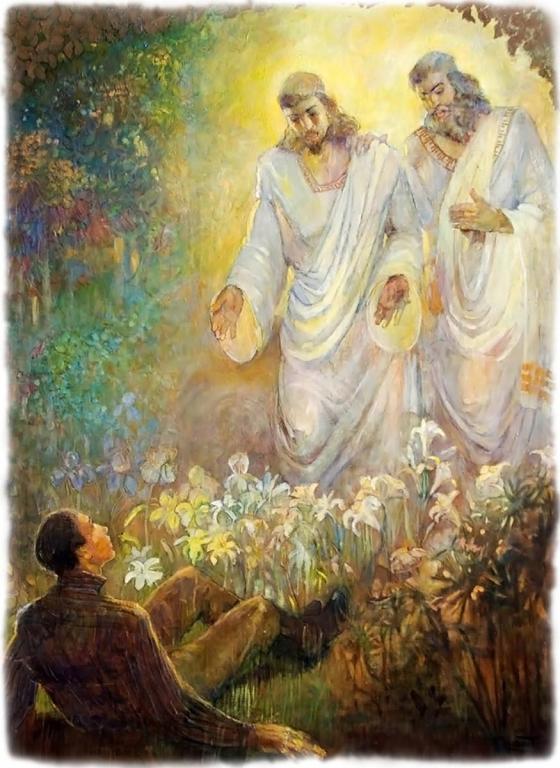
“The First Vision” (Minerva Teichert, 1934) Brigham Young University Museum of Art
But let’s move on. In addition to Joseph Smith’s own retellings, there are five secondary accounts of the First Vision that were committed to writing by contemporaries during his lifetime:
- 1840: Published in a pamphlet in Scotland by Orson Pratt, marking the earliest printed version. Elder Pratt relates that Joseph saw two distinct heavenly beings who looked exactly alike.
- 1842: Published in Germany in a pamphlet entitled Ein Ruf aus der Wüste (“A Cry Out of the Wilderness”) by Orson Hyde. In this version, two glorious heavenly personages appeared to Joseph Smith who resembled each other exactly in their features and stature.
- 1843: Recorded in the journal of Levi Richards on 11 June 1843 after hearing Joseph Smith preach. Richards’s account says that “the Lord” spoke to Joseph to tell him that the everlasting covenant was broken. It doesn’t detail the visual appearance of “the Lord,” nor does it describe two distinct divine personages.
- 1843: Written up by David Nye White, an editor of the Pittsburgh Weekly Gazette, after interviewing Joseph Smith in August 1843. According to White, Joseph Smith described seeing one personage appear, followed shortly by a second.
- 1844: Recounted in the journal of Alexander Neibaur after a personal conversation with Joseph. According to Neibaur, two personages appeared. Neibaur recorded that Joseph saw a fire descending and a first personage appear, followed shortly by a second personage.
Another commentator at the POB, reusing an argument that was, as I recall, first advanced by the late Fawn Brodie, declares that “Joseph’s power base was dwindling and he needed something to reinforce his specialness. So he came up with a vision story which he increasingly embellished over time, with each retelling.” (Reacting, yet another POB participant sees this as unmistakable evidence that Joseph was a con-artist.) But it’s difficult to see a neat, linear, evolutionary timeline with regard to the numbers of divine beings in the accounts of the First Vision: In 1832 and in a second-hand 1843 narrative, only one divine being is mentioned. However, two divine beings are mentioned in 1835, 1838, 1840, 1842, again in 1842, as well as in 1843 and 1844.
Travel and Religion
History and Religion
Previous Post

August 23, 2026
Does mind derive from mindless matter?
Next Post
August 25, 2026 Against Burgeoning Anti-Semitism
Recent Comments
"Sutherland's lecture sounds interesting. He seems to restate the Washington consensus that trade brings peace ..."
Learning more about a region of ..."
"In a meeting today, I learned another important reason why accurate (or at least as ..."
From Serbia’s “White City,” Belgrade
"I've been watching a lot of video interviews of NDErs and researchers. I think in ..."
"PL: "Let's hope he doesn't have your address..."I have to frankly confess that a few ..."
From Serbia’s “White City,” Belgrade
Browse Our Archives
Select a Category Uncategorized
Select a Month October 2026 September 2026 August 2026 July 2026 June 2026 May 2026 April 2026 March 2026 February 2026 January 2026 December 2025 November 2025 October 2025 September 2025 August 2025 July 2025 June 2025 May 2025 April 2025 March 2025 February 2025 January 2025 December 2024 November 2024 October 2024 September 2024 August 2024 July 2024 June 2024 May 2024 April 2024 March 2024 February 2024 January 2024 December 2023 November 2023 October 2023 September 2023 August 2023 July 2023 June 2023 May 2023 April 2023 March 2023 February 2023 January 2023 December 2022 November 2022 October 2022 September 2022 August 2022 July 2022 June 2022 May 2022 April 2022 March 2022 February 2022 January 2022 December 2021 November 2021 October 2021 September 2021 August 2021 July 2021 June 2021 May 2021 April 2021 March 2021 February 2021 January 2021 December 2020 November 2020 October 2020 September 2020 August 2020 July 2020 June 2020 May 2020 April 2020 March 2020 February 2020 January 2020 December 2019 November 2019 October 2019 September 2019 August 2019 July 2019 June 2019 May 2019 April 2019 March 2019 February 2019 January 2019 December 2018 November 2018 October 2018 September 2018 August 2018 July 2018 June 2018 May 2018 April 2018 March 2018 February 2018 January 2018 December 2017 November 2017 October 2017 September 2017 August 2017 July 2017 June 2017 May 2017 April 2017 March 2017 February 2017 January 2017 December 2016 November 2016 October 2016 September 2016 August 2016 July 2016 June 2016 May 2016 April 2016 March 2016 February 2016 January 2016 December 2015 November 2015 October 2015 September 2015 August 2015 July 2015 June 2015 May 2015 April 2015 March 2015 February 2015 January 2015 December 2014 November 2014 March 2014 August 2013 February 2012
Follow Us!
TAKE THE
Religious Wisdom Quiz
What book contains the "Suffering Servant" prophecy?
Select your answer to see how you score.
Zechariah Lamentations Isaiah Jeremiah
Related posts from Sic et Non


Notes on Women, Priesthood, and General Conference

"The Book of Moses as a Temple Text"

TRENDING AT PATHEOS Latter-day Saint

I was strolling through the top floor of the brand new Parthenon...

What Does Gêvâh Mean For Kimberley Guifoyle &...
This week, a lot of the news is focused on Kimberly Guilfoyle....

INNER CIRCLE: Profound Mystery (Of Christ In All...
Ephesians 5:31-32 “For this reason, a man will leave his father and...

Do Not Rejoice When Your Enemy Falls: The...
Turning an execution into a public spectacle is a disturbing expression of...

'The Chosen' S6 Trailer: The Passion Gets Very...
Not many watching 'The Chosen' worry about spoilers, but just because they...

The purpose-driven labor priest
A labor activist reads Rick Warren and it gets me wondering about...
view all Latter-day Saint blogs
What Are Your Thoughts?leave a comment
Ad-Free & Subscriber Log-In Subscription Support
- About Us
- 2026 Calendar
- Videos
- Podcasts
- Library of World Religions
- Faith In Media Tracker
- Advertise With Us
- Write for Us
- Privacy Policy
- Terms of Service
- Do Not Sell My Data
- Contact Us
- Radiant Digital
- Manage Newsletter Subscriptions
- Unsubscribe From Notifications
- Sitemap
Copyright 2008-2026, Patheos. All rights reserved.
Subscription Support Ad-Free & Subscriber Log-In
Follow Patheos