
BuddhistCatholicContemplativeEvangelicalGeneral ChristianHinduJewishLatter-day SaintMuslimNew VisionsProgressive Christian
Beliefs
- Buddhist
- Catholic
- Contemplative
- Evangelical
- General Christian
- Hindu
- Jewish
- Latter-day Saint
- More Voices
- Muslim
- New Visions
- Pagan
- Progressive Christian
Topics
- Religion News
- Food and Religion
- Sports and Religion
- Religious Art
- Religious Music and Entertainment
- Religious Events
- History and Religion
- Style and Religion
- Politics and Religion
- Women in Religion
- Recreation Outdoors and Religion
- Business Finance and Religion
- Careers Workplace and Religion
- Education and Religion
- Family Parenting and Religion
- Health Fitness and Religion
- Home and Religion
- Relationships and Religion
- Technology and Religion
- Travel and Religion
Columnists
- Buddhist Columnists
- Business Finance and Religion Columnists
- Careers Workplace and Religion Columnists
- Catholic Columnists
- Contemplative Columnists
- Education and Religion Columnists
- Evangelists Columnists
- Family Parenting and Religion Columnists
- General Christian Columnists
- Health Fitness and Religion Columnists
- Hindu Columnists
- History and Religion Columnists
- Home and Religion Columnists
- Jewish Columnists
- More Voices Columnists
- Latter Day Columnists
- Muslim Columnists
- New Visions Columnists
- Nonreligious Columnists
- Pagan Columnists
- Politics and Religion Columnists
- Progressive Columnists
- Recreation Outdoors and Religion Columnists
- Relationships and Religion Columnists
- Religion News Columnists
- Religious Art Columnists
- Religious Events Columnists
- Religious Music and Entertainment Columnists
- Sports and Religion Columnists
- Style and Religion Columnists
- Technology and Religion Columnists
- Travel and Religion Columnists
- Women in Religion Columnists
Resource Library
- 2026 Calendar
- Library of World Religions
- The 100 Most Holy Places on Earth
- Patheos Answers
- Podcasts
- Videos
- Faith Leaders Database
- Anglican Episcopalian
- Bahai
- Baptist
- Buddhism
- Christianity
- Confucianism
- Eastern Orthodoxy
- Hinduism
- Holiness and Pentecostal
- ISKCON
- Islam
- Judaism
- Lutheran
- Methodist
- The Church of Jesus Christ of Latter-day Saints
- New Age
- Paganism
- Presbytarian and Reformed
- Protestantism
- Religion Behind the Scenes
- Roman Catholic
- Scientology
- Shia Islam
- Sikhism
- Sufism
- Sunni Islam
- Taoism
- Zen
- See all religions
Research Tools
 Ad-Free & Subscriber Log-In Subscription Support
Ad-Free & Subscriber Log-In Subscription Support
Follow Patheos 

- Trending:
- Forgiveness
- |
- Marriage
- |
- Consciousness
- |
- Death Penalty
- |
- Election
- |
- Halloween

- Home
- Latter-day Saint
- Travel and Religion
- “The World’s Sixteen Crucified Saviors”?
“The World’s Sixteen Crucified Saviors”?
Last updated on: July 13, 2026 at 1:45 am by Dan Peterson
“The World’s Sixteen Crucified Saviors”? 2026-07-13T01:45:38-06:00 Dan Peterson
Patheos Explore the world's faith through different perspectives on religion and spirituality! Patheos has the views of the prevalent religions and spiritualities of the world.
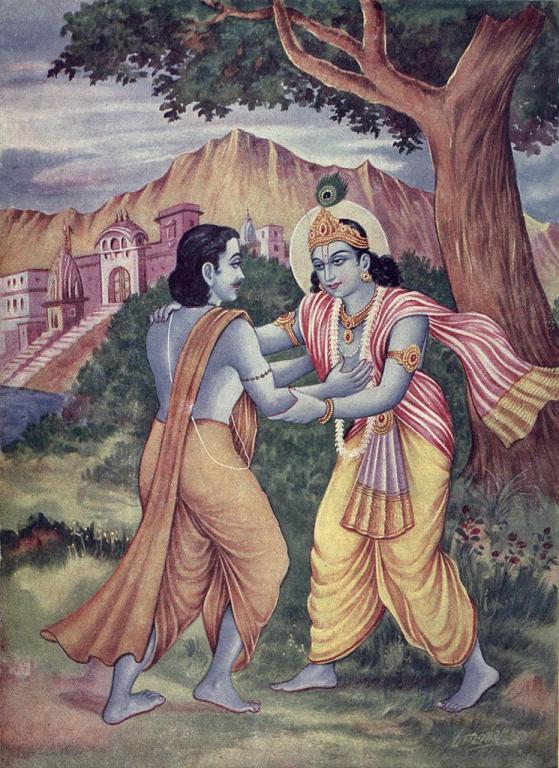
Contrary to some religious skeptics, Lord Krishna (shown on the right, greeting Arjuna) ISN’T actually a precise analogue to Jesus. Nor even a very close one at ALL. (Wikimedia Commons public domain image)
All the way back on 17 May 2012, I published a column in the Deseret News to which the newspaper’s editors assigned the title “‘Parallels’ of prophets not parallel.” The column read as follows:
From time to time, some triumphant atheist or other challenges me with a list of supposed parallels between the biblical depiction of Jesus and the stories of other important religious figures (mythical or historical), such as Krishna, Tammuz, the Buddha, Muhammad, Mithra, Cadmus, Osiris, and Baal.
The biographies of these characters are said to resemble each other right down to minute details: They commonly if not always came into the world via a virgin’s immaculate conception; were born on 25 December; were adored as infants by angels, shepherds, and visiting sages; performed miracles; taught New Testament doctrines; were regarded as divine; were crucified; atoned for human sin; descended into hell; rose again from the dead; and ascended into heaven.
The point of the list, of course, is to suggest that the story of Jesus is merely fictional, probably derived from myths about the death of vegetation in the winter and its miraculous rebirth in the spring.
It’s a very impressive catalog of parallels.
It’s also utterly bogus.
The ultimate source for the list seems to be an 1875 book by an American atheist writer named Kersey Graves, titled The World’s Sixteen Crucified Saviors: Christianity Before Christ.
And I’m being accurate when I describe the Graves book as the “ultimate source” for these ideas, since Graves supplies no references from ancient documents to back up his assertions. He simply announces them and then moves on as if he’s proved them true. But they’re nonsense.
Space permits only a hasty comparative analysis, and, since I’m the author of a biography of the founder of Islam, who is one of the figures identified by Graves as an exact parallel to Christ, perhaps I can be forgiven for focusing on Muhammad.
As a preliminary note, though, I need to say that the versions of this list that I’ve seen often confuse the Immaculate Conception — traditionally, Mary’s coming into the world as the daughter of Joachim and Anna (according to the second century “Protoevangelium of James”) without the taint of “Original Sin” — with the Virgin Birth, which is Mary’s conception of Jesus without an earthly father.
But now on to business:
No Islamic text of which I’m aware claims that Muhammad’s mother was a virgin at his birth. Muhammad’s father is known in Muslim sources as ‘Abd Allah, and he, in turn, was the son of ‘Abd al-Mutallib.
Muhammad wasn’t born on 25 December, but most likely near the end of April. Some relatively late legends surround his birth with miraculous events and have him working mighty wonders, but these folkloric tales probably arose out of competition with Christians, and neither the Qur’an nor the earliest, most reputable Islamic historical materials say anything about them. Muhammad himself explained that the reception of the Qur’an, the holy book of Islam, was his only (though sufficient) miracle.
Many of Muhammad’s doctrines are comparable to those of the New Testament. But this is scarcely surprising, since he claimed to be a prophet in the tradition of Abraham, Moses, and Jesus. Still, many of his doctrines are quite distinctive.
Islam has never taught that Muhammad was divine, nor even a son of God. “God does not beget,” says Qur’an 112:3, “nor is he begotten.” To suggest otherwise, Muslims believe, is shirk or polytheism, the worst possible theological error.
Muhammad was most definitely not crucified, atones for nobody’s sins, and did not rise from the dead.
Early stories exist of Muhammad ascending into heaven, and, on that same journey, seeing some of the sufferings of the damned in hell. But these stories don’t appear clearly in the Qur’an, they’re always placed years before Muhammad’s death, and they play no role in his life or in Islamic theology that’s even remotely comparable to the function that the “harrowing of hell” and Christ’s post-resurrection ascent have served in Christian lore and thought.
It’s simply false to say that Muhammad’s life precisely parallels that of Jesus. The differences are fundamental and far too numerous to be listed here. (Read my biography!) And when the same claim is actually examined with regard to Baal, Osiris, Krishna and the like, it fares no better.
If you’re ever confronted with Graves’ list or something like it, demand to see supporting references. Or, if you’re pressed for time, just go ahead and laugh. It’s not to be taken seriously.

Siddhartha Gautama, the Buddha (Wikimedia Commons public domain image)
I reproduce this old Deseret News column here out of exasperation at seeing the very same list of supposed parallels swim across my social media feed yet again yesterday, accompanied by the usual air of atheist triumphalism. Such dreck seems to be effectively immortal. But not in any glorious way. Rather, it’s immortal in the sense that zombies are immortal: The undead aren’t really alive, but they’re extremely difficult to kill.
Wrestling with a zombie or punching it in the face is seldom effective, and it puts the defender at risk of severe injury or infection from toxic zombie-body fluids. Wielding large sledgehammers or axes can quickly drain a defender’s stamina. Since zombies rely neither on a pulse nor on organs other than the brain stem, axes and sledgehammers are pretty much useless, just as gun shots to the torso or the chest merely waste ammunition. Moreover, reloading in the open or at the wrong time is another common error, because it leaves the defender temporarily vulnerable. Grenades and other low-yield explosives usually fail to destroy the zombie’s brain stem and only serve to draw the attention of other zombies who might be nearby — and it must not be forgotten that zombies are too stupid to feel fear or to be intimidated by possible physical trauma to their limbs or internal organs. Setting zombies on fire might seem an effective tactic and, indeed, it can occasionally work. But experienced zombie fighters strongly discourage it because, at least as commonly, the burning zombie becomes a walking “torch” that spreads the fire to the defender’s own allies or place of refuge.
The relevance of combat with zombies to dealing with this ridiculous list of “sixteen crucified saviors” should be immediately obvious to even the most casual thinker. And the lesson to be drawn from the accounts of survivors of such combat and of other experts is, probably, simply this: Trying to fight a zombie in hand-to-hand combat is a last resort, to be employed only when no viable alternative presents itself. The best tactic when facing a zombie invasion is, almost always, to run away. Simply don’t engage. Or, in the case of The Laughable List, to guffaw. And to do so with gusto.
Posted from the Gastineau Channel, near Juneau, Alaska
Travel and Religion
History and Religion
Previous Post

July 11, 2026
Sehnsucht and "Pure Northernness"
Next Post

July 13, 2026 The Kindness of Strangers
Recent Comments
"DP: “But Mr. Sutherland worries about the fact that our time, when we can communicate ..."
Learning more about a region of ..."
"Another class of memories are of individuals who previously lived. Some of these remembered individuals ..."
"Sutherland's lecture sounds interesting. He seems to restate the Washington consensus that trade brings peace ..."
Learning more about a region of ..."
"In a meeting today, I learned another important reason why accurate (or at least as ..."
From Serbia’s “White City,” Belgrade
Browse Our Archives
Select a Category Uncategorized
Select a Month October 2026 September 2026 August 2026 July 2026 June 2026 May 2026 April 2026 March 2026 February 2026 January 2026 December 2025 November 2025 October 2025 September 2025 August 2025 July 2025 June 2025 May 2025 April 2025 March 2025 February 2025 January 2025 December 2024 November 2024 October 2024 September 2024 August 2024 July 2024 June 2024 May 2024 April 2024 March 2024 February 2024 January 2024 December 2023 November 2023 October 2023 September 2023 August 2023 July 2023 June 2023 May 2023 April 2023 March 2023 February 2023 January 2023 December 2022 November 2022 October 2022 September 2022 August 2022 July 2022 June 2022 May 2022 April 2022 March 2022 February 2022 January 2022 December 2021 November 2021 October 2021 September 2021 August 2021 July 2021 June 2021 May 2021 April 2021 March 2021 February 2021 January 2021 December 2020 November 2020 October 2020 September 2020 August 2020 July 2020 June 2020 May 2020 April 2020 March 2020 February 2020 January 2020 December 2019 November 2019 October 2019 September 2019 August 2019 July 2019 June 2019 May 2019 April 2019 March 2019 February 2019 January 2019 December 2018 November 2018 October 2018 September 2018 August 2018 July 2018 June 2018 May 2018 April 2018 March 2018 February 2018 January 2018 December 2017 November 2017 October 2017 September 2017 August 2017 July 2017 June 2017 May 2017 April 2017 March 2017 February 2017 January 2017 December 2016 November 2016 October 2016 September 2016 August 2016 July 2016 June 2016 May 2016 April 2016 March 2016 February 2016 January 2016 December 2015 November 2015 October 2015 September 2015 August 2015 July 2015 June 2015 May 2015 April 2015 March 2015 February 2015 January 2015 December 2014 November 2014 March 2014 August 2013 February 2012
Follow Us!
TAKE THE
Religious Wisdom Quiz
Who was Jacob's favorite son?
Select your answer to see how you score.
Joseph Judah Dan Levi
Related posts from Sic et Non

An action movie and some vacuous theology

"The Loss of Jesus in the Small Plates...

We definitely didn't elect a mere choirboy.
TRENDING AT PATHEOS Latter-day Saint

Archdiocese Hosts Military Marriage Retreat in Germany
RASTATT, Germany — The transient military lifestyle, with its frequent deployments and...

Nearly every morning, I make the drive to Detroit with my high-school-age...

The Real AI Story Is Adoption Without Trust
Artificial intelligence has crossed a political threshold. It is no longer a...

A new article, written by Jeff Lindsay and Gale L. Pooley,...

Swimfan: Forgotten Aughts Pleasures
This is a recovery effort. In 2002, My Big Fat Greek Wedding...

Top Three Anti-Catholic Lies About Catholicism
This is my initial transcript for the video, "THE 3 WORST...
view all Latter-day Saint blogs
What Are Your Thoughts?leave a comment
Ad-Free & Subscriber Log-In Subscription Support
- About Us
- 2026 Calendar
- Videos
- Podcasts
- Library of World Religions
- Faith In Media Tracker
- Advertise With Us
- Write for Us
- Privacy Policy
- Terms of Service
- Do Not Sell My Data
- Contact Us
- Radiant Digital
- Manage Newsletter Subscriptions
- Unsubscribe From Notifications
- Sitemap
Copyright 2008-2026, Patheos. All rights reserved.
Subscription Support Ad-Free & Subscriber Log-In
Follow Patheos