
BuddhistCatholicContemplativeEvangelicalGeneral ChristianHinduJewishLatter-day SaintMuslimNew VisionsProgressive Christian
Beliefs
- Buddhist
- Catholic
- Contemplative
- Evangelical
- General Christian
- Hindu
- Jewish
- Latter-day Saint
- More Voices
- Muslim
- New Visions
- Pagan
- Progressive Christian
Topics
- Religion News
- Food and Religion
- Sports and Religion
- Religious Art
- Religious Music and Entertainment
- Religious Events
- History and Religion
- Style and Religion
- Politics and Religion
- Women in Religion
- Recreation Outdoors and Religion
- Business Finance and Religion
- Careers Workplace and Religion
- Education and Religion
- Family Parenting and Religion
- Health Fitness and Religion
- Home and Religion
- Relationships and Religion
- Technology and Religion
- Travel and Religion
Columnists
- Buddhist Columnists
- Business Finance and Religion Columnists
- Careers Workplace and Religion Columnists
- Catholic Columnists
- Contemplative Columnists
- Education and Religion Columnists
- Evangelists Columnists
- Family Parenting and Religion Columnists
- General Christian Columnists
- Health Fitness and Religion Columnists
- Hindu Columnists
- History and Religion Columnists
- Home and Religion Columnists
- Jewish Columnists
- More Voices Columnists
- Latter Day Columnists
- Muslim Columnists
- New Visions Columnists
- Nonreligious Columnists
- Pagan Columnists
- Politics and Religion Columnists
- Progressive Columnists
- Recreation Outdoors and Religion Columnists
- Relationships and Religion Columnists
- Religion News Columnists
- Religious Art Columnists
- Religious Events Columnists
- Religious Music and Entertainment Columnists
- Sports and Religion Columnists
- Style and Religion Columnists
- Technology and Religion Columnists
- Travel and Religion Columnists
- Women in Religion Columnists
Resource Library
- 2026 Calendar
- Library of World Religions
- The 100 Most Holy Places on Earth
- Patheos Answers
- Podcasts
- Videos
- Faith Leaders Database
- Anglican Episcopalian
- Bahai
- Baptist
- Buddhism
- Christianity
- Confucianism
- Eastern Orthodoxy
- Hinduism
- Holiness and Pentecostal
- ISKCON
- Islam
- Judaism
- Lutheran
- Methodist
- The Church of Jesus Christ of Latter-day Saints
- New Age
- Paganism
- Presbytarian and Reformed
- Protestantism
- Religion Behind the Scenes
- Roman Catholic
- Scientology
- Shia Islam
- Sikhism
- Sufism
- Sunni Islam
- Taoism
- Zen
- See all religions
Research Tools
 Ad-Free & Subscriber Log-In Subscription Support
Ad-Free & Subscriber Log-In Subscription Support
Follow Patheos 

- Trending:
- Forgiveness
- |
- Marriage
- |
- Consciousness
- |
- Death Penalty
- |
- Election
- |
- Halloween

- Home
- Latter-day Saint
- Travel and Religion
- A Home for the Gods
A Home for the Gods
Last updated on: July 10, 2026 at 3:18 pm by Dan Peterson
A Home for the Gods 2026-07-10T15:18:23-06:00 Dan Peterson
Patheos Explore the world's faith through different perspectives on religion and spirituality! Patheos has the views of the prevalent religions and spiritualities of the world.

A photograph taken at Glacier Bay in 2004 by Quentin Goodman (JanQuen at English Language Wikipedia)
A new article, written by Todd Uriona, went up earlier today in Interpreter: A Journal of Latter-day Saint Faith and Scholarship 69 (2026): 183-214. It is entitled “The Iron Rod Reimagined: Revisiting the Meaning of an Enduring Metaphor”:
Abstract: The iron rod, presented so prominently in Lehi’s visionary dream (1 Nephi 8:19–24), has traditionally been conceptualized as a static handrail or balustrade guiding travelers toward the tree of life. While this imagery has provided meaningful theological guidance for many years, the metaphor of the rod of iron can profitably be viewed through another lens: that of the Ancient Near Eastern shepherd-king. From this perspective, the rod functions as a scepter or staff symbolizing Christ’s divine authority and active leadership in gathering his flock. Rather than a fixed handrail lining a predetermined route, Christ’s staff or rod is an instrument of rescue actively extended to travelers as they traverse the strait and narrow path. This article expands on that premise by demonstrating that the iron rod may encompass a deeper, dualistic functionality that is rooted in the Hebrew terms for the word, rod. The central thesis of this paper posits that the metaphor of the rod of iron functions simultaneously on two levels. First, as the Shepherd’s authoritative staff, and second, as an organic branch that is actively extended to the scattered house of Israel to enable their restoration and covenantal grafting. This second horticultural dimension fuses Christ’s roles as the divine Shepherd-King with his role as the True Vine. This coupling allows for an intertextual synthesis. It maps the specific vocabulary of adherence (“clinging” vs. “holding fast”) in Lehi’s dream (1 Nephi 8) onto the established covenantal metaphors found in Zenos’s Allegory of the Olive Tree (Jacob 5), which describes the grafting of a branch as either withering or firmly taking hold.
Todd Uriona’s article is accompanied on the Interpreter Foundation’s website by “Interpreting Interpreter: A Reimagined Rod,” which was written by the remarkable and remarkably generous Kyler Rasmussen:
This post is a summary of the article “The Iron Rod Reimagined: Revisiting the Meaning of an Enduring Metaphor” by Todd J. Uriona in Volume 69 of Interpreter: A Journal of Latter-day Saint Faith and Scholarship. All of the Interpreting Interpreter articles may be seen at https://interpreterfoundation.org/category/summaries/. An introduction to the Interpreting Interpreter series is available at https:/interpreterfoundation.org/interpreting-interpreter-on-abstracting-thought/.
A video introduction to this Interpreter article is now available on all of our social media channels, including on YouTube at https://youtube.com/shorts/_OkKTVzmrcI.
The Takeaway: Uriona explores the concept of the iron rod within Lehi’s dream, suggesting that the rod may be best represented by a scepter or staff rather than a handrail and showing how it fits within the horticultural imagery used elsewhere within the Book of Mormon.

A 2014 Wikimedia Commons public domain image of Johns Hopkins Glacier in Glacier Bay National Park
And — I’ve been somewhat distracted by glaciers and soaring mountains and bald eagles and sea otters — I think that I failed, yesterday, to mention the appearance on the Interpreter Foundation’s long dead and never varying website of “Reprint: Abram Meets Melchizedek, with Joseph Smith at the Reader’s Side,” written by Jeffrey M. Bradshaw”:
Part of our book chapter reprint series, this article originally appeared in Abraham and His Family in Scripture, History, and Tradition, edited by Jeffrey M. Bradshaw, John S. Thompson, Matthew L. Bowen, and David R. Seely. For more information, go to https://interpreterfoundation.org/books/abraham-and-his-family.
“‘Abram Meets Melchizedek.’ Though the title of this essay is simple enough, the Genesis chapters that relate this story are full of enigmas. It has been claimed that ‘no chapter in the Bible has been more widely studied than Genesis 14’ and, going further, that the episode in which Melchizedek and Abram meet is ‘the most complex within this chapter.’ Scholars are divided about whether the battle scenes in the first twelve verses of the chapter—chock full of explicit historic details—are real or are intentionally fake history. ‘This is a chapter rife with unique literary devices, including explanatory glosses, plays on words, etymological significance of names, and even a possible use of gematria.’ The prevalence of these devices attest not only to the chapter’s importance, but likely also its sacred character.”

Another image from Glacier Bay National Park, this one taken by Diego Delso delso.photo, License CC BY-SA
I note with interest and enthusiasm the establishment of the Sharon Institute and the launch of its Journal of Faith and Scholarship. The similarity between the title of the Sharon Institute’s journal and the subtitle of the Interpreter Foundation’s journal might indicate that we’re fishing in the same waters — which, in a sense, we are — but the leadership roster of the Sharon Institute and the contents of the first issue of its new journal suggest that, while our loyalties and commitments align, our areas of focus are quite distinct. I wish them every success.
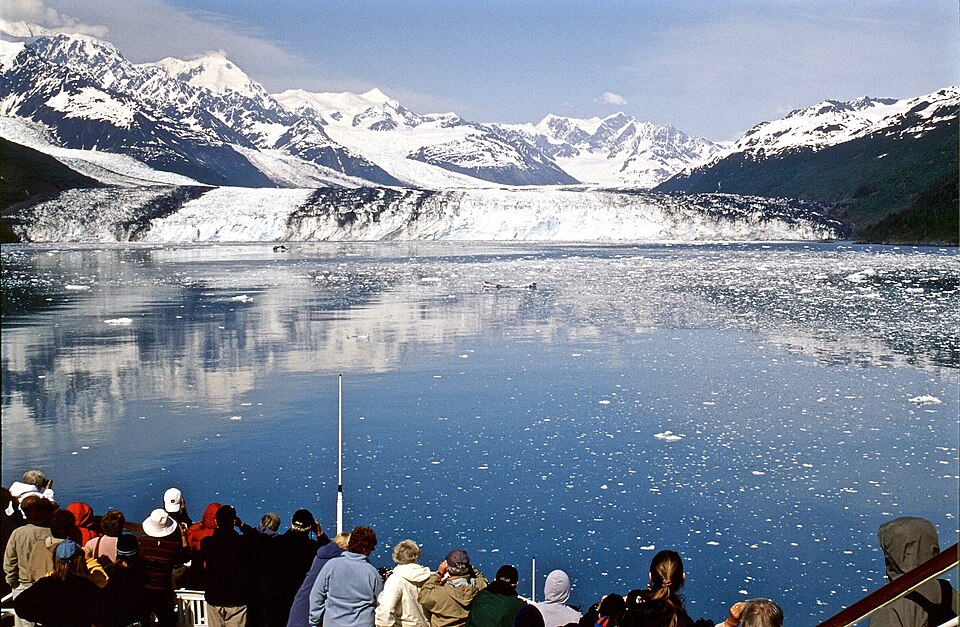
A group of tourists aboard a cruise ship in Glacier Bay back in 2004.
After posting my blog entry yesterday, we boarded one of two rather large catamarans and approached more closely than the cruise ship could to the enormous Hubbard Glacier, the largest tidewater glacier in the world (so far as I’m aware), which is located next to the significantly smaller Turner Glacier at the end of Disenchantment Bay, within eastern Alaska’s Wrangell–St. Elias National Park and Preserve. It was Alessandro Malaspina who gave the bay its name (“Puerto del Desengano”) in 1792 when, having first thought that he had finally found the long-sought Northwest Passage, he realized that, yet again, he hadn’t. Up by Anchorage, it was the otherwise ubiquitous Captain James Cook who expressed similar disappointment when Cook Inlet’s Turnaround Arm didn’t pan out.
Hubbard Glacier falls within the domain of the Tlingit people. In fact, the two catamarans that we used are apparently owned, in some sense, by the Tlingit or, at least, by people of Tlingit background. (I’m not precisely clear on that.) We maneuvered between and over bergy bits and growlers (see yesterday’s entry), and watched several instances of glacial calving.
We spent today cruising in Glacier Bay National Park, which is likewise Tlingit country. (We didn’t go ashore, but sailed very slowly through the very large bay. This is a grand, magnificent, and inspiring landscape. But it’s also an austere one, and quite inhospitable in many ways. It is not, I think, fitted to mortal humans but, rather, to the Gods. I can certainly understand why peoples around the world have thought of mountains as the abode of the divine, and have compared their own constructed temples to “the mountain of the Lord’s house.”
Posted from Glacier Bay National Park, Alaska
Travel and Religion
History and Religion
Previous Post

July 9, 2026
The Gulf of Alaska and Yakutat Bay
Next Post

July 11, 2026 Sehnsucht and "Pure Northernness"
Recent Comments
"Sutherland's lecture sounds interesting. He seems to restate the Washington consensus that trade brings peace ..."
Learning more about a region of ..."
"In a meeting today, I learned another important reason why accurate (or at least as ..."
From Serbia’s “White City,” Belgrade
"I've been watching a lot of video interviews of NDErs and researchers. I think in ..."
"PL: "Let's hope he doesn't have your address..."I have to frankly confess that a few ..."
From Serbia’s “White City,” Belgrade
Browse Our Archives
Select a Category Uncategorized
Select a Month October 2026 September 2026 August 2026 July 2026 June 2026 May 2026 April 2026 March 2026 February 2026 January 2026 December 2025 November 2025 October 2025 September 2025 August 2025 July 2025 June 2025 May 2025 April 2025 March 2025 February 2025 January 2025 December 2024 November 2024 October 2024 September 2024 August 2024 July 2024 June 2024 May 2024 April 2024 March 2024 February 2024 January 2024 December 2023 November 2023 October 2023 September 2023 August 2023 July 2023 June 2023 May 2023 April 2023 March 2023 February 2023 January 2023 December 2022 November 2022 October 2022 September 2022 August 2022 July 2022 June 2022 May 2022 April 2022 March 2022 February 2022 January 2022 December 2021 November 2021 October 2021 September 2021 August 2021 July 2021 June 2021 May 2021 April 2021 March 2021 February 2021 January 2021 December 2020 November 2020 October 2020 September 2020 August 2020 July 2020 June 2020 May 2020 April 2020 March 2020 February 2020 January 2020 December 2019 November 2019 October 2019 September 2019 August 2019 July 2019 June 2019 May 2019 April 2019 March 2019 February 2019 January 2019 December 2018 November 2018 October 2018 September 2018 August 2018 July 2018 June 2018 May 2018 April 2018 March 2018 February 2018 January 2018 December 2017 November 2017 October 2017 September 2017 August 2017 July 2017 June 2017 May 2017 April 2017 March 2017 February 2017 January 2017 December 2016 November 2016 October 2016 September 2016 August 2016 July 2016 June 2016 May 2016 April 2016 March 2016 February 2016 January 2016 December 2015 November 2015 October 2015 September 2015 August 2015 July 2015 June 2015 May 2015 April 2015 March 2015 February 2015 January 2015 December 2014 November 2014 March 2014 August 2013 February 2012
Follow Us!
TAKE THE
Religious Wisdom Quiz
Who said, "Come, follow me, and I will make you fishers of men"?
Select your answer to see how you score.
Jesus Peter Paul John the Baptist
Related posts from Sic et Non


Notes on Women, Priesthood, and General Conference

"The Book of Moses as a Temple Text"

TRENDING AT PATHEOS Latter-day Saint

Janie Learns the Way of the Cross: A...
Teaching children about Jesus' Passion can be challenging. Many parents and educators...

Looking For Good Catholic Writing - October 2026
He alone extends the heavens, and he walks upon the waves of...

In "Irreplaceable," our book on vocation and technology, Trevor Sutton and I...

I was strolling through the top floor of the brand new Parthenon...

What Does Gêvâh Mean For Kimberley Guifoyle &...
This week, a lot of the news is focused on Kimberly Guilfoyle....

INNER CIRCLE: Profound Mystery (Of Christ In All...
Ephesians 5:31-32 “For this reason, a man will leave his father and...
view all Latter-day Saint blogs
What Are Your Thoughts?leave a comment
Ad-Free & Subscriber Log-In Subscription Support
- About Us
- 2026 Calendar
- Videos
- Podcasts
- Library of World Religions
- Faith In Media Tracker
- Advertise With Us
- Write for Us
- Privacy Policy
- Terms of Service
- Do Not Sell My Data
- Contact Us
- Radiant Digital
- Manage Newsletter Subscriptions
- Unsubscribe From Notifications
- Sitemap
Copyright 2008-2026, Patheos. All rights reserved.
Subscription Support Ad-Free & Subscriber Log-In
Follow Patheos