
BuddhistCatholicContemplativeEvangelicalGeneral ChristianHinduJewishLatter-day SaintMuslimNew VisionsProgressive Christian
Beliefs
- Buddhist
- Catholic
- Contemplative
- Evangelical
- General Christian
- Hindu
- Jewish
- Latter-day Saint
- More Voices
- Muslim
- New Visions
- Pagan
- Progressive Christian
Topics
- Religion News
- Food and Religion
- Sports and Religion
- Religious Art
- Religious Music and Entertainment
- Religious Events
- History and Religion
- Style and Religion
- Politics and Religion
- Women in Religion
- Recreation Outdoors and Religion
- Business Finance and Religion
- Careers Workplace and Religion
- Education and Religion
- Family Parenting and Religion
- Health Fitness and Religion
- Home and Religion
- Relationships and Religion
- Technology and Religion
- Travel and Religion
Columnists
- Buddhist Columnists
- Business Finance and Religion Columnists
- Careers Workplace and Religion Columnists
- Catholic Columnists
- Contemplative Columnists
- Education and Religion Columnists
- Evangelists Columnists
- Family Parenting and Religion Columnists
- General Christian Columnists
- Health Fitness and Religion Columnists
- Hindu Columnists
- History and Religion Columnists
- Home and Religion Columnists
- Jewish Columnists
- More Voices Columnists
- Latter Day Columnists
- Muslim Columnists
- New Visions Columnists
- Nonreligious Columnists
- Pagan Columnists
- Politics and Religion Columnists
- Progressive Columnists
- Recreation Outdoors and Religion Columnists
- Relationships and Religion Columnists
- Religion News Columnists
- Religious Art Columnists
- Religious Events Columnists
- Religious Music and Entertainment Columnists
- Sports and Religion Columnists
- Style and Religion Columnists
- Technology and Religion Columnists
- Travel and Religion Columnists
- Women in Religion Columnists
Resource Library
- 2026 Calendar
- Library of World Religions
- The 100 Most Holy Places on Earth
- Patheos Answers
- Podcasts
- Videos
- Faith Leaders Database
- Anglican Episcopalian
- Bahai
- Baptist
- Buddhism
- Christianity
- Confucianism
- Eastern Orthodoxy
- Hinduism
- Holiness and Pentecostal
- ISKCON
- Islam
- Judaism
- Lutheran
- Methodist
- The Church of Jesus Christ of Latter-day Saints
- New Age
- Paganism
- Presbytarian and Reformed
- Protestantism
- Religion Behind the Scenes
- Roman Catholic
- Scientology
- Shia Islam
- Sikhism
- Sufism
- Sunni Islam
- Taoism
- Zen
- See all religions
Research Tools
 Ad-Free & Subscriber Log-In Subscription Support
Ad-Free & Subscriber Log-In Subscription Support
Follow Patheos 

- Trending:
- Forgiveness
- |
- Marriage
- |
- Consciousness
- |
- Death Penalty
- |
- Election
- |
- Halloween

- Home
- Latter-day Saint
- Travel and Religion
- Sehnsucht and “Pure Northernness”
Sehnsucht and “Pure Northernness”
Last updated on: July 11, 2026 at 6:59 pm by Dan Peterson
Sehnsucht and “Pure Northernness” 2026-07-11T18:59:23-06:00 Dan Peterson
Patheos Explore the world's faith through different perspectives on religion and spirituality! Patheos has the views of the prevalent religions and spiritualities of the world.
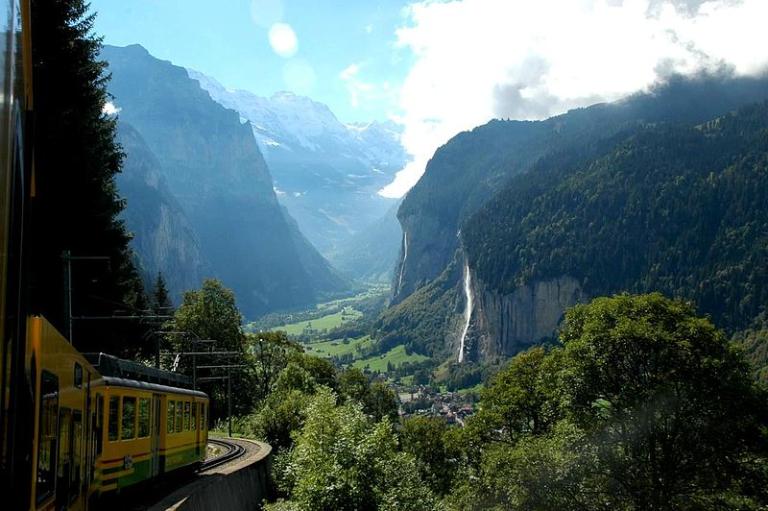
In my former missionary tracting area, Lauterbrunnen in the Berner Oberland of Switzerland — perhaps, in my judgment, the most beautiful landscape on Planet Earth. I post it here not merely for its (slight) relevance to this blog entry, but for the soothing power of splendid natural beauty.
(Wikimedia Commons public domain image)
I don’t know whether I’m unique (weird?) in this regard or not but, when I hear an excruciatingly beautiful piece of music or see an achingly beautiful landscape — please note those two adjectives expressive of pain; they were deliberately chosen — I want to possess it in some way more than I actually can possess it. I’m not sure precisely how to express what I mean. I definitely don’t mean that I want to possess it in some exclusive way — I have no problem with others enjoying it as well — but, rather, that I want it to be somehow permanent. I always think of the line that Goethe places in the mouth of Faust (though not exactly, I know, in the way that either Faust or Goethe intended it): Addressing a moment of particular joy and/or beauty, Faust says to it, Verweile doch, du bist so schön (“Linger a while. Thou art so beautiful,” or something to that effect.) I’ve felt that way many times on this trip, as I have before and elsewhere.
Many people love beaches and tropical islands. I love them, too. I grew up, after all, in southern California, and I made my first visit to Hawaii at the age of five. (I have no idea how many times I’ve been back since.)
But, if pressed — and even if not pressed — I must admit that the terrestrial landscapes that most powerfully resonate with me, that stir me most deeply, are alpine. For slightly more than two weeks, when I was eleven, I hiked the John Muir Trail through California’s Sierra Nevada Mountains. I fell in love with Switzerland and the Alps on my first visit to Europe just out of high school, and I was absolutely ecstatic to be called to serve in Switzerland thereafter as a missionary. Similarly, I love the fjords and the lakes and the mountainous valleys of my grandmother’s Norway. And I love the Canadian Rockies. I can’t get enough of them.

Valley of the Ten Peaks and Moraine Lake, Banff National Park, Alberta, Canada
(Wikimedia Commons public domain photograph)
In this context, I inevitably think of C. S. Lewis’s notion of Sehnsucht, and of what he called “pure northernness.” Back in early February 2o12, I wrote about it in a column for the Deseret News:
A central theme in C.S. Lewis’ autobiographical book “Surprised by Joy” — and the obvious source of its title — is what he terms “Joy.”
Yet Lewis struggles to convey what he means. “Longing,” he calls it, sometimes using the evocative German synonym “Sehnsucht.” He describes fleeting instants when, encountering a landscape or phrase or musical passage, he suddenly and unexpectedly “desired with almost sickening intensity something never to be described.” “It was a sensation, of course, of desire; but desire for what?” “Before I knew what I desired, the desire itself was gone, the whole glimpse withdrawn, the world turned commonplace again, or only stirred by a longing for the longing that had just ceased.” Of his earliest such experience, he writes, “It had taken only a moment of time, and in a certain sense everything else that had ever happened to me was insignificant in comparison.”
Lewis’ first encounters with “Joy” often involved Norse mythology and, eventually, the music of Wagner: “Pure ‘Northernness’ engulfed me: a vision of huge, clear spaces hanging above the Atlantic in the endless twilight of northern summer, remoteness, severity.” Yet he eventually realized that his yearning wasn’t really for things Norse and Northern, but for something beyond them.
Joy, in Lewis’ sense, is “an unsatisfied desire, which is itself more desirable than any other satisfaction.” Though it resembles them in the sense that “anyone who has experienced it will want it again,” it’s distinct from happiness and pleasure. Indeed, he describes it as “inconsolable,” a “stabbing,” a “pang” and a sense of “loss,” observing that “it might almost equally well be called a particular kind of unhappiness or grief. But then it is a kind we want. I doubt whether anyone who has tasted it would ever, if both were in his power, exchange it for all the pleasures in the world.” “All Joy reminds,” he says. “It is never a possession, always a desire for something longer ago or further away or still ‘about to be.'” It always “implies the absence of its object.”
When I first read Lewis on “Joy,” I knew immediately what he meant.
He wondered whether others shared his experience. I have.
The eminent Austrian-American sociologist Peter Berger regards northern Italy’s extraordinarily beautiful Lake Como as the most powerful argument for the existence of God. I would quibble about the specific location, but I understand.
Certain alpine landscapes — in the Canadian Rockies, in Italy around Cortina d’Ampezzo and the Dolomites, and, pre-eminently, in Switzerland’s Berner Oberland (where I served as a missionary) — have often awakened in me an aching and almost overwhelming sense of transcendence.
I know how it feels to want to possess them in a way that they simply cannot be possessed — though what I’ve just written doesn’t really capture the feeling. What would it mean to “possess” the Bernese Alps? How, Lewis asks, can anybody “possess” the “Idea of Autumn” (as, in one such transient moment, he deeply desired to do)?
I can no more define the experience than Lewis could. I’m confident, though, that some readers will recognize it.
The desire is, in a sense, entirely vain. “Stay a while!” Goethe’s Faust implores one rapturous but passing moment. “You are so beautiful!” But the moment doesn’t stay. Everything is transient.
Still, I believe that such experiences offer powerful religious meaning to those who’ve had them. They are, I think, “stabs” of “divine homesickness,” a yearning for something unspeakably and unchangingly beautiful, good, and holy. Eliza Snow reminisced that, even before Mormonism, “ofttimes a secret something whispered, ‘You’re a stranger here,’ and I felt that I had wandered from a more exalted sphere.” William Wordsworth perceived “intimations of immortality” (and of a premortal existence) in nature. The Persian poet Rumi compared the human soul to a reed; the plaintive sound of reed pipes expresses the reed’s longing for its lost home in the reed bed just as we yearn for the divine home from which we’ve been severed.
Reasoning that, since ordinary desires (e.g., for food, water, air, sex or companionship) can always be fulfilled (at least potentially), Lewis argued that the yearning he called “Joy” also promises the possibility of satisfaction — if only in another world.
“You have made us for Yourself, Oh Lord,” wrote St. Augustine in the first chapter of his “Confessions,” “and our hearts are restless until they rest in Thee.”
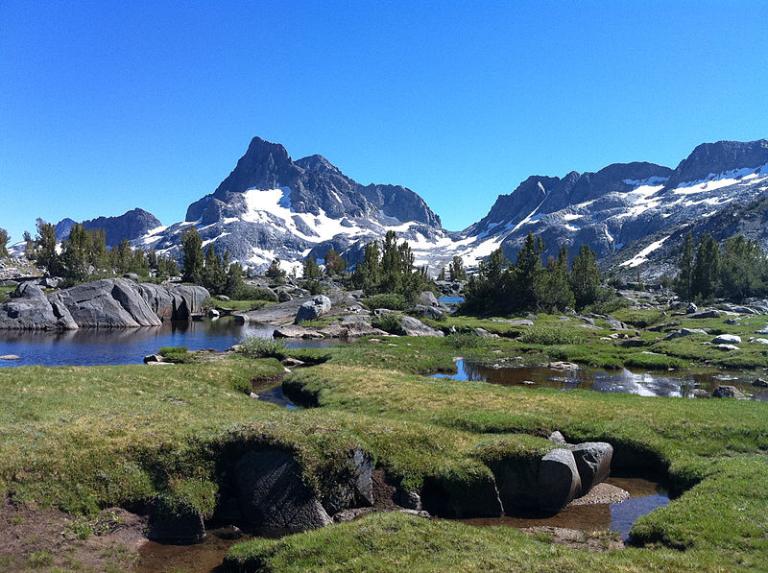
Spending fifteen days on the John Muir Trail in California’s High Sierras when I was eleven was a pivotal experience of my youth. (Wikimedia Commons public domain image)
My own experience with Sehnsucht, which has been recurrent throughout my life, goes back at least to a very specific moment when I was an eleven- or twelve-year-old Boy Scout hiking a mountain trail in California. I can’t even really describe it, though I can still somehow see it in my mind. (I don’t even remember exactly where it was, which is probably okay because, if I tried to return to it, I almost certainly wouldn’t have the same experience. As the saying has it, “You can’t go home again.”) Anyway, a friend and I came over a high ridge and looked down into a wooded valley at evening time. In the distance, the smoke of a cabin or a campfire curled up. And the feeling hit me. Powerfully. Unforgettably. Since then, a famous little poem by J. W. von Goethe has unfailingly evoked that memory in me, being mysteriously but inseparably connected with it — though I don’t need Goethe’s famous lyric to experience the feeling:
Wandrers Nachtlied II
Über allen Gipfeln
Ist Ruh,
In allen Wipfeln
Spürest du
Kaum einen Hauch;
Die Vögelein schweigen im Walde.
Warte nur, balde
Ruhest du auch.Wanderer’s Nightsong II (my rough translation, wholly unworthy of Goethe’s perfect little gem)
Over all the summits
Is repose,
In all the treetops
You hear
Scarcely a breath;
The birds are silent in the forest:
Wait. Soon
You too will rest.
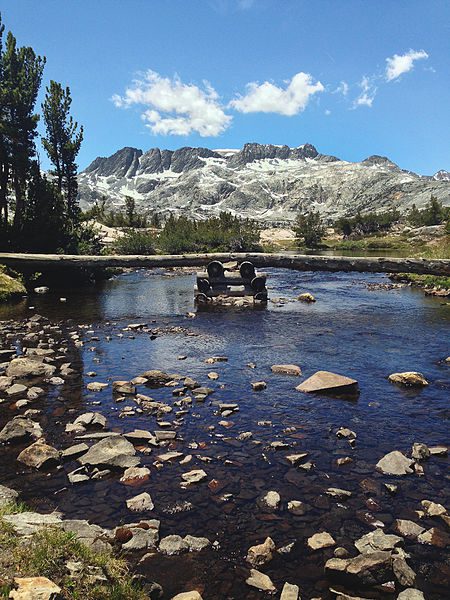
A bridge across part of Thousand Island Lake on the John Muir Trail in California’s Sierra Nevada Mountains.
When I was eleven years old, I backpacked half of the Trail with my Scout troop. It took fifteen days, and was one of the greatest formative experiences of my life.
I haven’t availed myself of even a fraction of the entertainment and activities that are available onboard the Coral Princess. I have reading and other things that I want to do, and some urgent writing tasks that I need to address. And, on these very long northern summer days, I really like to read and write out on our balcony, watching the ocean and the mountains go by. Last night, though, we attended an enjoyable concert of singing and dancing that centered on operas and musicals. The night before, we stayed in our cabin and watched the 1993 film version of Shakespeare’s Much Ado About Nothing that stars Kenneth Branagh and Emma Thompson and a number of other fine (and prominent) actors. I have one major interpretive quarrel with the production — I think that, in a single specific scene, it badly misreads and misrepresents what Shakespeare wrote — but, otherwise, I like it and I had a good time seeing it yet again.
Today, we spent at least twelve hours docked in Skagway, Alaska. (The name is an Anglicized corruption of the Tlingit Shg̱agwei.) Our major activity here was taking a narrow-gauge railroad train along the White Pass and Yukon Route that ultimately links the port of Skagway with Whitehorse, the capital of Yukon. (It was built to serve the needs generated by the gold rush that occurred in the Klondike region over in Yukon from 1896 until 1899.) We didn’t go that far, but we climbed up through forests and fog, over large gorges, and past waterfalls before we returned to Skagway below.
Posted from Skagway, Alaska
Travel and Religion
History and Religion
Previous Post

July 10, 2026
A Home for the Gods
Next Post

July 12, 2026 "The World's Sixteen Crucified Saviors"?
Recent Comments
"DP: “But Mr. Sutherland worries about the fact that our time, when we can communicate ..."
Learning more about a region of ..."
"Another class of memories are of individuals who previously lived. Some of these remembered individuals ..."
"Sutherland's lecture sounds interesting. He seems to restate the Washington consensus that trade brings peace ..."
Learning more about a region of ..."
"In a meeting today, I learned another important reason why accurate (or at least as ..."
From Serbia’s “White City,” Belgrade
Browse Our Archives
Select a Category Uncategorized
Select a Month October 2026 September 2026 August 2026 July 2026 June 2026 May 2026 April 2026 March 2026 February 2026 January 2026 December 2025 November 2025 October 2025 September 2025 August 2025 July 2025 June 2025 May 2025 April 2025 March 2025 February 2025 January 2025 December 2024 November 2024 October 2024 September 2024 August 2024 July 2024 June 2024 May 2024 April 2024 March 2024 February 2024 January 2024 December 2023 November 2023 October 2023 September 2023 August 2023 July 2023 June 2023 May 2023 April 2023 March 2023 February 2023 January 2023 December 2022 November 2022 October 2022 September 2022 August 2022 July 2022 June 2022 May 2022 April 2022 March 2022 February 2022 January 2022 December 2021 November 2021 October 2021 September 2021 August 2021 July 2021 June 2021 May 2021 April 2021 March 2021 February 2021 January 2021 December 2020 November 2020 October 2020 September 2020 August 2020 July 2020 June 2020 May 2020 April 2020 March 2020 February 2020 January 2020 December 2019 November 2019 October 2019 September 2019 August 2019 July 2019 June 2019 May 2019 April 2019 March 2019 February 2019 January 2019 December 2018 November 2018 October 2018 September 2018 August 2018 July 2018 June 2018 May 2018 April 2018 March 2018 February 2018 January 2018 December 2017 November 2017 October 2017 September 2017 August 2017 July 2017 June 2017 May 2017 April 2017 March 2017 February 2017 January 2017 December 2016 November 2016 October 2016 September 2016 August 2016 July 2016 June 2016 May 2016 April 2016 March 2016 February 2016 January 2016 December 2015 November 2015 October 2015 September 2015 August 2015 July 2015 June 2015 May 2015 April 2015 March 2015 February 2015 January 2015 December 2014 November 2014 March 2014 August 2013 February 2012
Follow Us!
TAKE THE
Religious Wisdom Quiz
"Thou shalt not..."
Select your answer to see how you score.
Fight Give into the Vainness of Men Covet Have Pride
Related posts from Sic et Non

Mrs. Harris goes to Paris . . ....

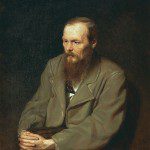
If there is no God, is everything permitted?
TRENDING AT PATHEOS Latter-day Saint

The First Eucharistic Controversy: Christ’s Real Presence
For Catholics, the Eucharist is the source and summit of the Christian...

What a Stop Sign Can Teach Us About...
How to Make a Decision When You Can't Hear God Main point:...

Archdiocese Hosts Military Marriage Retreat in Germany
RASTATT, Germany — The transient military lifestyle, with its frequent deployments and...

Nearly every morning, I make the drive to Detroit with my high-school-age...

The Real AI Story Is Adoption Without Trust
Artificial intelligence has crossed a political threshold. It is no longer a...

A new article, written by Jeff Lindsay and Gale L. Pooley,...
view all Latter-day Saint blogs
What Are Your Thoughts?leave a comment
Ad-Free & Subscriber Log-In Subscription Support
- About Us
- 2026 Calendar
- Videos
- Podcasts
- Library of World Religions
- Faith In Media Tracker
- Advertise With Us
- Write for Us
- Privacy Policy
- Terms of Service
- Do Not Sell My Data
- Contact Us
- Radiant Digital
- Manage Newsletter Subscriptions
- Unsubscribe From Notifications
- Sitemap
Copyright 2008-2026, Patheos. All rights reserved.
Subscription Support Ad-Free & Subscriber Log-In
Follow Patheos