
BuddhistCatholicContemplativeEvangelicalGeneral ChristianHinduJewishLatter-day SaintMuslimNew VisionsProgressive Christian
Beliefs
- Buddhist
- Catholic
- Contemplative
- Evangelical
- General Christian
- Hindu
- Jewish
- Latter-day Saint
- More Voices
- Muslim
- New Visions
- Pagan
- Progressive Christian
Topics
- Religion News
- Food and Religion
- Sports and Religion
- Religious Art
- Religious Music and Entertainment
- Religious Events
- History and Religion
- Style and Religion
- Politics and Religion
- Women in Religion
- Recreation Outdoors and Religion
- Business Finance and Religion
- Careers Workplace and Religion
- Education and Religion
- Family Parenting and Religion
- Health Fitness and Religion
- Home and Religion
- Relationships and Religion
- Technology and Religion
- Travel and Religion
Columnists
- Buddhist Columnists
- Business Finance and Religion Columnists
- Careers Workplace and Religion Columnists
- Catholic Columnists
- Contemplative Columnists
- Education and Religion Columnists
- Evangelists Columnists
- Family Parenting and Religion Columnists
- General Christian Columnists
- Health Fitness and Religion Columnists
- Hindu Columnists
- History and Religion Columnists
- Home and Religion Columnists
- Jewish Columnists
- More Voices Columnists
- Latter Day Columnists
- Muslim Columnists
- New Visions Columnists
- Nonreligious Columnists
- Pagan Columnists
- Politics and Religion Columnists
- Progressive Columnists
- Recreation Outdoors and Religion Columnists
- Relationships and Religion Columnists
- Religion News Columnists
- Religious Art Columnists
- Religious Events Columnists
- Religious Music and Entertainment Columnists
- Sports and Religion Columnists
- Style and Religion Columnists
- Technology and Religion Columnists
- Travel and Religion Columnists
- Women in Religion Columnists
Resource Library
- 2026 Calendar
- Library of World Religions
- The 100 Most Holy Places on Earth
- Patheos Answers
- Podcasts
- Videos
- Faith Leaders Database
- Anglican Episcopalian
- Bahai
- Baptist
- Buddhism
- Christianity
- Confucianism
- Eastern Orthodoxy
- Hinduism
- Holiness and Pentecostal
- ISKCON
- Islam
- Judaism
- Lutheran
- Methodist
- The Church of Jesus Christ of Latter-day Saints
- New Age
- Paganism
- Presbytarian and Reformed
- Protestantism
- Religion Behind the Scenes
- Roman Catholic
- Scientology
- Shia Islam
- Sikhism
- Sufism
- Sunni Islam
- Taoism
- Zen
- See all religions
Research Tools
 Ad-Free & Subscriber Log-In Subscription Support
Ad-Free & Subscriber Log-In Subscription Support
Follow Patheos 

- Trending:
- Forgiveness
- |
- Marriage
- |
- Consciousness
- |
- Death Penalty
- |
- Election
- |
- Halloween

- Home
- Latter-day Saint
- Travel and Religion
- “The Loss of Jesus in the Small Plates of Nephi”
“The Loss of Jesus in the Small Plates of Nephi”
Last updated on: June 15, 2026 at 12:14 am by Dan Peterson
“The Loss of Jesus in the Small Plates of Nephi” 2026-06-15T00:14:23-06:00 Dan Peterson
Patheos Explore the world's faith through different perspectives on religion and spirituality! Patheos has the views of the prevalent religions and spiritualities of the world.
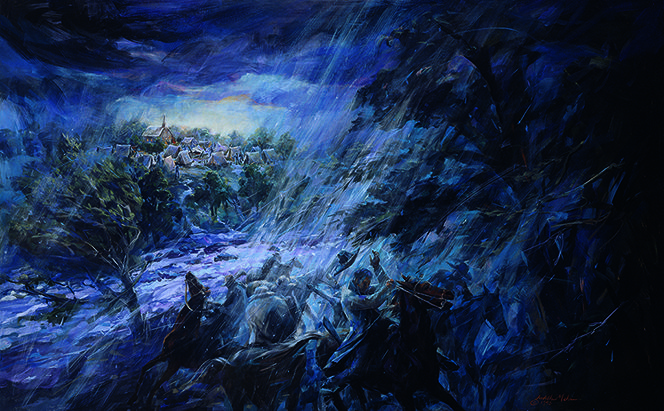
“Zion’s Camp at Fishing River” (Judith Mehr) LDS.org, public domain image.
The twenty-first installment of Becoming Brigham — “Saints and Complainers” — is now up online for (we hope!) your enjoyment and information:
Why did ordinary men like Brigham Young leave everything behind to walk over 1,000 miles under brutal conditions to help the Saints in Missouri?
How did Joseph Smith demonstrate remarkable leadership and patience while leading a group of exhausted, complaining men on Zion’s Camp?
What can we learn from the extreme sacrifices of the early Saints—and the women left behind—when facing trials that don’t turn out as expected?
This episode continues the story of the 1833–1834 Missouri persecutions. Joseph receives a revelation and calls for Zion’s Camp, an expedition of volunteers to aid the displaced Saints. Brigham Young is among the first to step forward, along with others like Wilford Woodruff.
The episode vividly describes the immense challenges of Zion’s Camp: volunteers walking 30–40 miles a day for nearly 2,000 total miles, enduring extreme heat, mosquitoes, bad water, blistered and bleeding feet, minimal sleep, and scarce supplies. The discussion emphasizes the true purpose of the camp—a defensive and relief mission seeking legal redress and militia protection, not armed conquest—and the powerful leadership lessons Joseph Smith taught through patience and meekness.
Nephi’s vision, as depicted in 2011 at the long-running but now-concluded annual Hill Cumorah Pageant in New York (Wikimedia Commons public domain image)
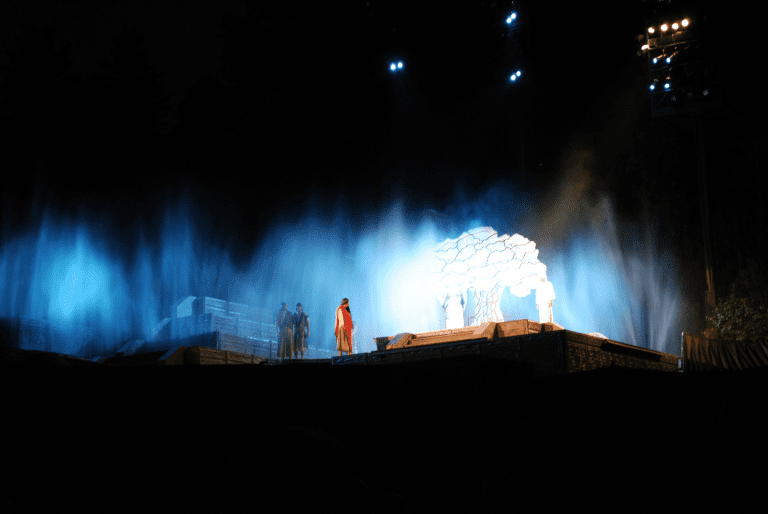
This podcast episode of Conversations with Interpreter, featuring Avram and Thora Shannon, went up yesterday: “The Loss of Jesus in the Small Plates of Nephi.” It’s not quite forty-five minutes in length:
In this episode of Conversations with Interpreter, Avram and Thora interview one another, discussing their education and research interests. They also talk about their most recent project together, a paper presented at “For a Wise Purpose in Him” The 2026 Small Plates of Nephi Conference In Honor of President Jeffrey R. Holland. This paper looks at evidence that there was a gradual loss of knowledge of the full name and mission of Jesus Christ between Jacob and King Benjamin, because Benjamin receives this information from an angel.
More information on the conference and their paper is available at https://interpreterfoundation.org/conferences/2026-small-plates-of-nephi-conference/.
In Conversations with Interpreter, we join Avram and Thora Shannon as they talk with scholars who contribute to The Interpreter Foundation through articles, book chapters, and conference presentations. Together, they explore the insights, research, and faith that inspire these contributions and enrich our understanding of the restored gospel.
Avram is an Associate Professor of Ancient Scripture at Brigham Young University, specializing in the intersection of early Christianity and Judaism. He earned a BA in ancient Near Eastern studies from Brigham Young University (2007), a master of studies in Jewish studies from the University of Oxford (2008), and a PhD in Near Eastern languages and cultures with a graduate interdisplinary specialization in religions of the ancient Mediterranean from The Ohio State University (2015).
Thora is a scholar and writer with a passion for scriptural study and education. She received a degree from Brigham University in Near Eastern Studies, where she studied Hebrew and Arabic, including a study abroad in Egypt. She has presented multiple time at BYU’s Religious Education Symposium and has appeared on the Y Religion podcast.
Weekly episodes will stream at noon on alternate Saturdays. Short clips from each episode will post on all of our social media channels twice a week.
Be sure to subscribe to our YouTube channel at https://youtube.interpreterfoundation.org/ and our other social media channels on Facebook, X, Instagram, and TikTok.
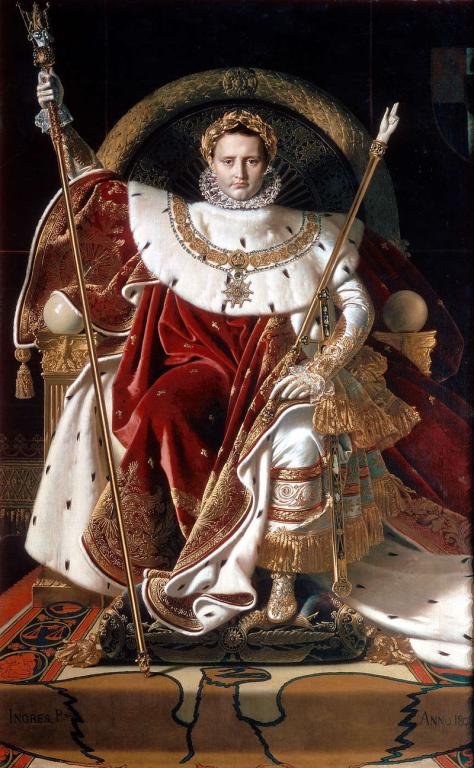
Napoleon on his Imperial Throne, by Jean Auguste Dominique Ingres (1806). (Wikimedia Commons public domain image) Not exactly a cross section of humanity or a representative of the typical human.
This is, in a way, a continuation of the thoughts that I expressed in “False Memories and Social Media,” albeit, obviously, on a more generalized, academic, and far less personal level:
History is about the past. Yet it exists only in the present – the moment of its creation as history provides us with a narrative constructed after the events with which it is concerned. The narrative must then relate to the moment of its creation as much as its historical subject. History presents an historian with the task of producing a dialogue between the past and the present. But as these temporal co-ordinates cannot be fixed, history becomes a continuous interaction between the historian and the past. As such, history can be seen as a process of evaluation whereby the past is always coloured by the intellectual fashions and philosophical concerns of the present. This shifting perspective on the past is matched by the fluid status of the past itself. (Dana Arnold, architectural historian, Middlesex University, London)
Professor Arnold puts her finger on one of the reasons why, for example, there will never be a definitive history of the Roman Empire, or a definitive biography of Napoleon or the K’ang-hsi Emperor: It’s not just that new sources and/or new archaeological evidence might be found. It’s not just that there’s more that might be said about any particular person — let alone about a vast subject such as the Roman Empire — than any particular historian or group of historians will ever be able to say. Those are important and relevant facts. But it’s also the case that historians in different eras, from different backgrounds, working from different cultures, with different personalities and interests, will be continually asking new and different questions of their topics. And those questions, and the answers that are given to them, will be shaped not only by the past but by the intellectual trends and psycho-cultural factors and economic contexts and political and religious issues surrounding the historians.
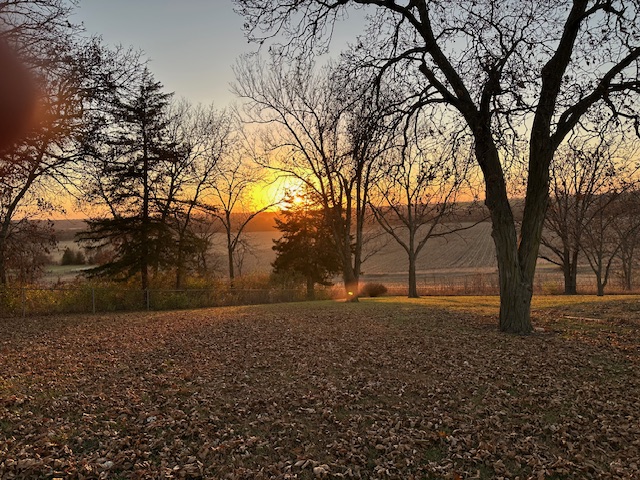
A sunset view toward the west from atop Mt. Pisgah, Iowa, taken with my cellphone near the grave of Joseph Knight, Sr.
Just so you know — and so that you can take preventive measures or engage in evasive maneuvers — I’ll be speaking this coming Friday evening to the Joseph Knight Sr. Family Reunion in American Fork, Utah. And who knows? By then I may be past the abominable cold that has been punishing me for a week now and that just seems to linger and linger and linger. Each day, I think that I’ll be over it tomorrow. And, each day, I’m surprised. In the meanwhile, though, I’m sleeping multiple times each night! It’s not often, typically, that I’m able to savor life at 3 AM and, again, at 4 AM and 5 AM and 6 AM.
Travel and Religion
History and Religion
Previous Post

June 13, 2026
False Memories and Social Media
Next Post

June 15, 2026 Twelve years ago
Recent Comments
"Another class of memories are of individuals who previously lived. Some of these remembered individuals ..."
"Sutherland's lecture sounds interesting. He seems to restate the Washington consensus that trade brings peace ..."
Learning more about a region of ..."
"In a meeting today, I learned another important reason why accurate (or at least as ..."
From Serbia’s “White City,” Belgrade
"I've been watching a lot of video interviews of NDErs and researchers. I think in ..."
Browse Our Archives
Select a Category Uncategorized
Select a Month October 2026 September 2026 August 2026 July 2026 June 2026 May 2026 April 2026 March 2026 February 2026 January 2026 December 2025 November 2025 October 2025 September 2025 August 2025 July 2025 June 2025 May 2025 April 2025 March 2025 February 2025 January 2025 December 2024 November 2024 October 2024 September 2024 August 2024 July 2024 June 2024 May 2024 April 2024 March 2024 February 2024 January 2024 December 2023 November 2023 October 2023 September 2023 August 2023 July 2023 June 2023 May 2023 April 2023 March 2023 February 2023 January 2023 December 2022 November 2022 October 2022 September 2022 August 2022 July 2022 June 2022 May 2022 April 2022 March 2022 February 2022 January 2022 December 2021 November 2021 October 2021 September 2021 August 2021 July 2021 June 2021 May 2021 April 2021 March 2021 February 2021 January 2021 December 2020 November 2020 October 2020 September 2020 August 2020 July 2020 June 2020 May 2020 April 2020 March 2020 February 2020 January 2020 December 2019 November 2019 October 2019 September 2019 August 2019 July 2019 June 2019 May 2019 April 2019 March 2019 February 2019 January 2019 December 2018 November 2018 October 2018 September 2018 August 2018 July 2018 June 2018 May 2018 April 2018 March 2018 February 2018 January 2018 December 2017 November 2017 October 2017 September 2017 August 2017 July 2017 June 2017 May 2017 April 2017 March 2017 February 2017 January 2017 December 2016 November 2016 October 2016 September 2016 August 2016 July 2016 June 2016 May 2016 April 2016 March 2016 February 2016 January 2016 December 2015 November 2015 October 2015 September 2015 August 2015 July 2015 June 2015 May 2015 April 2015 March 2015 February 2015 January 2015 December 2014 November 2014 March 2014 August 2013 February 2012
Follow Us!
TAKE THE
Religious Wisdom Quiz
I found the Book of the Law in the temple during repairs and wept when it was read to me. Who am I?
Select your answer to see how you score.
Joash Hezekiah Josiah Asa
Related posts from Sic et Non


Some notes on the archaeology of the Bible

An action movie and some vacuous theology

TRENDING AT PATHEOS Latter-day Saint

The Sermon on the Mount, Part I: Matthew...
The Sermon on the Mount, Part I (Matthew 4:12-5:12) St. Matthew moves...

What's up from Crossway: Reviewing some of their latest A few weeks...

Janie Learns the Way of the Cross: A...
Teaching children about Jesus' Passion can be challenging. Many parents and educators...

Looking For Good Catholic Writing - October 2026
He alone extends the heavens, and he walks upon the waves of...

In "Irreplaceable," our book on vocation and technology, Trevor Sutton and I...

I was strolling through the top floor of the brand new Parthenon...
view all Latter-day Saint blogs
What Are Your Thoughts?leave a comment
Ad-Free & Subscriber Log-In Subscription Support
- About Us
- 2026 Calendar
- Videos
- Podcasts
- Library of World Religions
- Faith In Media Tracker
- Advertise With Us
- Write for Us
- Privacy Policy
- Terms of Service
- Do Not Sell My Data
- Contact Us
- Radiant Digital
- Manage Newsletter Subscriptions
- Unsubscribe From Notifications
- Sitemap
Copyright 2008-2026, Patheos. All rights reserved.
Subscription Support Ad-Free & Subscriber Log-In
Follow Patheos