
BuddhistCatholicContemplativeEvangelicalGeneral ChristianHinduJewishLatter-day SaintMuslimNew VisionsProgressive Christian
Beliefs
- Buddhist
- Catholic
- Contemplative
- Evangelical
- General Christian
- Hindu
- Jewish
- Latter-day Saint
- More Voices
- Muslim
- New Visions
- Pagan
- Progressive Christian
Topics
- Religion News
- Food and Religion
- Sports and Religion
- Religious Art
- Religious Music and Entertainment
- Religious Events
- History and Religion
- Style and Religion
- Politics and Religion
- Women in Religion
- Recreation Outdoors and Religion
- Business Finance and Religion
- Careers Workplace and Religion
- Education and Religion
- Family Parenting and Religion
- Health Fitness and Religion
- Home and Religion
- Relationships and Religion
- Technology and Religion
- Travel and Religion
Columnists
- Buddhist Columnists
- Business Finance and Religion Columnists
- Careers Workplace and Religion Columnists
- Catholic Columnists
- Contemplative Columnists
- Education and Religion Columnists
- Evangelists Columnists
- Family Parenting and Religion Columnists
- General Christian Columnists
- Health Fitness and Religion Columnists
- Hindu Columnists
- History and Religion Columnists
- Home and Religion Columnists
- Jewish Columnists
- More Voices Columnists
- Latter Day Columnists
- Muslim Columnists
- New Visions Columnists
- Nonreligious Columnists
- Pagan Columnists
- Politics and Religion Columnists
- Progressive Columnists
- Recreation Outdoors and Religion Columnists
- Relationships and Religion Columnists
- Religion News Columnists
- Religious Art Columnists
- Religious Events Columnists
- Religious Music and Entertainment Columnists
- Sports and Religion Columnists
- Style and Religion Columnists
- Technology and Religion Columnists
- Travel and Religion Columnists
- Women in Religion Columnists
Resource Library
- 2026 Calendar
- Library of World Religions
- The 100 Most Holy Places on Earth
- Patheos Answers
- Podcasts
- Videos
- Faith Leaders Database
- Anglican Episcopalian
- Bahai
- Baptist
- Buddhism
- Christianity
- Confucianism
- Eastern Orthodoxy
- Hinduism
- Holiness and Pentecostal
- ISKCON
- Islam
- Judaism
- Lutheran
- Methodist
- The Church of Jesus Christ of Latter-day Saints
- New Age
- Paganism
- Presbytarian and Reformed
- Protestantism
- Religion Behind the Scenes
- Roman Catholic
- Scientology
- Shia Islam
- Sikhism
- Sufism
- Sunni Islam
- Taoism
- Zen
- See all religions
Research Tools
 Ad-Free & Subscriber Log-In Subscription Support
Ad-Free & Subscriber Log-In Subscription Support
Follow Patheos 

- Trending:
- Forgiveness
- |
- Marriage
- |
- Consciousness
- |
- Death Penalty
- |
- Election
- |
- Halloween

- Home
- Latter-day Saint
- Travel and Religion
- “Praise to the Man”
“Praise to the Man”
Last updated on: June 28, 2026 at 7:37 pm by Dan Peterson
“Praise to the Man” 2026-06-28T19:37:42-06:00 Dan Peterson
Patheos Explore the world's faith through different perspectives on religion and spirituality! Patheos has the views of the prevalent religions and spiritualities of the world.

This statue of Joseph and Hyrum Smith stands just across the street in front of the rebuilt Nauvoo Illinois Temple. My wife took the photograph just after sunset during a visit there, looking westward.
About a month after the martyrdom of the Prophet Joseph Smith, his friend and associate William Wines Phelps (1792–1872) penned a heartfelt tribute to him. It was eventually set to a famous Scottish folk melody that is most familiar, outside of the Church of Jesus Christ of Latter-day Saints, as “Scotland the Brave.” (You can listen to it here, in a recording from a recent General Conference of the Church by the Tabernacle Choir at Temple Square: “Praise to the Man.”)
The Scottish tune wasn’t W. W. Phelps’s original setting for the poem that he had written. He had evidently first had in mind a traditional melody known as “Star in the East,” which I really like. Happily, you can hear that setting online in an informal performance by Ben Abbott, who happens to be an associate professor of Plant and Wildlife Sciences at Brigham Young University: “Praise to the Man (original tune).”
- Praise to the man who communed with Jehovah!
Jesus anointed that Prophet and Seer.
Blessed to open the last dispensation,
Kings shall extol him, and nations revere.Chorus: Hail to the Prophet, ascended to heaven!
Traitors and tyrants now fight him in vain.
Mingling with Gods, he can plan for his brethren;
Death cannot conquer the hero again.
- Praise to his mem’ry, he died as a martyr;
Honored and blest be his ever great name!
Long shall his blood, which was shed by assassins,
Plead unto heav’n while the earth lauds his fame.Repeat chorus.
- Great is his glory and endless his priesthood.
Ever and ever the keys he will hold.
Faithful and true, he will enter his kingdom,
Crowned in the midst of the prophets of old.Repeat chorus.
4. Sacrifice brings forth the blessings of heaven;
Earth must atone for the blood of that man.
Wake up the world for the conflict of justice.
Millions shall know “Brother Joseph” again.Repeat chorus.
We sang W. W. Phelps’s tribute to Joseph (using the Scottish melody) as our opening hymn in sacrament meeting today. As I often do for the amusement of my wife, I sang Phelps’s original words sotto voce into her ear:
Long shall his blood, which was shed by assassins,
Stain Illinois while the earth lauds his fame.
I’m guessing that we were far from alone in singing “Praise to the Man,” given that yesterday was the anniversary of the Prophet’s murder, along with his brother, Hyrum, at the hands of an anti-Mormon mob in Carthage, Illinois, on 27 June 1844.

Leaving Nauvoo for Carthage, Joseph Smith (portrayed by Paul Wuthrich) looks back one last time toward his wife, Emma, and his family, in a scene from the 2024 Interpreter Foundation film Six Days in August.
I know that some are offended — or, anyway, that they claim to be offended — by what they criticize as the hymn’s quasi-deification of Joseph Smith. I am not offended in the least, and it has never bothered me even slightly. Quite the contrary. We absolutely do not worship Joseph. As a church, we celebrate neither his birthday nor the day of his martyrdom. He has no “feast day.” We don’t pray to him or through him, and we don’t teach that he is an intercessor with the Father or the Son. None of our chapels are dedicated to him. No chapels or altars or side chapels or side altars feature his image. We create no icons of him and we venerate none.
The opening two lines of W. W. Phelps’s lyrics make it clear, in the relationship between Joseph Smith and the Lord, who the Master is and who is the servant, and who is subordinate to whom:
Praise to the man who communed with Jehovah!
Jesus anointed that Prophet and Seer.
Yet we Latter-day Saints honor Joseph Smith, and I’m quite unashamed to say that I join in honoring him.
I have no interest in entering into a discussion of whether singing such a song passes into the realm of idolatry, as some critics allege. It doesn’t. Not for me, and not for anybody of whom I’m aware. But I would like to look at it as a powerful expression of testimony and conviction.
William W. Phelps was more than thirteen years older than the Prophet. Although almost entirely self-taught, he was one of the more articulate and better educated among the early Latter-day Saints, earning his living life-long as a printer, a newspaper editor, and a publisher, and his conversion indeed came early.
According to one source that I’ve seen, he bought a copy of the Book of Mormon from Parley P. Pratt on 9 April 1830, which would have been only three days after the organization of the Church of Jesus Christ of Latter-day Saints. He and his wife, Sally, read the book and were converted to its truth. On Christmas Eve, 24 December 1830, Phelps met the twenty-five year-old Joseph Smith, when he himself was approaching thirty-nine, and he became convinced that Joseph was indeed a prophet.
However, the first years of his tenure in the Church were tumultuous. He settled with the Saints in Kirtland, Ohio, and then in the violent, charged, and unstable conditions of Missouri, and then gathered to Nauvoo, Illinois. Persecution, economic pressure, financial losses, property losses, destruction of property, political controversies, doctrinal innovations — it wasn’t exactly a sedate time. Along the way, his relationship with Church leadership was often fraught, and he was excommunicated not just once but, by 1847, on three different occasions. Each time, though, he returned, and ultimately, after the assassinations of Joseph and Hyrum Smith he went west with the Saints under the leadership of Brigham Young and the Twelve.
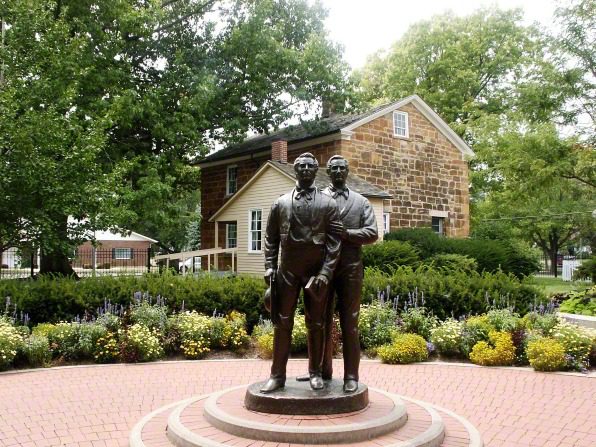
A bronze statue of Joseph and Hyrum Smith on the grounds of Carthage Jail today (Wikimedia Commons public domain photo)
On 22 July 1840, in the wake of Phelps’s most recent excommunication, Joseph Smith wrote a letter responding to an inquiry from Phelps, whom Joseph had first met nearly a decade before. The letter closes with these memorable words:
Believing your confession to be real and your repentance genuine, I shall be happy once again to give you the right hand of fellowship, and rejoice over the returning prodigal.
Your letter was read to the Saints last Sunday and an expression of their feeling was taken, when it was unanimously resolved that W. W. Phelps should be received into fellowship.
“Come on dear Brother since the war is past,
For friends at first are friends again at last.”
Yours as Ever
Joseph Smith Jr
With that personal history behind him, the words that William W. Phelps wrote — and the life that he lived after writing them — speak powerfully and eloquently of his conviction of the calling of the Prophet Joseph Smith. Are you one of those who judge the lyrics too close to idolatry? I don’t. But, even if so, consider what they say about Brother Phelps’s confidence in Joseph as a prophet — a man whom he had known up close and extremely well for nearly a decade and a half., by that point, under the most stressful of circumstances.
Travel and Religion
History and Religion
Previous Post

June 27, 2026
"An Early Christian Context for the Book of Moses"?
Next Post

June 29, 2026 Fire, Fireworks, the Fourth, the Twenty-Fourth, and Prudence
Recent Comments
"Sutherland's lecture sounds interesting. He seems to restate the Washington consensus that trade brings peace ..."
Learning more about a region of ..."
"In a meeting today, I learned another important reason why accurate (or at least as ..."
From Serbia’s “White City,” Belgrade
"I've been watching a lot of video interviews of NDErs and researchers. I think in ..."
"PL: "Let's hope he doesn't have your address..."I have to frankly confess that a few ..."
From Serbia’s “White City,” Belgrade
Browse Our Archives
Select a Category Uncategorized
Select a Month October 2026 September 2026 August 2026 July 2026 June 2026 May 2026 April 2026 March 2026 February 2026 January 2026 December 2025 November 2025 October 2025 September 2025 August 2025 July 2025 June 2025 May 2025 April 2025 March 2025 February 2025 January 2025 December 2024 November 2024 October 2024 September 2024 August 2024 July 2024 June 2024 May 2024 April 2024 March 2024 February 2024 January 2024 December 2023 November 2023 October 2023 September 2023 August 2023 July 2023 June 2023 May 2023 April 2023 March 2023 February 2023 January 2023 December 2022 November 2022 October 2022 September 2022 August 2022 July 2022 June 2022 May 2022 April 2022 March 2022 February 2022 January 2022 December 2021 November 2021 October 2021 September 2021 August 2021 July 2021 June 2021 May 2021 April 2021 March 2021 February 2021 January 2021 December 2020 November 2020 October 2020 September 2020 August 2020 July 2020 June 2020 May 2020 April 2020 March 2020 February 2020 January 2020 December 2019 November 2019 October 2019 September 2019 August 2019 July 2019 June 2019 May 2019 April 2019 March 2019 February 2019 January 2019 December 2018 November 2018 October 2018 September 2018 August 2018 July 2018 June 2018 May 2018 April 2018 March 2018 February 2018 January 2018 December 2017 November 2017 October 2017 September 2017 August 2017 July 2017 June 2017 May 2017 April 2017 March 2017 February 2017 January 2017 December 2016 November 2016 October 2016 September 2016 August 2016 July 2016 June 2016 May 2016 April 2016 March 2016 February 2016 January 2016 December 2015 November 2015 October 2015 September 2015 August 2015 July 2015 June 2015 May 2015 April 2015 March 2015 February 2015 January 2015 December 2014 November 2014 March 2014 August 2013 February 2012
Follow Us!
TAKE THE
Religious Wisdom Quiz
Why did Jesus often use parables?
Select your answer to see how you score.
To reveal truths to those open to God To entertain only To confuse listeners To show off
Related posts from Sic et Non


Notes on Women, Priesthood, and General Conference

"The Book of Moses as a Temple Text"

TRENDING AT PATHEOS Latter-day Saint

In "Irreplaceable," our book on vocation and technology, Trevor Sutton and I...

I was strolling through the top floor of the brand new Parthenon...

What Does Gêvâh Mean For Kimberley Guifoyle &...
This week, a lot of the news is focused on Kimberly Guilfoyle....

INNER CIRCLE: Profound Mystery (Of Christ In All...
Ephesians 5:31-32 “For this reason, a man will leave his father and...

Do Not Rejoice When Your Enemy Falls: The...
Turning an execution into a public spectacle is a disturbing expression of...

'The Chosen' S6 Trailer: The Passion Gets Very...
Not many watching 'The Chosen' worry about spoilers, but just because they...
view all Latter-day Saint blogs
What Are Your Thoughts?leave a comment
Ad-Free & Subscriber Log-In Subscription Support
- About Us
- 2026 Calendar
- Videos
- Podcasts
- Library of World Religions
- Faith In Media Tracker
- Advertise With Us
- Write for Us
- Privacy Policy
- Terms of Service
- Do Not Sell My Data
- Contact Us
- Radiant Digital
- Manage Newsletter Subscriptions
- Unsubscribe From Notifications
- Sitemap
Copyright 2008-2026, Patheos. All rights reserved.
Subscription Support Ad-Free & Subscriber Log-In
Follow Patheos