
BuddhistCatholicContemplativeEvangelicalGeneral ChristianHinduJewishLatter-day SaintMuslimNew VisionsProgressive Christian
Beliefs
- Buddhist
- Catholic
- Contemplative
- Evangelical
- General Christian
- Hindu
- Jewish
- Latter-day Saint
- More Voices
- Muslim
- New Visions
- Pagan
- Progressive Christian
Topics
- Religion News
- Food and Religion
- Sports and Religion
- Religious Art
- Religious Music and Entertainment
- Religious Events
- History and Religion
- Style and Religion
- Politics and Religion
- Women in Religion
- Recreation Outdoors and Religion
- Business Finance and Religion
- Careers Workplace and Religion
- Education and Religion
- Family Parenting and Religion
- Health Fitness and Religion
- Home and Religion
- Relationships and Religion
- Technology and Religion
- Travel and Religion
Columnists
- Buddhist Columnists
- Business Finance and Religion Columnists
- Careers Workplace and Religion Columnists
- Catholic Columnists
- Contemplative Columnists
- Education and Religion Columnists
- Evangelists Columnists
- Family Parenting and Religion Columnists
- General Christian Columnists
- Health Fitness and Religion Columnists
- Hindu Columnists
- History and Religion Columnists
- Home and Religion Columnists
- Jewish Columnists
- More Voices Columnists
- Latter Day Columnists
- Muslim Columnists
- New Visions Columnists
- Nonreligious Columnists
- Pagan Columnists
- Politics and Religion Columnists
- Progressive Columnists
- Recreation Outdoors and Religion Columnists
- Relationships and Religion Columnists
- Religion News Columnists
- Religious Art Columnists
- Religious Events Columnists
- Religious Music and Entertainment Columnists
- Sports and Religion Columnists
- Style and Religion Columnists
- Technology and Religion Columnists
- Travel and Religion Columnists
- Women in Religion Columnists
Resource Library
- 2026 Calendar
- Library of World Religions
- The 100 Most Holy Places on Earth
- Patheos Answers
- Podcasts
- Videos
- Faith Leaders Database
- Anglican Episcopalian
- Bahai
- Baptist
- Buddhism
- Christianity
- Confucianism
- Eastern Orthodoxy
- Hinduism
- Holiness and Pentecostal
- ISKCON
- Islam
- Judaism
- Lutheran
- Methodist
- The Church of Jesus Christ of Latter-day Saints
- New Age
- Paganism
- Presbytarian and Reformed
- Protestantism
- Religion Behind the Scenes
- Roman Catholic
- Scientology
- Shia Islam
- Sikhism
- Sufism
- Sunni Islam
- Taoism
- Zen
- See all religions
Research Tools
 Ad-Free & Subscriber Log-In Subscription Support
Ad-Free & Subscriber Log-In Subscription Support
Follow Patheos 

- Trending:
- Forgiveness
- |
- Marriage
- |
- Consciousness
- |
- Death Penalty
- |
- Election
- |
- Halloween

- Home
- Latter-day Saint
- History and Religion
- Once more unto the breach, dear friends, once more.
Once more unto the breach, dear friends, once more.
Last updated on: June 25, 2026 at 7:00 pm by Dan Peterson
Once more unto the breach, dear friends, once more. 2026-06-25T19:00:11-06:00 Dan Peterson
Patheos Explore the world's faith through different perspectives on religion and spirituality! Patheos has the views of the prevalent religions and spiritualities of the world.
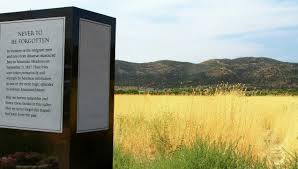
One of the several relatively new monuments at Mountain Meadows (Wikimedia Commons public domain image)
The principal theme of our filming this week, although not the only one, was the infamous mass murder that occurred in southern Utah on 11 September 1857. A fairly vigorous discussion has ensued in the wake of my Tuesday evening blog entry, “On the Massacre at Mountain Meadows,” and I call your attention to the comments there. One critic has posted a number of times to contradict my expressed judgment that theology, as such, had little or nothing to do — certainly not in any direct sense — with the Massacre. Rather, I said, “The Massacre was motivated by primal fear.”
I would like to reply here to his counterclaims. The disingenuous assertions by certain other critics, that I’m trying to “bowdlerize” Brigham, to whitewash the crime at Mountain Meadows, and to defend its perpetrators, merit no response. I’ll permit what I’ve actually said — and, perhaps even better, what I’ve said on camera (which will eventually be made fully public) — to define my position on this tragic subject.
I think that I’ll call the critic in question by the Ancient Greek term Antidikos, which referred, often in a legal setting, to an “adversary” or “opponent” or “accuser.” (I’m trying not to make this personal, and he’s pseudonymous in any case.) Here is the critic’s first comment:
Antidikos: It wasn’t fear that caused this unspeakable massacre of men, women, children, and the elderly . . . but a deeply ingrained us-versus-them religious exceptionalism that convinced ordinary LDS settlers that such slaughter was a holy act of survival.
I honestly don’t know what would make an “act of survival” somehow particularly “holy.” It seems to me that Antidikos is simply and without evidence asserting his presupposition that the motive for the Massacre was religious. But that is precisely what I deny. I don’t see the evidence for his claim.
And yet, in his subsequent comments, he repeatedly describes the Massacre as having been propelled by “ideological fanaticism,” driven by “a toxic ideology.” It was, he says, “motivated by religious extremism and xenophobia.” At multiple places, he describes those who committed the crime as “the LDS pioneers,” which, at first blush, seems inarguably true and sadly uncontroversial. There is no denying the fact, unfortunately, that the perpetrators of the Mountain Meadows Massacre were members of the Church of Jesus Christ of Latter-day Saints.
But his repetitive references to “the LDS pioneers” seem to me to represent a not especially subtle effort to insinuate the “toxic ideology” that, he imagines, made the Massacre virtually inevitable: It was, he implies, the theology of the Church.
Antidikos: [T]hese murderers believed that destroying another group was not a crime, but a sacred duty required for their own safety or revenge.
If it’s not clear enough, I’m arguing against the idea that the murderers acted out of simple, panicky “primal fear.” Instead, the evidence points to a much more calculated, religiously/holy driven mindset.
I flatly deny this. Or, perhaps to put it more mildly, I remain to be convinced of it.
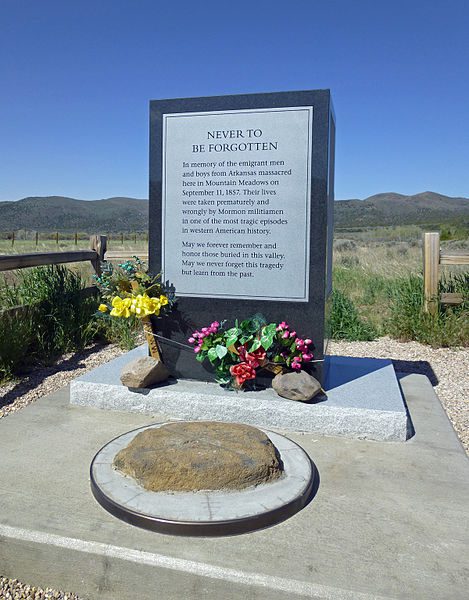
Another view of a monument erected (by the Church of Jesus Christ of Latter-day Saints, I’m told) at the site of the Mountain Meadows Massacre, in southern Utah (Wikimedia Commons public domain photograph)
The Mountain Meadows Massacre occurred under very specific circumstances, which were, in a sense, a kind of “perfect storm” that would lead basically good people (their fundamental decency is demonstrated by their lives both before and after that fatal September 1857) to commit an unspeakable offense against a basically good group of strangers:
- Responding to misleading reports of a “Mormon rebellion,” President James Buchanan had decided to replace Brigham Young as the governor of Utah Territory with Alfred Cumming, of Georgia. But he hadn’t informed Governor Young or the people of Utah that he was doing so.
- President Buchanan decided to send a detachment of roughly 2,000 federal troops — approximately a third of the entire United States Army at the time — as an escort for Alfred Cumming, but he had informed neither Governor Young nor the people of Utah of this fact and, of course, the intentions of the armed federal troops had not been explained.
- At the same time, President Buchanan abruptly canceled mail contracts for Utah, effectively leaving the Territory under an information blackout.
Governor Young was only told of the pending arrival of Alfred Cumming and a massive escort of federal troops on 24 July 1857, during a Pioneer Day celebration. (Orrin Porter Rockwell and Salt Lake Mayor Abraham Smoot, returning from the East, brought the news to him.) Surely it’s not surprising that residents of Utah were left in a state of anxiety, even panic. These were a people, after all, who had been subjected to persecution since the founding of the Church in April 1830, who had been driven violently from Missouri and then violently expelled from Illinois, and who had left the United States behind to seek refuge in the Great Basin West.
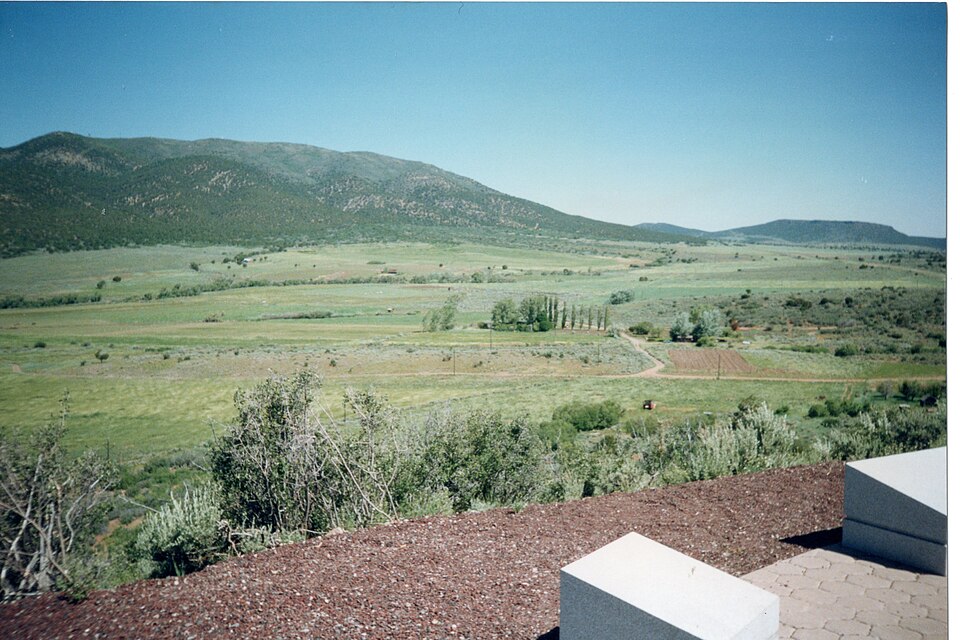
A Wikimedia Commons public domain view over the Mountain Meadows area
Antidikos tries to claim that it was “a deeply ingrained us-versus-them religious exceptionalism” on the part of “the LDS pioneers” that led to the burst of fatal violence in southern Utah during September 1857. I don’t see the evidence for that. I see little if anything to suggest that the Latter-day Saints of Cedar City and its environs attacked the Baker-Fancher emigrant train solely or largely because it was made up of non-Latter-day Saints. I see no evidence for the insinuation that a sense of “exceptionalism” led “the LDS pioneers” to see themselves as superior to moral law.
Rather, it seems obvious to me that it was an understandable fear that set the stage. Antidikos claims that “the LDS pioneers” viewed their action as “a holy act of survival.” I agree that they saw it, quite incorrectly but also, alas, rather understandably, as an act of survival. (We’ll explain this at some length in the appropriate video episodes of Becoming Brigham when they appear.) And, as I’ve said, when survival seems to be at stake, that begets fear. (Even non-religious people, I suspect, are likely to regard the possible deaths of their families with apprehension.) The supposed “holiness” of their effort to survive is, from my point of view, merely a question-begging addition from Antidikos. I ask for his evidence. The behavior of the perpetrators in the decades after 1857 — denial, obfuscation, deception, flight, even the intentional misleading of the apostolic investigators who were sent to southern Utah by Brigham Young — certainly doesn’t suggest any confident, bold, or unashamed belief in the Massacre’s “holiness.” (When James Haslam delivered Brigham’s letter to Isaac Haight telling him to leave the emigrant train alone, Haight is said to have burst into tears. “Too late,” he wept. “Too late.”)
Was it a matter of “us versus them”? Of course it was. That’s a trivially obvious fact, common to every struggle between differing groups. (Think of the Hatfields and the McCoys.) But the dynamics of the episode as it played out wouldn’t have been substantially different had the groups in question been Armenians and Turks, say, or Palestinians and Israelis, or Irish Catholics and Irish Protestants, or Navajos and Utes, or Hutus and Tutsis, or Serbs and Croats and Bosnians.
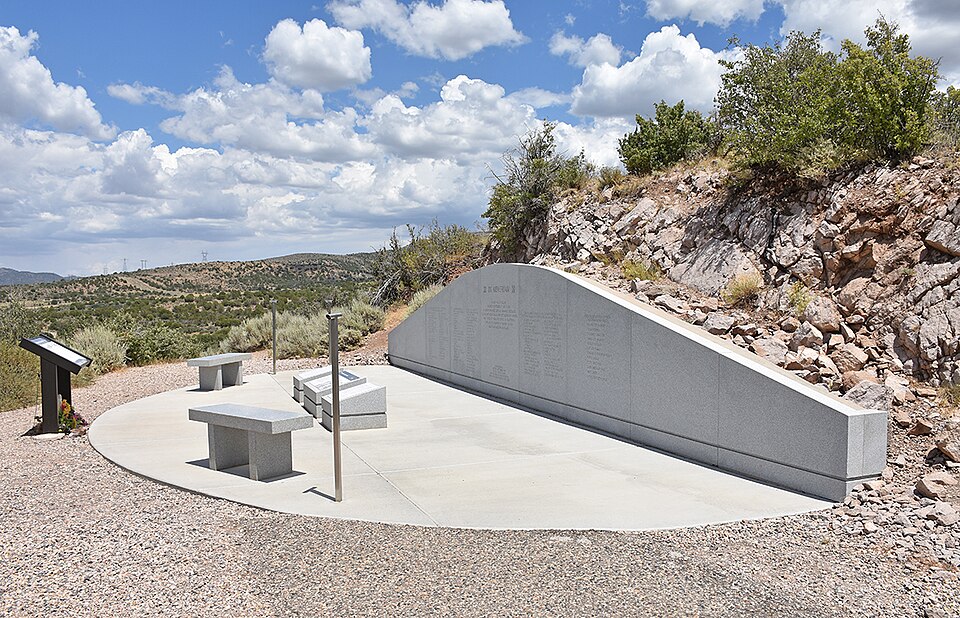
We did some of our Tuesday filming at this hilltop overlook. (Wikimedia Commons public domain image)
The immediate spark that led to the Massacre was probably connected with the orders from Governor Young for the residents of Utah Territory to store up grain and preserve their cattle rather than to sell them to emigrant trains passing through the region. Such nutritional sources might be sorely needed during a potentially protracted guerrilla war that would interfere with sowing and harvesting and that might well lead to the abandonment of farms and the disruption of trade networks. The Baker/Fancher train was trying to amass provisions for its push across the desert to California; the colonists of southern Utah were unwilling to sell such provisions, and tensions flared.
No “religiously/holy driven mindset” is required to account for the Mountain Meadows Massacre. Yes, the religious difference of “Mormon” and non-“Mormon” played a role in President Buchanan’s decision to deploy troops to Utah. It was part of the distinction between the people of the Cedar City area and the members of the Baker/Fancher party. But so was the distinction between Utahn and Arkansan, between passing emigrant and resident, between the targets of the approaching federal invasion force and people who weren’t targets and who would be gone before the troops arrived.
Did the perpetrators of the Mountain Meadows Massacre “believe that destroying another group was not a crime, but a sacred duty required for their own safety or revenge”? Yes, they probably believed that killing others in self-defense was no crime. They probably believed that it was their duty to protect their wives and their children and their neighbors. Historically and still today, most people probably have believed and do believe that self-defense is permissible, and that the defense of innocent others is a moral duty. One needn’t be a theist or a Christian or a Latter-day Saint to believe such things.
There is no evidence of which I’m aware that the Mountain Meadows Massacre was principally, let alone solely, motivated by theological doctrines or the sheer hatred of “infidels.” If Antidikos has evidence showing otherwise, he should share it. Simply repeating his conviction that the Massacre was an example of theologically-driven violence isn’t sufficient to make his case.
History and Religion
Travel and Religion
Previous Post
June 24, 2026
St. George, at Its Core
Next Post
June 26, 2026 Faith, Doubt, and "Caractors"
Recent Comments
"Sutherland's lecture sounds interesting. He seems to restate the Washington consensus that trade brings peace ..."
Learning more about a region of ..."
"In a meeting today, I learned another important reason why accurate (or at least as ..."
From Serbia’s “White City,” Belgrade
"I've been watching a lot of video interviews of NDErs and researchers. I think in ..."
"PL: "Let's hope he doesn't have your address..."I have to frankly confess that a few ..."
From Serbia’s “White City,” Belgrade
Browse Our Archives
Select a Category Uncategorized
Select a Month October 2026 September 2026 August 2026 July 2026 June 2026 May 2026 April 2026 March 2026 February 2026 January 2026 December 2025 November 2025 October 2025 September 2025 August 2025 July 2025 June 2025 May 2025 April 2025 March 2025 February 2025 January 2025 December 2024 November 2024 October 2024 September 2024 August 2024 July 2024 June 2024 May 2024 April 2024 March 2024 February 2024 January 2024 December 2023 November 2023 October 2023 September 2023 August 2023 July 2023 June 2023 May 2023 April 2023 March 2023 February 2023 January 2023 December 2022 November 2022 October 2022 September 2022 August 2022 July 2022 June 2022 May 2022 April 2022 March 2022 February 2022 January 2022 December 2021 November 2021 October 2021 September 2021 August 2021 July 2021 June 2021 May 2021 April 2021 March 2021 February 2021 January 2021 December 2020 November 2020 October 2020 September 2020 August 2020 July 2020 June 2020 May 2020 April 2020 March 2020 February 2020 January 2020 December 2019 November 2019 October 2019 September 2019 August 2019 July 2019 June 2019 May 2019 April 2019 March 2019 February 2019 January 2019 December 2018 November 2018 October 2018 September 2018 August 2018 July 2018 June 2018 May 2018 April 2018 March 2018 February 2018 January 2018 December 2017 November 2017 October 2017 September 2017 August 2017 July 2017 June 2017 May 2017 April 2017 March 2017 February 2017 January 2017 December 2016 November 2016 October 2016 September 2016 August 2016 July 2016 June 2016 May 2016 April 2016 March 2016 February 2016 January 2016 December 2015 November 2015 October 2015 September 2015 August 2015 July 2015 June 2015 May 2015 April 2015 March 2015 February 2015 January 2015 December 2014 November 2014 March 2014 August 2013 February 2012
Follow Us!
TAKE THE
Religious Wisdom Quiz
Who said, 'For the wages of sin is death, but the gift of God is eternal life'?
Select your answer to see how you score.
James John Peter Paul
Related posts from Sic et Non


Notes on Women, Priesthood, and General Conference
"America's Most Neighborly City"? It's not in Switzerland

"The Book of Moses as a Temple Text"
TRENDING AT PATHEOS Latter-day Saint

In "Irreplaceable," our book on vocation and technology, Trevor Sutton and I...

I was strolling through the top floor of the brand new Parthenon...

What Does Gêvâh Mean For Kimberley Guifoyle &...
This week, a lot of the news is focused on Kimberly Guilfoyle....

INNER CIRCLE: Profound Mystery (Of Christ In All...
Ephesians 5:31-32 “For this reason, a man will leave his father and...

Do Not Rejoice When Your Enemy Falls: The...
Turning an execution into a public spectacle is a disturbing expression of...

'The Chosen' S6 Trailer: The Passion Gets Very...
Not many watching 'The Chosen' worry about spoilers, but just because they...
view all Latter-day Saint blogs
What Are Your Thoughts?leave a comment
Ad-Free & Subscriber Log-In Subscription Support
- About Us
- 2026 Calendar
- Videos
- Podcasts
- Library of World Religions
- Faith In Media Tracker
- Advertise With Us
- Write for Us
- Privacy Policy
- Terms of Service
- Do Not Sell My Data
- Contact Us
- Radiant Digital
- Manage Newsletter Subscriptions
- Unsubscribe From Notifications
- Sitemap
Copyright 2008-2026, Patheos. All rights reserved.
Subscription Support Ad-Free & Subscriber Log-In
Follow Patheos