
BuddhistCatholicContemplativeEvangelicalGeneral ChristianHinduJewishLatter-day SaintMuslimNew VisionsProgressive Christian
Beliefs
- Buddhist
- Catholic
- Contemplative
- Evangelical
- General Christian
- Hindu
- Jewish
- Latter-day Saint
- More Voices
- Muslim
- New Visions
- Pagan
- Progressive Christian
Topics
- Religion News
- Food and Religion
- Sports and Religion
- Religious Art
- Religious Music and Entertainment
- Religious Events
- History and Religion
- Style and Religion
- Politics and Religion
- Women in Religion
- Recreation Outdoors and Religion
- Business Finance and Religion
- Careers Workplace and Religion
- Education and Religion
- Family Parenting and Religion
- Health Fitness and Religion
- Home and Religion
- Relationships and Religion
- Technology and Religion
- Travel and Religion
Columnists
- Buddhist Columnists
- Business Finance and Religion Columnists
- Careers Workplace and Religion Columnists
- Catholic Columnists
- Contemplative Columnists
- Education and Religion Columnists
- Evangelists Columnists
- Family Parenting and Religion Columnists
- General Christian Columnists
- Health Fitness and Religion Columnists
- Hindu Columnists
- History and Religion Columnists
- Home and Religion Columnists
- Jewish Columnists
- More Voices Columnists
- Latter Day Columnists
- Muslim Columnists
- New Visions Columnists
- Nonreligious Columnists
- Pagan Columnists
- Politics and Religion Columnists
- Progressive Columnists
- Recreation Outdoors and Religion Columnists
- Relationships and Religion Columnists
- Religion News Columnists
- Religious Art Columnists
- Religious Events Columnists
- Religious Music and Entertainment Columnists
- Sports and Religion Columnists
- Style and Religion Columnists
- Technology and Religion Columnists
- Travel and Religion Columnists
- Women in Religion Columnists
Resource Library
- 2026 Calendar
- Library of World Religions
- The 100 Most Holy Places on Earth
- Patheos Answers
- Podcasts
- Videos
- Faith Leaders Database
- Anglican Episcopalian
- Bahai
- Baptist
- Buddhism
- Christianity
- Confucianism
- Eastern Orthodoxy
- Hinduism
- Holiness and Pentecostal
- ISKCON
- Islam
- Judaism
- Lutheran
- Methodist
- The Church of Jesus Christ of Latter-day Saints
- New Age
- Paganism
- Presbytarian and Reformed
- Protestantism
- Religion Behind the Scenes
- Roman Catholic
- Scientology
- Shia Islam
- Sikhism
- Sufism
- Sunni Islam
- Taoism
- Zen
- See all religions
Research Tools
 Ad-Free & Subscriber Log-In Subscription Support
Ad-Free & Subscriber Log-In Subscription Support
Follow Patheos 

- Trending:
- Forgiveness
- |
- Marriage
- |
- Consciousness
- |
- Death Penalty
- |
- Election
- |
- Halloween

- Home
- Latter-day Saint
- Travel and Religion
- On the Massacre at Mountain Meadows
On the Massacre at Mountain Meadows
Last updated on: June 25, 2026 at 2:29 pm by Dan Peterson
On the Massacre at Mountain Meadows 2026-06-25T14:29:00-06:00 Dan Peterson
Patheos Explore the world's faith through different perspectives on religion and spirituality! Patheos has the views of the prevalent religions and spiritualities of the world.
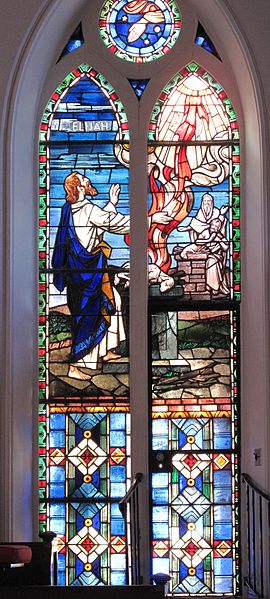
A stained-glass window with an Elijah theme (Wikimedia Commons public domain image)
These study notes for students and teachers of the Sunday School curriculum of the Church of Jesus Christ of Latter-day Saints, generously provided by Jonn Claybaugh for the next appropriate lesson, went up earlier today on the notoriously unchanging website of the Interpreter Foundation: Come, Follow Me — Old Testament Study and Teaching Helps — June 29-July 5, 2026: 1 Kings 12-13; 17-22 — “If the Lord Be God, Follow Him”

A portion of the principal memorial at the site of the Mountain Meadows Massacre (Wikimedia Commons public domain image)
We spent the day filming for our Becoming Brigham series at Mountain Meadows, where, in September 1857, Latter-day Saint militiamen from Cedar City and other southern Utah settlements treacherously murdered the men, the women, and the older children of an emigrant wagon train from Arkansas that was bound for California along the Old Spanish Trail. They had paused at Mountain Meadows in preparation for the next (and in many ways most difficult) portion of their journey, across the vast desert that stretched between them and their destination. They were fattening up their cattle, repairing their wagons, waiting for the temperatures to cool, and trying, with little success, to secure provisions from the pioneer farmers of Utah’s southern towns.
And, of course, their difficulty in obtaining supplies was a major contributor to the tensions that would ultimately culminate in the appalling slaughter at Mountain Meadows. But why were the Latter-day Saints of southern Utah so churlish in dealing with the Baker-Fancher emigrant train? Was it because, as members of the Restored Church, they despised “Gentiles”? No, it was because roughly a third of the entire Army of the United States was marching toward them, sent by the newly-elected Democratic president, James Buchanan — who, by the way, has long been esteemed one of the worst presidents ever to occupy the office — and they were being urged by Governor Brigham Young and other ecclesiastical and territorial leaders to store up grain and other necessities in preparation for what they feared might prove a very protracted guerrilla war of resistance against the federal invasion. The Latter-day Saint settlers of Utah might be forced to abandon their farms, and to forego sowing and harvesting for an indefinite period while they retreated to the mountains to fight. They had, really, nowhere else to go: They had fled beyond the boundaries of the United States, and yet, now, a significant portion of the armed forces of the United States was coming toward them, with evident hostile intent, in their Great Basin retreat.
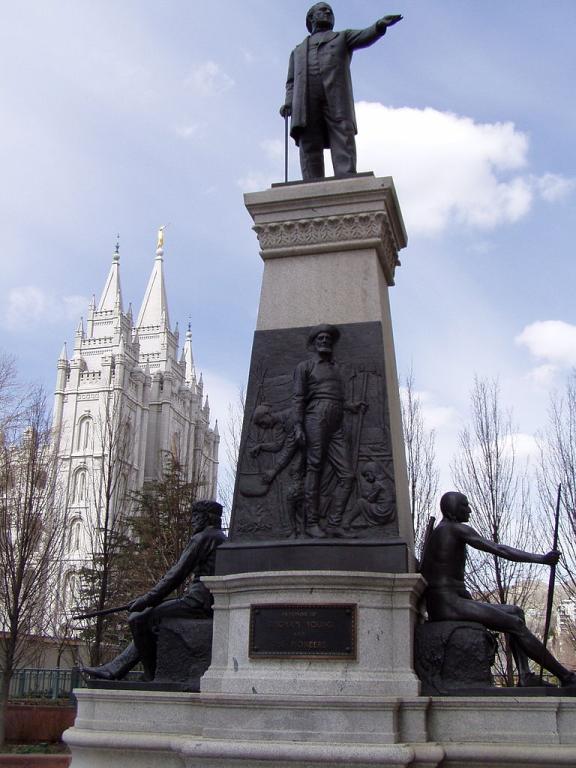
Cyrus Dallin’s 1897 statue of Brigham Young, near Temple Square in Salt Lake City
(Wikimedia Commons public domain image)
In fact, the territorial capital of Salt Lake City would be temporarily abandoned when, facing what Utah and Church leaders understandably regarded as an invading federal army, Brigham Young ordered the “Move South” in the spring of 1858. Approximately 30,000 residents completely evacuated Salt Lake City and the surrounding northern settlements, packing up their belongings and moving beyond the southern border of Utah County. They left behind only a small group of men whose assignment was to guard Salt Lake City and the other abandoned settlements and, if necessary, to burn them to the ground. When the U.S. Army, commanded by Colonel Albert Sidney Johnston, marched through the Salt Lake Valley in June 1858, it found a completely deserted ghost town. (It’s worth pointing out that Colonel Johnston, who had been assigned to put down a supposed Mormon rebellion in Utah, would be killed less than four years later, on 6 April 1862, at the Battle of Shiloh during the American Civil War. Ironically, by the time of his death, he was fighting as General Albert Sidney Johnson of the Confederate States Army. Which was, by the way, made up of actual rebels.)
We discussed these and other political and economic issues, which formed the background for the Mountain Meadows Massacre, creating a framework into which portions of my interview with Richard Turley will eventually be placed. We make, and will make, no effort to justify the Massacre. It was a tragedy and a flagrant, murderous, injustice, and it is the worst black mark in its history against the Latter-day Saints and, unfortunately, their Church. That any of the Saints, who had long been driven and robbed and pillaged and oppressed and murdered, could have done such evil is almost beyond fathoming.
In his dialogue Gorgias, the great ancient Greek philosopher Plato argues (through his “Socrates”) that doing wrong is fundamentally worse than suffering wrong because committing an injustice corrupts and degrades the soul, which is the most precious part of a person. Suffering physical or material harm impacts the body or external circumstances, but committing a wrongful act inflicts a spiritual and moral disease on the soul itself.
One repeated theme of our conversations was that it is virtually certain that, contrary to accusations leveled against him ever since the Massacre took place, Brigham Young did not order the killings at Mountain Meadows. There has never been any serious evidence of his guilt in this regard, and there is a large quantity of evidence against it. Did his rhetoric in the months leading up the attack on the Baker-Fancher train contribute to an atmosphere of war hysteria? Very likely. And he wasn’t alone in such rhetoric among Utah and Latter-day Saint leaders. But James Buchanan’s actions also contributed: Without informing Governor Brigham Young, Buchanan appointed Alfred Cumming to replace him and sent Cumming to Utah accompanied by a very substantial military force, also unannounced and unexplained. And he abruptly cut off mail contracts to Utah, leaving the Territory in an information vacuum. Is it any wonder that “paranoia” gripped Utah’s residents? Rumors of the Army’s approach only reached Brigham Young on 24 July 1857. He was given the news by Salt Lake City’s mayor, Abraham Smoot, and Porter Rockwell, who had hurried back from the East with it and who interrupted Pioneer Day celebrations in Big Cottonwood Canyon to tell Brigham.
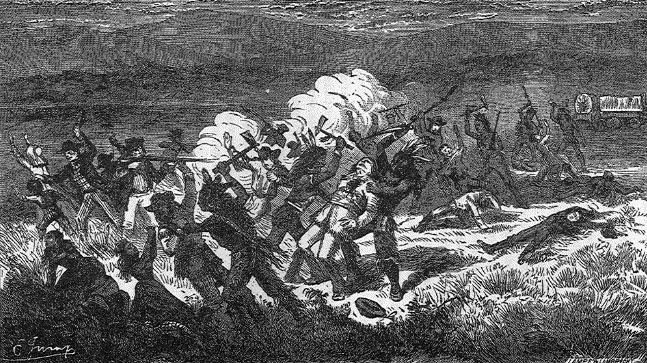
The Mountain Meadows Massacre as imaginatively envisioned by somebody who wasn’t there. In such treatments, John D. Lee and his “Mormonites” are behaving as . . . well, as “Mormonites” DO. (Wikimedia Commons public domain image)
Another theme, though, at least in my own comments, is that what happened at Mountain Meadows was not an evil result of religion. Not, at least, in the way that critics have often sought to portray it. Yes, religion was obviously involved in the sense that the Latter-day Saints were where they were in the Great Basin because of their religious beliefs, and in the sense that the perpetrators of the Massacre were overwhelmingly Latter-day Saints while their victims were not. But the Massacre wasn’t motivated by theology. Nobody was practicing “blood atonement” or seeking to kill “gentiles” simply because they were “gentiles.” This wasn’t a “crusade” or a jihad.
The Massacre was motivated by primal fear. The Saints had nowhere to go. They had left New York and Ohio, been driven from Missouri and Illinois. They had taken refuge in the distant and arid Great Basin West, initially beyond the borders of the United States, and they had simply run out of options. They felt that they and their families were now facing an existential threat. They were also deep in the fog of war. They had no clear picture of what was happening but, whatever it was, it was deeply menacing. And when people are trapped or feel existentially threatened, they do desperate things. This isn’t unique to Latter-day Saints, or to Christians, or to theists. Under similar circumstances, mutatis mutandis, whether involving religious differences or ethnic differences or whatever other differences humans can find about which to fight, similar actions can easily be imagined and similar things have happened.
Posted from St. George, Utah
Travel and Religion
History and Religion
Previous Post
June 22, 2026
Of violence and a violent storm
Next Post
June 24, 2026 St. George, at Its Core
Recent Comments
"I have cpnsidered in my mond if the 4 volume Saints could be made into ..."
From Serbia’s “White City,” Belgrade
"DP: “But Mr. Sutherland worries about the fact that our time, when we can communicate ..."
Learning more about a region of ..."
"Another class of memories are of individuals who previously lived. Some of these remembered individuals ..."
"Sutherland's lecture sounds interesting. He seems to restate the Washington consensus that trade brings peace ..."
Learning more about a region of ..."
Browse Our Archives
Select a Category Uncategorized
Select a Month October 2026 September 2026 August 2026 July 2026 June 2026 May 2026 April 2026 March 2026 February 2026 January 2026 December 2025 November 2025 October 2025 September 2025 August 2025 July 2025 June 2025 May 2025 April 2025 March 2025 February 2025 January 2025 December 2024 November 2024 October 2024 September 2024 August 2024 July 2024 June 2024 May 2024 April 2024 March 2024 February 2024 January 2024 December 2023 November 2023 October 2023 September 2023 August 2023 July 2023 June 2023 May 2023 April 2023 March 2023 February 2023 January 2023 December 2022 November 2022 October 2022 September 2022 August 2022 July 2022 June 2022 May 2022 April 2022 March 2022 February 2022 January 2022 December 2021 November 2021 October 2021 September 2021 August 2021 July 2021 June 2021 May 2021 April 2021 March 2021 February 2021 January 2021 December 2020 November 2020 October 2020 September 2020 August 2020 July 2020 June 2020 May 2020 April 2020 March 2020 February 2020 January 2020 December 2019 November 2019 October 2019 September 2019 August 2019 July 2019 June 2019 May 2019 April 2019 March 2019 February 2019 January 2019 December 2018 November 2018 October 2018 September 2018 August 2018 July 2018 June 2018 May 2018 April 2018 March 2018 February 2018 January 2018 December 2017 November 2017 October 2017 September 2017 August 2017 July 2017 June 2017 May 2017 April 2017 March 2017 February 2017 January 2017 December 2016 November 2016 October 2016 September 2016 August 2016 July 2016 June 2016 May 2016 April 2016 March 2016 February 2016 January 2016 December 2015 November 2015 October 2015 September 2015 August 2015 July 2015 June 2015 May 2015 April 2015 March 2015 February 2015 January 2015 December 2014 November 2014 March 2014 August 2013 February 2012
Follow Us!
TAKE THE
Religious Wisdom Quiz
What did God put in Isaiah's mouth in his vision to cleanse his lips?
Select your answer to see how you score.
A scroll Oil A burning coal Honey
Related posts from Sic et Non


Notes on Women, Priesthood, and General Conference
"America's Most Neighborly City"? It's not in Switzerland

"The Book of Moses as a Temple Text"
TRENDING AT PATHEOS Latter-day Saint

Methodist Central Hall and Westminster Abbey
Situated on the same square is Methodist Central Hall and Westminster Abbey. ...

57th Dove Awards Honor Dolly Parton, Crown New...
On gospel music’s biggest night, the 57th annual GMA Dove Awards honored...

The First Eucharistic Controversy: Christ’s Real Presence
For Catholics, the Eucharist is the source and summit of the Christian...

What a Stop Sign Can Teach Us About...
How to Make a Decision When You Can't Hear God Main point:...

Archdiocese Hosts Military Marriage Retreat in Germany
RASTATT, Germany — The transient military lifestyle, with its frequent deployments and...

Nearly every morning, I make the drive to Detroit with my high-school-age...
view all Latter-day Saint blogs
What Are Your Thoughts?leave a comment
Ad-Free & Subscriber Log-In Subscription Support
- About Us
- 2026 Calendar
- Videos
- Podcasts
- Library of World Religions
- Faith In Media Tracker
- Advertise With Us
- Write for Us
- Privacy Policy
- Terms of Service
- Do Not Sell My Data
- Contact Us
- Radiant Digital
- Manage Newsletter Subscriptions
- Unsubscribe From Notifications
- Sitemap
Copyright 2008-2026, Patheos. All rights reserved.
Subscription Support Ad-Free & Subscriber Log-In
Follow Patheos